
Chemistry Optional PYQs Topic-wise for UPSC Mains (2000–2026) are listed below unit by unit, in the order of the official syllabus – 2111 questions in all. Click any unit to open all its previous year questions, arranged topic-wise with the latest first.
Paper I
| Unit | Topic (click to open PYQs) | Sub-topics | Questions | Link |
|---|---|---|---|---|
| 1 | Atomic Structure | 2 | 60 | Click here → |
| 2 | Chemical Bonding | 3 | 78 | Click here → |
| 3 | Solid State | 3 | 60 | Click here → |
| 4 | The Gaseous State and Transport Phenomenon | 2 | 40 | Click here → |
| 5 | Liquid State | – | 33 | Click here → |
| 6 | Thermodynamics | 4 | 93 | Click here → |
| 7 | Phase Equilibria and Solutions | 2 | 52 | Click here → |
| 8 | Electrochemistry | 3 | 90 | Click here → |
| 9 | Chemical Kinetics | 4 | 68 | Click here → |
| 10 | Photochemistry | – | 41 | Click here → |
| 11 | Surface Phenomena and Catalysis | 2 | 43 | Click here → |
| 12 | Bio-Inorganic Chemistry | 2 | 44 | Click here → |
| 13 | Coordination Chemistry | 7 | 153 | Click here → |
| 14 | Main Group Chemistry | 5 | 57 | Click here → |
| 15 | General Chemistry of ‘f’ Block Element | 2 | 53 | Click here → |
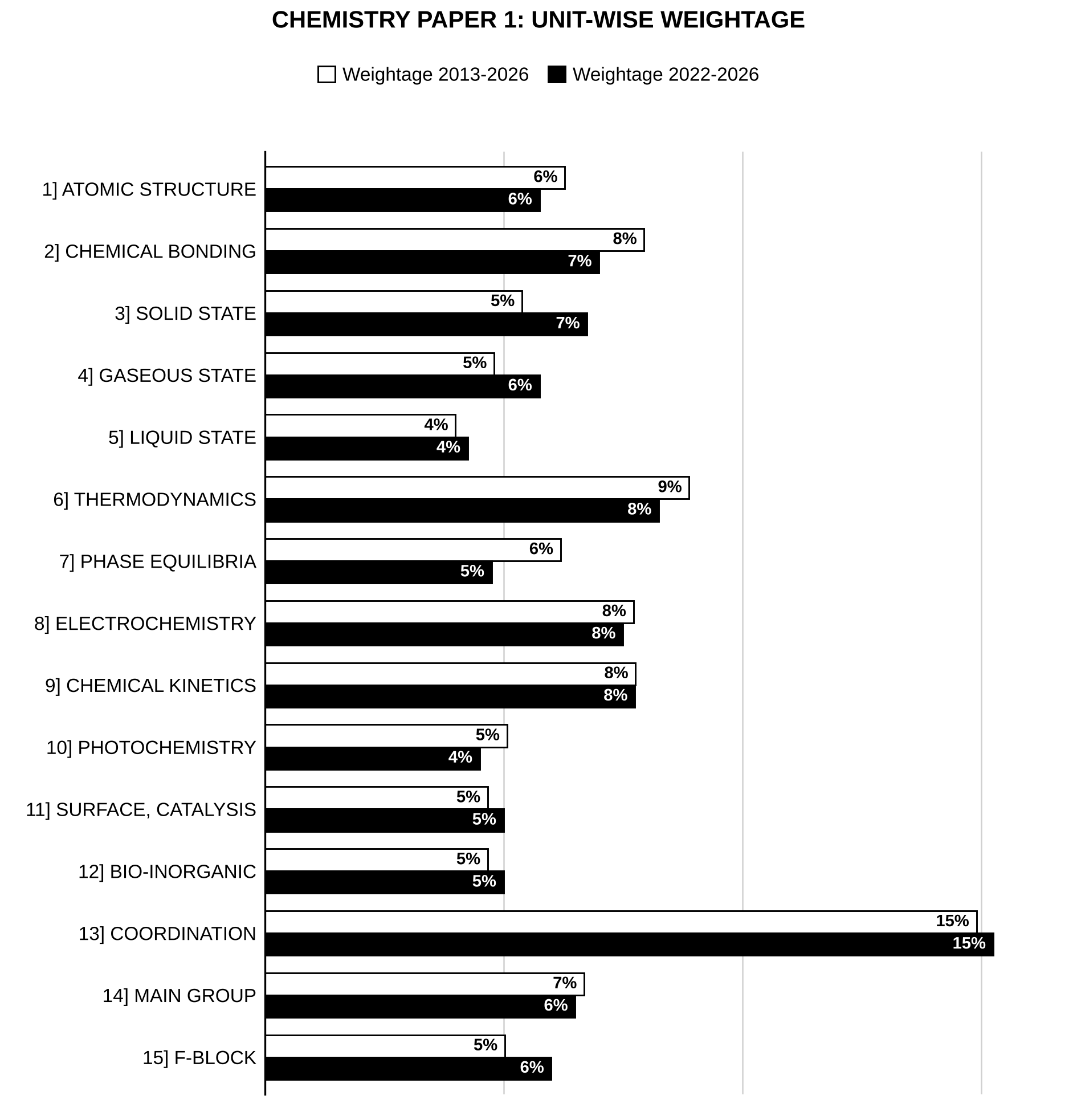
Trend: Coordination chemistry is by far the largest unit of Paper I (about 15% of the marks, both since 2013 and in the last five years), followed by thermodynamics (8–9%), chemical bonding, chemical kinetics and electrochemistry (each about 7–8%). The other ten units each take roughly 4–7%. Within the units, bonding, magnetism and spectra of complexes (topic 13.1) and isomerism and stereochemistry of complexes (13.2), particle in a box and the hydrogen atom (1.2), molecular orbital theory (2.3), galvanic cells and e.m.f. (8.2), equilibrium and the third law (6.4) and theories of reaction rates (9.3) have been asked most often since 2013. In 2022–2026 solid state (unit 3) and f-block elements (unit 15) have gained share, and complex reactions (9.2), electrode processes (8.3) and boranes (14.1) have come up more often.

Preparing for Prelims too?
Our UPSC Prelims Topic-wise PYQ eBook covers every Prelims question with detailed explanations, so you can see exactly where UPSC asks from.
View the BookDownload Free SamplePaper II
| Unit | Topic (click to open PYQs) | Sub-topics | Questions | Link |
|---|---|---|---|---|
| 1 | Delocalised Covalent Bonding | 2 | 59 | Click here → |
| 2 | Reaction Mechanisms | 8 | 455 | Click here → |
| 3 | Pericyclic Reactions | 3 | 104 | Click here → |
| 4 | Polymers | 2 | 95 | Click here → |
| 5 | Synthetic Uses of Reagents | 3 | 126 | Click here → |
| 6 | Photochemistry | – | 64 | Click here → |
| 7 | Spectroscopy | 5 | 243 | Click here → |
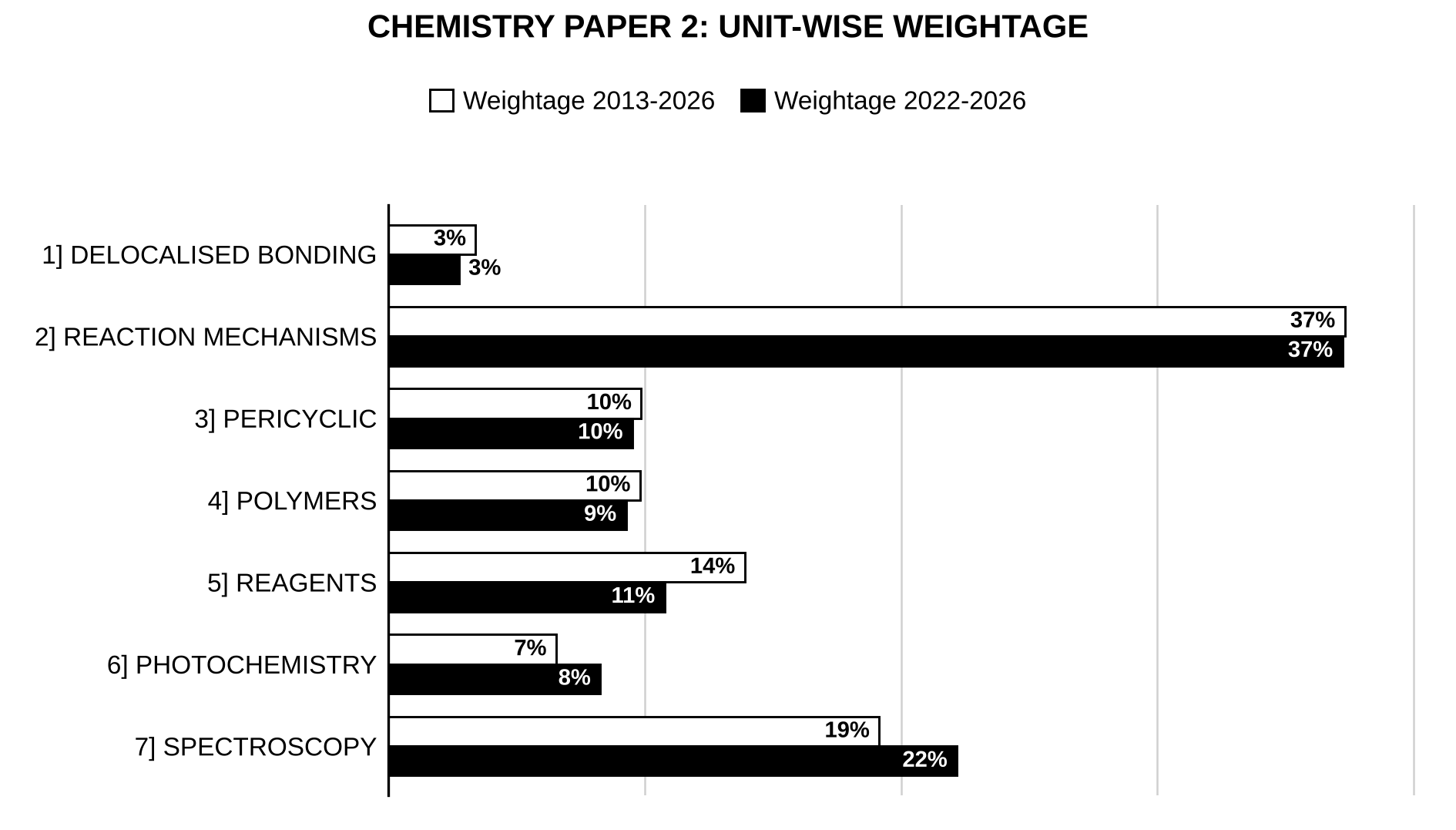
Trend: Reaction mechanisms dominate Paper II, with about 37% of the marks in both periods, followed by spectroscopy (19% since 2013, rising to 22% in 2022–2026), synthetic uses of reagents (11–14%), pericyclic reactions and polymers (about 10% each), organic photochemistry (7–8%) and delocalised bonding (about 3%). The most-asked topics since 2013 are named reactions and condensations (2.8), rearrangements (2.7) and aliphatic substitution (2.3), NMR (7.4), IR (7.2) and mass spectrometry (7.5), hydride and borane reagents (5.2) and oxidising reagents (5.1), and cycloadditions (3.2). In 2022–2026 spectroscopy and organic photochemistry have taken a larger share, while reagents have taken a smaller one.
More questions
Other questions (outside the present syllabus) – 20 questions
How this collection is organised
Considering the changing exam pattern over the years, we felt it necessary to declare some practices we’ve adopted in this collection.
Units follow the official syllabus – Paper 1: 1 Atomic Structure, 2 Chemical bonding, 3 Solid state, 4 The gaseous state and Transport Phenomenon, 5 Liquid State, 6 Thermodynamics, 7 Phase equilibria and solutions, 8 Electrochemistry, 9 Chemical kinetics, 10 Photochemistry, 11 Surface phenomena and catalysis, 12 Bio-inorganic chemistry, 13 Coordination chemistry, 14 Main Group Chemistry, 15 General Chemistry of ‘f’ Block Elements; Paper 2: 1 Delocalised covalent bonding, 2 Reaction mechanisms, 3 Pericyclic reactions, 4 Polymers, 5 Synthetic Uses of Reagents, 6 Photochemistry, 7 Spectroscopy. The official syllabus has been divided into numbered topics (e.g. Paper 1 – 13.4 Metal carbonyls and nitrosyls) to arrange the questions.
Questions on areas the syllabus does not name separately are placed under the nearest topic: for example, VSEPR and hybridisation under covalent bonding (Paper 1 – 2.2); thermochemistry under the first law (6.1); colligative properties under phase equilibria (7.1); conductance under Debye-Hückel theory (8.1); enzyme catalysis under heterogeneous catalysis (11.2); catalytic cycles such as Wilkinson’s catalyst under oxidative addition and insertion (13.6); in Paper 2, Mannich and Michael reactions under named reactions and additions (2.8, 2.6); Grignard reagents under n-BuLi (5.3); and ¹³C NMR and ESR under NMR (7.4).
Until 2008 the two papers followed an older syllabus, and a few subjects (for example phosphazenes, borazine and silicones) appeared in Paper 2. Such questions of 2000–2008 are placed under the topic of the present syllabus, even when that topic is now in the other paper; Part III shows each paper as set. From 2009 every question is kept in its own paper.
Questions on subjects no longer in the syllabus (for example non-aqueous solvents, statistical thermodynamics, stereochemistry as such, natural products and analytical tests) are placed at the end of each paper under “Other Questions (Outside the Present Syllabus)”.
Some questions cover more than one topic. We’ve kept such questions in each topic of relevance.
Every structure, reaction scheme, spectrum or figure printed with a question is given as a complete description in square brackets – [Figure: …] – naming each compound and showing every substituent, stereochemical feature, reagent, condition and label, so that the question can be solved from the description. Standard tables attached to a paper are not reproduced.
Graphs at the start of each paper show the weightage of every unit in that paper, and graphs for each unit show the weightage of its topics. Weightage is the share of marks asked from a unit or topic, compared for 2013–2026 (white bars) and the last five years, 2022–2026 (black bars). A question placed under two topics has its marks split equally between them.
Each of the topicwise question is suffixed by a question code like this [2024/20m/2a]. This code indicates a) year in which the question was asked, b) maximum marks the question carried, c) prescribed word limit (where UPSC set one, e.g. 200w) and, d) the question number in actual paper, in given order.
Until 2012, each paper carried 300 marks (60 per question); since 2013 each paper carries 250 marks (50 per question). Where a compulsory question offered more parts than were to be answered (“any three” of four), every part is included with its own marks. Where a retyped copy of an older paper prints no marks for a part, the code carries the marks implied by the question. Pages of physical constants printed with the papers are not reproduced.
2016, 2017, 2021–2023 and 2026 papers are transcribed from the official UPSC question papers; 2009–2015, 2018–2020, 2024 and 2025 from scans of the printed papers; 2005 from a scan of the papers as reproduced in a book; and 2000–2004 and 2006–2008 from a single retyped copy each, with the structures pasted in from the printed paper. No copy of the 1995–1999 papers could be found, so they are not included. Doubtful readings in the older copies are marked [?], and some parts of the older copies carry no printed marks.
The wording, figures and data of the questions are as printed, including the papers’ own grammar and apparent misprints such as wrong units.
Spotted an error? Use the “Report an Error” box at the end of any page – we review every report and update the page.

Strengthen your GS papers
Our UPSC Mains Topic-wise & Year-wise PYQ eBook (2013–2026) maps every GS question to the syllabus, so you know what UPSC asks and how often.
View the BookDownload Free SampleLast updated: 30 October 2026