
Here are all 57 Main Group Chemistry questions asked in UPSC Chemistry Optional Paper I from 2000 to 2026, arranged under the 5 topics of the official syllabus. Within each topic the latest questions come first.
Each question ends with a code such as [2024/15m/3b] – the year, the marks, the word limit (where UPSC set one) and the question number in the paper.
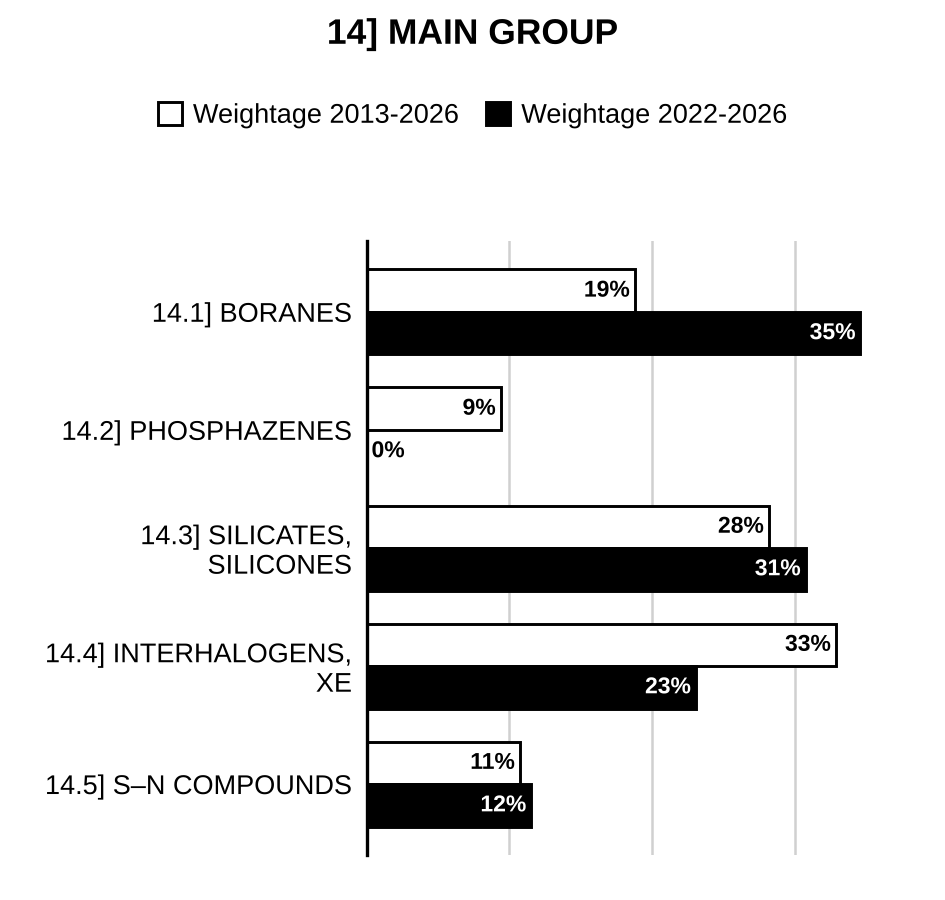
14.1] Boranes and borazines
13 questions
What is inorganic benzene? Explain it with structure. [2026/5m/5i]
Describe the structure and bonding in diborane. [2026/10m/8b(i)]
Draw the structure of . Explain the bonding in on the basis of hybridization approach. [2024/10m/8b(ii)]
Complete the following reactions and draw the structure of the major product(s) formed: (i) ____ (ii) ____ + ____ (iii) ____ (iv) ____ + ____ (v) ____ + ____ + ____. [2023/10m/6a]
Predict the number of framework bonding electrons and the structure of the following boranes: (i) (ii) (iii) [2023/10m/6e]
(i) How can be separated from a mixture of , and ? (ii) Write the products with explanation [2022/10m/6d]
What is inorganic benzene? Write down its structural formula. [2020/5m/7b(i)]
What is inorganic benzene? How is it prepared? Compare and contrast the reactivities of inorganic benzene and benzene. [2019/10m/4c(ii)]
How diborane can be synthesized industrially? Draw the structure of diborane. Comment on the nature of boron-hydrogen bond present in it. [2018/10m/6d]
Discuss the structure and bonding in diborane. [2012/10m/3c(i)]
Which compound is called ‘inorganic benzene’ and why? [2012/12m/6e]
(i) Borazine is a close analogue of benzene. Explain on the basis of preparation, molecular structure and reactions of borazine. (ii) Discuss magnetic and spectral properties of lanthanides. [2011/20m/6b]
Identify the products A and B in the reaction given below:
[Figure: B-vinylborazine (borazine ring B3N3 with H on each N and on two B atoms, a vinyl group CH=CH2 on the third B) –Borazine, 125° C→ A –1000° C, NH3→ B] [2002/15m/7a]
14.2] Phosphazenes
7 questions
How does the bonding in cyclic phosphazene differ from that of benzene and borazine? [2021/10m/6a]
Define phosphazenes with formulae for ring and chain types. Write two examples of substitution reactions of cyclophosphazenes.
Values of fundamental physical constants (printed at the head of Section A of Paper I): Planck’s constant ; mass of electron ; charge on electron ; velocity of light in a vacuum ; Avogadro constant ; Boltzmann constant ; Faraday constant ; Gas constant ; [2017/15m/8c]
In the following sequence of reactions, identify the products (A – H). (i) (ii) (iii) (iv) [2014/20m/6a]
Explain the structure and bonding in (i) Hexachlorocyclotriphosphazene (ii) Xenon hexafluoride. [2009/20m/8b]
Write the mechanism involved: (i) In the chain termination step during the cationic ring opening polymerization of hexachlorocyclotriphosphazines. (ii) In propagation step during the anionic ring Opening polymerization of octamethylcycloterasiloxanes. [2004/30m/4a]
What are phosphazene polymers? How a phosphazene polymer having group is prepared? What are its important surgical uses? [2003/20m/6a]
Which compound A or B is expected to show lower stretching frequency for C = O group in the IR spectrum? (ii) How do trimeric phosphonitrillic halides compare with benzene in structure and reactivity?
[Figure: A = 4′-methoxyacetophenone (, para); B = 4′-nitroacetophenone (, para)] [2001/15m/8b(i)]

Preparing for Prelims too?
Our UPSC Prelims Topic-wise PYQ eBook covers every Prelims question with detailed explanations, so you can see exactly where UPSC asks from.
View the BookDownload Free Sample14.3] Silicates and silicones
11 questions
How are silicates classified? Predict the names and structures of the following silicates: (1) ion, (2) ion, (3) ion. [2026/10m/8b(ii)]
What are silicones? Mention some of their uses. How will you prepare hexamethyldisiloxane? Draw its structure. What happens if some is mixed with and hydrolysed? [2025/10m/8b]
Pyroxenes, amphiboles and phyllosilicates are well-known groups of silicates that occur in crust of the earth. Write the empirical formulae and draw the basic structural units of the above-mentioned silicates. [2023/10m/4d]
Write the general synthetic procedure of lower cyclosiloxanes like cyclic dimethylsiloxane trimer . Draw its structure. Why is not used as starting material for its synthesis? [2022/10m/5e]
What are silicones? How are they obtained? Discuss the important properties and applications of organosilicon polymers. [2017/15m/7c]
Silicates produce a large number of silicate frameworks like () () () () () Name the compounds , , , and . [2015/10m/8d]
In the following sequence of reactions, identify the products (A – H). (i) (ii) (iii) (iv) [2014/20m/6a]
“ tetrahedra form the framework of all silicates, including silica ().” Justify this statement with appropriate framework structures of ortho, pyro, cyclic, infinite chain, sheet and silica. [2014/20m/8a]
, , , (R = methyl) are used for making silicon polymers. Explain the roles of these compounds in the synthesis. [2013/10m/6a]
Give the reaction and show the structure of the polymer products formed from the following monomers: and What will be the geometry of these polymers? How are these polymers used? [2003/20m/5a]
(i) Name the various types of ultramarines. Give their composition and uses. (ii) Rationalise the following transformations:
[Figure: (A) 2-vinylbicyclo[2.2.2]octan-2-ol skeleton drawn in perspective (bicyclo[2.2.2] cage, the carbon bearing OH and a vinyl group ; ring C=C not clearly shown [?]) –THF, reflux→ (B) cis-octalone: 3,4,4a,5,6,8a-hexahydronaphthalen-2(1H)-one type bicyclic ketone with both ring-junction H on dashed bonds (cis), C=O in one ring and a C=C in the other ring adjacent to a ring-junction carbon; (C) 6-vinylbicyclo[3.1.0]hex-2-ene (cyclopentene fused to a cyclopropane, the cyclopropane carbon bearing H and a vinyl group) –heat→ (D) bicyclo[3.2.1]octa-2,6-diene] [2003/20m/7c]
14.4] Interhalogen and noble gas compounds
20 questions
Complete the following reactions: (i) (ii) (iii) (iv) (v) [2025/10m/5g]
Draw all the possible structural dispositions of molecule. Establish logically which will be the most favoured disposition. Comment on the shape of molecule. [2024/10m/8b(i)]
Determine the electronic and molecular geometry of and interhalogen compounds. [2023/10m/3a]
Complete the following reactions and draw the structure of the major product(s) formed: (i) ____ (ii) ____ + ____ (iii) ____ (iv) ____ + ____ (v) ____ + ____ + ____. [2023/10m/6a]
(i) How can be separated from a mixture of , and ? (ii) Write the products with explanation [2022/10m/6d]
Complete the following reactions: (i) ____ (ii) ____ (iii) ____ (iv) ____ (v) ____ [2021/10m/5e]
Justify that the interhalogen compound acts as an aprotic solvent and undergoes acid-base and neutralization reactions by giving examples. [2021/10m/8a]
What is the order of reactivity of the following interhalogens? , , ClF, , IF. [2020/10m/7b(ii)]
Suggest a method for the preparation of Xenontrioxide. Complete the following reactions by balancing of atoms. [2019/10m/2c]
How would you prepare octafluoroxenate? Describe its structure and bonding. [2019/10m/5a]
Predict the product of the following reactions with justification: (A) ClF + (B) ClF + CsF (C) (D) [2018/10m/8a(i)]
Using valence bond theory justify the presence of two lone electron pairs in . [2017/15m/4c]
What are the main reasons for the formation of interhalogen compounds? Give one example of each type. Give the method of formation of and draw its structure. [2016/15m/6a(i)]
Chlorine trifluoride, , is one of the most reactive compounds known. It can be made by heating and in a closed container. (i) Draw the electron-dot structure of . (ii) What is the electron-pair geometry for ? (iii) Knowing that the molecule is polar, what can you conclude about the molecular geometry? (iv) Calculate the standard enthalpy of formation of gaseous , given the following bond energies: F—F: ; Cl—Cl: ; Cl—F: [2015/20m/6c]
Using hybridization, explain what is the shape of . Explain how VSEPR theory accounts for the distortion. [2012/10m/3c(ii)]
Give brief account on inter halogen compounds and discuss molecular structure of . [2011/10m/7b(i)]
What are interhalogen compounds? How are they classified? Give structures of and . [2010/15m/5a]
Explain the structure and bonding in (i) Hexachlorocyclotriphosphazene (ii) Xenon hexafluoride. [2009/20m/8b]
Explain the structure and bonding in (i) iodine pentafluoride and (ii) polythiazyl. [2008/20m/8c]
Discuss the general features of aprotic solvents and the properties of . [2002/20m/7a]
14.5] Sulphur–nitrogen compounds
6 questions
Complete the following reactions: (i) (ii) (iii) (iv) (v) [2025/10m/5g]
Draw the structures of , , , and . [2025/10m/8a]
How tetrasulphur tetranitride () is prepared? Present its structure. What happens when is subjected to chlorine? [2019/15m/6c]
Identify the products and draw the structure of A.
[Figure: Reaction scheme: (1 : 2.67 ratio) –320 K, → A; A –490 K, over Ag wool→ B (colourless solid); A –550 K, over quartz wool→ C (golden-yellow solid)] [2018/10m/5d]
Give a short account of S-N compounds. [2010/10m/8a(i)]
Explain the structure and bonding in (i) iodine pentafluoride and (ii) polythiazyl. [2008/20m/8c]

Strengthen your GS papers
Our UPSC Mains Topic-wise & Year-wise PYQ eBook (2013–2026) maps every GS question to the syllabus, so you know what UPSC asks and how often.
View the BookDownload Free Sample« Previous: Coordination Chemistry | Next: General Chemistry of ‘f’ Block Element »
Back to: Chemistry Optional PYQs – Topic-wise
Last updated: 30 October 2026