
Here are all 93 Thermodynamics questions asked in UPSC Chemistry Optional Paper I from 2000 to 2026, arranged under the 4 topics of the official syllabus. Within each topic the latest questions come first.
Each question ends with a code such as [2024/15m/3b] – the year, the marks, the word limit (where UPSC set one) and the question number in the paper.
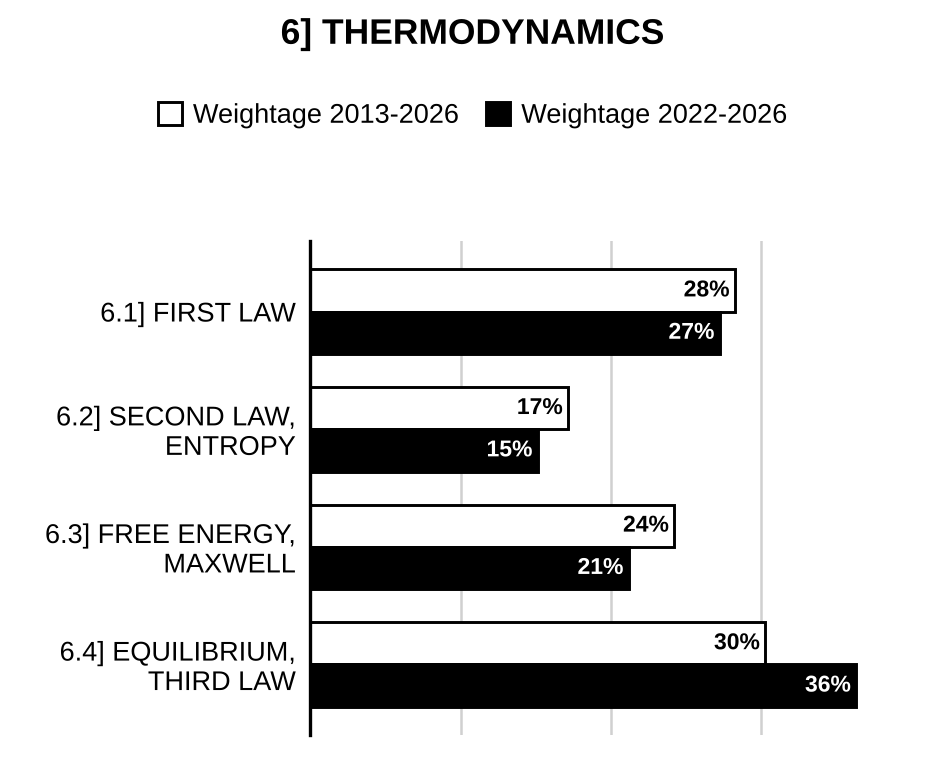
6.1] First law of thermodynamics
28 questions
At 25 °C, the latent heat of sublimation per mole of iodine is and the standard enthalpy of formation of HI(g) is . Calculate the enthalpy change which occurs when HI(g) is formed from the gaseous elements at 225 °C. The mean molar heat capacities over the temperature range 25 °C to 225 °C are: ; ; HI(g); [2026/10m/2c(i)]
0.500 g of benzoic acid was burnt under oxygen. The combustion produced a temperature rise of 1.236 K. The same calorimetric set-up was used to burn 0.300 g of naphthalene and the resulting temperature rise was 1.128 K. The heat of combustion of benzoic acid, . What is the heat of combustion of naphthalene? [2025/5m/1g]
A container with 100 g of ice at 0°C is placed in a humid room whose temperature is 40°C. The ice melts as water vapour condenses into the container. Assuming that all the heat transferred to the container comes from the condensation, how much water will have condensed in the container once all the ice is melted and has reached 40°C? Given: Heat of fusion of ice ; Heat of vaporization of water ; Heat capacity of water [2025/10m/3d]
Why does a tyre get hot when air is pumped into it? Can a tyre be inflated without a rise in temperature? [2024/5m/3c(ii)]
An ideal gas ( L and atm) is subjected to reversible isothermal expansion ( L and atm) at 25 °C. Calculate the work done, , and for this process. Is the heat () same as in this process? If not, why? [2023/10m/7e]
An automobile tyre contains air at Pa at 20°C. The stem valve is removed and the air is allowed to expand adiabatically against a constant external pressure of Pa until . For air, . Calculate the final temperature of the gas in the tyre. Assume ideal gas behaviour. [2022/10m/2a]
A thermally insulated box is separated into two compartments (volumes and ) by a membrane. One of the compartments contains an ideal gas at temperature , the other is empty (vacuum). The membrane is suddenly removed, and the gas fills up the compartments and reaches the equilibrium. What is the final temperature of the gas? Show that the gas expansion process is irreversible.
[Figure: Upper drawing: a rectangular box with “Insulated walls” (double-line outline, arrow pointing to the wall) divided by a membrane into a left compartment (arrow labelled ; stippled, i.e. filled with gas) and an empty right compartment . A downward arrow leads to the lower drawing: the same box without the membrane, the whole volume stippled (gas filling both compartments)] [2021/10m/3c(ii)]
1.0 mol of a monoatomic ideal gas expands to double of its initial volume against a constant pressure under isothermal condition of 300 K. Calculate the heat involved. [2020/10m/2a]
One mole of an ideal gas at 273.15 K undergoes expansion from an initial volume of 2.24 to 22.4 against a constant pressure of 1 atm. Calculate the work done. Also calculate ΔU, ΔH and ΔS. [2019/20m/2b]
Calculate the internal energy, U when 1.00 mol of goes from 25.0°C and 1.00 atm to 30.0°C and 1.00 atm. Densities of water are 0.9970 g/cm³ at 0°C and 0.9956 g/cm³ at 100°C. [2018/10m/1b]
Using the statement of First law of thermodynamics, argue upon the various effects on rising clouds as it goes to higher altitudes. [2018/5m/3a(i)]
If atm atm Calculate the work, for the processes shown in figure (a) and (b).
[Figure: Two P–V diagrams (P vertical axis, V horizontal axis). (a): step 1 = vertical arrow downward (pressure decreases at constant volume), followed by step 2 = horizontal arrow to the right (volume increases at constant pressure). (b): step 1 = horizontal arrow to the right (volume increases at constant pressure), followed by step 2 = vertical arrow downward (pressure decreases at constant volume)] [2018/10m/3a(ii)]
Consider the reversible expansion of a perfect gas. Provide the physical interpretation for the fact = constant for an adiabatic change, whereas PV = constant for an isothermal change. [2018/5m/4b(i)]
What happens to the air temperature in a valley when cold air blowing from the mountain tops descends into the valley? [2018/5m/4b(ii)]
The heat of reaction at 27°C was found to be –21.97 Kcal. What will be the heat of reaction at 50°C? The molar heat capacities at constant pressure and at 27°C for , and are 6.8, 6.77 and 8.86 . [2016/10m/2c]
The standard enthalpy of vapourization, , for water at 100 °C is around and 1 mol of liquid water is undergoing vapourization at 100 °C and 1 atm pressure. (i) Calculate . (ii) Calculate . (iii) Under these conditions does the entropy change of the system or the surroundings drive the process? State reasons for your answer. [2015/10m/1c]
A bomb calorimeter has a measured heat capacity of . The combustion of 1.84 g of magnesium (at. wt. = ) leads to a temperature change from 21.30 °C to 25.56 °C. The specific heat of water is . (i) Calculate the change in internal energy () per mole of Mg for the reaction (ii) If the reaction were carried out open to the atmosphere at 25 °C, what would be the enthalpy change () of the reaction per mole of Mg? [2015/10m/3a]
The enthalpy of decomposition of gaseous water per mole at 20 °C and 1 atm pressure is 243.05 kJ. Calculate its value at 80 °C, given the following data: , , [2014/10m/3d]
Determine the values of and for the reversible isothermal evaporation of 90.0 g of water at 100 °C. Assume that water vapour behaves as an ideal gas and heat of vaporization of water is . [2012/12m/1d]
Given the following information: ; . Calculate for each of the following reactions: (i) (ii) (iii) [2011/15m/1b]
One mole of was heated in an open vessel at 1 bar pressure to 1000 K when it decomposed into CaO (s) and (g). Calculate the work done during the decomposition, assuming that may be regarded as an ideal gas. () [2011/15m/4a]
Explain what are meant by extensive and intensive properties of a system. Which of the following properties are extensive and which are intensive? (i) Entropy (ii) Gibbs free energy (iii) Viscosity (iv) Chemical potential (v) Heat capacity. [2010/15m/5c]
One mole of a perfect gas is ten-fold expanded isothermally and reversibly at 300 K. Calculate w, q, , , , and . [2009/20m/1d]
A perfect monatomic gas is expanded reversibly and adiabatically at 300 K from a pressure of Pa to 10 Pa. What is the final temperature? How much work can be done? [2008/20m/1d]
The enthalpy of neutralization of and HCl is kJ/mole. Calculate the enthalpy of ionisation of . Assume that the enthalpy of neutralization of a strong acid with a strong base is kJ/mole. [2007/20m/3a]
Explain Hess’s law. Calculate the enthalpy change for the reaction Given that ; ; [2006/20m/7b]
Define enthalpy and its implications in thermo chemistry. How will you evaluate an enthalpy change using a differential scanning calorimeter? [2004/20m/8c]
Calculate the strength of O-O bond from the following data: [2001/20m/1b]
6.2] Second law and entropy
20 questions
Two blocks of a metal having same mass have same heat capacity (presumed independent of T), but are at different temperatures 300 K and 400 K, respectively. Calculate the final temperature and entropy change, if the blocks are in thermal contact and reach equilibrium. (Assume two blocks together constitute the isolated system) [2026/5m/1c]
A steam turbine is operated with an intake temperature of 400°C, and an exhaust temperature of 150°C. What is the maximum amount of work the turbine can do for a given heat input ‘Q’? Under what conditions is the maximum work achieved? [2025/5m/1j]
An ideal gas ( L and atm) is subjected to reversible isothermal expansion ( L and atm) at 25 °C. Calculate the work done, , and for this process. Is the heat () same as in this process? If not, why? [2023/10m/7e]
A 74.6 g ice cube floats in the sea. The temperature and pressure of the system and surroundings are 0°C and 1 atm. Calculate , and for the melting of ice cube. What can you conclude about the nature of process from the value of ? (The molar heat of fusion of water is 6.01 kJ/mol) [2022/10m/3b]
A thermally insulated box is separated into two compartments (volumes and ) by a membrane. One of the compartments contains an ideal gas at temperature , the other is empty (vacuum). The membrane is suddenly removed, and the gas fills up the compartments and reaches the equilibrium. What is the final temperature of the gas? Show that the gas expansion process is irreversible.
[Figure: Upper drawing: a rectangular box with “Insulated walls” (double-line outline, arrow pointing to the wall) divided by a membrane into a left compartment (arrow labelled ; stippled, i.e. filled with gas) and an empty right compartment . A downward arrow leads to the lower drawing: the same box without the membrane, the whole volume stippled (gas filling both compartments)] [2021/10m/3c(ii)]
A person claims that a heat engine exchanges heat with reservoirs at 300 and 500 K, produces 450 J of work per 1000 J of heat extracted from the hot reservoir. Is his/her claim feasible? Give reason(s) to support your answer. [2020/10m/2b]
One mole of an ideal gas at 273.15 K undergoes expansion from an initial volume of 2.24 to 22.4 against a constant pressure of 1 atm. Calculate the work done. Also calculate ΔU, ΔH and ΔS. [2019/20m/2b]
The standard enthalpy of vapourization, , for water at 100 °C is around and 1 mol of liquid water is undergoing vapourization at 100 °C and 1 atm pressure. (i) Calculate . (ii) Calculate . (iii) Under these conditions does the entropy change of the system or the surroundings drive the process? State reasons for your answer. [2015/10m/1c]
Calculate the entropy change involved in the isothermal reversible expansion of 5 moles of an ideal gas from a volume of 20 L to a volume of 200 L at 300 K. [2014/10m/1c]
(i) How is entropy defined thermodynamically? (ii) What role does play in determining the direction of spontaneous change? (iii) At 25 °C, the enthalpy change of the graphite → diamond phase transition is and the entropy change is . Which is the spontaneous direction at 25 °C? Which direction is favoured by a rise in temperature? [2013/10m/1b]
Calculate the values of , and for the reversible condensation of 36 g of water at 0 °C to ice at 0 °C. The latent heat of melting of ice at 0 °C is equal to . [2013/15m/8b]
Calculate and for reversibly heating 2 moles of liquid water from 0 °C to 100 °C at a constant pressure of 1 atm. Treat heat capacity of water independent of T and equal to . [2012/15m/4b]
Discuss the entropy change in reversible and irreversible processes. Comment on the statement: Entropy of the universe is always increasing. [2007/20m/3b]
What do you understand by entropy of a system? How it increases with increasing temperature & ΔS becomes zero at absolute zero temperature? [2006/20m/5c]
Prove that entropy is a state function. [2005/10m/2c]
Derive an expression for the entropy of mixing of two ideal gases at the same temperature and pressure. [2005/20m/8b]
Derive the equation for calculating the entropy change for the isothermal expansion of a perfect gas. [2004/20m/5a]
(i) Obtain the expression for the entropy of mixing of two ideal gases with and moles respectively at the same temperature and pressure. (ii) What is the entropy of mixing of one mole of oxygen with one mole of nitrogen at 25°C, assuming they are ideal gases? [2003/20m/1c]
Prove that entropy is a state function. [2002/30m/2a]
Discuss the entropy of phase transition at the transition temperature and the variation of entropy with temperature. [2002/30m/2b]

Preparing for Prelims too?
Our UPSC Prelims Topic-wise PYQ eBook covers every Prelims question with detailed explanations, so you can see exactly where UPSC asks from.
View the BookDownload Free Sample6.3] Free energy and Maxwell relations
19 questions
Calculate the change in Helmholtz energy for a reversible isothermal compression of 1 mole of an ideal gas whose volume decreases from 100.0 L to 22.4 L. Assume that temperature is 298 K. [2024/10m/3c(i)]
Estimate the final temperature of one mole of gas at 200.00 atm and 19.0°C as it is forced through a porous plug to a final pressure of 0.95 atm. Given: The Joule-Thomson coefficient () of the gas is 0.150 K/atm. [2024/5m/3c(iv)]
Using the Gibbs equation for a closed system in the absence of non-expansion work at constant composition, answer the following: (i) Deduce the thermodynamic relations for the variation of with , and with . (ii) What are the implications of the above relations? (iii) Draw versus graph and identify the phase transition temperatures, if any. (iv) Explain how the presence of (1) attractive and (2) repulsive molecular interactions affects the molar Gibbs free energy of a gas relative to its normal value. [2023/20m/2a]
For a rubber band What would be the length of the rubber band with an increase in temperature? Explain it. [2021/10m/1c]
Express heat capacity at constant volume () of a substance in terms of its internal energy (U) and show that ; for ideal gas. [2020/10m/1c]
Using appropriate fundamental equation of thermodynamics, derive the following Maxwell relation: [2020/10m/6d]
van der Waals’ equation states that ( and are constants). Find for van der Waals’ gas. [2019/10m/1c]
Define Joule-Thomson coefficient . What is its unit in SI system? Show that [2017/10m/1c]
for an electrochemical reaction, as a function of temperature, (K) is given by ; where , and are constants and independent of . (I) What are the units of , and ? and (II) Find the expressions of and as a function of . [2017/15m/3a(ii)]
Show that for a gas obeying the van der Waals equation: [2014/10m/4c]
Show that in the adiabatic reversible expansion of a gas where = Joule – Thomson Coefficient, = Molar specific heat at constant pressure. [2013/10m/5a]
What is meant by heat capacity? Establish a relationship between heat capacity at constant pressure and constant volume, i.e. Deduce the relationship for an ideal gas. [2010/20m/6a]
One mole of a perfect gas is ten-fold expanded isothermally and reversibly at 300 K. Calculate w, q, , , , and . [2009/20m/1d]
(i) Which among the following are intensive properties: pressure, volume, temperature, internal energy, free energy and chemical potential? (ii) Define Gibbs free energy function. Explain its significance. [2009/20m/3c]
Show that (i) (ii) [2009/20m/4a]
(i) Nitrogen gas gets cooled as it expands whereas hydrogen gas gets warmer as it expands. Justify the observation. (ii) The standard free energy change for the following reaction is : Calculate the equilibrium constant of the reaction at 900 K. [2009/20m/4c]
Define chemical potential. Explain its significance. Deduce equations for the variation of chemical potential with temperature and pressure. [2008/20m/4b]
Derive Clausius-Clapeyron equation for the variation of vapour pressure with temperature. Calculate the equilibrium pressure for the conversion of graphite to diamond at 25°C assuming their densities to be 2.25 and 3.51 and . [2005/25m/4b]
Show that the total differential of entropy in terms of temperature and volume can be expressed by the equation [2001/30m/4a]
6.4] Equilibrium and third law
26 questions
At 300 K temperature and 1 atm pressure, dinitrogen tetraoxide is 20 percent dissociated into nitrogen dioxide. Calculate the equilibrium constant () and standard free energy change for the reaction at this temperature: [2026/5m/1d]
Calculate at 400 K temperature for the following reaction: Assume that is independent of temperature. (Given: ; ; ; ) [2026/10m/2c(ii)]
Suppose we redefine the standard state as Pressure, P = 2 atm. Find the new standard values of each substance: (i) HCl (g) (ii) (g) Explain the results in terms of the relative entropies of reactants and products of each reaction. Given: Standard free energy of formation at 25°C: (i) (ii) [2025/10m/4d]
Use the following data to determine the normal boiling point of mercury. What assumptions must you make in order to do the calculations? Hg (l) , J/K mol; Hg (g) kJ/mol, J/K mol. [2024/10m/1c]
Calculate the pressure of (in atm) over a sample of NiO at 25°C if kJ/mole for the following reaction: [2024/5m/3c(iii)]
Consider the equilibrium reaction , in which gas is 18.5% dissociated at 25 °C and 1 bar. (i) Calculate at 25 °C. (ii) Calculate at 100 °C. Given that (at the above temperature range). (iii) What is the effect of compression on this reaction? [2023/10m/2d]
Calculate at 298 K for the formation of from in urban smog, where atm and atm. Given; . , . [2022/10m/1d]
Use third law of thermodynamics to show that absolute zero of temperature is unattainable. [2019/15m/8a]
Consider the formation of MgO(s). Assume that and are independent of temperature. , Calculate for the formation of MgO(s) at 0°C. Is this reaction spontaneous or non-spontaneous at 0°C. [2018/5m/1c(i)]
Is there a temperature at which formation of MgO switches from spontaneous to non-spontaneous or vice-versa? If no, explain why not? If yes, calculate the temperature at which the spontaniety of the reaction switches? [2018/5m/1c(ii)]
Show that two phases are in thermal equilibrium only if their temperature are same. [2018/10m/3b]
At constant pressure, the temperature of a fixed amount of hot tea in a cup decreases spontaneously to room temperature. What will be the sign of (I) and (II) of this process? Give reason(s) in support of your answer. [2017/10m/3a(i)]
What is residual entropy? Why certain substances like CO and are associated with residual entropy even at 0K? [2016/10m/1b]
An important metabolic step is the conversion of fumarate to malate: At 25 °C, the equilibrium constant for the reaction, , where is the activity of fumarate and is the activity of malate. (i) Calculate the standard Gibbs energy change, , for the above reaction. (ii) Calculate the reaction Gibbs energy, , when at some time during the course of the reaction, the reaction quotient, , is 0.01. (iii) What is the difference in chemical potential between the two species when ? [2015/15m/3b]
(i) How is entropy defined thermodynamically? (ii) What role does play in determining the direction of spontaneous change? (iii) At 25 °C, the enthalpy change of the graphite → diamond phase transition is and the entropy change is . Which is the spontaneous direction at 25 °C? Which direction is favoured by a rise in temperature? [2013/10m/1b]
gas is a paramagnetic brown gas at room temperature. When a sample of the gas is cooled below 0 °C, its molecular weight increases, and it loses its paramagnetism and colour. (i) Using electron dot structure, write an equation which accounts for these observations. (ii) Based on these observations, predict whether the reaction taking place is endothermic or exothermic. (iii) Use the following data for the pressures of and its product at equilibrium to calculate the equilibrium constant for the reaction at 298 K: , p (product) = 23 mm Hg. [2013/15m/4a]
For the equilibrium at 298 K, . What is for the reaction? []. [2010/20m/8c]
(i) Nitrogen gas gets cooled as it expands whereas hydrogen gas gets warmer as it expands. Justify the observation. (ii) The standard free energy change for the following reaction is : Calculate the equilibrium constant of the reaction at 900 K. [2009/20m/4c]
Explain the criteria of equilibrium and spontaneity in terms of U, S, A and G. [2008/20m/3c]
“The third law of thermodynamics states an impossibility.” Justify this statement. [2008/10m/4a(i)]
Explain why the molar entropy of ice crystals approaches [?], as the temperature approaches zero kelvin. [2008/10m/4a(ii)]
For the reaction , at 670 K. Calculate . [2008/10m/4c(ii)]
Explain Nernst heat-theorem. How does it lead to the enunciation of the Third Law of Thermodynamics? How can the latter be verified experimentally? [2007/20m/3c]
What do you understand by entropy of a system? How it increases with increasing temperature & ΔS becomes zero at absolute zero temperature? [2006/20m/5c]
Derive the Nernst heat theorem. [2004/20m/5b]
What is residual entropy? Why certain substances like CO and are associated with residual entropy even at 0K? [2003/30m/4b]

Strengthen your GS papers
Our UPSC Mains Topic-wise & Year-wise PYQ eBook (2013–2026) maps every GS question to the syllabus, so you know what UPSC asks and how often.
View the BookDownload Free Sample« Previous: Liquid State | Next: Phase Equilibria and Solutions »
Back to: Chemistry Optional PYQs – Topic-wise
Last updated: 30 October 2026