
Here are all 104 Pericyclic Reactions questions asked in UPSC Chemistry Optional Paper II from 2000 to 2026, arranged under the 3 topics of the official syllabus. Within each topic the latest questions come first.
Each question ends with a code such as [2024/15m/3b] – the year, the marks, the word limit (where UPSC set one) and the question number in the paper.
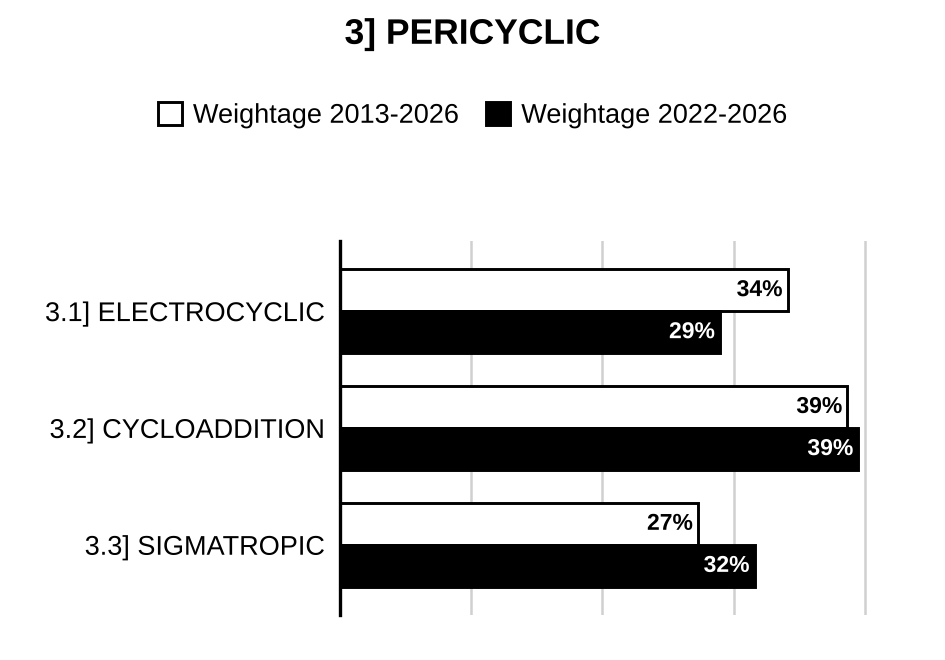
3.1] Electrocyclic reactions
31 questions
How may the following conversion be carried out? Draw the structures of transition state for both the products.
[Figure: Conversion: 1,3-butadiene (s-cis) → cyclobutene + bicyclo[1.1.0]butane (drawn as a square with a diagonal bond)] [2026/5m/1e(ii)]
Write the structure of the stereochemical product formed in the reaction of (2E, 4E)-hexa-2,4-diene under photochemical conditions and explain using the FMO approach. [2026/10m/4a(i)]
(1) Identify the mode of ring closure for each of the following electrocyclic reactions: (2) Are the indicated hydrogens cis or trans?
[Figure: (A) (Z,Z)-cycloocta-1,3-diene –Δ→ bicyclo[4.2.0]oct-7-ene (cyclobutene fused to cyclohexane) with the two ring-fusion H atoms drawn on wavy bonds. (B) cyclonona-1,3,5-triene (three conjugated C=C in a nine-membered ring; the two left C=C drawn cis, the third C=C at the upper right drawn trans) –Δ→ bicyclo[4.3.0]nona-2,4-diene (cyclohexa-1,3-diene fused to cyclopentane) with the two ring-fusion H atoms drawn on wavy bonds] [2025/10m/7c(ii)]
Consider the following electrocyclic reactions: (i) Predict the mode of ring closure/opening at each of the three steps. (ii) Predict the structure of M. (iii) Are the indicated hydrogens cis or trans?
[Figure: Scheme: cyclonona-1,3,5-triene (nine-membered ring with three conjugated C=C) ⇌ (100 °C, I step) bicyclo[4.3.0]nona-2,4-diene (cyclohexa-1,3-diene fused to cyclopentane) with the two ring-fusion H on wavy bonds ⇌ (hν, II step) M ⇌ (25 °C, III step) bicyclo[4.3.0]nona-2,4-diene with the two ring-fusion H on wavy bonds; all three steps drawn with equilibrium half-arrows] [2024/10m/1e]
Explain the formation of enone in the following reaction:
[Figure: Reaction: methyl (E)-3-[2-(1-methoxyvinyl)cyclohex-1-en-1-yl]prop-2-enoate (cyclohexene whose C=C carbons bear –C(OMe)=CH2 and –CH=CH–CO2Me (E)) –1) 215 °C; 2) HCl (aq), EtOH→ methyl 4-oxo-1,2,3,4,5,6,7,8-octahydronaphthalene-2-carboxylate (bicyclic: cyclohexanone ring fused to cyclohexane through a tetrasubstituted ring-fusion C=C conjugated with the C=O; CO2Me on the carbon meta to C=O)] [2024/5m/3b(i)]
The above compounds both undergo photo-induced electrocyclic reactions. What are the structures and stereochemistry of the products?
[Figure: (A) cyclonona-1,3-diene, nine-membered ring with a conjugated diene in which one double bond is cis (Z) and the other trans (E), i.e. (1Z,3E)-cyclonona-1,3-diene; (B) (1Z,3Z)-cyclonona-1,3-diene, nine-membered ring with a conjugated diene, both double bonds cis] [2023/10m/1d]
Considering the structural features of ergosterol () and precalciferol (), a precursor of vitamin D, giving mechanistic details, explain why vitamin D deficiency is endemic in those parts of the world where sunlight is scarce:
[Figure: = ergosterol: steroid skeleton with 3β-OH (HO on wedge), C-19 methyl on a wedge at C-10, 9α-H (hashed), conjugated C5=C6 and C7=C8 double bonds in ring B, C-18 methyl at C-13, side chain at C-17 ; = precalciferol (previtamin D2): ring B opened between C-9 and C-10, ring A bearing HO (wedge) and a methyl on the C-10 double bond carbon (C5=C10), a cis C6=C7 linkage, and C8=C9 in ring C, with the same C-17 side chain and C-18 methyl] [2022/10m/3b(i)]
Complete the above transformations.
[Figure: (i) octa-2,4,6-triene drawn as a zigzag with the central C4=C5 double bond cis; reactant: left terminal alkene carbon C2 bearing Me (up) and H (down), right terminal alkene carbon C7 bearing H (up) and Me (down) → product: C2 bearing H (up) and Me (down), C7 bearing H (up) and Me (down), central double bond cis (no reagents or conditions printed over the arrow); (ii) bicyclo[4.3.0]nona-2,4-diene (a cyclohexa-1,3-diene ring fused to a cyclopentane; 3a,7a-dihydroindane) with both ring-fusion H on wedges (cis) → the same skeleton with one ring-fusion H on a wedge and the other on a hashed bond (trans); no reagents or conditions printed] [2021/10m/1e]
Predict the major product, and identify the type and stereochemical mode of the following reaction:
[Figure: Reaction scheme: (2E,4Z,6E)-octa-2,4,6-triene (zig-zag skeletal formula: terminal CH3–CH=CH (E), central CH=CH (Z), CH=CH–CH3 (E)) –Δ, 130 °C→ ?] [2020/10m/1e]
Complete the following conversion writing missing intermediate compounds , and :
[Figure: Reaction scheme: 3,4-dimethylcyclobutene drawn in perspective (ring as a parallelogram, double bond on the left edge; the methyl on one sp3 carbon drawn pointing up and the methyl on the other sp3 carbon drawn pointing down) –Δ→ A –hν→ B –Δ→ C; C –Δ, maleic anhydride (shown beside the arrow)→ product shown: 3,6-dimethylcyclohex-4-ene-cis-1,2-dicarboxylic anhydride (bicyclic: cyclohexene ring fused to a five-membered anhydride ring O=C–O–C=O), anhydride ring fused at C1–C2; C3 methyl (next to the upper anhydride-bearing carbon) on a hashed bond, C6 methyl (next to the lower anhydride-bearing carbon) on a wedged bond; ring double bond C4=C5] [2020/15m/2a]
Complete the conversion given below writing intermediate steps involved:
[Figure: Reaction: α,α,α′,α′-tetrabromo-o-xylene (benzene ring with two adjacent groups) –1) ; 2) → ?] [2020/15m/6b]
Write the structure of the product with proper stereochemical outcome, in each of the following reactions and justify your answers with the help of FMO theory.
[Figure: (2E,4E)-hexa-2,4-diene (Me–CH=CH–CH=CH–Me, both double bonds trans, drawn in the s-cis conformation) in the centre; to the left an equilibrium arrow labelled hν (product to be written on the left); to the right an equilibrium arrow labelled Δ (product to be written on the right)] [2017/10m/1e]
Predict the products of the following reactions.
[Figure: (i) norbornadiene (bicyclo[2.2.1]hepta-2,5-diene) + tetracyanoethylene ((NC)2C=C(CN)2) –cycloaddition→ ?; (ii) cis-3,4-disubstituted cyclobutene (cyclobutene with R at C3 and at C4, both H atoms on hashed bonds, i.e. the two R groups cis) ⇌ (arrows labelled CON, conrotatory) ?] [2017/10m/6a]
What will be the stereochemical course of thermal cyclization of (i) Pentadienyl anion, and (ii) Pentadienyl cation? [2017/10m/6b]
Write various steps for the following conversions:
[Figure: (i) cyclohexanone → Nylon-6; (ii) 1-phenylhexa-1,3,5-triene (H5C6–CH=CH–CH=CH–CH=CH2, drawn in a cis, ring-like conformation) → Biphenyl] [2016/15m/4d]
Write the product for the electrocyclic reaction of the following: (i) (ii) (iii) [2016/15m/7b]
Identify the reaction and predict the product/s in the following transformations:
[Figure: (i) 7-cyano-7-(trifluoromethyl)bicyclo[4.1.0]hepta-2,4-diene (norcaradiene: cyclohexadiene ring fused to a cyclopropane whose third carbon bears CF3 and CN) ⇌(Δ) ?; (ii) 1-methoxycyclohexa-1,3-diene (OCH3 on a terminal diene carbon) + vinyl p-tolyl sulfone () –Δ→ ?; (iii) allyl vinyl ether: where R = (i.e. 2-methylpent-1-en-3-yl 3-methylbuta-1,3-dien-2-yl ether) –Δ→ ?] [2015/15m/2d]
What frontier molecular orbitals are involved in the reaction of (E, Z)-2,4-hexadiene via thermal and photochemical pathways? Account for the formation of the different stereoisomeric products. [2015/15m/4b]
Predict and account for the formation of stereoisomers in the following reactions:
[Figure: Reaction scheme: a conjugated triene in which the first C=C lies in a cyclohexene ring (left ring; its upper alkene carbon bears CH3), the middle C=C is a CH=CH linking unit, and the third C=C lies in a second cyclohexene ring (upper right; its terminal alkene carbon is a ring CH lying next to the CH3), i.e. CH3–C(ring)=C(ring)–CH=CH–C(ring)=CH(ring), drawn s-cis/s-cis so the CH3-bearing carbon and the terminal ring CH face each other; branching arrows: upper arrow labelled hν → ?; lower arrow labelled Δ → Δ (the product is printed as “Δ”)] [2014/10m/1e]
Identify [X] and [Y] in the following reactions. Explain their formation.
[Figure: (i) cis-1,2-diphenylbenzocyclobutene: benzocyclobutene (benzene ring fused to a cyclobutane ring) with a Ph on each of the two four-membered-ring sp3 carbons, both Ph drawn with wedged bonds (cis); branching arrows: Δ → [X], hν → [Y]. (ii) “2” × cyclohepta-2,4,6-trien-1-one (tropone: seven-membered ring with C=O and three C=C); branching arrows: Δ → [X], hν → [Y]. (iii) bicyclo[2.1.0]pent-2-ene (cyclobutene ring with a cyclopropane ring fused on the edge opposite the C=C; drawn as a square with a triangle on top and the double bond at the bottom edge); branching arrows: Δ, Low temp. → [X]; Δ, High temp. → [Y]] [2013/20m/4a]
(i) [structure 1] on heating produces trans 9,10-Dihydronaphthalene. What is the mechanism of this transformation? (ii) β-Lactone [structure 2] can be obtained by treatment of sodium maleate with -water. Explain the mechanism of its formation.
[Figure: structure 1 = bicyclo[6.2.0]deca-2,4,6,9-tetraene: eight-membered ring with three C=C double bonds fused to a cyclobutene ring (C=C in the four-membered ring), the two ring-fusion carbons each marked with a dot (H); structure 2 = β-lactone drawn as a four-membered ring O–CH(CO2H)–CHBr–C(=O), i.e. ring O bonded to a CH bearing CO2H and to a C=O carbon, with CHBr between the CH and the C=O (3-bromo-4-oxooxetane-2-carboxylic acid)] [2012/12m/5b]
Thermal cyclisation of cis, trans-2,4-hexadiene gives cis-3,4-dimethyl cyclobutene whereas trans, trans-2,4-hexadiene gives trans-3,4-dimethyl cyclobutene by the conrotatory process. Explain using Woodward – Hoffmann rule. [2011/20m/6a]
Identify intermediate (P) and product (Q) in the reaction.
[Figure: cis-9,10-dihydronaphthalene (two fused six-membered rings, each with two C=C double bonds, the two ring-fusion carbons sp3 with their H atoms shown as dots on the same side) –(hν)→ [P] → [Q]] [2010/10m/1e]
Using FMO approach, give explanation for the following reactions:
[Figure: (Trans-3, trans-3, 5-octadiene) [as printed; i.e. (3E,5E)-octa-3,5-diene drawn s-cis with the two terminal groups outward and the two inner H] –Δ→ (Trans-3, 4-diethylcyclobutene): cyclobutene with and H on C-3, H and on C-4, the ethyl groups on opposite faces; and –hν→ (Cis-3, 4-diethylcyclobutene): both groups on the same face, both H on the other face] [2007/20m/6a]
Explain why on heating cis-3, 4- dimethylcyclobutene gives (E, Z)-hexa-2, 4-diene while its trans-isomer gives only the (E, E)-hexa-2, 4-diene. What happens when the same substrates are irradiated with UV light? [2006/20m/5d]
Illustrate different types of pericyclic reactions by taking at least one example for each type. Explain why some of these reactions are also occasionally referred to as ‘no reagent’ reactions. [2005/15m/8c]
(i) In the reaction shown below with (A), the product isolated is (B) and not (C). Explain the reason with mechanism. (ii) Give the name and stereochemistry of the product in the following transformation from .
[Figure: (i) pyrrole (A) –, An. → (B) 3-acetylpyrrole ( on C-3) + (C) 2-acetylpyrrole ( on C-2); (ii) Trans, cis, trans-2, 4, 6-octatriene (A) (drawn U-shaped with the terminal groups pointing outward and the two inner terminal H atoms pointing inward) –disrotatory cyclisation→ (B)] [2003/20m/3c]
When compound A is heated at 150°, It is transformed to compound C and D. via a cyclic tetraene (B). Propose a structure for B and describe the process involved in the conversion of A → B, B → C and C → D.
[Figure: A = cis-bicyclo[6.2.0]deca-2,4,6,9-tetraene (cyclooctatriene ring fused to a cyclobutene; H, H at the ring fusion) –160° C→ B → C = trans-9,10-dihydronaphthalene (H at the two ring-fusion carbons, one up, one down) –Δ→ D = 1,2-dihydronaphthalene] [2002/0m/6b(i)]
Give stereochemistry of the product that you would. expect from each of the following electrocyclic reactions:
[Figure: (i) (2E,4Z,6E)-octa-2,4,6-triene (drawn U-shaped: terminal CH3 groups pointing outward, terminal H inward) –Heat (label below arrow illegible [?])→ ?; (ii) trans, trans-2,4-hexadiene (drawn s-cis: CH3 at both ends pointing outward, H inward; label “trans, trans 2,4-hexadiene”) –hν→ ?] [2001/20m/1b]
(i) In theory, trans-3,4-dimethyl cyclobutene can open by two conrotatory paths to give either (2E,4E)-hexadiene or (2Z,4Z)-hexadiene. Explain why both products are symmetry allowed and then account for the fact that only the 2E,4E isomer is obtained in practice. (ii) What products would you expect to obtain from the photochemical cyclizations of (2E,4Z,6E)-octatriene and of (2E,4Z,6Z)-octatriene? [2000/15m/3b]
(i) What stereochemistry would you expect for the product of the Diels-Alder reaction between (2E,4E)-hexadiene and ethylene? What stereochemistry would you expect if (2E,4Z)-hexadiene were used instead? (ii) (2E,4Z,6Z,8E)-Decatetraene has been cyclised to 7,8-dimethyl-1,3,5-cyclo-octatriene. Predict the manner of ring closure conrotatory or disrotatory-for both thermal and photochemical reactions and predict the stereochemistry of the product in each case. [2000/15m/3c]

Preparing for Prelims too?
Our UPSC Prelims Topic-wise PYQ eBook covers every Prelims question with detailed explanations, so you can see exactly where UPSC asks from.
View the BookDownload Free Sample3.2] Cycloaddition reactions
43 questions
Write the structures of two products formed in the following cycloaddition reaction, and mention the major and minor product with justification:
[Figure: Reaction: maleic anhydride + o-xylylene (5,6-dimethylidenecyclohexa-1,3-diene) –Δ→ ?] [2026/5m/1e(i)]
Write the major product showing correct stereochemistry of the following cycloaddition reaction:
[Figure: Reaction: 1-methoxycyclopenta-1,3-diene (MeO on a diene carbon) + methyl vinyl ketone (CH2=CH–COCH3) –Δ→ ?] [2026/5m/4b(ii)]
Write the structure of the product(s) and the intermediate formed in the following reaction: [2025/10m/5a]
Rank the following dienes in order of increasing reactivity in a Diels-Alder reaction (1 = least reactive, 4 = most reactive). Briefly explain your answer:
[Figure: A: octahydronaphthalene (two fused six-membered rings) with a heteroannular diene: one C=C in each ring, each starting at a ring-fusion carbon, pointing in opposite directions (diene locked s-trans). B: 1,3-butadiene drawn s-trans. C: 1,3-butadiene drawn s-cis. D: cyclohexa-1,3-diene] [2025/10m/7b(i)]
Write the structure of the product in the following reaction:
[Figure: Reaction: 2-methoxybuta-1,3-diene (CH2=C(OMe)–CH=CH2) + acrylonitrile (CH2=CH–CN) –1) Heat; 2) H, H2O→ ?] [2025/5m/7b(ii)]
Write the structure of the major product formed in the following reaction:
[Figure: Reaction: 2-methoxy-5-methyl-1,4-benzoquinone (Me and OMe on opposite C=C bonds of the quinone, para to each other) + 1,3-butadiene (s-cis) –100 °C→ ?] [2024/5m/3b(iii)]
Would you expect the above conversion to require heat or light? Explain using molecular orbital diagram.
[Figure: Cycloocta-1,4-diene (eight-membered ring with two C=C separated by one CH2) → tricyclo[3.3.0.0^{2,4}]octane (a cyclopropane fused to a cyclobutane, whose opposite edge is fused to a cyclopentane)] [2023/15m/3a]
Write down the structure(s) of the product(s) obtained in the above reactions. Provide suitable justification and propose the mechanisms.
[Figure: (i) 2-methoxybuta-1,3-diene (H3CO on C-2) + acrolein (CH2=CH–CHO) –Δ→ ; (ii) (E)-1-methoxybuta-1,3-diene (OCH3 on terminal C-1, trans), drawn s-cis + acrolein (CH2=CH–CHO) –Δ→] [2023/10m/3d]
Predict the product(s) formed on heating the cyclopentadiene and provide a suitable justification to your answer. [2022/10m/1e]
(i) Heating of 3-deuteroindene causes scrambling of the deuterium. Explain with mechanism. (ii) Write the structure of product(s) formed during the thermal reaction of maleic anhydride with cyclopentadiene. Explain with mechanism. [2021/20m/4a]
Complete the following conversion writing missing intermediate compounds , and :
[Figure: Reaction scheme: 3,4-dimethylcyclobutene drawn in perspective (ring as a parallelogram, double bond on the left edge; the methyl on one sp3 carbon drawn pointing up and the methyl on the other sp3 carbon drawn pointing down) –Δ→ A –hν→ B –Δ→ C; C –Δ, maleic anhydride (shown beside the arrow)→ product shown: 3,6-dimethylcyclohex-4-ene-cis-1,2-dicarboxylic anhydride (bicyclic: cyclohexene ring fused to a five-membered anhydride ring O=C–O–C=O), anhydride ring fused at C1–C2; C3 methyl (next to the upper anhydride-bearing carbon) on a hashed bond, C6 methyl (next to the lower anhydride-bearing carbon) on a wedged bond; ring double bond C4=C5] [2020/15m/2a]
Match Column–I (Cycloadditions) with Column–II (Hückel-Möbius systems) using PMO approach:
| Column–I | Column–II |
| I : [2s + 2s] | A = An, M, -allowed |
| II : [4s + 2a] | B = A, H, Δ-allowed |
| III : [4s + 2s] | C = A, M, Δ-allowed |
| IV : [2a + 2s] | D = An, H, -allowed |
where An = Antiaromatic, A = Aromatic, M = Möbius, H = Hückel, Δ = Thermally, = Photochemically. [2020/15m/2b]
Mention the reagent(s) and write the mechanism for the following conversion:
[Figure: Conversion –[A]→: starting material: benzene ring bearing COOH, NH2 ortho to it, then an O–CH2 ether ortho to the NH2, and Me ortho to the ether (i.e. 2-amino-3-(alkoxy)-4-methylbenzoic acid); the O–CH2 is attached to a quaternary carbon that is a 1,3-dioxolane ketal carbon (ethylene ketal) also bearing a 5-methylfuran-2-yl group. Product: intramolecular benzyne–furan Diels–Alder adduct: the former aromatic ring (now carrying Me and the ring O–CH2) fused to a 1,4-dihydro-1,4-epoxynaphthalene unit (oxa-bridged bicyclic with a C=C), the bridgehead remote from the tether bearing Me, the other bridgehead joined to the spiro 1,3-dioxolane ketal carbon, which is linked through CH2–O back to the aromatic ring (a new six-membered O-containing ring)] [2020/15m/3b]
Predict the structure of the products in the following reactions: (i) (ii) (iii)
[Figure: (i) (3E,5E)-6-phenylhexa-3,5-dien-1-amine (, both C=C trans, diene drawn in the s-cis conformation) + maleic anhydride –Δ→; (ii) 3,3-dimethyl-2-(prop-1-en-2-yl)pent-4-enal () –Δ→; (iii) N-allyl-N-benzyl-N-methylanilinium iodide (N⁺ bearing Me, , Ph and ; counter-ion ) –Stevens Rearrangement→] [2019/15m/2a]
Identify () and () in the following reaction:
[Figure: Reaction: 1,3-diphenyl-2-indanone (1,3-diphenyl-1,3-dihydro-2H-inden-2-one: benzene ring fused to a five-membered ring whose C1 and C3 each carry Ph and C2 is C=O) –→ () –maleic anhydride (drawn above the arrow), Δ→ ()] [2019/10m/8c(ii)]
Which of the following conjugated dienes would not react with a dienophile in Diels-Alder reaction? Justify your answer:
[Figure: (i) 3-methylenecyclohexene (ring C=C conjugated with an exocyclic =CH2); (ii) (E)-penta-1,3-diene (trans-piperylene, zig-zag); (iii) 1,2-dimethylenecyclohexane (two adjacent exocyclic =CH2); (iv) bicyclic diene: two fused six-membered rings; the upper ring-fusion carbon is sp3 (CH); the lower ring-fusion carbon is double-bonded to its neighbour in the left ring, and in the right ring the carbon adjacent to the lower ring-fusion carbon is double-bonded to the next carbon, so the conjugated diene runs across the ring fusion and is held s-trans (2,3,4,4a,5,6-hexahydronaphthalene); (v) 1-vinylcyclohexene ( on ring C1, ring C1=C2)] [2018/10m/4a]
Maleic anhydride reacts rapidly with 1,3-butadiene, but does not react at all with ethene under thermal conditions. Explain. [2018/15m/4c]
Predict the products of the following reactions.
[Figure: (i) norbornadiene (bicyclo[2.2.1]hepta-2,5-diene) + tetracyanoethylene ((NC)2C=C(CN)2) –cycloaddition→ ?; (ii) cis-3,4-disubstituted cyclobutene (cyclobutene with R at C3 and at C4, both H atoms on hashed bonds, i.e. the two R groups cis) ⇌ (arrows labelled CON, conrotatory) ?] [2017/10m/6a]
How do you prepare the following compounds?
[Figure: (i) cyclohexene; (ii) cyclobutane; (iii) 9,10-dihydro-9,10-ethanoanthracene-11,12-dicarboxylic anhydride (Diels–Alder adduct of anthracene and maleic anhydride: two benzene rings joined by two bridgehead C–H carbons, bridged by a CH–CH unit that is part of a five-membered cyclic anhydride); (iv) trans-cyclohexane-1,2-diol (one OH on a bold wedge, the other on a hashed bond); (v) a polycyclic diester: a 7-oxabicyclo[2.2.1]heptane (O bridge at the top) whose C5–C6 bond is also part of a cyclopropane; the third cyclopropane carbon and C6 are both members of a cyclohexene ring (C6–CH2–CH=CH–CH2–C); COOMe groups on C5 and on the third cyclopropane carbon (complex figure; see scan page 19/20)] [2017/10m/8e]
Identify the reaction and predict the product/s in the following transformations:
[Figure: (i) 7-cyano-7-(trifluoromethyl)bicyclo[4.1.0]hepta-2,4-diene (norcaradiene: cyclohexadiene ring fused to a cyclopropane whose third carbon bears CF3 and CN) ⇌(Δ) ?; (ii) 1-methoxycyclohexa-1,3-diene (OCH3 on a terminal diene carbon) + vinyl p-tolyl sulfone () –Δ→ ?; (iii) allyl vinyl ether: where R = (i.e. 2-methylpent-1-en-3-yl 3-methylbuta-1,3-dien-2-yl ether) –Δ→ ?] [2015/15m/2d]
Predict the product and identify the product/s in the following reactions:
[Figure: (i) (6-methyleneocta-1,7-dien-3-one, drawn as a zig-zag chain: a 1,3-diene unit tethered by two CH2 groups to a vinyl ketone) –ΔΔ→ ?; (ii) 1-[(E)-but-2-enyloxy]-4-methoxybenzene (benzene ring with O–CH2–CH=CH–CH3, drawn trans, and OCH3 para to it) –Δ→ ? ⇌ ?; (iii) 5-vinylbicyclo[2.2.2]oct-2-ene (bicyclo[2.2.2]octene: one two-carbon bridge contains the C=C, one is CH2–CH2, the third is CH2–CH bearing a vinyl group CH=CH2) –Δ→ ?] [2014/15m/2c]
Diels-Alder reaction of cyclopentadiene with maleic anhydride is much faster than the reaction of cyclopentadiene with cis-2-butene. Account for the same on the basis of HOMO-LUMO energies involved. [2014/10m/4a]
Explain the origin of regioselectivities observed in Diels-Alder reaction. Predict the major regioisomer formed in the following reaction:
[Figure: Reaction scheme: penta-1,3-diene drawn s-cis with the CH3 on a terminal diene carbon (C-1) + methyl acrylate () –Δ→ ?] [2014/10m/4b]
Identify [X] and [Y] in the following reactions. Explain their formation.
[Figure: (i) cis-1,2-diphenylbenzocyclobutene: benzocyclobutene (benzene ring fused to a cyclobutane ring) with a Ph on each of the two four-membered-ring sp3 carbons, both Ph drawn with wedged bonds (cis); branching arrows: Δ → [X], hν → [Y]. (ii) “2” × cyclohepta-2,4,6-trien-1-one (tropone: seven-membered ring with C=O and three C=C); branching arrows: Δ → [X], hν → [Y]. (iii) bicyclo[2.1.0]pent-2-ene (cyclobutene ring with a cyclopropane ring fused on the edge opposite the C=C; drawn as a square with a triangle on top and the double bond at the bottom edge); branching arrows: Δ, Low temp. → [X]; Δ, High temp. → [Y]] [2013/20m/4a]
(i) [structure] is exposed to u – v light and compounds C and D are produced. What are the structures of C and D? (ii) 1,3-butadiene is treated with . What product will be formed?
[Figure: The structure in (i): 5-methylcyclopent-2-en-1-one – cyclopentenone ring with C=O, a ring C=C conjugated with it, and a Me group on the ring carbon on the other side of the C=O] [2012/12m/1b]
(i) The rate of rearrangement of hydroazobenzene to benzidine is proportional to square of concentration of in solution. Explain. (ii) Explain the mechanism of thermally allowed concerted reaction between cis-1,3-butadiene with ethylene using HOMO and LUMO. [2012/12m/5e]
Explain the following with reasons: (i) Electrophilic substitution of pyrrole is easier than benzene. (ii) Furan undergoes Diels – Alder reaction more readily than pyrrole. [2011/20m/2c]
Explain why (2 + 2) thermal cycloaddition of two molecules of ethylene to cyclobutene is forbidden but photochemically allowed. Explain this result by using HOMO-LUMO concept. [2011/20m/7a]
Sketch the mechanism of following reactions:
[Figure: (i) 2,3-bis(bromomethyl)-1,4-dimethylbenzene (ring bearing , , , on four consecutive carbons) –(Δ, Zn/Ag)→ A –()→ B; (ii) allyl 2,6-dimethylphenyl ether ( on the ring carbon flanked by two groups) –(Δ)→ ; (iii) tetraphenylcyclopentadienone (cyclopenta-2,4-dien-1-one with Ph on C2, C3, C4 and C5) + –(Δ)→ ] [2010/45m/4a]
Identify the intermediates and products in the following reactions:
[Figure: diene drawn as skeletal 1,3-butadiene] [2009/9m/3b]
Identify the intermediates and products:
[Figure: (i) –base→ A –, Base→ B –Acid hydrolysis→ C. (ii) 1, 3-butadiene (excess) + p-benzoquinone –heat at 50°C→ A –heated with Se→ B –Zn+ acid→ C] [2008/20m/3a]
4 + 2 cycloaddition is thermally allowed. Explain through HUMO and LUMO. [2008/15m/7b]
What is a symmetry forbidden reaction? Explain the process by taking one example of an alkene. [2006/12m/3b]
Explain why the following 4 + 2 cycloaddition reaction does not occur to produce cantharidin isolated from dried beetles (Cantharis vesicatoria)
[Figure: Reaction scheme: furan + 2,3-dimethylmaleic anhydride → Diels–Alder adduct (7-oxabicyclo[2.2.1]hept-5-ene-2,3-dicarboxylic anhydride with groups (H3C, CH3) on both C-2 and C-3, oxygen bridge at C-7) – (as printed)→ cantharidin (the saturated 7-oxabicyclo[2.2.1]heptane-2,3-dimethyl-2,3-dicarboxylic anhydride, labelled “Cantharidin”)] [2005/0m/2a(i)]
Give the mechanism of the reaction that explains the following observations: Explain your answer.
[Figure: Isoprene (2-methyl-1,3-butadiene) + methyl vinyl ketone () → 1-(4-methylcyclohex-3-en-1-yl)ethanone (acetyl and the ring-double-bond methyl in 1,4-“para” relationship) + second product drawn as 1-(3-methylcyclohexyl)ethanone (acetyl and methyl 1,3 on a cyclohexane ring; no ring double bond drawn). Yields: (i) Heat in a sealed tube at 120 °C: 71% and 29%; (ii) Keep in contact with at 0 °C: 93% and 7%] [2005/15m/4b]
Illustrate different types of pericyclic reactions by taking at least one example for each type. Explain why some of these reactions are also occasionally referred to as ‘no reagent’ reactions. [2005/15m/8c]
Explain the effect of Lewis acid on the cycloaddition of 1, 3-butadiene and methyl acrylate using ‘Frontier Molecular Orbitals’ method. [2004/15m/8b]
(i) “A 2πS + 2πS cycloaddition reaction is thermally forbidden while it is photochemically allowed”. Explain by writing the symmetry correlation diagram. (ii) Give the structure of the product(s) in the following reactions showing mechanism.
[Figure: hexa-1,5-dien-3-ol (, HO on the carbinol carbon) –Δ→ ; 2-methoxybuta-1,3-diene ( on C-2) + acrylonitrile () –Δ→] [2003/20m/2c]
An adduct A is formed by the Diels-Alder reaction of cyclopentadiene with ethyne. When A is treated with hexachlorocyclopentadiene (B), it forms the well known pesticide Aldrin (C). Epoxidation of C with per acid produces another pesticide. Dieldrin (D). Draw structures of A, B, C, D and explain how these products are formed. [2002/20m/1b(i)]
In principle one of the following Diels-Alder reactions could give two products, while the other must product only one. Explain.
[Figure: (i) cyclohexa-1,3-diene + maleic anhydride –Δ→ –→; (ii) six-membered-ring 1,3-diene drawn with its double bonds on the left side of the ring (appears to be cyclohexa-1,3-diene drawn in a different orientation; exact diene unclear [?]) + maleic anhydride –Δ→ –→] [2001/20m/4c]
What is sigmatropic reaction? Illustrate [1, 3], [1, 5] and [3, 3] sigmatropic reactions. (ii) Why is thermal [4 + 2] cycloaddition of 1, 3-butadiene and ethylene easy but [2 + 2] addition difficult? (iii) Explain the following observations:
[Figure: 1-allyl-2-(but-3-en-2-yloxy)-3-methylbenzene (aryl ether: O–CH(CH3)–CH=CH2 on C2, CH3 on C3, allyl CH2–CH=CH2 on C1; both ortho positions blocked) –Δ→ 2-allyl-4-(but-3-en-2-yl)-6-methylphenol (OH, CH3 and allyl on the ring as before, CH3–CH(–CH=CH2)– para to OH) and 2-(but-2-enyl)-4-allyl-6-methylphenol (crotyl CH2–CH=CH–CH3 ortho to OH, allyl para to OH, CH3 ortho)] [2001/20m/6a(i)]
(i) What stereochemistry would you expect for the product of the Diels-Alder reaction between (2E,4E)-hexadiene and ethylene? What stereochemistry would you expect if (2E,4Z)-hexadiene were used instead? (ii) (2E,4Z,6Z,8E)-Decatetraene has been cyclised to 7,8-dimethyl-1,3,5-cyclo-octatriene. Predict the manner of ring closure conrotatory or disrotatory-for both thermal and photochemical reactions and predict the stereochemistry of the product in each case. [2000/15m/3c]
(i) What stereochemistry would you expect to observe in these reactions? (a) A photochemical [1, 5] sigmatropic rearrangement (b) A thermal [4, 6] cyclo addition (c) A thermal [1, 7] sigmatropic rearrangement (ii) A photochemical [2, 6] cyclo addition Predict the product you would expect to obtain from the following reaction. Should this shift be a suprafacial or an antarafacial process?
[Figure: Phenyl 2,4-hexadienyl ether, C6H5–O–CH2–CH=CH–CH=CH–CH3 (benzene ring bonded to O; zigzag chain from O with double bonds at the second and fourth bonds, ending in CH3) –((5, 5) over arrow; Δ under arrow)→ ?] [2000/15m/3d]
3.3] Sigmatropic shifts
30 questions
Write the structures of the major products M, N, O and P in the following reaction sequence. Suggest a mechanism for the conversion of O to P.
[Figure: Scheme: 2,6-dimethylphenol (OH at top, CH3 on both ortho carbons) –(i) K2CO3; (ii) CH3COCl (arrow to the left)→ M –hν (downward)→ N; 2,6-dimethylphenol –(i) NaH; (ii) (E)-1-bromoprop-1-ene (H3C–CH=CH–Br, CH3 and Br trans) (arrow to the right)→ O –Δ, 220°C (downward)→ P] [2026/15m/3b]
Identify the major product with correct stereochemistry in the following sigmatropic rearrangement:
[Figure: Reaction: 3,4-dimethylhexa-1,5-diene drawn as CH2=CH–CH(Me)–CH(Me)–CH=CH2 in a chair-like U shape, Me on a wedge at the upper sp3 carbon and Me on a hashed bond at the lower sp3 carbon –Δ→ ?] [2026/5m/4a(ii)]
Write the product(s) of the following sigmatropic rearrangement and explain using the FMO approach:
[Figure: Reaction: (propan-2-ylidene)cyclopentane, i.e. cyclopentane with an exocyclic C=C to C(Me)2 –hν→ ?] [2026/10m/4b(i)]
Write the structure of the product formed in the following sigmatropic rearrangement and categorize it with suitable explanation. Explain the thermal feasibility of this rearrangement by drawing orbital diagram:
[Figure: Reaction: cis-1,2-disubstituted cyclopropane (both ring H atoms drawn on the same face) bearing a vinyl group (–CH=CH2) on one carbon and a hex-1-enyl group (–CH=CH–Bu) on the adjacent carbon –80 °C, CCl4→ ?] [2025/10m/7c(i)]
Classify the following sigmatropic rearrangement and comment if it is symmetry-allowed or symmetry-forbidden:
[Figure: Reaction: 6-vinylbicyclo[3.1.0]hex-2-ene (cyclopentene fused to cyclopropane; vinyl on the cyclopropane carbon, cis to the ring C=C) –33 °C→ bicyclo[3.2.2]nona-2,6-diene] [2024/5m/3b(ii)]
3-Phenyl-4-pentenal is synthesised in the following manner:
[Figure: Reaction: HOOC–CH=CH–O–CH2–CH=CH–C6H5 (3-(cinnamyloxy)acrylic acid: the O atom joined to the CH= of an acrylic acid unit and to the CH2 of a 3-phenylallyl unit) –Δ→ 3-Phenyl-4-pentenal, (drawn as CH2=CH–CH(C6H5)–H2C–C(=O)–H)]
(i) Identify the type of pericyclic reaction involved in the formation of unsaturated intermediate. (ii) What elements are lost when the intermediate is converted to 3-phenyl-4-pentenal? (iii) Identify the carbon atom in the starting acrylic acid that becomes the aldehyde carbon in the pentenal. (iv) Write the steps involved for this transformation. [2023/15m/3b]
The compound , acetal of acetaldehyde, on reaction with , under given reaction conditions, yields and the final product : (i) Write down the structures of the products and . Propose a mechanism with suitable explanation. (ii) Write down the product(s) if ortho-ester is used instead of the compound under the similar reaction conditions:
[Figure: Reaction: = (acetaldehyde dimethyl acetal) + = (allylic alcohol) –Propionic acid→ –Δ→ ; = (trimethyl orthoacetate)] [2022/15m/3a]
(i) Heating of 3-deuteroindene causes scrambling of the deuterium. Explain with mechanism. (ii) Write the structure of product(s) formed during the thermal reaction of maleic anhydride with cyclopentadiene. Explain with mechanism. [2021/20m/4a]
Write the product of the following reaction and comment on the stereochemistry of the product:
[Figure: Reaction: ethyl (2E,4E)-5-[3-(benzyloxymethoxy)-2,6,6-trimethylcyclohex-1-en-1-yl]penta-2,4-dienoate: cyclohexene ring with ring C1=C2; C1 carries the dienyl chain (both chain double bonds drawn trans; the H on the carbon bearing drawn explicitly); C2 carries CH3; C3 carries on a wedged bond; C6 carries two CH3 groups –240 °C→ (product)] [2019/10m/1e]
Predict the structure of the products in the following reactions: (i) (ii) (iii)
[Figure: (i) (3E,5E)-6-phenylhexa-3,5-dien-1-amine (, both C=C trans, diene drawn in the s-cis conformation) + maleic anhydride –Δ→; (ii) 3,3-dimethyl-2-(prop-1-en-2-yl)pent-4-enal () –Δ→; (iii) N-allyl-N-benzyl-N-methylanilinium iodide (N⁺ bearing Me, , Ph and ; counter-ion ) –Stevens Rearrangement→] [2019/15m/2a]
Which of the following known sigmatropic rearrangements would proceed readily and which slowly? Explain your answers: (i) (ii)
[Figure: (i) with an H drawn on the carbon of the product (i.e. ); (ii) 7-deuteriocyclohepta-1,3,5-triene (sp3 ring carbon bearing H and D) → 3-deuteriocyclohepta-1,3,5-triene (sp3 ring carbon drawn as ; D on the ring sp2 carbon farthest from the CH2, i.e. three bonds away round the ring)] [2018/10m/1d]
Give the structures of to showing the position of the labelled carbon [*] in each.
[Figure: Reaction scheme: allyl 2,6-dimethylphenyl ether (benzene ring with O–CH2–CH=CH2 and Me groups at both ortho positions; the terminal =CH2 carbon of the allyl group is marked *) ⇌(Δ) [E] → [F] → G. From [E] a downward arrow with maleic anhydride beside it leads to [H]; [H] –Δ→ G + maleic anhydride] [2017/10m/2a]
Explain why concerted 1,3-sigmatropic shift of hydrogen is thermally forbidden and give Woodward-Hoffmann selection rules for sigmatropic rearrangement reactions. [2017/10m/5a]
Give the Woodward-Hoffmann rule for sigmatropic rearrangement for 1,5-shift involving hydrogen in pentadiene. Illustrate with FMO approach. [2016/10m/5a]
Account for the stereochemical outcome in the following reaction by proposing appropriate transition state:
[Figure: Reaction: meso-3,4-dimethyl-1,5-hexadiene (drawn as H3C–CH(CH=CH2)–CH(CH=CH2)–CH3 with both CH3 groups on bold wedges; label printed “Meso-3,4-dimethyl-1,5-pentadiene”) –Δ→ octa-2,6-diene drawn curled in a six-carbon “ring-like” outline (open between the two terminal alkene carbons on the left): CH2–CH2 on the right, C=C upper and lower; the upper terminal alkene carbon bears H3C; the lower terminal alkene carbon bears H3C and H drawn overlapping, plus an H drawn below it; label printed “cis-trans-2,6-octadiene”] [2015/10m/1e]
Explain with the help of FMO approach, why stereochemical outcome for 1,5-suprafacial carbon migration and 1,5-antarafacial carbon migration are different. [2015/10m/4a]
Predict the product and identify the product/s in the following reactions:
[Figure: (i) (6-methyleneocta-1,7-dien-3-one, drawn as a zig-zag chain: a 1,3-diene unit tethered by two CH2 groups to a vinyl ketone) –ΔΔ→ ?; (ii) 1-[(E)-but-2-enyloxy]-4-methoxybenzene (benzene ring with O–CH2–CH=CH–CH3, drawn trans, and OCH3 para to it) –Δ→ ? ⇌ ?; (iii) 5-vinylbicyclo[2.2.2]oct-2-ene (bicyclo[2.2.2]octene: one two-carbon bridge contains the C=C, one is CH2–CH2, the third is CH2–CH bearing a vinyl group CH=CH2) –Δ→ ?] [2014/15m/2c]
The exo-norborene (A) as shown below when heated gives (B) with complete retention of configuration of the migrating group. Explain showing the mechanism.
[Figure: (A) bicyclo[3.2.0]hept-2-ene drawn as a cyclopentene ring (one C=C) fused at a ring carbon to a two-carbon unit: from one ring-fusion carbon a solid bond down to a carbon bearing D and H, which is bonded to a carbon bearing OAc and H; that OAc-bearing carbon is joined to the other ring-fusion carbon by a dashed (breaking) bond. –(Δ)→ (B) bicyclo[2.2.1]hept-2-ene (norbornene) with OAc on C5 and D on C6, both drawn on the exo face] [2011/10m/7b(i)]
Sketch the mechanism of following reactions:
[Figure: (i) 2,3-bis(bromomethyl)-1,4-dimethylbenzene (ring bearing , , , on four consecutive carbons) –(Δ, Zn/Ag)→ A –()→ B; (ii) allyl 2,6-dimethylphenyl ether ( on the ring carbon flanked by two groups) –(Δ)→ ; (iii) tetraphenylcyclopentadienone (cyclopenta-2,4-dien-1-one with Ph on C2, C3, C4 and C5) + –(Δ)→ ] [2010/45m/4a]
What is the name of the reaction.
[Figure: (Z)- (s-cis diene drawn with and ends facing each other) → (same s-cis shape, ends and )] [2009/5m/8b]
Explain the mechanism of following transformation:
[Figure: indene-1-d equilibria: 1-deuterioindene (C-1 bearing H and D) ⇌ 2-deuterioindene (D on C-2) ⇌ 3-deuterioindene (D on C-3); benzene ring drawn with inner circle, five-membered ring C=C between C-2 and C-3] [2008/15m/7a]
What are sigmatropic shifts? Give one example each of 3, 3- and 1, 5- sigmatropic shifts in organic reactions while explaining the logic behind such migrations. [2006/12m/4b]
Explain the formation of citral through the following reaction sequence via sigmatopic shifts:
[Figure: 3-methylbut-3-enal [as drawn: ] + 3-methylbut-2-en-1-ol (prenyl alcohol, ) → dienyl ether: [as drawn] –Δ→ Citral ()] [2006/15m/7a]
Provide mechanism for the following reactions:
[Figure: (i) bicyclo[3.2.0]hept-2-ene (cyclopentene fused to cyclobutane) bearing on the cyclobutane carbon C-7 an OAc and an H, and on C-6 a D and an H (stereochemistry as drawn: OAc and D on wedge-type bonds, H on the other bonds) –Δ, 300°C→ bicyclo[2.2.1]hept-2-ene (norbornene) bearing OAc on one carbon of the saturated two-carbon bridge (with H) and D on the adjacent carbon (with H), the stereochemistry being shown (1,3-sigmatropic shift); (ii) 2-methoxytropone (cyclohepta-2,4,6-trien-1-one with on C-2) –hν→ ? –hν→ 7-methoxybicyclo[3.2.0]hept-6-en-2-one (cyclopentanone fused to a cyclobutene; C=O on the five-membered ring adjacent to a ring-junction carbon; on the cyclobutene double-bond carbon next to that junction)] [2003/20m/1b]
(i) “A 2πS + 2πS cycloaddition reaction is thermally forbidden while it is photochemically allowed”. Explain by writing the symmetry correlation diagram. (ii) Give the structure of the product(s) in the following reactions showing mechanism.
[Figure: hexa-1,5-dien-3-ol (, HO on the carbinol carbon) –Δ→ ; 2-methoxybuta-1,3-diene ( on C-2) + acrylonitrile () –Δ→] [2003/20m/2c]
Suggest the possible mechanism for the conversion of 2, 6-dimethyl phenyl allyl ether (A) to 4-allyl-2, 6-dimethyl phenol (B). How will you prove that it passes through a dienone intermediate?
[Figure: (A) 2,6-dimethylphenyl allyl ether, on C-1 with on C-2 and C-6 –Δ→ (B) 4-allyl-2,6-dimethylphenol (OH on C-1, on C-2 and C-6, on C-4)] [2003/20m/4b]
(i) Name the various types of ultramarines. Give their composition and uses. (ii) Rationalise the following transformations:
[Figure: (A) 2-vinylbicyclo[2.2.2]octan-2-ol skeleton drawn in perspective (bicyclo[2.2.2] cage, the carbon bearing OH and a vinyl group ; ring C=C not clearly shown [?]) –THF, reflux→ (B) cis-octalone: 3,4,4a,5,6,8a-hexahydronaphthalen-2(1H)-one type bicyclic ketone with both ring-junction H on dashed bonds (cis), C=O in one ring and a C=C in the other ring adjacent to a ring-junction carbon; (C) 6-vinylbicyclo[3.1.0]hex-2-ene (cyclopentene fused to a cyclopropane, the cyclopropane carbon bearing H and a vinyl group) –heat→ (D) bicyclo[3.2.1]octa-2,6-diene] [2003/20m/7c]
What is sigmatropic reaction? Illustrate [1, 3], [1, 5] and [3, 3] sigmatropic reactions. (ii) Why is thermal [4 + 2] cycloaddition of 1, 3-butadiene and ethylene easy but [2 + 2] addition difficult? (iii) Explain the following observations:
[Figure: 1-allyl-2-(but-3-en-2-yloxy)-3-methylbenzene (aryl ether: O–CH(CH3)–CH=CH2 on C2, CH3 on C3, allyl CH2–CH=CH2 on C1; both ortho positions blocked) –Δ→ 2-allyl-4-(but-3-en-2-yl)-6-methylphenol (OH, CH3 and allyl on the ring as before, CH3–CH(–CH=CH2)– para to OH) and 2-(but-2-enyl)-4-allyl-6-methylphenol (crotyl CH2–CH=CH–CH3 ortho to OH, allyl para to OH, CH3 ortho)] [2001/20m/6a(i)]
(i) What are sigmatropic rearrangements? Give their stereochemistry. Say whether 5-methyl cyclopentadiene can offer such a rearrangement. (ii) Depict Cope and Claisen rearrangements as examples of sigmatropic shift. [2000/20m/1d]
(i) What stereochemistry would you expect to observe in these reactions? (a) A photochemical [1, 5] sigmatropic rearrangement (b) A thermal [4, 6] cyclo addition (c) A thermal [1, 7] sigmatropic rearrangement (ii) A photochemical [2, 6] cyclo addition Predict the product you would expect to obtain from the following reaction. Should this shift be a suprafacial or an antarafacial process?
[Figure: Phenyl 2,4-hexadienyl ether, C6H5–O–CH2–CH=CH–CH=CH–CH3 (benzene ring bonded to O; zigzag chain from O with double bonds at the second and fourth bonds, ending in CH3) –((5, 5) over arrow; Δ under arrow)→ ?] [2000/15m/3d]

Strengthen your GS papers
Our UPSC Mains Topic-wise & Year-wise PYQ eBook (2013–2026) maps every GS question to the syllabus, so you know what UPSC asks and how often.
View the BookDownload Free Sample« Previous: Reaction Mechanisms | Next: Polymers »
Back to: Chemistry Optional PYQs – Topic-wise
Last updated: 30 October 2026