
Here are all 60 Atomic Structure questions asked in UPSC Chemistry Optional Paper I from 2000 to 2026, arranged under the 2 topics of the official syllabus. Within each topic the latest questions come first.
Each question ends with a code such as [2024/15m/3b] – the year, the marks, the word limit (where UPSC set one) and the question number in the paper.
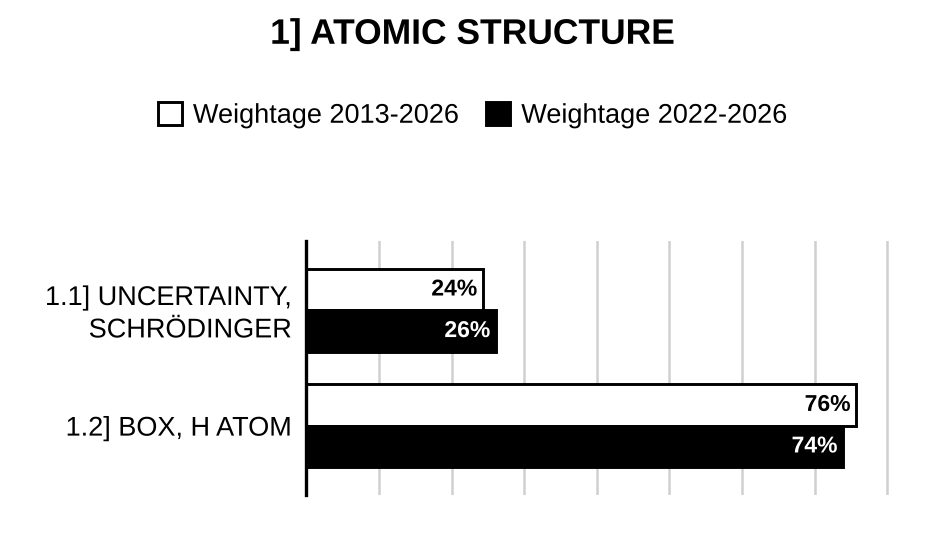
1.1] Uncertainty principle and Schrödinger equation
18 questions
What is the de Broglie wavelength for a baseball (140 g) moving at ? Comment on your finding. [2026/5m/5a]
Show that is an eigenfunction for the operator . What is the eigenvalue? [2026/5m/7a(i)]
Find the minimum uncertainty in momentum and speed if we wish to locate an electron within an atom so that pm, using . Comment on your two findings. [2026/10m/7b(i)]
State Heisenberg’s uncertainty principle. Show that for a particle in a one-dimensional box having length from 0 to L, the two normalised eigen functions corresponding to the eigenvalues and (characterised by quantum numbers 1 and 2 respectively) are orthogonal to each other. [2024/10m/2a]
(i) Find the wavelength of the emitted light when g particle in a one-dimensional box of length 3 Å goes from to level. (ii) Explain the Heisenberg uncertainty principle. [2023/10m/1a]
Use the Heisenberg uncertainty principle to calculate the uncertainty (in metres) in the position of a honeybee weighing 0.68 g and travelling at a velocity of 0.85 m/s. Assume that the uncertainty in the velocity is 0.1 m/s. [2019/10m/1d]
What is an orbital and how is it related to the probability density? [2018/5m/2a(i)]
Would it be possible to determine the position and momentum of an electron simultaneously and accurately if the value of Plank’s constant is zero? [2018/5m/2a(iii)]
Set up the Schrödinger’s wave equation in 3-dimension. Comment on the nature of the equation and various terms involved. Explain the significance of and . [2016/15m/4b]
What do you mean by the terms ‘eigen functions and eigen values’? Which of these functions is/are eigen functions of the d/dx operator? (i) , (ii) , (iii) , (iv) What is/are the eigen value/s? [2014/20m/4a]
Define and differentiate between the following: (i) Normalized and Orthogonal wave functions (ii) Eigen value and Eigen function (iii) Eigen value and Most probable value. [2012/12m/1a]
Electromagnetic radiation of wavelength 242 nm is just sufficient to ionize the sodium atom. Calculate the ionization energy of sodium in . [2012/12m/1c]
State and explain Heisenberg’s uncertainty principle. Why is it not applicable to large particles. [2008/10m/1a(i)]
When an electron was accelerated through a potential difference of 1.00 ± 0.01 kilovolt, what is the uncertainty of position of the electron along its line of projection? [2008/10m/1a(ii)]
What do you understand by orthogonal wave function? Normalise the wave function, for a particle in a one-dimensional box of size ‘a’. [2005/20m/1a]
What are orthonormal wave functions? Normalise the following wave function for a particle in a one-dimensional box [2003/20m/1a]
Write Schrodinger equation and its solution from Interpret the equation with respect to probability density, eigenvalues and eigenfunctions. [2002/20m/3a]
Normalize the wave function [2001/20m/1a]

Preparing for Prelims too?
Our UPSC Prelims Topic-wise PYQ eBook covers every Prelims question with detailed explanations, so you can see exactly where UPSC asks from.
View the BookDownload Free Sample1.2] Particle in a box and hydrogen atom
42 questions
The time-independent Schrödinger equation for a free particle (of mass m) in a box of length L (inside the box potential energy is zero, but outside the box is infinity) is The solution of the above equation is ; where n = 1, 2, 3, … . Why is n = 0 not allowed? Explain. [2026/5m/7a(ii)]
What are the n, l and values of orbital? Explain. [2026/5m/7b(ii)]
Calculate the ratio of probability of finding the 1s electron of hydrogen atom at and at , where ‘r’ is the distance from the nucleus and = radius of the first Bohr orbit. [2025/5m/1a]
Find the probability of existence of a particle in a one-dimensional box of length ‘a’ in the region for the states n = 1, 2 and 3. [2025/15m/2a]
Determine the distance from the nucleus at which the electron is most expected in the hydrogen atom in its ground state. [Given: The normalized radial function for hydrogen-like systems is where and is the first Bohr orbit radius. Other notations have their usual meanings.]. [2024/5m/1a(i)]
State Heisenberg’s uncertainty principle. Show that for a particle in a one-dimensional box having length from 0 to L, the two normalised eigen functions corresponding to the eigenvalues and (characterised by quantum numbers 1 and 2 respectively) are orthogonal to each other. [2024/10m/2a]
(i) Find the wavelength of the emitted light when g particle in a one-dimensional box of length 3 Å goes from to level. (ii) Explain the Heisenberg uncertainty principle. [2023/10m/1a]
Explain why the energy of a free particle can vary continuously but the energy of a particle in a box is quantized. [2023/10m/2b]
Compare average and most probable values of position of an electron in the ground state of hydrogen atom. Explain with the help of drawing, why two values differ. [2022/10m/1a]
A particle is in the th energy state, , of an infinite square well potential with width (box size from to ). Calculate the probability that the particle is confined to the first of the width of the well. [2022/20m/2b]
Calculate , the expectation value of position of a particle, in the ground state of one-dimensional box having length from 0 to . [2021/10m/1a]
Hydrogen atoms are observed to have radiative transitions from to to occur. (i) What are the frequency and wavelength of the radiation emitted in this transition? (ii) Why is it difficult to observe this transition? [2021/10m/2a]
The wave function of the hydrogen atom is given by (in atomic units). What will be the most probable distance of an electron from the nucleus in its ground state (in unit of , the Bohr radius and in Å unit)? [2020/10m/3a]
What do you mean by degeneracy of energy level? Find the number of degeneracy of hydrogenic orbital having energy . = Rydberg constant. [2020/10m/5a]
A particle in a rigid box of length ‘L’ is in its ground state. What is the probability of finding the particle in the centre half of the box? [2018/10m/1a]
Determine the number of radial nodes, angular nodes and total number of nodes in the following orbitals: 2p, 3s, 3p, 4d, 5f. [2018/5m/2a(ii)]
For a particle in one-dimensional box of length calculate the probability of its locating between zero and . [2017/15m/4a(i)]
Write the complete wave function for 1s-orbital and deduce its shape. [2017/10m/4a(ii)]
What are the angular wave functions of d-orbitals? Explain them, including their geometric signs, with the help of neat and labelled diagrams. [2016/10m/3c]
The wave functions for a particle in a one-dimensional box (length ) are where is the quantum number and is the distance along the length of the box. Find expectation values of the momentum and square of the momentum for the state of the particle in the box. Interpret your answer. [2015/10m/1a]
The Bohr model for single-electron atoms predicts that the energies of the allowed orbits are given by where and is the nuclear charge. (i) The Balmer series corresponds to transitions between which energy levels in the hydrogen atom? Does the Paschen series appear at higher or lower wavelengths than the Balmer series? (ii) Calculate the minimum energy (in J) required to ionize an electron in the state of hydrogen atom. (iii) Calculate the wavelength (in nm) of the photon emitted by an electron in making the transition from the to level of the single-electron ion, . (iv) Is the photon higher in energy or lower in energy than the transition from to in ? Explain your answer. [2015/20m/2a]
For a particle confined in a one-dimensional box of length , calculate the values of the average position () and momentum (). [2014/10m/1e]
Draw the radial part of the wave function and radial probability distribution for hydrogen atom for 1s, 2s and 2p orbitals. [2014/10m/3a]
Draw the contours of the five d orbitals. Show how , and bonds are formed with metal d-orbital participation. [2014/10m/7e]
A particle of mass m is confined in a one-dimensional box of length L. The wavefunctions of the particle are given by n is the quantum number, and is the distance along the length of the box. (i) Sketch the wavefunctions for the states with n = 1, n = 2 and n = 3. (ii) Describe what is meant by the Born interpretation, (iii) Sketch the probability of finding the particle within the box for the states with n = 1, n = 2 and n = 3. (iv) What is the average momentum of a particle in a box? [2013/10m/1a]
The basic Schrödinger equation for a hydrogenic (1–electron) atom is (i) Explain what the terms in this equation mean. [2013/5m/3a(i)]
is the reduced mass of the electron-nucleus pair. For hydrogen, how does it compare with , the mass of the electron? [2013/5m/3a(ii)]
Evaluate the average electron-nucleus separation for the ground state of a hydrogenic atom: given that and the wavefunction is given by where Z is the nuclear charge and is the Bohr radius. [2013/10m/3a(iii)]
Why is this different from the most probable radius ()? [2013/5m/3a(iv)]
The wave function for 1s electron of Li is given by , where is equal to 52.9 pm. Calculate the value of radius at which the probability of finding 1s electron is a maximum. [2012/20m/2a]
(i) Show that the function satisfies the Schrödinger equation for a particle in a one-dimensional box with a potential function equal to zero for and infinity elsewhere. (ii) What values may the quantum number take? What are the allowed energy levels? (iii) Why is it important that the wavefunction be normalized? Calculate the normalization constant, N. [Given ]. [2011/15m/1a]
The energy levels of the electron in a hydrogen atom are given by where is the Rydberg constant and n is the principal quantum number. (i) Draw a clearly labelled energy level diagram showing the first three energy levels of the electron and all of the quantum states belonging to each energy level. (ii) Give the degeneracies of the first three energy levels, giving the allowed and values and the orbital rotations. Suggest a simple formula which relates the degeneracy of an energy level to its principal quantum number. (iii) The wavefunction of an electron in a hydrogen 1s orbital is given by: where r is the radial distance from the nucleus, and is the Bohr radius. Write down an expression for the radial distribution function and explain why this function has a different physical interpretation to . Sketch and . (iv) Find the most probable radius at which the electron will be found. Justify the statement “the hydrogen atom has a diameter of approximately one Å”. [2011/30m/3a]
Deduce the following equation for a particle in a one-dimensional box giving the Hamiltonian explicitly: Also deduce the energy for the system. [2010/15m/1a]
Give the Schrödinger’s wave equation for H-atoms in cartesian and polar co-ordinates. With the help of a diagram show the relation between the two co-ordinates. [2009/20m/1a]
What do you mean by quantum numbers? Discuss different types of quantum numbers and their significance. [2009/20m/2a]
What is meant by electron probability function? Draw the radial distribution curves for 1s, 2s, 2p, 3s, 3p and 3d electrons, and explain radial nodes, radius of maximum probability and penetrating power of electrons. [2008/20m/2a]
Set up and solve the Schrodinger equation for particle in one-dimensional box. [2007/20m/1a]
Explain Aufbau principle, Hund’s rule of maximum multiplicity and Pauli’s exclusion principle. What is their significance in writing electronic configuration? Give suitable examples. [2006/20m/7a]
Justify that s-orbitals are non-directional whereas p- and d-orbitals have directional character. Derive wave functions of hybridized orbitals. [2005/20m/3a]
Calculate the energy spacing between the first two levels if a particle of mass gm is moving in a box of length 10 cm. [2001/20m/2a]
Explain the difference between 1s and 2s orbitals and also between 2s and 2p orbitals. [2000/20m/1a]
What is the node in an atomic orbital and what role does it play in determining broadly the relative stability of various types of atomic orbitals with the same principal quantum number? [2000/20m/1b]

Strengthen your GS papers
Our UPSC Mains Topic-wise & Year-wise PYQ eBook (2013–2026) maps every GS question to the syllabus, so you know what UPSC asks and how often.
View the BookDownload Free SampleNext: Chemical Bonding »
Back to: Chemistry Optional PYQs – Topic-wise
Last updated: 30 October 2026