
Here are all 68 Chemical Kinetics questions asked in UPSC Chemistry Optional Paper I from 2000 to 2026, arranged under the 4 topics of the official syllabus. Within each topic the latest questions come first.
Each question ends with a code such as [2024/15m/3b] – the year, the marks, the word limit (where UPSC set one) and the question number in the paper.
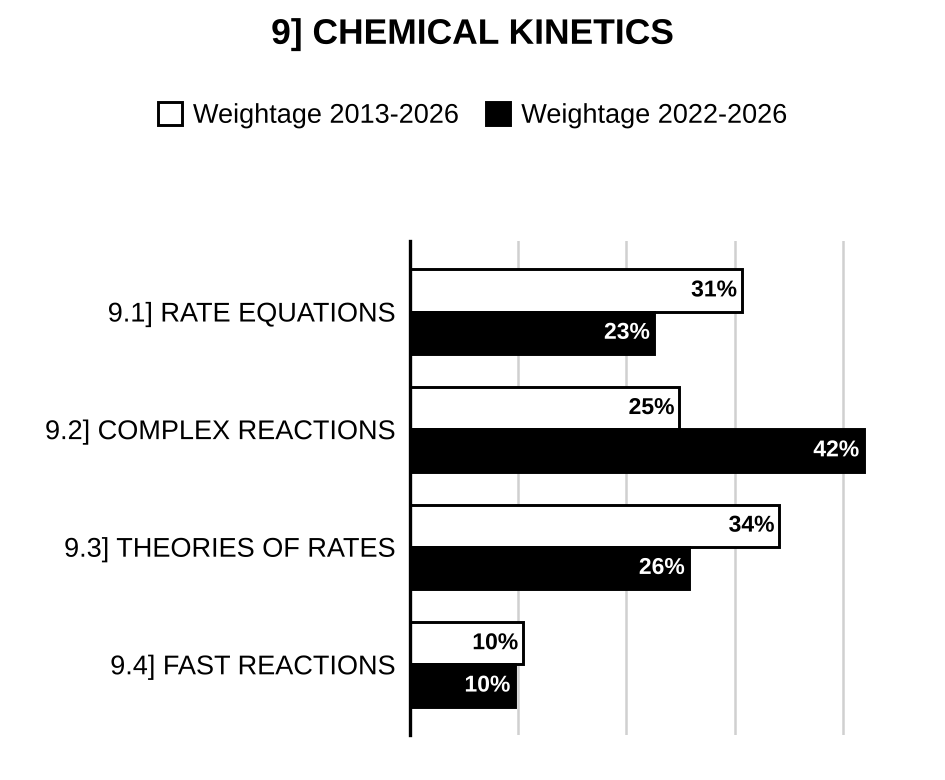
9.1] Rate equations and order of reaction
24 questions
From the following data for the decomposition of ammonium nitrite in aqueous solution, show that the reaction is of the first order.
| Time (minutes) | 10 | 15 | 20 | 25 | ∞ |
| Volume of (cc) | 6.25 | 9.00 | 11.40 | 13.65 | 35.05 |
[2025/5m/5d]
(i) Consider a second-order reaction: where the initial concentration of A is ‘a’ and that of B is ‘b’ . After time ‘t’, x of A and x of B react to form x of the product, P. Show that the second-order rate constant for this reaction will be given by with the assumption that a > b. What will be the unit of ? (Consider time in seconds) (ii) Determine the units of the rate constants for zeroth-order and order reactions. Assume that concentrations are expressed in and time in seconds. [2025/10m/7d]
The decomposition of to and is a first-order reaction with at K. The atomic weights of and are 12 and 32, respectively. (i) Find the half-life of this reaction at 1000 °C. (ii) In how many days will 1 g of decompose to the extent that 0.6 g of remains? (iii) How much of 1 g of would remain after 35 days? [2023/10m/5a]
The rate Law for the reaction is of first order in the concentration of . Derive an expression for the time-dependent behaviour of the product concentration [NO]. [2022/10m/5a]
Derive an equation for rate constant of a zero-order reaction. Show that half-life period of the reaction is proportional to the initial concentration of reactant. [2021/10m/5a]
A reaction completes in twice the time of its half-life period. What is the order of the reaction? Give reason(s). [2020/7m/7a(i)]
Show that for a first order reaction, the time required for 99.9% completion is almost 10 times the time for 50% completion. [2020/8m/7a(ii)]
For the reaction the plot of conc. of against time () was found to be linear with a negative slope. Predict the order of reaction. Justify your answer. [2019/10m/5d]
The rate constant for the reaction described by is . Calculate the half life of the above reaction if the initial conditions are (i) (ii) [2018/10m/5a]
In the hydrolysis of ethyl acetate using equal concentrations of ester and NaOH, the following results were obtained:
| t (minutes) | 0 | 5 | 15 | 25 | 35 |
| HCl (ml) | 16.0 | 10.24 | 6.13 | 4.32 | 3.41 |
Show that the reaction is of second order. [2018/10m/6a(ii)]
The hydrolysis of bicarbonate ions in water at a high pH follows the rate law Rate = where at 25 °C. (i) What is the overall order of the reaction? (ii) What is the half-life of , if the initial concentration of , ? (iii) Is hydroxide ion a catalyst in this reaction? Explain in two lines. (iv) Write down the Arrhenius equation and define each of the terms in this equation. What each term physically relates to? (v) What is the rate constant of the above equation at 350 K, if the activation energy of the reaction is ? (vi) The hydrolysis reaction is exothermic. Draw a curve of the reaction showing how the energy of the system changes in going from reactants to products. Mark in the activation energy for the forward and back activation steps, and show the overall change in energy of the reaction. [2015/25m/7b]
State whether the following statements are true or false, and if false, correct them: (i) It is possible to change the rate constant for a reaction by changing the temperature. (ii) The reaction rate remains constant as a first-order reaction proceeds at a constant temperature.
Useful Constants and Integrals (printed on page 15 of Paper I): ; ; ; ; ; ; ; At 25 °C, , ; ; [2015/10m/8e]
Decomposition of a gas is of second order. It takes 60 min. for 60% of the gas to be decomposed, when its initial concentration is . Calculate the specific reaction rate. [2014/10m/7b]
Calculate the half-life of at 25 °C and the fraction decomposed after s, given that the rate constant of its decomposition is . [2013/15m/7d]
Show that for a second order reaction , the half-life is inversely proportional to the initial concentration of A. [2012/10m/4d]
Derive an expression for the rate constant of a first order reaction. [2011/10m/7c(i)]
Show that the half-life period of a first order reaction is independent of initial concentration. [2011/10m/7c(ii)]
Half-change time and initial concentrations of a reaction are as follows:
| (sec) | (mm of mercury) |
| 425 | 354 |
| 275 | 540 |
| 941 | 158 |
What is the order of the reaction? Calculate the rate constant. [2010/10m/2b(ii)]
How much will the rate of reaction change if volume of the vessel is reduced to of its original volume? [2010/10m/4c(ii)]
Derive the rate constant of a second order reaction when (i) two different reactants have same initial concentrations. (ii) two different reactants have different initial concentrations. [2009/20m/5b]
What is first-order reaction? Deduce an equation for first-order reaction and show that its half-life period is independent of the initial concentration of the reactant. [2008/20m/6a]
Half life of a first order may be determined from its rate constant. If rate constant of a first order reaction is then calculate its half life. [2005/20m/1d]
Benzaldehyde undergoes transfromation in presence of as: where following kinetic data were obtained:
| initial concn. () | initial concn. () | Initial reaction rate () |
| 0.50 | 0.50 | |
| 1.00 | 0.50 | |
| 1.00 | 1.00 |
Calculate overall order of reaction and its rate constant. [2005/20m/2b]
Show that for a first-order reaction the time required for 99.9% of reaction to take place is ten times of that required for one-half the reaction. [2000/20m/8c]
9.2] Complex reactions
16 questions
The photodecomposition of HI(g) takes place following three elementary steps: Find the expression of , quantum yield () and kinetic order of the reaction. [2026/10m/3c(ii)]
A substance B converts simultaneously to the products D and D′ by two parallel elementary reactions . The initial concentration of B is . After 40 minutes, the concentration of B has decreased to ; in the same time, the product D′ with a concentration is formed. Calculate the rate coefficients and . [2026/10m/4b(ii)]
Consider the following photochemical reaction: Give the mechanism of this reaction. Applying steady-state approximations to [Br] and [H], show that the rate of formation of HBr (g) varies with the square root of the intensity () of the absorbed radiation. What is the quantum yield for this reaction? Why is the value so low? [2025/20m/6b]
For the sequential reaction , the rate constants are and . Determine the time when the concentration of B is at a maximum. [2024/10m/4c(i)]
In acidic condition, benzyl penicillin (BP) undergoes the following reaction: Imagine while swallowing penicillin, pH of the stomach is ~ 3. At this pH, and temperature 22°C, the rate constants for the processes are: , , . What is the yield of formation?
[Figure: Parallel reaction scheme: BP –k1→ P1 (arrow to the left); BP –k2→ P2 (arrow to the right); BP –k3→ P3 (arrow downward)] [2024/5m/4c(ii)]
The reaction cis-2-butene trans-2-butene is first order in both the direction. At 25°C, the equilibrium constant is 0.406 and the forward reaction rate constant is . Starting with a sample of pure cis isomer with , how long it will take to form half of equilibrium amount of the trans isomer from cis isomer? [2022/10m/7c]
Define stationary and non-stationary (branching) chain reaction. Non-stationary chain reactions always lead to explosion under certain conditions. Give a detailed account of these conditions. [2022/10m/8c]
What is meant by steady-state approximation? How this approximation helps in deriving the kinetics of following photochemical reaction? The quantum yield of this reaction is extremely large. Justify or criticize this statement. [2022/10m/8d]
Consider the following opposing reaction: (both are elementary) Depict the plots of concentration of and as a function of time and explain. Given: [2020/15m/2c]
Show that half-life period () of the following parallel reaction is . (Both reactions are elementary).
[Figure: Parallel reaction scheme: A → B (rate constant , upper arrow) and A → C (rate constant , lower arrow)] [2020/10m/5c]
Photodimerization of a monomer in the presence of a photoinitiator occurs by a chain polymerization process in three steps: Photoinitiation: Rate = ; Propagation: Rate = ; Termination: Rate = where and are the rate constants for the propagation and termination steps, involving the propagating chain radical and is the intensity of absorbed light. Show that the rate of photopolymerization (i.e., the rate of loss of monomer) is proportional to the square root of the light intensity. [2015/15m/6a]
The mechanism of a chemical reaction can be written as follows: (i) Write expressions for and in terms of [A], [A*] and the rate constants. (ii) Assuming a steady state approximation for A*, express the rate constant for the formation of the product B in terms of [A] and the rate constants. (iii) Under what conditions does the reaction become (1) first order and (2) second order? [2013/10m/5d]
Lindemann’s mechanism for the first-order reaction is given as follows: (rapid equilibrium); product (slow). Show that Under what condition will the reaction show (i) first order and (ii) second order? [2010/20m/2c]
Derive the rate equations for the consecutive reaction and parallel reaction. [2007/20m/5b]
Explain the difference between consecutive and chain reaction. The rate constant for the reaction is at 1000 K. Calculate the rate constant for the backward reaction, if for is , and . [2006/30m/4a]
For a consecutive unimolecular reaction through the formation of an intermediate I, as in the reaction , set up rate laws: (i) for the variation of concentration with time (ii) when and (iii) for steady state approximation. [2004/30m/3a]

Preparing for Prelims too?
Our UPSC Prelims Topic-wise PYQ eBook covers every Prelims question with detailed explanations, so you can see exactly where UPSC asks from.
View the BookDownload Free Sample9.3] Temperature and pressure effects; theories of reaction rates
20 questions
Everyday experience demonstrates that food will spoil outside in a hot summer day much faster than it would be in a refrigerator. Estimate the activation energy of these decomposition processes by assuming that food will spoil about 40 times faster at a temperature of 30 °C than at a temperature of 8 °C. [2026/5m/1h]
The gas-phase reaction between methane () and diatomic sulphur () is given by the following reaction: At 823 K, the rate constant for this reaction is and at 898 K, the rate constant is . Calculate the activation energy for this reaction. [Given: ]. [2025/5m/5a]
The activation energy for the decomposition of hydrogen peroxide is 42 kJ/mol, whereas when the reaction is catalyzed by enzyme catalase, it is 7.0 kJ/mol. Calculate the temperature that would cause the uncatalyzed reaction to proceed as rapidly as the enzyme catalyzed decomposition at 20°C. Assume the frequency factor A to be the same in both cases. [2024/10m/1e]
Explain the transition-state theory for reaction rates. How is this theory considered superior to collision theory in providing a much more complete interpretation of the pre-exponential factor in the Arrhenius equation? [2023/20m/8d]
What are the limitations of collision theory? How is it explained by transition state theory? [2021/20m/6b]
Explain the effect of temperature on rate constant. [2018/5m/6a(i)]
For zero-order reaction, write down the Arrhenius equation, indicating name of the symbols and their units in SI system. What is high temperature limiting value of rate constant? [2017/10m/5a]
Define activation energy, of a chemical reaction. A gas-phase reaction completes 25% in 30 min at 27°C and in 10 min at 37°C. Determine the in SI unit. [2017/15m/6a(ii)]
Discuss the theory of absolute reaction rate. How does a catalyst make reaction faster? [2016/10m/2a(ii)]
The hydrolysis of bicarbonate ions in water at a high pH follows the rate law Rate = where at 25 °C. (i) What is the overall order of the reaction? (ii) What is the half-life of , if the initial concentration of , ? (iii) Is hydroxide ion a catalyst in this reaction? Explain in two lines. (iv) Write down the Arrhenius equation and define each of the terms in this equation. What each term physically relates to? (v) What is the rate constant of the above equation at 350 K, if the activation energy of the reaction is ? (vi) The hydrolysis reaction is exothermic. Draw a curve of the reaction showing how the energy of the system changes in going from reactants to products. Mark in the activation energy for the forward and back activation steps, and show the overall change in energy of the reaction. [2015/25m/7b]
State whether the following statements are true or false, and if false, correct them: (i) It is possible to change the rate constant for a reaction by changing the temperature. (ii) The reaction rate remains constant as a first-order reaction proceeds at a constant temperature.
Useful Constants and Integrals (printed on page 15 of Paper I): ; ; ; ; ; ; ; At 25 °C, , ; ; [2015/10m/8e]
Calculate , and for the second order reaction, at 400 K. Given: Arrhenius factor and the energy of activation is . [2014/10m/5d]
Calculate the room temperature (300 K) ratio of the rate constants for two reactions that have the same A value but have values that differ by (i) (ii) . [2014/20m/8b]
The value of temperature coefficient, at 300 K for a reaction is 2.8. Calculate the energy of activation () of the reaction. [2012/12m/5b]
How do you account for the fact that the rate of reaction is more than double for a ten degree rise of temperature, whereas the number of collisions increases by only 3–4% for the same rise of temperature? [2010/15m/1c]
For the reaction , rate Explain that the rate of this reaction decreases with increase of temperature. [2010/10m/4c(i)]
Explain collision theory of reaction rates. What are the factors which cause failure of this theory in certain cases? How do you make allowance for the deviation from the ideal behaviour? [2009/20m/6a]
Derive an equation to relate temperature on rate of reaction and calculate the energy of activation. [2008/20m/5b]
The activation energy of a reaction in the absence and in the presence of catalyst are 75.24 kJ/mole and 50.14 kJ/mole respectively. How many times will the rate of the reaction grow in the presence of the catalyst if the reaction proceeds at 25° C? [2007/20m/6c]
A certain reaction is 20% complete in 15 minutes at 40 °C and in 3 minutes at 60 C, Estimate its activation energy. [2000/20m/8b]
9.4] Fast reactions
8 questions
The equilibrium at 25 °C is subjected to a sudden temperature increase that slightly increases the concentrations of B and C. The measured relaxation time is 3.0 μs. The equilibrium constant for the system is at 25 °C, and the equilibrium concentrations of B and C at 25 °C are both . Calculate the rate constants involved in the system. [2026/15m/4b(i)]
When a sample of pure water is heated by a pulse of microwave radiation the equilibrium in the water dissociation reaction is shifted. The relaxation time for the re-establishment of equilibrium at 25°C is 36 microseconds. Calculate and in . Ion product of water at 25°C is . [2019/20m/6b]
Find out the equilibrium constant for the reaction assuming the relaxation time and for M and M respectively. [2016/10m/4c]
Describe the relaxation method for studying kinetics of fast reactions. [2012/12m/6d]
Derive an expression to estimate the frequency of collisions of gas molecules with a surface. Describe the relaxation method for studying fast reactions. [2009/20m/2c]
Write salient features of stop-flow and relaxation methods for studying fast reactions. [2006/20m/3a]
(i) Define “relaxation-time”. How is it related to the rate constant of the first-order reaction? (ii) The “relaxation-time” for a reversible first-order reaction is 10 micro second, and the equilibrium constant is 1.0 × 10g [?]. Find and . [2003/30m/3b]
Explain the techniques of stopped-flow and flash photolysis to study the kinetics of a reaction. [2002/20m/7b]

Strengthen your GS papers
Our UPSC Mains Topic-wise & Year-wise PYQ eBook (2013–2026) maps every GS question to the syllabus, so you know what UPSC asks and how often.
View the BookDownload Free Sample« Previous: Electrochemistry | Next: Photochemistry »
Back to: Chemistry Optional PYQs – Topic-wise
Last updated: 30 October 2026