
Here are all 90 Electrochemistry questions asked in UPSC Chemistry Optional Paper I from 2000 to 2026, arranged under the 3 topics of the official syllabus. Within each topic the latest questions come first.
Each question ends with a code such as [2024/15m/3b] – the year, the marks, the word limit (where UPSC set one) and the question number in the paper.
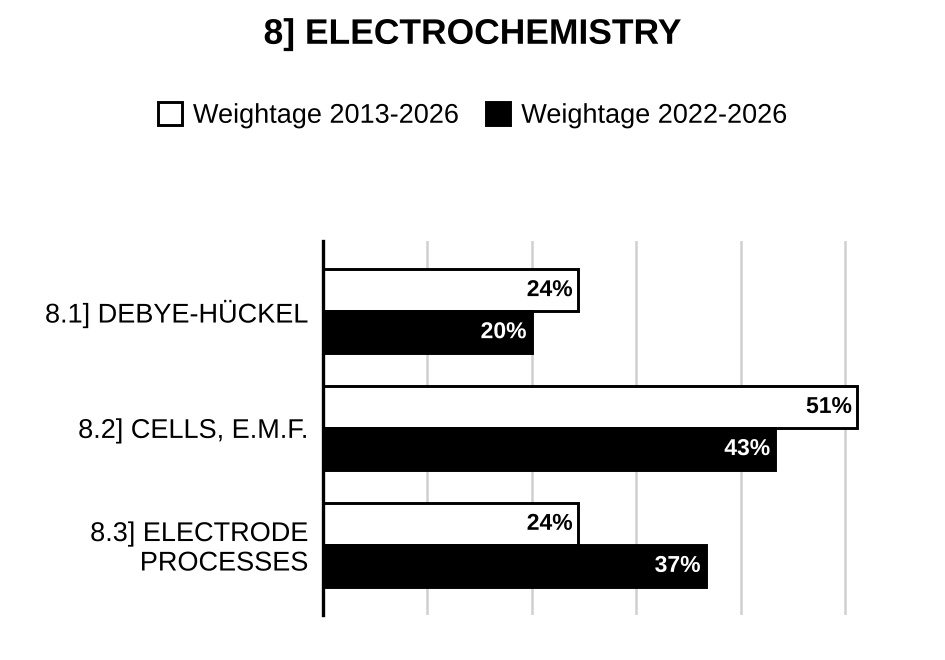
8.1] Debye-Hückel theory
16 questions
In a homogeneous electric field , the speed v of ions in aqueous solution at 25 °C is . (i) Estimate the radius r of the hydrated ion. The coefficient of viscosity of water at the given temperature is 0.890 mPa s. (ii) Calculate the diffusion coefficient D of the ion. [2026/10m/3b]
The level of conductivity in a decimolar aqueous solution of calcium nitrate, which is a strong electrolyte, is measured as at 25°C. Calculate the molar conductivity of the electrolyte, that of calcium ions and the transport numbers of the two types of ions present in the solution, with the data given below. Molar conductivity at infinite dilution in an aqueous solution at 25°C:
| (i) | |
| 11.9 | |
| (ii) | |
| 7.14 |
[2025/10m/4c]
Provide briefly a qualitative account of different forces which influence the speed of an ion in solution of strong electrolyte moving under an externally applied electric field. [2022/10m/3e]
Write down Debye-Huckel limiting equation for type of ionic species in a salt solution with symbolic significances and units. [2020/10m/3e]
The ionic mobilities of and are and respectively. Calculate the equivalent conductance of 0.1 M NaCl. [2019/10m/5c]
A silver nitrate solution containing 0.00739 gm of per gm of water is electrolysed between silver electrodes. During the experiment 0.078 gm of Ag was deposited on the cathode. At the end of the experiment anode solution contained 23.14 gm of and 0.236 gm of . What is the transport number of ? After electrolysis, the anode solution has (a) 23.14 gm water and (b) 0.236 gm . [2018/10m/3c(ii)]
Write down the Debye-Hückel limiting equation with symbolic significances and their units. Calculate mean ionic activity co-efficient of 0.1 M NaCl (aq) solution at 25°C. The value of Debye-Hückel constant (A) is . [2017/10m/1e]
In aqueous solution, at 298 K, the mobility of ion is . Calculate its (i) molar conductivity; (ii) velocity if 15.0 V is applied across the electrodes of 25.0 cm apart. Calculate the transport numbers of the ions in (aq) solution if the mobility of ion is under same condition. [2017/15m/6c]
The solubility product of is . If the ionic conductance at infinite dilution at 25°C of and , calculate the specific conductance of . [2016/10m/1e]
During the electrolysis of a solution of potassium chloride between platinum electrodes, 0.0145 g of the chloride were lost from the anodic compartment and 0.0875 g of silver was deposited in a silver coulometer connected in series with the cell. Determine the transport number of and ions. [2014/10m/2d]
(i) Define transport number of anion and describe how it is measured. (ii) Explain the basis of polarography. How is it used in diffusion measurements? (iii) What is the principle behind ion selective electrode and how is it used as a reference electrode? (iv) Define overpotential and exchange current density. [2009/20m/5a]
Define activity, activity coefficient and mean activity coefficient of ions in solution. Derive and use the Debye-Huckel limiting law for mean activity coefficient, and indicate how it can be extended to more concentrated solution. [2008/20m/5a]
Give an account of Debye-Huckel theory of strong electrolytes. Discuss its significance. [2007/20m/4c]
(i) Write the expression for the activity of 2-1 electrolyte in terms of its molality and mean ionic activity coefficient. (ii) Calculate the activity coefficients , and , and activity for 0.001 molal sodium chloride in water at 25°C. (Take Debye-Huckel constant ) [2003/20m/1d]
Explain Debye-Huckel limiting law and the extended Debye-Huckel law. Calculate the ionic strength and the mean activity co-efficient of (aq) at . [2002/20m/8c]
Calculate the mean activity coefficient of an aqueous solution of 0.001 molality of at 25°C. [2001/20m/2b]

Preparing for Prelims too?
Our UPSC Prelims Topic-wise PYQ eBook covers every Prelims question with detailed explanations, so you can see exactly where UPSC asks from.
View the BookDownload Free Sample8.2] Galvanic cells and e.m.f.
45 questions
One silver rod is immersed in a silver nitrate solution of the concentration and a second silver rod in the concentration . The electrolyte solutions are connected by salt bridge. Calculate the difference of the redox potential for the electrochemical cell at 25 °C (under equilibrium conditions). [2026/5m/1f]
Why is it necessary to measure the cell potential using potentiometer under zero-current conditions? [2026/5m/1g]
The standard reduction potential of oxygen under acidic conditions at 298 K is +1.23 V. What is the standard reduction potential for the four-electron reduction of under basic conditions?. [2025/15m/2b]
Define concentration cell and mention its types. Justify the statement “Fuel cells are energy conversion devices and not energy storage devices.” [2024/5m/4b(ii)]
Calculate the value for the half-reaction Given that at 25 °C [2023/5m/1e(i)]
Consider the reaction , which occurs in a – fuel cell. (i) Identify the elements that undergo oxidation and reduction. (ii) Calculate the standard reaction Gibbs free energy () at 25 °C. (iii) Write down the two reduction half-reactions for the cell. (iv) Calculate the . Given that [2023/20m/3c]
For a cell reaction the standard electrode potential for V and for V at 25°C. Calculate standard change in free energy and equilibrium constant K for the reaction. []. [2022/10m/1e]
Define electrochemical series. Give its significance. [2021/10m/1e]
Calculate the e.m.f. of the following electrochemical cell at 25 °C: [2021/10m/4a]
The equilibrium constant for the reaction: ; is 0.531 at 298 K. Calculate when at 298 K. [2020/10m/1e]
To eliminate liquid-junction potential, KCl-salt bridge is used, generally. Does it eliminate liquid-junction? If not, how salt-bridge eliminates liquid junction potential? [2020/10m/4c]
Write down the respective electrode reactions, cell reaction and Nernst equation for cell EMF of the following galvanic cell: [2020/10m/8a]
Devise an electrochemical cell in which the following reaction takes place: [2019/10m/7d]
Write electrode reactions for the following: (i) fuel cell under acidic condition. (ii) Lead acid battery during discharge. [2019/10m/8d]
Observe the following half cell reactions: (i) ; (ii) ; (iii) ; Using the above Standard Electrode Potential Values, explain the spontaneity or non-spontaneity for the following reactions: (A) (B) (C) (D) [2018/10m/1e]
Distinguish between Galvanic cells and concentration cells with an example each. [2018/5m/3c(i)]
Calculate the equilibrium constant for the disproportion reaction: at 298 K. Given: and at 298 K. [2017/15m/2c]
Discuss, with the aid of diagrams– (i) why a block of magnesium is attached to a pipeline to reduce corrosion; (ii) what is meant by pitting corrosion and how it occurs. [2015/10m/5a]
For the galvanic cell the standard reduction potentials at 25 °C are the following: and (i) Write down the two spontaneous half-cell reactions based on the convention for electron flow for the cell as written. (ii) Calculate the e.m.f. of this cell based on the concentrations given. In your calculations, use the fact that the mean activity coefficients () for and ions under the conditions given are 0.3 and 0.2, respectively. [2015/15m/7a]
What are the electrode reactions for charging and discharging of the Cd – Ni alkaline battery? What are the advantages of choosing Cd and Ni for the cell? [2013/10m/3c]
is found to be −77.8 kJ, for the following reaction Calculate for the following half-reaction (Given: 1 Faraday = 96,500 C) [2013/10m/5c]
Calculate the standard potential of the reaction Given the following reduction potentials: ; ; ;
Given: Constants for use: ; ; ; ; ; [2013/10m/8d]
When is dissolved in water, it disproportionates, producing ion and HClO. Find at what concentration the potential for the disproportionation changes from a negative value to a positive value, assuming 1.0 atm of pressure and concentration of 1.0 M for all species except hydronium ions. Given: and at 25 °C. [2012/12m/5a]
Calculate overall voltage output of a hydrogen – oxygen fuel cell which shows free energy change () at 25 °C equal to . Also, write anodic, cathodic and overall reaction taking place in presence of KOH. [2012/12m/6a]
What are sacrificial anodes? How do they inhibit corrosion? [2012/10m/7a]
From the following data calculate the solubility product of AgCl at 25 °C: (Given: at 25 °C = 0.455 V, ) [2012/14m/8a]
What is meant by liquid-junction potential? Why is KCl salt bridge used to eliminate it? Give one example of a concentration cell with transference. [2010/15m/5d]
What is Nernst equation? Explain the various terms involved. [2010/5m/7a(i)]
Calculate the potential of the following cell. Write down the cell reaction and indicate the polarities of the electrodes: [, ]. [2010/10m/7a(ii)]
Distinguish between chemical cell and concentration cell giving examples. [2010/5m/8b(i)]
Derive an expression for the e.m.f. of electrode concentration cell without transference. [2010/12m/8b(ii)]
(i) Describe the structure of electric double layer and define outer potential and inner potential. (ii) Calculate the emf of the following cell and predict whether the given cell representation is correct or wrong. If wrong, write the correct reaction. Given , [2009/20m/6b]
With neat diagram, describe – (i) lead acid battery with discharge and charging reactions; (ii) – fuel cell with anodic and cathodic reactions. [2008/20m/6b]
Considering the following electrochemical cell: Fe, (0.1 M) || (0.01 M), Cd, (i) write the cell reaction, (ii) calculate the EMF of the cell, (iii) determine the direction of the spontaneous reaction and (iv) calculate the equilibrium constant of the reaction. [2007/20m/5a]
Explain the following briefly: (i) Metal atom clusters (ii) Fuel cells (iii) BET isotherm (iv) Quantum yield. [2006/20m/3c]
Explain the free energy change in a Galvanic cell generating positive e.m.f. What happens when it is drained off? [2006/20m/5d]
Explain following: (i) Ion selective electrodes (ii) Quantum yield (iii) Nernst heat theorem (iv) Fuel cells (v) Langmuir isotherm. [2005/30m/2a]
Describe the construction and functioning of lithium batteries and its advantages over conventional batteries. [2005/20m/7c]
Calculate the potential of the following cell and indicate whether it is galvanic or electrolytic The standard reduction potentials are and [2004/20m/2c]
Explain the principle, construction and uses of hydrogen-oxygen fuel cell and its advantages. [2004/20m/6a]
What are concentration cells? Show that the e.m.f. of an anion-reversible cell with transference is: [2003/30m/2a]
Explain the construction and functioning of lithium battery and its advantages. [2002/20m/3c]
How is the standard potential of a half cell determined? [2001/20m/2c]
Show that the junction potential of a concentration cell is given by the equation [2001/20m/3a]
(Standard state pH = 7) for the electrode reaction is volt. Calculate E at pH = 6 when ethanol and acetaldehyde are present at M, temperature = 25 °C. [2000/20m/2a]
8.3] Electrode processes and electroanalytical techniques
29 questions
Draw and discuss the polarographic wave obtained in the case of a dropping mercury electrode in polarography. [2026/10m/4a]
The surface area of an object to be gold plated is , and the density of gold is . A current of 3.25 A is applied to a solution that contains gold in the +3 oxidation state. Calculate the time required to deposit an even layer of gold, cm thick, on the object. (Given: Molecular mass of gold = 196.97 g/mol) [2025/5m/1i]
Calculate the diffusion limiting current for the oxidation of an organic compound at an electrode in a quiescent solution. Assume six electrons are involved in the reaction and the thickness of diffusion layer is taken as 0.05 cm in an unstirred solution. Given: (i) Concentration of organic compound, (ii) Diffusion coefficient of organic compound, [2025/10m/4b]
Define overvoltage. Mention the applications of overvoltage. [2024/5m/1d(ii)]
What is polarography? Explain the concentration polarization at the electrode. Give the labelled diagram of polarographic cell assembly. [2024/15m/4b(i)]
Write down the basic principle of polarography. With the help of a neat typical polarogram discuss the significance of halfwave potential, diffusion current and limiting current. [2022/10m/4d]
What are ion-selective electrodes? How is glass electrode used in the determination of pH of a given solution? [2021/20m/3b]
800 milliampere of current is passed through an aqueous solution of using two Pt electrodes for a period of 20 minutes. Predict the products at anode and cathode. Estimate the quantity of products. (At. weight of Cu is 63.6) [2019/20m/3d]
Discuss the principle of polarographic analysis. Explain the meaning and significance of half wave potential. [2016/10m/4a(ii)]
Explain the term ‘overpotential’. [2012/12m/5e]
Discuss the working of a polarograph. Define and and mention their application in chemical analysis. [2012/12m/6b]
Write a short note on ion selective electrodes and their uses. [2012/12m/6c]
(i) Define transport number of anion and describe how it is measured. (ii) Explain the basis of polarography. How is it used in diffusion measurements? (iii) What is the principle behind ion selective electrode and how is it used as a reference electrode? (iv) Define overpotential and exchange current density. [2009/20m/5a]
(i) Describe the structure of electric double layer and define outer potential and inner potential. (ii) Calculate the emf of the following cell and predict whether the given cell representation is correct or wrong. If wrong, write the correct reaction. Given , [2009/20m/6b]
Explain the basic principle of polarography. Write Ilkovic equation explaining all the terms and show that diffusion current is directly proportional to concentration. [2006/15m/6b]
Explain following: (i) Ion selective electrodes (ii) Quantum yield (iii) Nernst heat theorem (iv) Fuel cells (v) Langmuir isotherm. [2005/30m/2a]
Draw the nature of a typical polarogram and explain diffusion current, limiting current and residual current. Show that is independent of concentration. [2005/20m/5d]
How does a glass electrode develop potential in the solutions of varying hydrogen ion concentrations, and how is pH measured? [2004/20m/2a]
Describe the principle and technique of amperometry and the estimation of lead by this technique. [2004/20m/2b]
Explain the technique of cyclic voltammetry and the significance of peak potential, wave slope and reversibility. [2004/20m/6c]
Discuss the principle of polarographic analysis. What are the advantages of using a dropping mercury electrode over conventional electrodes? Why is it necessary to remove any dissolved oxygen before carrying out voltammetric studies? [2003/20m/6a]
What are indicator electrodes? Discuss three kinds of metal indicator electrodes. [2002/15m/4a]
Give the construction and functioning of a liquid ion-exchange electrode and a gas-sensing electrode. [2002/30m/4b]
Derive the polarographic wave equation and prove that is approximately equal to . [2002/20m/5a]
Discuss the various titrations that can be performed in amperometry. [2002/20m/5b]
What changes do you expect in a cathodic polarogram if the d.m.e. is replaced with some solid stationary electrode while solution conditions remain the same? Also explain why. [2000/20m/2b]
Employing d.m.e. as the indicator electrode, sometimes it is possible to estimate a very dilute solution of some metal ion amperometrically even when there is no apparent chemical interaction between it and the titrant. Elaborate the statement taking an example. [2000/20m/3a]
What is an electrometric indicator and how does it facilitate the amperometric estimation of some metal species at d.m.e.? Give an example. [2000/20m/3b]
ions when titrated with amperometrically at d.m.e. at 0.0 V in an acidic medium, yield a curve which shows only non-faradic current in the beginning and faradic current appears (and then increases regularly as the titration progresses) only after the null point has been reached. however, a V-shaped curve is obtained when the same titration is carried out at V. Explain why it is so. [2000/20m/3c]

Strengthen your GS papers
Our UPSC Mains Topic-wise & Year-wise PYQ eBook (2013–2026) maps every GS question to the syllabus, so you know what UPSC asks and how often.
View the BookDownload Free Sample« Previous: Phase Equilibria and Solutions | Next: Chemical Kinetics »
Back to: Chemistry Optional PYQs – Topic-wise
Last updated: 30 October 2026