
Here are all 52 Phase Equilibria and Solutions questions asked in UPSC Chemistry Optional Paper I from 2000 to 2026, arranged under the 2 topics of the official syllabus. Within each topic the latest questions come first.
Each question ends with a code such as [2024/15m/3b] – the year, the marks, the word limit (where UPSC set one) and the question number in the paper.
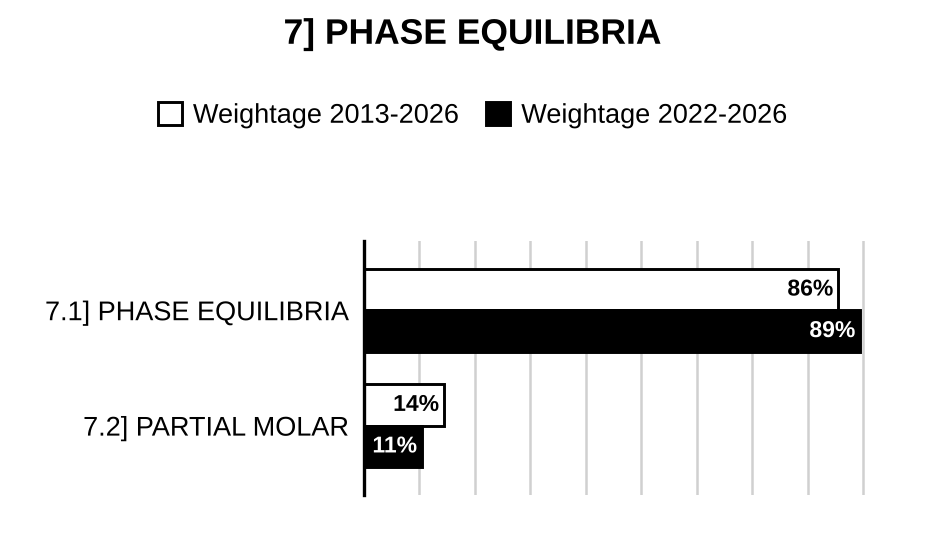
7.1] Phase equilibria
45 questions
decomposes when heated. (i) How many components and phases are present when the salt is heated in a closed container? (ii) Now, suppose additional is also present in the container. How many components and phases will be present? [2026/5m/1e]
Cadmium (m. pt. = 321 °C) and bismuth (m. pt. = 271 °C) do not form solid solutions or compounds with one another. Their eutectic point lies at 61 weight percent of bismuth and 146 °C. Sketch their phase diagram and label each region to show what phases are present. Explain the cooling curves of this eutectic mixture. [2026/10m/3a(ii)]
How does acetone-dry ice freezing mixture work? [2026/5m/3a(iii)]
You are given the following data for butane: Normal melting point = –138°C; Normal boiling point = 0°C; Critical temperature = 152°C; Critical pressure = 38 atm. Assume that the triple point is slightly lower in temperature than the melting point and that the vapour pressure at the triple point is torr. (i) Sketch a phase diagram for butane. (ii) Butane at 1 atm and 140°C is compressed to 40 atm. Are two phases present at any time during this process? (iii) Butane at 1 atm and 200°C is compressed to 40 atm. Are two phases present at any time during this process? [2025/10m/3c]
A new drug has been synthesized and its phase diagram is explored. It is found that near its triple point, vapour pressure over the liquid () and over the solid () are given by: Calculate the triple point temperature and pressure. Is the new drug solid, gas or liquid at 1 bar, 298 K? What is ? Explain. [2024/15m/4a]
Answer the following questions based on the phase diagram given below:
[Figure: One-component phase diagram, pressure (vertical axis, labelled “Pressure, P”) versus temperature (horizontal axis, labelled “Temperature, T”). A curve rises from the origin to point ; from a nearly straight line rises steeply towards the upper left (negative slope) and passes through point ; from another curve rises gently to the right through point and ends at point . A horizontal dashed line at “1 atm” runs from the pressure axis through to . Point lies vertically below (at a pressure below ) and point vertically above ; point lies to the right of at the same pressure and point to the right of at the same pressure, and being above the level of and , to the right of . Dashed arrows: (vertically upward); (rightward), (upward), (leftward)]
(i) How many components does this phase diagram represent? (ii) Identify the points to with corresponding degrees of freedom. (iii) Explain the changes expected in the paths and . [2023/20m/3b]
Construct a phase-diagram for a one component system (water) and explain all the three curves. Also describe the significance of critical pressure, critical temperature and triple point. [2022/10m/3d]
The vapour pressure of water at 363.2 K is 529 torr. Use the Clausius-Clapeyron equation to determine the average value of molar heat of vaporization, , of water between 363.2 K and 373.2 K. []. [2022/10m/4b]
The vapour pressure of water at 95 °C is found to be 634 mm. What would be the vapour pressure at a temperature of 100 °C? The heat of vapourization in this range of temperature may be taken as . []. [2021/10m/1d]
Draw and explain the graph of enthalpy of vapourization from the triple point () to the critical point (). [2021/10m/3c(i)]
Explain the phase diagram of phenol-water system by highlighting the importance of tie lines. [2021/20m/4c]
Phenol and water are partially miscible liquids. By mixing these two liquids, we get two phases in equilibrium. Find the number of degrees of freedom of the system and mention them with the help of its phase diagram. [2020/10m/1d]
Solid sulphur on heating in an open container melts, but solid iodine sublimes. Explain why. [2020/10m/6e]
Predict the maximum number of phases that can coexist for (i) 3 component system at constant P & T (ii) 2 component system at constant T (iii) one component system at constant T & P. [2019/15m/7a]
Explain why fusion curve of ice has negative slope whereas sublimation curve has positive slope in the phase diagram. [2018/5m/4d(i)]
Label and compare the phase diagrams given above:
[Figure: Three unlabelled phase diagrams, each in its own box (no axes labelled): (1) an inverted-U (dome-shaped) curve open at the bottom; (2) a U-shaped (bowl-shaped) curve open at the top; (3) a closed loop (ring-shaped) curve] [2018/5m/4d(ii)]
Four-phase sulphur system (in equilibrium) is impossible. Explain. [2017/5m/1d(i)]
In open container, on heating, solid sulphur melts, but solid iodine sublimes. Explain. [2017/5m/1d(ii)]
Starting with the expression for the system consisting of two phases of a single substance in chemical equilibrium, derive the integrated form of the Clausius-Clapeyron equation. [2016/15m/2b]
Benzene and toluene form a nearly ideal solution. At 80 °C, the vapour pressure of pure benzene (MW = 78.1) is 753 torr and that of pure toluene (MW = 92.1) is 290 torr. The following questions refer to a solution containing equal masses of benzene and toluene: (i) Calculate the partial pressure of each substance in the vapour that would be in equilibrium with the above solution at 80 °C. (ii) At what atmospheric pressure will the solution boil at 80 °C? (iii) Suppose that some of the vapour from the solution is collected and condensed. What will be the composition of the resulting liquid? [2015/15m/3c]
The phase diagram for a pure substance is shown below. Use the diagram to answer the following questions: (i) What does the point represent? What characteristics are specific to the system only at point ? (ii) What does each point on the curve between and represent? (iii) Describe the changes that the system undergoes as the temperature slowly increases from to to at 1.0 atm. (iv) In a solid-liquid mixture of the substance will the solid float or sink? Explain.
[Figure: Phase diagram: vertical axis P (atm) with the value 1.0 marked; horizontal axis T. A curve rises from lower left to the point V (above 1.0 atm); the point Y lies on this lower curve at 1.0 atm. From V one curve rises almost vertically, leaning slightly to the right (positive slope); another curve rises from V to the right through the point W. Point X lies at 1.0 atm to the left of (above) the lower curve; point Z lies at about 1.0 atm to the right of (below) the curves.] [2015/20m/4c]
Calculate the number of components, and number of phases, and evaluate the number of degrees of freedom for the following equilibria: (i) An iceberg floating in a lake, considering the lake, iceberg and atmosphere as one system. (ii) (iii) Pure partly frozen acetic acid (iv) system (v) system. [2014/20m/4b]
Calculate the number of phases, components and degrees of freedom in the following systems: (i) (ii) (iii) (iv) (v) [2013/10m/1d]
What is an ideal solution? [2013/5m/4b(i)]
Below 18.5 °C triethylamine is miscible with water in any proportion. What is the temperature known as? What is the molecular mechanism for the existence of such a temperature? [2013/10m/5b]
What are the differences between the triple point and boiling point? Illustrate with the help of the phase diagram of water. [2013/10m/7c]
Explain why the eutectic point of a solution between solid A and solid B is invariant. [2013/10m/8c]
The heat of vaporization of ether is at its boiling point 34.5 °C. Calculate the rate of change of vapour pressure of ether with temperature at the boiling point. [2012/12m/1b]
For a pure substance, what is the maximum number of phases that may exist at constant pressure? Explain and illustrate. [2012/10m/4c(i)]
The nicotine-water system exhibits two critical solution temperatures. What is the effect of external pressure on the system? [2011/15m/1d]
(i) The vapour pressure, p, of a liquid varies with temperature, T, according to the Clausius – Clapeyron equation, where is the gas constant and is the standard enthalpy change of vaporization. Show by integration that this equation can be used to predict the vapour pressure, , at one temperature, , from a known vapour pressure, , at another temperature, . (ii) What assumption have you made about the temperature dependence of ? (iii) Use the above formula to predict the saturation vapour pressure at 298 K from its value at 373 K. Take . [2011/25m/4b]
Write phase rule equation and define the terms used therein. How many phases, components and degrees of freedom are in the following system: [2011/20m/6c]
What are meant by phase, component and degree of freedom? Define Gibbs phase rule. A saturated solution of sodium sulphate with excess salt is at equilibrium with its vapour in a close vessel. How many phases, components and degrees of freedom are there in the system? [2010/15m/1d]
Draw the phase diagram of a simple eutectic system. Give an example of such a system. [2010/20m/4a]
What is the effect of temperature on the vapour pressure of a liquid? Derive Clapeyron-Clausius equation for the equilibrium between liquid vapour Give the integrated form of this equation. [2010/15m/7c]
(i) The vapour pressures of water at 298 K and 308 K are 3167 Pa and 5599 Pa respectively. Calculate the enthalpy of vaporisation of water. (ii) Define excess free energy. What is its significance? [2009/20m/4b]
What is the maximum number of phases that can be in equilibrium at constant pressure and temperature in two- and three- component systems? [2008/10m/4c(i)]
The vapour pressure of ice water system at 0.0075 °C [?] is 4.58 mm [?] and at 0° C is 759.8 mm of Hg. Calculate the molar heat of fusion of ice. Given that the specific volumes of ice and water at 0° C are 1.0907 cc [?] and 1.0001 cc [?] respectively. Density of Hg at 0°C = 13.6 g per cc [?]. [2007/20m/4a]
Explain the terms: upper consolute temperature and lower consolute temperature, conjugate solution and tie-line as applied to the solubility of partially miscible liquids. [2007/20m/4b]
Mention the temperature and pressure at which water has a triple point where it can exist as solid ice, liquid and vapour. Apply phase rule to this triple point. [2005/20m/1c]
Derive Clausius-Clapeyron equation for the variation of vapour pressure with temperature. Calculate the equilibrium pressure for the conversion of graphite to diamond at 25°C assuming their densities to be 2.25 and 3.51 and . [2005/25m/4b]
Discuss upper and lower critical solution temperatures, with examples. Explain the thermodynamic interpretations of the upper critical solution temperature. [2004/20m/5c]
Derive Clausius-Clapeyron equation for the variation of vapour pressure with temperature. [2004/20m/5d]
The vapour pressure of water is 23.75 torr at 25°C and 760 torr at 100°C. What will be the heat of vaporisation? [2003/30m/2b]
Derive Clapeyron equation and show that it can be represented by the equation for liquid-vapour boundary assuming ideal gas behaviour and making certain approximations. [2001/30m/3b]

Preparing for Prelims too?
Our UPSC Prelims Topic-wise PYQ eBook covers every Prelims question with detailed explanations, so you can see exactly where UPSC asks from.
View the BookDownload Free Sample7.2] Partial molar and excess quantities
7 questions
Derive the expressions of chemical potential of a component in a mixture system in terms of extensive thermodynamic properties U, H, A and G. [2026/10m/3a(i)]
Define partial molar Gibbs free energy. What is its unit in SI system? Is it intensive property? Answer with justification. What factors influence its value? [2017/10m/3b]
Define “Partial molal property”. What is its physical significance? [2016/15m/3b]
Show that the entropy of mixing of two liquids to form an ideal solution of mole fractions and is where is the total amount of solution resulting from moles of liquid A and moles of liquid B. [2013/10m/4b(ii)]
What mole fractions give the maximum entropy of mixing? [2013/5m/4b(iii)]
What are partial molar properties? Show that the partial molar free energy is equal to . [2012/10m/4c(ii)]
(i) The vapour pressures of water at 298 K and 308 K are 3167 Pa and 5599 Pa respectively. Calculate the enthalpy of vaporisation of water. (ii) Define excess free energy. What is its significance? [2009/20m/4b]

Strengthen your GS papers
Our UPSC Mains Topic-wise & Year-wise PYQ eBook (2013–2026) maps every GS question to the syllabus, so you know what UPSC asks and how often.
View the BookDownload Free Sample« Previous: Thermodynamics | Next: Electrochemistry »
Back to: Chemistry Optional PYQs – Topic-wise
Last updated: 30 October 2026