
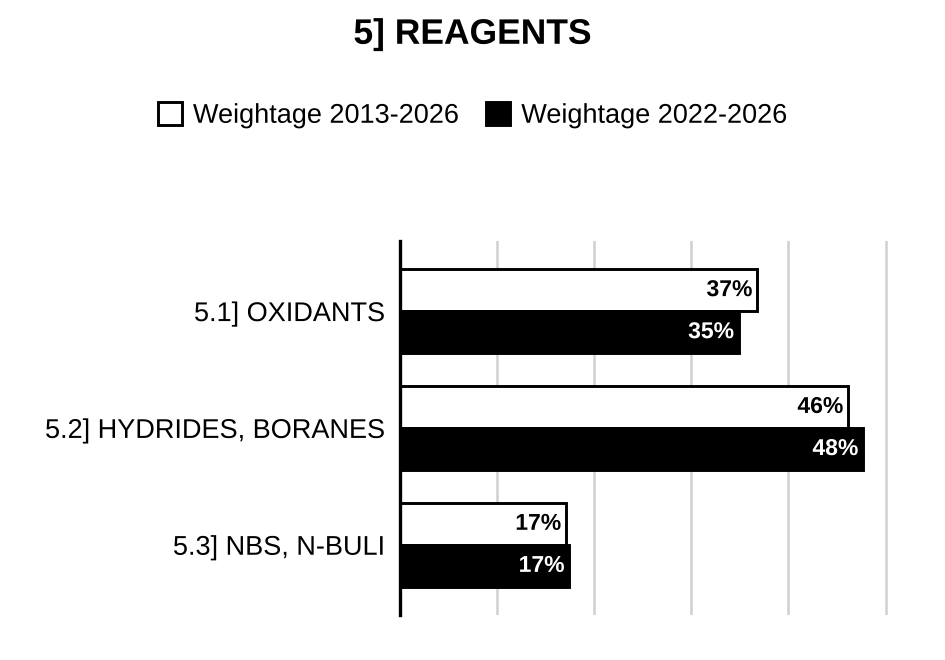
Here are all 126 Synthetic Uses of Reagents questions asked in UPSC Chemistry Optional Paper II from 2000 to 2026, arranged under the 3 topics of the official syllabus. Within each topic the latest questions come first.
Each question ends with a code such as [2024/15m/3b] – the year, the marks, the word limit (where UPSC set one) and the question number in the paper.
5.1] Oxidising reagents
54 questions
Write the structure of the major product indicating the stereochemistry and mechanism of the following reactions:
[Figure: Substrate: cis-4-tert-butyl-3-methylcyclopentene (cyclopentene; tBu on a wedge at C4 and CH3 on a wedge at C3, C3 adjacent to the C=C). Left: –m-CPBA→ ?; right: –(i) NBS; (ii) 30% NaOH→ ?] [2026/10m/5b]
Write the structure of the major product formed in the following reactions and provide the mechanism:
[Figure: (i) methyl 3-formylbenzoate (COOCH3 and CHO meta) –NaBH4, EtOH→ ?; (ii) 4-tert-butylcyclohexanone drawn as a chair with tBu equatorial and the ring H on C4 axial (down) –(i) LiAlH4; (ii) H2O→ ?; (iii) anisole (C6H5OMe) –Na, NH3 (l), ether, ethanol→ ?; (iv) RHC=CMe2 (H and R on one carbon, two Me on the other) –SeO2→ ?; (v) 2,5-dihydroxybenzonitrile (OH at C1 and C4 of the ring, CN ortho to the C1–OH) –Pb(OAc)4→ ?] [2026/20m/7c]
Describe the synthesis of ketone (A) when only isobutanol is available as the starting material:
[Figure: Ketone A: 2,5-dimethylhexan-3-one, (CH3)2CH–CH2–CO–CH(CH3)2] [2025/5m/3a(ii)]
Provide the structure of missing reagents and intermediates in the following synthesis:
[Figure: Scheme: 3-methylbutan-1-ol ((CH3)2CHCH2CH2OH) –M→ 3-methylbutanal ((CH3)2CHCH2CHO) –N→ O –P→ 1-amino-4-methylpentan-2-ol ((CH3)2CHCH2CH(OH)CH2NH2)] [2025/10m/3c(i)]
Describe the role of NMO during the dihydroxylation of an alkene using catalytic amount of in the presence of N-methylmorpholine N-oxide (NMO). [2025/5m/6a(ii)]
Predict the structure of P, Q and R in the following sequence of reactions:
[Figure: Scheme: –Na, NH3(l)→ P –1) OsO4; 2) NaHSO3, H2O→ Q –HIO4 (downward arrow)→ R] [2024/10m/5b]
Predict the structure of X, Y and Z in the following sequence of reactions:
[Figure: Scheme: tert-butyl 4-(2-oxoethyl)-3-methylidenepiperidine-1-carboxylate (N-Boc piperidine, Boc = tBuO–C(=O)–; CH2CHO on C4 and exocyclic =CH2 on C3) –LiAlH4, THF, 0 °C→ X –1) BH3/THF; 2) HO, H2O2, H2O→ Y –CrO3, H2SO4→ Z] [2024/15m/7b]
Write the structure of the compounds (A), (B), (C), (D) and (E).
[Figure: (1) 2-methylpentan-3-ol, –i. CS2, NaOH; ii. MeI→ (A) –SeO2→ (B); (2) a 6–7–6 fused tricyclic compound –mcpba, CH2Cl2, 0 °C→ (C): left ring is a cyclohexene whose C=C is the fusion bond to the central seven-membered ring and which carries a gem-dimethyl group on the ring carbon next to the lower fusion carbon; the central seven-membered ring contains, besides the two fusion bonds, a CH2 (between the upper left fusion carbon and the upper benzene fusion carbon) and a cis CH=CH (between the lower benzene fusion carbon and the lower left fusion carbon); the right ring is a benzene ring bearing OMe on the carbon next to the CH2-side fusion carbon, a second OMe on the next carbon, an isopropyl group on the next carbon, and H on the remaining carbon; (3) 2,2,3,3-tetramethylbutanedioic acid, –Pb(OAc)4, O2→ (D); (4) 3-methylcyclohexene with the CH3 on a wedged bond at the allylic sp3 carbon –CrO3-Pyridine→ (E)] [2023/10m/7c(i)]
From the reaction sequence below, answer the following questions: (I) Write structure of (A) and (B) (II) Write the oxidation state of Osmium in the intermediate (A) and its geometry.
[Figure: Reaction: cyclohexene –OsO4, Pyridine→ (A) –(B)→ cis-cyclohexane-1,2-diol (both OH on wedged bonds)] [2023/5m/7c(ii)]
Write the structure of (A) and (B) in the above reactions.
[Figure: Reaction: hexane-1,2,3,4,5,6-hexol drawn as a zigzag HOCH2–CH(OH)–CH(OH)–CH(OH)–CH(OH)–CH2OH with C-2 OH on a wedge (up), C-3 OH on a hash (down), C-4 OH on a hash (up), C-5 OH on a wedge (down) (D-mannitol) –cyclohexanone, BF3·Et2O, (MeO)3CH→ (A) –HIO4→ (B)] [2023/5m/7c(iii)]
Complete the following reaction by showing stepwise reaction mechanism for the formation of products:
[Figure: Reaction: (E)-but-2-ene (Me and H on each carbon, the two Me groups trans) + PhCOOOH –→] [2022/10m/4a(i)]
Write the structures of the products , and in the following reactions and indicate the mechanism for the formation of :
[Figure: Reaction: a tricyclic lactone – a γ-butyrolactone (C=O and ring O) cis-fused to a cyclopentane, which is fused at its other edge to a cyclopropane; the two cyclopropane ring-fusion H atoms on wedges (one up, one down as drawn); the exocyclic cyclopropane carbon bears H (wedge) and a side chain –CH=CH–CH2–CH2–CH2–Ph (double bond drawn cis) –(1) OsO4, Pyridine; (2) , H2O→ –→ ] [2022/10m/6c(i)]
Predict the product(s) and suggest mechanism in each of the above chemical transformations.
[Figure: I. acetophenone () –→ ?; II. benzoic acid () –Na, , → ?] [2021/10m/5c]
Write the products X/Y in the above chemical transformations.
[Figure: I. 1-phenyl-1,2-dihydronaphthalene (C-1 bearing Ph and H, C3=C4 double bond conjugated with the benzene ring) –MCPBA→ X; II. 1,4-dihydronaphthalene (C2=C3 double bond between two CH2 groups) –→ X –→ Y; III. 3-hydroxybutanoic acid () –→ X; IV. cyclohexene –-Pyridine, → X] [2021/15m/8a(i)]
Identify the compounds A, B and C in the following conversions: (i) cyclohexene + NBS [A] [B] [C] (ii) [C]. [2020/20m/6c]
Identify X and Y in the following reactions and outline the mechanism for the formation of X in both the reactions:
[Figure: (i) fused bicyclic substrate drawn as two six-membered rings: right ring = cyclohexane carrying a CH3 on the carbon next to the left-ring fusion carbon; left ring (as drawn) = C(SiMe3)=CH–CH2–CH(ring-fusion)–C(ring-fusion)=O–(back to C(SiMe3)), i.e. the ring O is drawn bonded to the -bearing vinylic carbon and double-bonded (=) to the ring-fusion carbon that is adjacent to the CH3-bearing carbon –mCPBA→ [X] –→ [Y]; (ii) 2-ethyl-3-methylcyclopentanone tosylhydrazone (C=N–NHTs; Et on C2, Me on C3) –1) n-BuLi, 2 equiv., THF; 2) → [X]] [2020/15m/8b]
Identify () and () in the following: (i) () cyclohexene () (ii) methylenecyclobutane () () + HCHO (iii) () [2019/15m/6b]
Write the products () and () of the following reactions: (i) (ii) (iii) (iv)
[Figure: (i) (drawn as CH–COOH ‖ CH–COOH, no geometry shown) –, → (); (ii) o-phenylenediamine (benzene-1,2-diamine) –→ (); (iii) cyclopentene –, Aq. → (); (iv) 3-methyl-3-phenylcyclopropene –(1) ; (2) → () –→ ()]
Comment on the stereochemistry of product () in each case. [2019/20m/7c]
When trans-4-tert-butylcyclohex-2-enol is reacted separately with mCPBA and V(acac)/tert-butylhydroperoxide, in the second reaction only one product is formed, whereas in the first case a mixture of two isomeric products is obtained. Write the structure of the product in each case with proper stereochemical outcome and justification. [2018/15m/6a]
Write the structures of the products expected from hydroxylation of maleic acid and fumaric acid using , with the stereochemistry. What is the role of pyridine in the above reaction? [2018/10m/7b]
Predict the final product obtained after the following sequence of reactions and also suggest the corresponding plausible mechanistic pathway.
[Figure: Reaction: (E)-2-ethylhept-5-enenitrile (Me–CH=CH–CH2–CH2–CH(CN)–CH2–Me, trans double bond) –(i) mCPBA; (ii) LiN(iPr)2, −78°C, THF; (iii) H3O+→ ?] [2017/10m/4a]
Write the reagent(s) for the following conversions and write the mechanism for reaction (i).
(i)
[Figure: 2-methylhept-2-ene (Me2C=CH–CH2CH2CH2CH3) → (E)-2-methylhept-2-en-1-ol (HOCH2–C(Me)=CH–CH2CH2CH2CH3, the CH2OH group trans to the butyl chain); reagent to be supplied] [2017/6m/4c(i)]
(ii)
[Figure: 1-methylcyclohexene → cis-1-methylcyclohexane-1,2-diol (labelled “cis – diol”) → 2-hydroxy-2-methylcyclohexan-1-one; reagents to be supplied for both steps] [2017/4m/4c(ii)]
Identify the major product () formed in the following reactions.
[Figure: (i) 1,2-bis(benzyloxy)hept-3-ene with the double bond drawn cis: C6H5–CH2–O–CH2–CH(O–CH2–C6H5)–CH=CH–CH2–CH2–CH3, the OCH2C6H5 at C2 on a bold wedge, cis C3=C4 double bond –OsO4, pyridine (above arrow), THF (below arrow)→ (Z); (ii) ethyl acetoacetate (CH3–CO–CH2–CO–OC2H5) with two routes: LiAlH4, C2H5–O–C2H5 → (Z); and (1) HO–CH2CH2CH2–OH (propane-1,3-diol), H+; (2) LiAlH4; (3) H3O+ → (Z); (iii) a 4-methylcyclohex-3-en-1-yl ring attached to C(=CH2)–CH2–CH2–CH=C(CH3)–CH2OH (the CH2 next to the =CH drawn with both H atoms shown; the CH2OH cis to the chain on the trisubstituted double bond) –Na, NH3, C2H5OH→ (Z)] [2017/15m/7b]
Identify the major product and discuss its stereochemistry:
[Figure: Reaction: norbornene (bicyclo[2.2.1]hept-2-ene) –OsO4 (above arrow), NaHSO3 (below arrow)→ (X)] [2016/10m/1b]
Discuss the stereoselectivity of products in the reaction of MCPBA with cis- and trans-butene. [2016/10m/3b]
Glucose on periodic acid oxidation gives 5 molecules of formic acid, whereas fructose gives only 3 molecules of formic acid. Explain with reactions. [2016/10m/4c]
Identify the major product formed in the following reactions:
[Figure: (i) 2-acetylnaphthalene (naphthalene with –CO–CH3 at C2) –SeO2→ (X); (ii) cyclopentene –1) NBS; 2) hν/heat→ (X); (iii) trans-decalin-4a,8a-diol (decalin with OH on both ring-fusion carbons, one on a bold wedge and one on a hashed bond) –Pb(OAc)4→ (X)] [2016/15m/8d]
Give the mechanisms involved in the epoxidation of an alkene and Baeyer-Villiger oxidation of a ketone using MCPBA. [2015/10m/7a]
Complete the following reactions and suggest a suitable reaction mechanism for each:
[Figure: (i) 1-(hydroxymethyl)cyclopentan-1-ol (cyclopentane C1 bearing OH and CH2OH) –→ ?; (ii) 3-nitrobenzaldehyde (O2N and CHO meta on a benzene ring) –, methanol→ ?; (iii) methyl phenyl sulfoxide () –→ ?; (iv) cyclohexanone –→ ?] [2015/20m/7d]
Suggest appropriate reagents/conditions, with justification, for the desired chemical transformations shown below:
[Figure: 1-methylcyclohexene at the centre with four arrows, each labelled “?”, to: (1, left) cis-1-methylcyclohexane-1,2-diol (C-2 bears H and a hashed OH; C-1 bears CH3 and a hashed OH); (2, right) trans-2-methylcyclohexan-1-ol (C-1 bears H and a hashed OH; C-2 bears a wedged CH3 and a hashed H); (3, lower left) trans-1-methylcyclohexane-1,2-diol (C-2 bears a wedged OH and a hashed H; C-1 bears CH3 and a hashed OH); (4, lower right) 1-methylcyclohexan-1-ol (C-1 bears a wedged CH3 and a hashed OH)] [2014/15m/6c]
Suggest suitable reagents and provide mechanism for the following chemical conversions:
[Figure: (i) octahydro-2H-chromene-4a,8a-diol (two fused six-membered rings, one containing a ring O next to the lower ring-fusion carbon; an OH on each ring-fusion carbon) –?→ the same bicyclic outline (the bond between the two former ring-fusion carbons is still drawn) with a C=O in place of each OH (the lower one next to the ring O, i.e. a lactone C=O), intended as the ten-membered keto-lactone from cleavage of the fusion bond; (ii) 7-(methoxymethyl)bicyclo[2.2.1]heptan-2-one (H3COH2C– on the one-carbon bridge) –?→ the corresponding bicyclic lactone with O inserted between the C=O and the bridgehead (2-oxabicyclo[3.2.1]octan-3-one carrying H3COH2C– on the one-carbon bridge); (iii) bicyclo[2.2.1]heptan-2-one (norcamphor) –?→ bicyclo[2.2.1]heptane-2,3-dione; (iv) norbornene –?→ ? → cis-exo-bicyclo[2.2.1]heptane-2,3-diol (both OH exo, drawn up; both H endo, drawn down)] [2014/20m/7c]
Write the products (X) and (Y) in the following reactions:
[Figure: Reaction scheme: CH≡CH branching into two arrows: upper arrow labelled H2CrO4 → (X); lower arrow labelled alk. KMnO4 → (Y)] [2013/10m/1e]
What is the major product of each of the following reactions? (i) and (ii) Give the mechanisms of the reactions.
[Figure: Printed before “(i) …”: cyclohexene drawn with the two vinylic H atoms shown on the C=C carbons –(i) and (ii)→ (no product shown)] [2013/10m/5b]
Give structures of compounds (A), (B), (C) and (D) in the following reactions: (i) n-Octaldehyde + Ethyl bromo acetate + Zn and then (ii) in glacial acetic acid (iii) , then benzyl chloride (iv) , heat, then warm [2012/20m/2b]
What are the reagents (A, B and C) used for the following conversion: (i) (ii) (iii) [structure] [structure].
[Figure: (i) drawn as R–C(R)(OH)–C(R)(OH)–R (a pinacol, each carbon bearing two R and one OH) –A→ R(R)C=O; (ii) acetophenone C6H5–C(=O)–CH3 –B, in acetic acid→ phenylglyoxal C6H5–C(=O)–C(=O)–H; (iii) decalin (two fused saturated six-membered rings) –C, Heat→ naphthalene] [2012/15m/7d]
How Malaprade oxidation is used to determine cis-glycolic units in sugars? Illustrate with one example showing mechanism. [2011/10m/5b]
Predict the structure of the products in the following reactions. Give the mechanism. (i) ? (ii) ? (iii) (iv)
[Figure: (i) substrate: partial structure: cyclopentanone ring whose α-carbon is a quaternary ring-fusion carbon carrying an angular methyl group, the next ring carbon a ring-fusion CH; the bonds to the rest of the fused ring system are shown as wavy lines (as in a steroid D-ring 17-ketone); (ii) substrate: 2-methylcyclohexanone] [2011/20m/7c]
Write the product formed in the oxidation of quinoline by . [2010/10m/6c]
Which among the following (A or B) is formed when Pent-2-ene is oxidised by and ? Explain its formation with the mechanism.
[Figure: two Fischer projections of pentane-2,3-diol with at top and at bottom. (A) upper carbon H left, OH right; lower carbon H left, OH right (both OH on the same side: erythro). (B) upper carbon H left, OH right; lower carbon HO left, H right (OH on opposite sides: threo)] [2010/10m/7c]
Identify the compound susceptible for oxidation and justify (i) (ii) [2010/10m/7d]
Write the reagents required for the following conversions.
[Figure: (i) indane-1,3-dione (benzene ring fused to a five-membered ring with C=O at C1 and C3, C2 a ) → five-membered ring with three C=O groups (C1, C2, C3) fused to a six-membered ring drawn without any double bonds or aromatic circle (as printed); (ii) p-xylene (1,4-dimethylbenzene) → terephthalaldehyde (benzene-1,4-dicarbaldehyde)] [2010/10m/7e]
[Figure: starting compound acetophenone (, drawn as benzene ring with )] [2009/16m/4b(iii)]
Write suitable reagents for converting cyclohexene to . [2009/10m/7e]
Write reagent(s) for the following conversion:
[Figure: cyclopentene → cyclopentane-1,2-diol (both OH drawn on plain bonds on adjacent carbons)] [2008/20m/5d(ii)]
Identify A-D in the following How adipic acid can be produced from phenol (only two steps)? [2008/10m/6c]
How is azelaic acid obtained from oleic acid? Azelaic acid Oleic acid = . [2008/10m/8b]
Explain the following transformations:
[Figure: (i) cyclohexene –→ cis-cyclohexane-1,2-diol (both OH on wedged bonds); (ii) indoline (2,3-dihydro-1H-indole, N–H) –→ indole (N–H); (iii) 2-methylbut-2-ene – and then → 3-methylbutan-2-ol (); (iv) cyclohexanone –NBS and then → cyclohex-2-en-1-one] [2007/20m/6c]
How will you carry out the following transformations in good yields? Indicate the reagents used, conditions employed & reasons thereof:
[Figure: (i) cyclohex-2-en-1-ol → cyclohexane-1,2,3-triol (C-1 OH plain, C-2 OH hashed, C-3 OH on a wedged/bold bond); (ii) → (aldol: OH on hashed bond, wedged; 4-hydroxy-3-methyl-4-phenylbutan-2-one); (iii) 1-chloro-3-phenylpropan-2-one () → phenyl cyclopropanone [as drawn: benzene ring attached to a cyclopropanone ring carbon]; (iv) phenyl 3-methylbut-2-enyl ether () → 2-(1,1-dimethylprop-2-enyl)phenol (OH at C-1, at C-2)] [2006/48m/4a]
Indicate the steps by means of which you will effect the following conversions in good yields:
[Figure: Conversions: (i) 2-acetylfuran (furan-2-yl–) → furan-2-yl–; (ii) acetophenone () → phenol (); (iii) cyclohexanone → 4,4a,5,6,7,8-hexahydronaphthalen-2(3H)-one (bicyclic octalone: C=O at C-2 conjugated with the C-1=C-8a ring-fusion double bond); (iv) cis-alkene (R and R on the same side, H and H on the same side, RHC=CHR) → trans-alkene (R and R on opposite sides)]
The only reagents available are m-chloroperbenzonic acid and triphenyl phosphine. [2005/20m/2c]
Predict the product(s) in the reactions given below with mechanism wherever possible.
[Figure: (i) tetralin (1,2,3,4-tetrahydronaphthalene) –, ACOH→ ; (ii) 3-methylthiophene –NBS, Pyridine / Peroxide→ ; (iii) cyclohex-2-en-1-ol – [?], Pyridine / THF [?] (printed “CHF”)→ ; (iv) methyl 3-oxohex-4-enoate, , with two arrows: –, → and –, ether→] [2003/20m/5b]
Suggest suitable reagents for the synthesis of the following.
[Figure: (i) cyclohexane-1,2-dione from cyclohexanone; (ii) 3-(but-3-enyl)cyclohexan-1-ol (cyclohexanol with at C-3) from 3-(2-bromoethyl)cyclohexan-1-ol (cyclohexanol with at C-3); (iii) 1-methylcyclopentan-1-ol from 1-methylcyclopentene; (iv) 2,4-dimethylpyrrole ( on C-2 and C-4 of 1H-pyrrole) from ] [2003/20m/7b]
In cyclohexane series it is observed that with chromic acid it is the axial hydroxyl group that is oxidised more rapidly than equatorial hydroxyl group by a factor of about 3, but the saponification of the esters of related compounds however shows a reverse order of reactivities i.e., axial ester group hydrolyses very slowly than the equatorial ester group. Explain. [2002/13m/3b(i)]
Which types of compounds are oxidised by the periodate? Give an example in each case. Mention the product formed by the periodate oxidation of the following compound.
[Figure: Two fused six-membered rings (decalin-type) with OH on each ring-fusion carbon (one drawn up, one drawn down); the left ring has a ring O attached to the lower ring-fusion carbon (octahydro-2H-chromene-4a,8a-diol)] [2000/15m/7a]
How is used in organic chemistry? Give two examples and discuss their mechanisms. [2000/15m/7c]

Preparing for Prelims too?
Our UPSC Prelims Topic-wise PYQ eBook covers every Prelims question with detailed explanations, so you can see exactly where UPSC asks from.
View the BookDownload Free Sample5.2] Hydride, borane and dissolving-metal reagents
51 questions
Write the structures of the products formed in the following reactions:
[Figure: (i) cyclohex-2-en-1-one –NaBH4/CeCl3, MeOH→ ?; (ii) cyclohex-2-en-1-one –Na/NH3 (l)→ ?; (iii) EtO2C–CH2–CH(Me)–CH2–CO2H –(i) B2H6; (ii) H→ ?; (iv) EtO2C–CH2–CH(Me)–CH2–CO2H –(i) LiAlH4; (ii) H→ ?; (v) methyl 1-benzyl-5-oxopyrrolidine-3-carboxylate (N-CH2Ph lactam, CO2Me on C4 of the ring, β to N) –B2H6, THF→ ?] [2026/10m/6a]
Write the structure of the major product formed in the following reactions and provide the mechanism:
[Figure: (i) methyl 3-formylbenzoate (COOCH3 and CHO meta) –NaBH4, EtOH→ ?; (ii) 4-tert-butylcyclohexanone drawn as a chair with tBu equatorial and the ring H on C4 axial (down) –(i) LiAlH4; (ii) H2O→ ?; (iii) anisole (C6H5OMe) –Na, NH3 (l), ether, ethanol→ ?; (iv) RHC=CMe2 (H and R on one carbon, two Me on the other) –SeO2→ ?; (v) 2,5-dihydroxybenzonitrile (OH at C1 and C4 of the ring, CN ortho to the C1–OH) –Pb(OAc)4→ ?] [2026/20m/7c]
Identify the missing reagent and intermediates in the following chemical conversion:
[Figure: Reaction scheme: cyclohexyl methyl ketone (1-cyclohexylethan-1-one, cyclohexyl–CO–CH3) –PCl5, 0 °C (–POCl3)→ M –1) 3 equiv. NaNH2, Heat; 2) HA→ N –NaNH2, C2H5Br→ O –P (reagent to be identified, vertical arrow)→ (E)-1-cyclohexylbut-1-ene (cyclohexyl–CH=CH–CH2CH3, drawn with the two vinylic H trans to each other)] [2025/10m/1b]
Provide the structure of missing reagents and intermediates in the following synthesis:
[Figure: Scheme: 3-methylbutan-1-ol ((CH3)2CHCH2CH2OH) –M→ 3-methylbutanal ((CH3)2CHCH2CHO) –N→ O –P→ 1-amino-4-methylpentan-2-ol ((CH3)2CHCH2CH(OH)CH2NH2)] [2025/10m/3c(i)]
Elucidate the structure of the product and the intermediate (if any) in the following reactions:
[Figure: (A) 3-methylpentanedioic acid monoethyl ester, EtO2C–CH2–C(H)(Me)–CH2–CO2H, with H on a hashed bond and Me on a wedge at the central carbon –1) BH3; 2) H→ ?]
[Figure: (B) (E)-3-cyclohexylprop-2-enal (cyclohexyl–CH=CH–CHO) –NaBH4→ ?] [2025/10m/6a(i)]
Predict the structure of P, Q and R in the following sequence of reactions:
[Figure: Scheme: –Na, NH3(l)→ P –1) OsO4; 2) NaHSO3, H2O→ Q –HIO4 (downward arrow)→ R] [2024/10m/5b]
Identify A, B, C and D in the following reaction sequence: Write the mechanism of the first step of the above reaction sequence.
[Figure: Scheme: A –NaBH4, MeOH→ cyclohexanol –H→ B –C→ 3-bromocyclohexene –mCPBA (downward arrow)→ D] [2024/20m/6c]
Predict the structure of X, Y and Z in the following sequence of reactions:
[Figure: Scheme: tert-butyl 4-(2-oxoethyl)-3-methylidenepiperidine-1-carboxylate (N-Boc piperidine, Boc = tBuO–C(=O)–; CH2CHO on C4 and exocyclic =CH2 on C3) –LiAlH4, THF, 0 °C→ X –1) BH3/THF; 2) HO, H2O2, H2O→ Y –CrO3, H2SO4→ Z] [2024/15m/7b]
Complete the above reactions and give suitable mechanism.
[Figure: Reaction: (2-ethyl-1,1-diphenylbut-1-ene) –→ (A) –, → (B)] [2023/10m/4a(iii)]
Reduction of camphor with leads to 90% of the isomer in which the OH group is cis to the bridge. Give a suitable explanation of this observation.
[Figure: Reaction: Camphor (1,7,7-trimethylbicyclo[2.2.1]heptan-2-one: bridgehead C-1 bearing H3C, C-7 bridge bearing two CH3 (H3C, CH3), C=O at C-2) –→ the corresponding bicyclic alcohol with C-2 bearing OH (drawn pointing right) and H (drawn pointing down)] [2023/10m/5d]
Write the structure of product(s) in the above reactions:
[Figure: (1) methyl 4-oxocyclohexane-1-carboxylate (O= on ring C-4, C(=O)OCH3 on C-1) –(i) NaBH4, H2O, ; (ii) H2O, → A; (2) estrone (3-hydroxyestra-1,3,5(10)-trien-17-one: aromatic A ring with HO at C-3, C-13 Me on a wedge, C-17 ketone) –(i) HC≡CH, BuLi; (ii) , H2O→ B; (3) anisole (methoxybenzene, OMe) –Na, NH3(l); Et2O, EtOH→ C] [2023/10m/6b(i)]
Complete the following reactions and give suitable mechanisms for the formation of products: (i) (ii) [2022/15m/7b]
Predict the product(s) and suggest mechanism in each of the above chemical transformations.
[Figure: I. acetophenone () –→ ?; II. benzoic acid () –Na, , → ?] [2021/10m/5c]
Discuss the solvent compatibility for and reagents and the factors responsible for differential reactivity. Also suggest preferred reagent between the two for the above transformations.
[Figure: (1) 4-acetylbenzamide (, para) –?→ 4-(1-hydroxyethyl)benzamide (); (2) –?→ (E)-pent-3-en-2-ol, with the two alkene H atoms trans] [2021/15m/7b]
Write the products X/Y in the above chemical transformations.
[Figure: I. 1-phenyl-1,2-dihydronaphthalene (C-1 bearing Ph and H, C3=C4 double bond conjugated with the benzene ring) –MCPBA→ X; II. 1,4-dihydronaphthalene (C2=C3 double bond between two CH2 groups) –→ X –→ Y; III. 3-hydroxybutanoic acid () –→ X; IV. cyclohexene –-Pyridine, → X] [2021/15m/8a(i)]
Predict the product in the reaction of 2-methyl-1-butene with diborane. Account for the regioselectivity observed in the reaction. [2021/5m/8a(ii)]
Identify the compounds A and B in the following reaction sequence:
[Figure: Reaction scheme: methyl (4-oxocyclohexyl)acetate (cyclohexanone ring with at C4) –, MeOH→ [A] –1) ; 2) → [B]] [2020/10m/5b]
Name the reagent for the following regioselective conversion. Propose the mechanism:
[Figure: Conversion: 3-methylpentanedioic acid monoethyl ester (, CH3 on a wedged bond) –?→ 4-methyltetrahydro-2H-pyran-2-one (δ-valerolactone ring with CH3 on a wedged bond at C4)] [2019/15m/7b]
By taking 1-methylcyclopentene as an example, explain hydroboration-oxidation reaction. Justify that it is stereoselective and regioselective. [2018/10m/2a]
Outline the mechanism for the following reaction: In what way is different from in ‘chemoselectivity’?
[Figure: Reaction: carboxylic acid R–C(=O)–OH –i) ; ii) → ] [2018/15m/2c]
Predict the product(s) with mechanism for the following:
[Figure: (i) chiral 1-phenylethyl chlorosulfite: stereocentre bearing Ph (up), CH3 (wedged, down), H (hashed) and –1,4-dioxane, Δ→; (ii) 4a-(tosyloxymethyl)-4,4a,5,6,7,8-hexahydronaphthalen-2(3H)-one (octalone with angular , enone C=O at C2 conjugated with C1=C8a) –1) Li/liq. , Tetrahydrofuran; 2) →; (iii) naphthalene –Na, 6-bromohex-1-ene (, drawn below the arrow)→] [2018/15m/3d]
What is Birch reduction? Suggest its mechanism by taking a suitable example. Why does Birch reduction on benzene derivatives with an electron-donating group happen on ortho and meta positions? [2018/15m/7c]
Write specific reagents necessary for each of the following transformations. Out of ‘stereospecific’ and ‘stereoselective’, which one suits for each reaction?
[Figure: But-2-yne (Me–C≡C–Me) with two branches: (i) → cis-but-2-ene ((Z)-Me–CH=CH–Me); (ii) → trans-but-2-ene ((E)-Me–CH=CH–Me)] [2017/10m/4e]
Identify the major product () formed in the following reactions.
[Figure: (i) 1,2-bis(benzyloxy)hept-3-ene with the double bond drawn cis: C6H5–CH2–O–CH2–CH(O–CH2–C6H5)–CH=CH–CH2–CH2–CH3, the OCH2C6H5 at C2 on a bold wedge, cis C3=C4 double bond –OsO4, pyridine (above arrow), THF (below arrow)→ (Z); (ii) ethyl acetoacetate (CH3–CO–CH2–CO–OC2H5) with two routes: LiAlH4, C2H5–O–C2H5 → (Z); and (1) HO–CH2CH2CH2–OH (propane-1,3-diol), H+; (2) LiAlH4; (3) H3O+ → (Z); (iii) a 4-methylcyclohex-3-en-1-yl ring attached to C(=CH2)–CH2–CH2–CH=C(CH3)–CH2OH (the CH2 next to the =CH drawn with both H atoms shown; the CH2OH cis to the chain on the trisubstituted double bond) –Na, NH3, C2H5OH→ (Z)] [2017/15m/7b]
Identify the product in the following reaction and provide the mechanism for the formation of the product.
[Figure: Reaction: α-cyperone-type bicyclic enone: 4,4a,5,6,7,8-hexahydronaphthalen-2(3H)-one with CH3 at C1 (C1=C8a double bond conjugated with the C2=O), angular CH3 at C4a on a bold wedge, and an isopropenyl group (C(CH3)=CH2) at C7 on a bold wedge –(i) Na, NH3, ether; (ii) NH4Cl→ ?] [2017/10m/8c]
Give the structures of and :
[Figure: 4-nitrobenzaldehyde (benzene ring with NO2 at the top and CHO para at the bottom) with two branches: LiAlH4 → (X); NaBH4 → (Y)] [2016/10m/1e]
Discuss the stereospecificity of reduction of to alkene with sodium and liquid . [2016/10m/5d]
Predict the major product and explain the origin of the regioselectivity and stereoselectivity observed in the following hydroboration-oxidation reaction:
[Figure: Reaction: 1-methylcyclopentene –(i) ; (ii) , → ?] [2015/10m/5b]
Give the mechanism for reduction of a ketone by and predict the products in the following reactions:
[Figure: (i) 1,2-epoxydecane ( with an O bridging the two carbons) –→ ?; (ii) hexa-2,4-dienoic acid (sorbic acid, , drawn as a zigzag) –→ ?; (iii) (p-tolylacetonitrile) –→ ?] [2015/15m/6d]
Complete the following reactions and suggest a suitable reaction mechanism for each:
[Figure: (i) 1-(hydroxymethyl)cyclopentan-1-ol (cyclopentane C1 bearing OH and CH2OH) –→ ?; (ii) 3-nitrobenzaldehyde (O2N and CHO meta on a benzene ring) –, methanol→ ?; (iii) methyl phenyl sulfoxide () –→ ?; (iv) cyclohexanone –→ ?] [2015/20m/7d]
Propose the mechanism for the following chemical conversion:
[Figure: Reaction: benzoic acid (C6H5–COOH) –Na, liq. NH3→ cyclohexa-2,5-diene-1-carboxylic acid (ring carbon bearing H and COOH, the para CH2 drawn with two H, two C=C between them)] [2015/10m/8c]
Explain why hydroboration-oxidation protocol gives anti-Markonikoff’s alcohol from unsymmetrical alkene. Complete the following reaction giving predominant stereoisomer and regioisomer.
[Figure: Reaction scheme: 2-methylbicyclo[2.2.1]hept-2-ene (norbornene with CH3 on one alkene carbon) –(i) B2H6; (ii) H2O2, NaOH→ ?] [2014/10m/5c]
Suggest appropriate reagents/conditions, with justification, for the desired chemical transformations shown below:
[Figure: 1-methylcyclohexene at the centre with four arrows, each labelled “?”, to: (1, left) cis-1-methylcyclohexane-1,2-diol (C-2 bears H and a hashed OH; C-1 bears CH3 and a hashed OH); (2, right) trans-2-methylcyclohexan-1-ol (C-1 bears H and a hashed OH; C-2 bears a wedged CH3 and a hashed H); (3, lower left) trans-1-methylcyclohexane-1,2-diol (C-2 bears a wedged OH and a hashed H; C-1 bears CH3 and a hashed OH); (4, lower right) 1-methylcyclohexan-1-ol (C-1 bears a wedged CH3 and a hashed OH)] [2014/15m/6c]
Provide mechanism for the following conversion:
[Figure: 4-tert-butylcyclohexanone drawn as a chair with the t-butyl group equatorial and the ring H on that carbon axial –Na/liq. NH3→ ? followed by the product drawn as a chair: trans-4-tert-butylcyclohexanol with t-butyl equatorial, OH equatorial and the H on the carbinol carbon axial (drawn up)] [2014/5m/8d]
Describe using appropriate reagents and conditions a method to achieve the following transformations:
[Figure: Multistep conversion (three stacked arrows): methyl 6-oxobicyclo[2.2.1]heptane-2-carboxylate (norbornane skeleton with a ring C=O on one two-carbon bridge and a –C(=O)–OCH3 group on the other two-carbon bridge, both on the carbons attached to the same bridgehead) ⇒ 6-(hydroxymethyl)bicyclo[2.2.1]heptan-2-one (same skeleton, ketone retained, the ester replaced by CH2OH)] [2013/20m/3b]
Identify [X] and [Y] in the following:
[Figure: 2-Pentyne with two branching arrows: upper arrow labelled Na/NH3 → [X]; lower arrow labelled Lindlar’s Catalyst → [Y]] [2013/10m/5c]
Identify (X) and (Y) in the following:
[Figure: Reaction scheme: cyclohexene –O3→ (X) –NaBH4→ (Y)] [2013/10m/8b]
Write down the products of the following reactions with chemical equation: (i) (ii) (iii) [2012/15m/8a]
Predict the structure of the products in the following reactions. Give the mechanism. (i) ? (ii) ? (iii) (iv)
[Figure: (i) substrate: partial structure: cyclopentanone ring whose α-carbon is a quaternary ring-fusion carbon carrying an angular methyl group, the next ring carbon a ring-fusion CH; the bonds to the rest of the fused ring system are shown as wavy lines (as in a steroid D-ring 17-ketone); (ii) substrate: 2-methylcyclohexanone] [2011/20m/7c]
Benzoic acid on reduction with Na in liq gives 1,2-dihydroproduct, whereas, anisole gives 2,5-dihydroproduct. Explain. [2010/10m/5b]
Identify A and B and discuss the selectivity of the reagents.
[Figure: methyl 4-oxocyclohexane-1-carboxylate (cyclohexanone with at C4) –(; )→ A; same compound –(; )→ B] [2010/20m/6d]
Which reagent can be used to convert to . [2009/6m/6b(ii)]
Why does follow anti-Markovnikovs addition to ? [2008/10m/7c(iii)]
(i) Write the structures of the product/s formed in the Birch reduction of anisole and benzaldehyde and explain their formation. (ii) Describe a method for the conversion of 1-methyl-cyclohexene to 2-methylcyclohexanone and explain the mechanism. [2007/20m/5b]
Explain the following transformations:
[Figure: (i) cyclohexene –→ cis-cyclohexane-1,2-diol (both OH on wedged bonds); (ii) indoline (2,3-dihydro-1H-indole, N–H) –→ indole (N–H); (iii) 2-methylbut-2-ene – and then → 3-methylbutan-2-ol (); (iv) cyclohexanone –NBS and then → cyclohex-2-en-1-one] [2007/20m/6c]
Identify the major product in each of the following reactions. Give mechanisms of the reactions involved and stereostructure, if any:
[Figure: (i) 3,5-dimethoxybenzoic acid ( at C-1, MeO at C-3 and C-5) –1) Na/, 2) , 3) → ?; (ii) 1,1′-bi(cyclobutyl)-1,1′-diol (two cyclobutane rings joined at carbons each bearing OH) –→ ?; (iii) cyclohexane bearing on adjacent carbons: HO (wedge, top), (HO–CH2 on a hashed/wedged bond) and OH (at the next carbon, plain bond down) –PhCHO, → ?; (iv) 2-methoxybuta-1,3-diene [?] (drawn as a diene with OMe on C-2) + –Δ→ ?] [2006/48m/3a]
Give steps and reagents involved in the conversion of compounds written on the left hand side of the arrow to compounds written on the right hand side of the arrow:
[Figure: (i) cyclohexanone → 4-cyclohexylpentan-2-one (); (ii) 2-methoxybenzoic acid (OMe and ortho) → 2-heptylcyclohexanone (C=O with on the adjacent ring carbon); (iii) cyclohex-2-en-1-one → cyclohexane-1,2,3-triol drawn as two stereoisomers: the first with all three OH on plain bonds, “and” the second with the C-2 OH on a hashed bond (OH at C-1 and C-3 plain); (iv) ethyl acetoacetate () → 3-methylcyclohex-2-en-1-one] [2005/20m/3b]
Predict the product(s) in the reactions given below with mechanism wherever possible.
[Figure: (i) tetralin (1,2,3,4-tetrahydronaphthalene) –, ACOH→ ; (ii) 3-methylthiophene –NBS, Pyridine / Peroxide→ ; (iii) cyclohex-2-en-1-ol – [?], Pyridine / THF [?] (printed “CHF”)→ ; (iv) methyl 3-oxohex-4-enoate, , with two arrows: –, → and –, ether→] [2003/20m/5b]
Identify the products of the following sequence of reactions and explain how these are formed:
[Figure: (i) cyclohexanone [ring size uncertain, ?] –(i) LiAlH4; (ii) H3O+→ A –(i) NaH, Ether; (ii) CS2; (iii) CH3I→ B –Heat→ C. (ii) α-pinene –BH3→ [(pinanyl)2BH] (diisopinocampheylborane) –cis-2-butene (CH3, CH3 on one side, H, H on the other)→ A –H2O2, OH−→ B. (iii) benzophenone (C6H5)2C=O + benzyl bromide (Br–CH2–C6H5) –(i) Ph3P; (ii) n-BuLi→ A –N-bromosuccinimide→ B. (iv) cyclohexanone –NaBH4→ A –H2SO4→ B –Pb(OAc)4→ C + D + E] [2002/30m/6a]
Give mechanism to account for the formation of the following product(s)
[Figure: (i) dimethyl hexanedioate drawn as a chain with two COOMe ends –2 Na, Ether→ 2-hydroxycyclohexanone (acyloin). (ii) 2-methylcyclohexanone drawn as a chair with Me axial at C2 and C1=O –→ A (Less stable) 25% [?] + B (More stable) 25% [?]; same ketone – ( = bulky group)→ A 100%] [2001/20m/5c]
Describe the reduction of acid chlorides with lithium aluminium hydride and give its mechanism. What happens when 3 equivalents of t-butyl alcohol and LAH are used in this reaction? [2000/15m/7b]
5.3] NBS and n-BuLi
21 questions
Write the major products formed in the following reactions:
[Figure: Reaction 1: indole (N–H) –(i) nBuLi; (ii) CO2; (iii) H→ ?; Reaction 2: indole –(i) nBuMgBr; (ii) CO2; (iii) H→ ?] [2026/5m/4c(iii)]
Write the structure of the major product indicating the stereochemistry and mechanism of the following reactions:
[Figure: Substrate: cis-4-tert-butyl-3-methylcyclopentene (cyclopentene; tBu on a wedge at C4 and CH3 on a wedge at C3, C3 adjacent to the C=C). Left: –m-CPBA→ ?; right: –(i) NBS; (ii) 30% NaOH→ ?] [2026/10m/5b]
Describe the synthesis of ketone (A) when only isobutanol is available as the starting material:
[Figure: Ketone A: 2,5-dimethylhexan-3-one, (CH3)2CH–CH2–CO–CH(CH3)2] [2025/5m/3a(ii)]
Deduce the structure of the starting material (A) and all the intermediates formed in each step that would lead to the formation of the following product through the defined reactions:
[Figure: Scheme: A –1) NaNH2, EtI; 2) Lindlar’s cat., H2; 3) NBS, ROOR, Δ; 4) NaOMe, MeOH→ (E)-2-methoxy-5,5-dimethylhex-3-ene (CH3–CH(OMe)–CH=CH–C(CH3)3, C=C drawn trans)] [2025/10m/5b]
Identify A, B, C and D in the following reaction sequence: Write the mechanism of the first step of the above reaction sequence.
[Figure: Scheme: A –NaBH4, MeOH→ cyclohexanol –H→ B –C→ 3-bromocyclohexene –mCPBA (downward arrow)→ D] [2024/20m/6c]
Write the structure of product(s) in the above reactions:
[Figure: (1) methyl 4-oxocyclohexane-1-carboxylate (O= on ring C-4, C(=O)OCH3 on C-1) –(i) NaBH4, H2O, ; (ii) H2O, → A; (2) estrone (3-hydroxyestra-1,3,5(10)-trien-17-one: aromatic A ring with HO at C-3, C-13 Me on a wedge, C-17 ketone) –(i) HC≡CH, BuLi; (ii) , H2O→ B; (3) anisole (methoxybenzene, OMe) –Na, NH3(l); Et2O, EtOH→ C] [2023/10m/6b(i)]
Predict and in the following reaction:
[Figure: Reaction: 1,2-dihydronaphthalene (benzene ring fused to a six-membered ring containing CH2–CH2 and one C=C conjugated with the benzene ring) –NBS, CCl4→ –NaOEt, EtOH/Δ→ ] [2022/5m/2b(ii)]
(i) By using appropriate reactants, reagents and conditions and using acetylene as starting material, how will you synthesize the following compound? (ii) Identify the products , , and in the following reactions:
[Figure: (i) 1-ethynylcyclopentan-1-ol (cyclopentane carbon bearing OH and C≡C–H); (ii) Scheme: toluene –hν, NBS, Dibenzoyl peroxide ()→ (arrow to the left); toluene –, , → –, NaOAc, Δ→ – excess→ ] [2022/10m/5c]
Although carbon and magnesium are both common elements in the human body, Grignard reactions do not occur in cells. Why is it so? [2020/10m/1d]
Identify the compounds A, B and C in the following conversions: (i) cyclohexene + NBS [A] [B] [C] (ii) [C]. [2020/20m/6c]
Identify X and Y in the following reactions and outline the mechanism for the formation of X in both the reactions:
[Figure: (i) fused bicyclic substrate drawn as two six-membered rings: right ring = cyclohexane carrying a CH3 on the carbon next to the left-ring fusion carbon; left ring (as drawn) = C(SiMe3)=CH–CH2–CH(ring-fusion)–C(ring-fusion)=O–(back to C(SiMe3)), i.e. the ring O is drawn bonded to the -bearing vinylic carbon and double-bonded (=) to the ring-fusion carbon that is adjacent to the CH3-bearing carbon –mCPBA→ [X] –→ [Y]; (ii) 2-ethyl-3-methylcyclopentanone tosylhydrazone (C=N–NHTs; Et on C2, Me on C3) –1) n-BuLi, 2 equiv., THF; 2) → [X]] [2020/15m/8b]
Predict the structure of () and () in the following sequence:
[Figure: Reaction: ethyl 4-oxopentanoate () –(1) Excess MeMgBr; (2) → () → () → 2,2,5,5-tetramethyltetrahydrofuran] [2019/10m/4c(i)]
Identify () and () in the following: (i) () cyclohexene () (ii) methylenecyclobutane () () + HCHO (iii) () [2019/15m/6b]
How is NBS obtained from succinimide? Write its reaction with propene in presence of sunlight. Outline the mechanism. [2018/10m/1b]
Carry out the following transformations:
[Figure: (i) indole → 2-(1H-indol-2-yl)ethan-1-ol (indole bearing at C2, N–H retained); (ii) 1-vinylcyclohex-1-ene (1-ethenylcyclohexene) → hexahydro-1-indanone (octahydro-1H-inden-1-one: cyclohexane ring fused to cyclopentanone, C=O on the five-membered-ring carbon adjacent to the ring fusion)] [2018/10m/3a]
Write the mechanism of the following:
[Figure: (i) 3-benzylidenephthalide (3-benzylidene-2-benzofuran-1(3H)-one: benzene ring fused to a five-membered lactone, exocyclic =CHPh on C3, C1=O) –PhMgBr→ –, Δ→ 2,3-diphenyl-1H-inden-1-one (2,3-diphenylindenone); (ii) pyrrole-2-carbaldehyde (1H-pyrrole with CHO at C2, N–H) –, Δ→ (product not shown); (iii) 3-acetoxy-4a-methyl-4,4a,5,6,7,8-hexahydronaphthalen-2(3H)-one (octalone: OAc on the carbon α to C=O, C=O conjugated with the ring C=C at the ring fusion, angular CH3) –1) –MeOH; 2) → 4a-methyloctahydronaphthalene-1,7(2H,8H)-dione (bicyclic decalin-dione: angular CH3 at the upper ring-fusion carbon; in the right ring the C=O is on the carbon adjacent to the lower ring-fusion carbon; in the left ring the C=O is on the lower-left carbon, two carbons from the CH3-bearing ring-fusion carbon)] [2018/15m/3c]
What happens when 2,4-pentadione is treated with one equivalent of MeMgI? How can you convert the mentioned dione to 2,4-hexadione? [2017/10m/3a]
Write a method of preparation of a tertiary alcohol containing two identical alkyl groups. Write one method for distinguishing primary, secondary and tertiary alcohols. [2017/10m/3b]
Identify the major product formed in the following reactions:
[Figure: (i) 2-acetylnaphthalene (naphthalene with –CO–CH3 at C2) –SeO2→ (X); (ii) cyclopentene –1) NBS; 2) hν/heat→ (X); (iii) trans-decalin-4a,8a-diol (decalin with OH on both ring-fusion carbons, one on a bold wedge and one on a hashed bond) –Pb(OAc)4→ (X)] [2016/15m/8d]
The N-benzoyl methyl ester derivatives of the amino acids glycine. alanine and valine react with N-bromosuccinimide to give monobromination products containing bromine at the α-carbon atom of amino acids. The order of reactivity is glycine > alanine > valine (23 : 8 : 1) Account for this trend of reactivity. [2002/20m/3b(ii)]
Suggest the reaction product(s) and explain its mechanism:
[Figure: (i) methylenecyclohexane (cyclohexane ring with exocyclic =CH2) –(NBS over arrow; CCl4, Δ under arrow)→ ? (ii) trans-alkenyl iodide n-C7H15–CH=CH–I (n-C7H15 and H on one carbon, H and I on the other, n-C7H15 and I trans; the I label is faint) –(n-Bu Li over arrow; CuI, ether under arrow)→ ? (iii) C6H5–CH(OCH3)–CH2–Hg–O2CCF3 (benzene ring bearing a CH(OCH3) group whose other carbon is CH2–Hg–O2CCF3) –(1. NaBH4; 2. H2O)→ ?] [2000/20m/5b]

Strengthen your GS papers
Our UPSC Mains Topic-wise & Year-wise PYQ eBook (2013–2026) maps every GS question to the syllabus, so you know what UPSC asks and how often.
View the BookDownload Free Sample« Previous: Polymers | Next: Photochemistry (Paper II) »
Back to: Chemistry Optional PYQs – Topic-wise
Last updated: 30 October 2026