
Public Administration Optional PYQs Topic-wise for UPSC Mains (1995–2026) are listed below unit by unit, in the order of the official syllabus – 1499 questions in all. Click any unit to open all its previous year questions, arranged topic-wise with the latest first.
Want full papers instead? Open the Public Administration Optional year-wise question papers for Paper I and Paper II.
Paper I
| Unit | Topic (click to open PYQs) | Sub-topics | Questions | Link |
|---|---|---|---|---|
| 1 | Introduction | 8 | 99 | Click here → |
| 2 | Administrative Thought | 8 | 110 | Click here → |
| 3 | Administrative Behaviour | 5 | 51 | Click here → |
| 4 | Organisations | 6 | 42 | Click here → |
| 5 | Accountability and Control | 8 | 61 | Click here → |
| 6 | Administrative Law | 4 | 39 | Click here → |
| 7 | Comparative Public Administration | 5 | 51 | Click here → |
| 8 | Development Dynamics | 7 | 61 | Click here → |
| 9 | Personnel Administration | 8 | 66 | Click here → |
| 10 | Public Policy | 3 | 59 | Click here → |
| 11 | Techniques of Administrative Improvement | 4 | 49 | Click here → |
| 12 | Financial Administration | 6 | 61 | Click here → |
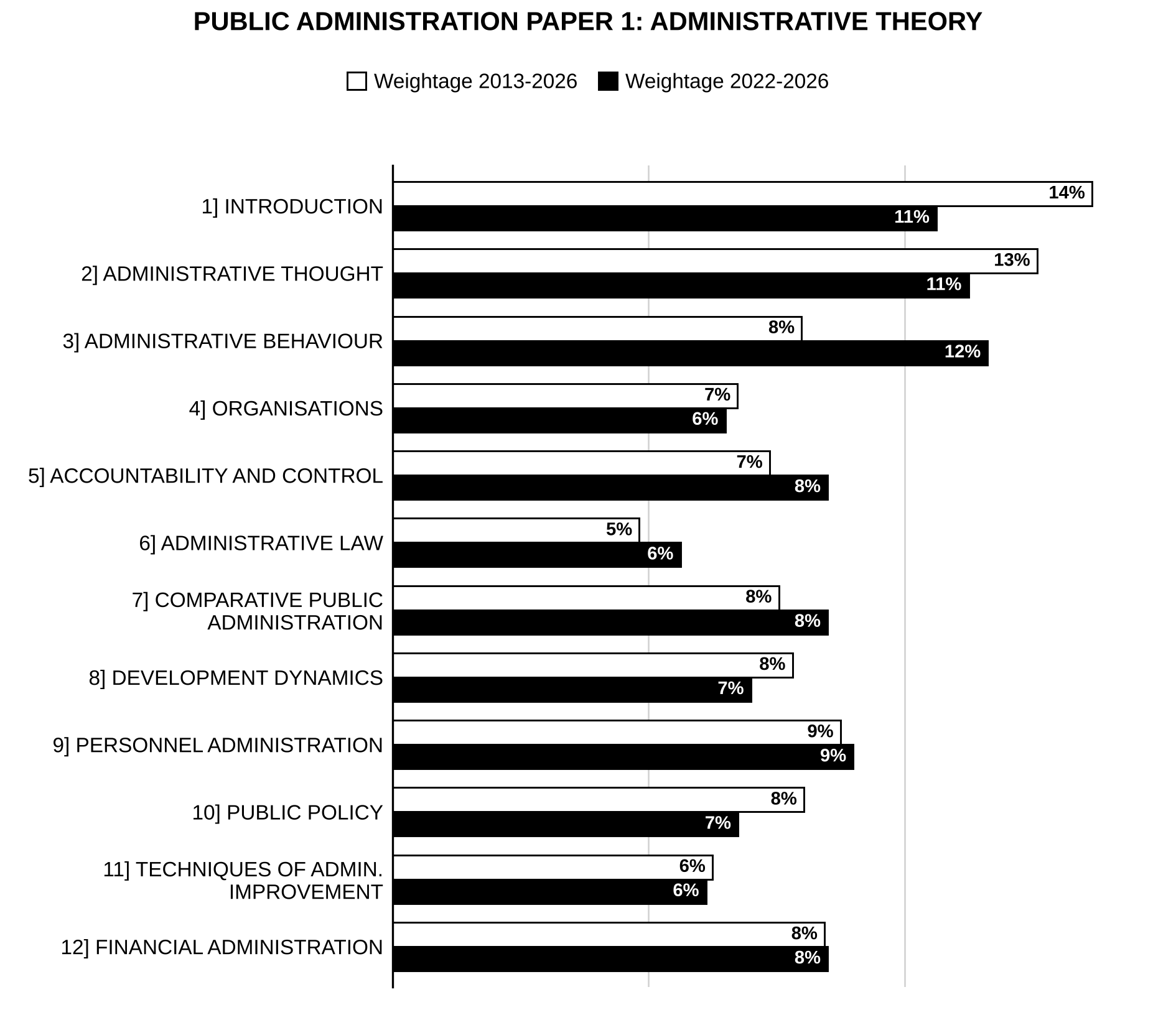
Trend: Marks are spread fairly evenly across the twelve units. Introduction (14%) and Administrative Thought (13%) are the heaviest over 2013–2026, led by New Public Management, good governance, the evolution of the discipline and Weber. In the last five years Administrative Behaviour has risen sharply (8% → 12%), driven by motivation and leadership theories, and is now the single heaviest unit. Personnel Administration (9%) and Financial Administration (8%) are steady; Administrative Law (5%) and Techniques of Administrative Improvement (6%) are the lightest.

Preparing for Prelims too?
Our UPSC Prelims Topic-wise PYQ eBook covers every Prelims question with detailed explanations, so you can see exactly where UPSC asks from.
View the BookDownload Free SamplePaper II
| Unit | Topic (click to open PYQs) | Sub-topics | Questions | Link |
|---|---|---|---|---|
| 1 | Evolution of Indian Administration | 6 | 44 | Click here → |
| 2 | Philosophical and Constitutional Framework of Government | 5 | 53 | Click here → |
| 3 | Public Sector Undertakings | 4 | 35 | Click here → |
| 4 | Union Government and Administration | 7 | 70 | Click here → |
| 5 | Plans and Priorities | 5 | 46 | Click here → |
| 6 | State Government and Administration | 7 | 78 | Click here → |
| 7 | District Administration Since Independence | 4 | 32 | Click here → |
| 8 | Civil Services | 7 | 69 | Click here → |
| 9 | Financial Management | 6 | 55 | Click here → |
| 10 | Administrative Reforms Since Independence | 4 | 39 | Click here → |
| 11 | Rural Development | 4 | 59 | Click here → |
| 12 | Urban Local Government | 5 | 41 | Click here → |
| 13 | Law and Order Administration | 6 | 45 | Click here → |
| 14 | Significant Issues in Indian Administration | 7 | 84 | Click here → |
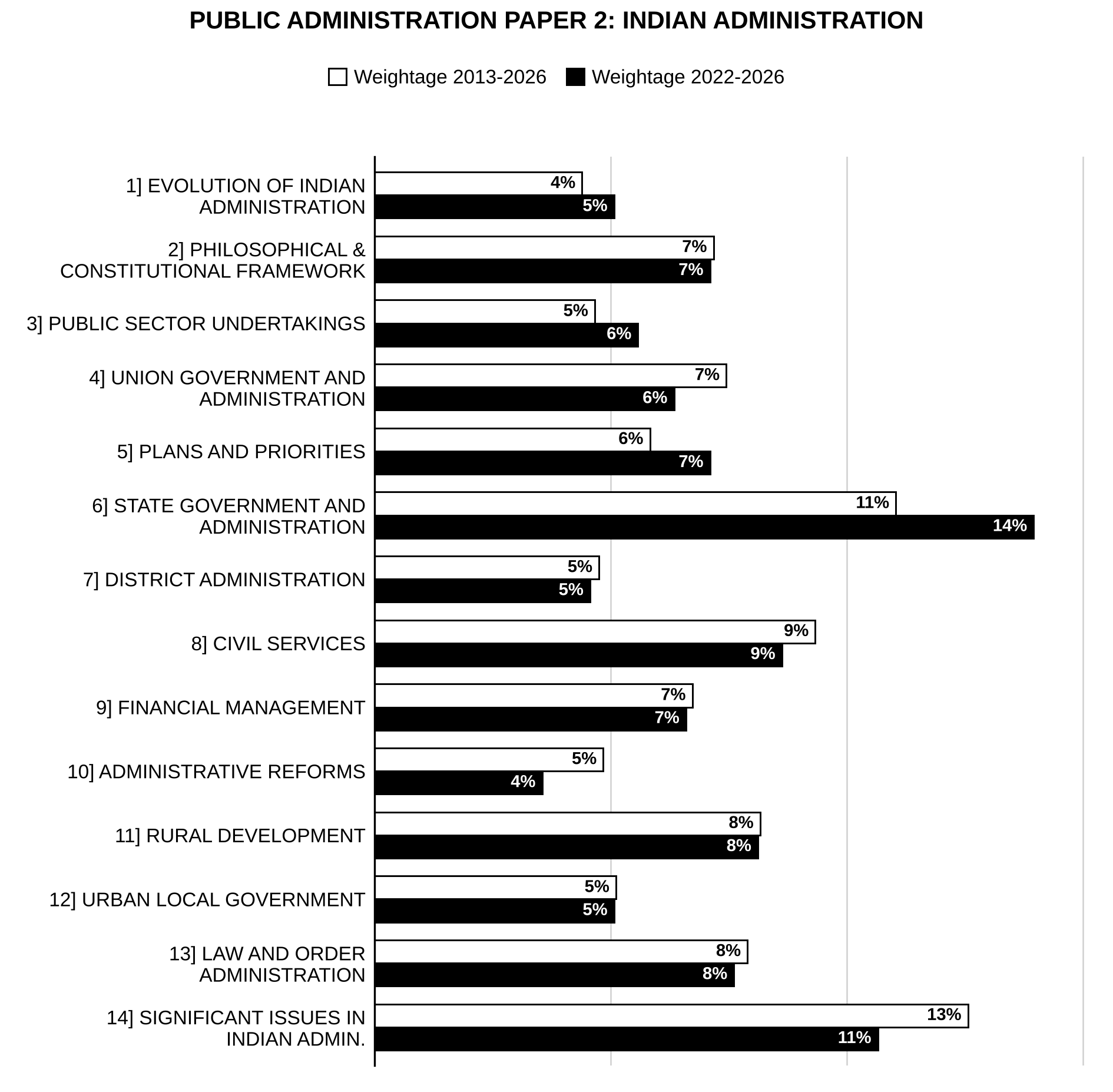
Trend: Significant Issues in Indian Administration (13%) and State Government and Administration (11%) carry the most marks over 2013–2026. State Government has risen to 14% in the last five years, driven mainly by Union-State relations (GST, fiscal federalism, Governors). Civil Services (9%), Rural Development (8%) and Law and Order Administration (8%) follow; within them recruitment, lateral entry and capacity building, the Panchayati Raj institutions, and police reforms dominate. Evolution of Indian Administration, PSUs, District Administration and Administrative Reforms carry about 4–6% each.
More questions
Other questions (outside the present syllabus) – 14 questions
How this collection is organised
Considering the changing exam pattern and syllabus over three decades, we felt it necessary to declare some practices we’ve adopted in this collection.
Some old questions (for example on social welfare administration, or welfare of women, children and the disabled) are not part of the present syllabus, but we’ve decided to keep them. These, and a few questions on government schemes that fall outside every unit of the syllabus, are placed under “Other Questions (Outside the Present Syllabus)” at the end of Paper 2. Students should not worry about such questions being asked in exams.
Some questions cover more than one topic. We’ve kept such questions in each topic of relevance. Topics that the syllabus does not name separately are placed in the nearest topic: for example, principles of organisation such as hierarchy, coordination and span of control under Classical Theory; generalists and specialists, lateral entry and training under Recruitment, training and career advancement; Lokpal and Lokayuktas under Corruption and administration; and the judiciary under Executive, Parliament, Judiciary.
Units are numbered exactly as in the official syllabus: Paper 1 – units 1–12 (Administrative Theory); Paper 2 – units 1–14 (Indian Administration). Where a unit has many questions, they are further divided by the topics of that unit.
Graphs at the start of each paper show the weightage of every unit in that paper, and graphs for the six heaviest units of each paper show the weightage of their topics. Weightage is the share of marks asked from a unit or topic, compared for 2013–2026 (white bars) and the last five years, 2022–2026 (black bars). A question placed under two topics has its marks split equally between them.
Each of the topicwise question is suffixed by a question code like this [2024/10m/150w/5e]. This code indicates a) year in which the question was asked, b) maximum marks the question carried, c) prescribed word limit and, d) the question number in actual paper, in given order. Where UPSC prescribed no word limit, that field is skipped.
Until 2012, each paper carried 300 marks (60 marks per question); since 2013 each paper carries 250 marks. For 1995–2008 the marks were not printed against each question in available sources, so codes follow the standard pattern of those papers: 20 marks for each part of Q1 and Q5 (any three), 60 marks for a single question and an equal split for a question with two or three parts.
Where a part of a short-answer question is a statement without a directive word, it is shown as “Comment on: …”, as the question paper asks. The wording of the questions is otherwise as printed.
Spotted an error? Use the “Report an Error” box at the end of any page – we review every report and update the page.

Strengthen your GS papers
Our UPSC Mains Topic-wise & Year-wise PYQ eBook (2013–2026) maps every GS question to the syllabus, so you know what UPSC asks and how often.
View the BookDownload Free SampleLast updated: 30 October 2026