
Here are all 61 Financial Administration questions asked in UPSC Public Administration Optional Paper I from 1995 to 2026, arranged under the 6 topics of the official syllabus. Within each topic the latest questions come first.
Each question ends with a code such as [2024/15m/3b] – the year, the marks, the word limit (where UPSC set one) and the question number in the paper.
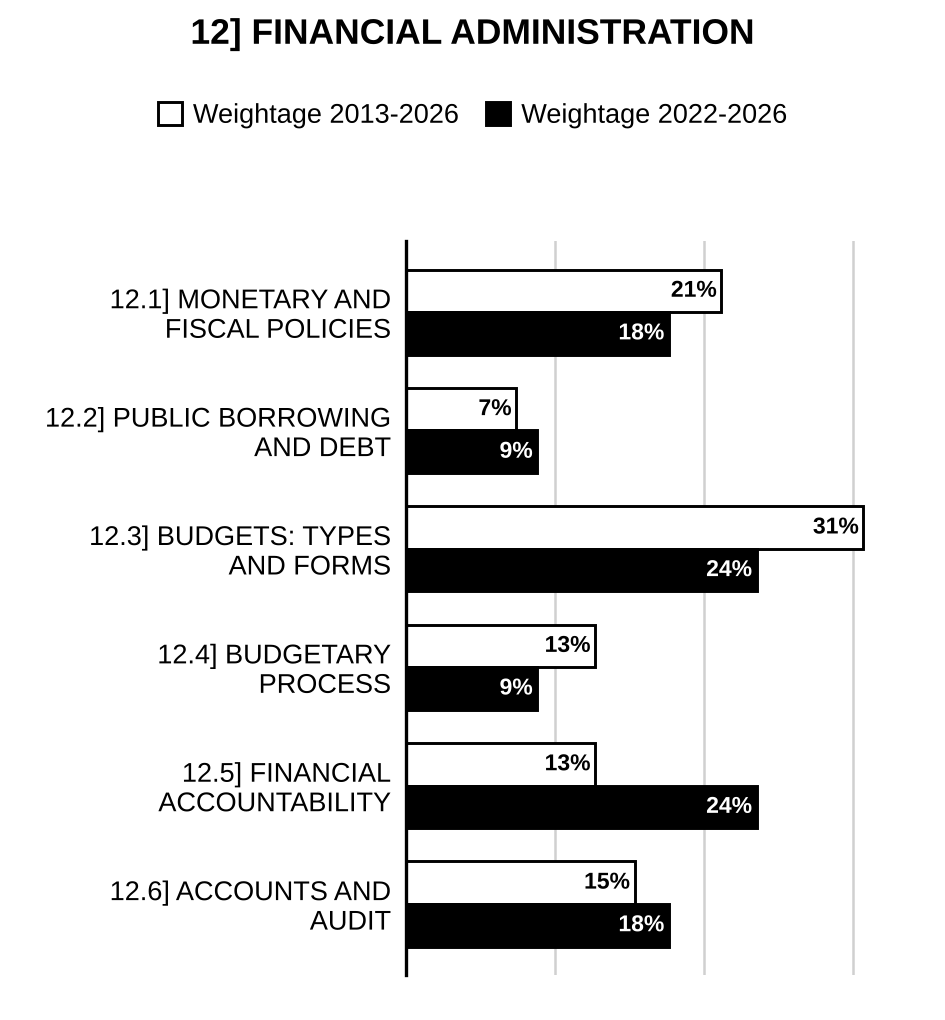
12.1] Monetary and fiscal policies
9 questions
“No tax shall be levied or collected except by authority of law.” Analyse. [2026/10m/150w/5d]
Neo-liberal policies have enhanced the scope and opportunities of taxation for the government. Explain. [2025/10m/150w/5b]
“Monetary policy and fiscal policy are different; but both are used to regulate economy.” Discuss. [2023/10m/150w/5d]
Emphasis on cost control and reducing public expenditure has diverted the focus of government budgets from the basic objectives of reallocation of resources, bringing economic stability and promoting social equity. Examine. [2021/20m/6a]
“Fiscal policy should address the issues of inequity, intricacy and obscurantism.” Explain. [2020/10m/150w/5d]
Discuss the major areas of change in the Tax-Reforms of the post-liberalisation era. How do you justify the importance of the direct tax reform in this context? [2019/15m/7c]
“Monetary policy of a country can help or hinder its development process.” Discuss. [2018/15m/7b]
“Fiscal policy and monetary policy are the two tools used by the State to achieve its macroeconomic objectives.” Examine the statement and point out the differences between the tools. [2016/20m/7a]
Critically examine the monetary and fiscal policies of Government of India in the decade 1991 to 2001. Do you think world financial institutions had a role to play in opening Indian economy to global forces? Give reasons to substantiate your argument. [2001/60m/8]
12.2] Public borrowings and public debt
3 questions
Modern economists think public debt is an essential means of increasing employment, and element of economic policy, but it also shifts the burden to future generations. Analyse. [2024/15m/8b]
“A large public debt forces the adoption of tax and spending policies that result into higher taxes and reduced services.” Analyse. [2017/10m/150w/5e]
“Public borrowing produces different effects on the economy.” Examine. [2016/10m/150w/5b]
12.3] Budgets: types and forms
22 questions
Deficit budgeting as a tool for stimulating economic development emerged with government investment and initiative. Is deficit budgeting still relevant in the era of liberal ideology? Justify your answer. [2026/15m/7c]
“Zero-based budgeting (ZBB) is based on programme efficiency rather than budget history.” In the light of this, examine the advantages of ZBB over traditional budget. [2023/15m/6c]
‘Outcome budgeting addresses the weaknesses of performance budgeting.’ Elaborate. [2022/10m/150w/5e]
Emphasis on cost control and reducing public expenditure has diverted the focus of government budgets from the basic objectives of reallocation of resources, bringing economic stability and promoting social equity. Examine. [2021/20m/6a]
Zero-based budgeting was intended to get away from incrementalism, but ended up being the most incremental of any budgetary approach. Discuss. [2021/15m/7b]
“Objectives of performance budgeting include improving expenditure prioritization, effectiveness and efficiency.” Has performance budgeting worked effectively in governmental system? Argue. [2020/15m/8c]
“Sound Performance Auditing is impossible without systematic Performance or Outcome Budgeting.” Explain the relationship between the two. [2018/15m/7c]
“There can be no performance auditing without performance budgeting.” Elucidate. [2017/15m/6c]
“The key to understanding performance-based budgeting lies beneath the word ‘result’.” In the light of the statement, examine the elements of performance-based budgeting. [2016/20m/8a]
Identify the main elements of Program Budgeting, Output Budgeting and ‘New’ Performance Budgeting. What do they have in common with PPBS? [2014/20m/8a]
What new models of budgetary capacity and incapacity have emerged after the decline of Planning Programming Budgeting and Zero-based Budgeting? [2013/10m/150w/5e]
‘Budget is a series of goals with price-tags attached.’ Explain. [2011/20m/200w/5a]
An administrator uses the budget as a framework for communication and co-ordination, as well as for exercising administrative discipline throughout the administrative structure. Explain. [2011/30m/8b]
Distinguish between PPBS and performance budgeting. [2010/20m/8a]
What is performance budgeting? Bring out its merits, limitations and difficulties. [2007/60m/8]
“The budget is an instrument of coordination.” Explain. [2005/20m/200w/5c]
Examine the government budget as an instrument of public policy and a tool of legislative control. [2002/60m/8]
Burkhead says: ‘Budget in Government is a vehicle of fiscal policy and a tool of management.’ Examine this statement. [2001/20m/200w/5b]
Write a short note on: Budget as an instrument of socio-economic transformation. [2000/20m/200w/5a]
Give reasons for the failure of Government of India to introduce the performance programme budgetary technique in Union Ministries. What type of budgetary system is being currently practised in India and why? [2000/60m/6]
Comment on: “Budget is a tool which serves many purposes.” [1998/20m/200w/5a]
Comment on: Program budgeting is often considered interchangeable with performance budgeting, but there is a significant difference, at least in theory. [1995/20m/200w/5a]

Preparing for Prelims too?
Our UPSC Prelims Topic-wise PYQ eBook covers every Prelims question with detailed explanations, so you can see exactly where UPSC asks from.
View the BookDownload Free Sample12.4] Budgetary process
10 questions
A sound budgeting system is one which engenders trust among citizens that the government is listening to their concerns. Elaborate this in the context of budgetary governance. [2022/15m/7b]
“Budgeting is a political process” — (Aaron Wildavsky). Examine. [2017/10m/150w/5a]
“No significant change can be made in the budgetary process without affecting the political process.” (Wildavsky). Analyse. [2015/10m/150w/5c]
“Instead of reforms to budgetary process, Wildavsky proposes to redefine the role of political institutions and rules by which politics leads to agreement on budget.” Explain. [2014/10m/150w/5e]
Budget allocation involves series of tensions between actors with different backgrounds, orientations and interests and between short-term goals and long-term institutional requirements. Discuss. [2013/15m/7c]
‘Those who budget, deal with their overwhelming burdens by adopting heuristic aids to calculation’ [Wildavsky]. Explain. [2012/12m/150w/5e]
“Good economics and bad politics cannot coexist in a sound budgetary process.” Discuss this statement in the context of the developmental challenges in countries experiencing competitive politics. [2008/60m/7]
“Successfully implementing budgeting approach requires favourable incentive structures.” Discuss. [2006/20m/200w/5d]
Why does the issue of budgeting as politics versus budgeting as analysis remain important in the budgeting process? Do you agree that some synthesis of the two positions seems possible? Illustrate. [2005/60m/8]
“Budgeting and fiscal administration require the public administrator to resolve a variety of operational, managerial and strategic issues.” Examine. [1996/30m/7b]
12.5] Financial accountability
7 questions
Financial integrity, compliance with laws and performance standards, and efficient, economical and effective service delivery performance are mandatory for every government. Discuss the existing practices in ensuring public financial accountability and also give suggestions to improve it. [2026/20m/8a]
“The management of sound public finances used to be the backbone of administrative systems; but unfortunately, it has become the prisoner of populist policies.” Critically evaluate. [2023/20m/8a]
Performance measurement remains an emerging issue but it is relegated to exclusively monitor and assess the use of funds. In light of the statement discuss various non-financial parameters of performance measurement to evaluate public sector organizations. [2019/20m/7a]
“Legislative controls over finances are inadequate and incomplete.” Comment. [2003/20m/200w/5d]
Examine the government budget as an instrument of public policy and a tool of legislative control. [2002/60m/8]
“Time-honoured and yet often not sufficiently appreciated are the fiscal techniques for securing responsible conduct of administrative business.” Discuss. [1997/30m/7a]
Describe the methods by which the Public Accounts Committee and the Estimates Committee control administration. [1995/60m/8]
12.6] Accounts and audit
10 questions
Auditing is not about finding faults, it is about ensuring the accuracy and integrity of financial information. Analyse. [2024/10m/150w/5d]
The audit function has always been viewed as an integral part of government financial management. Discuss the significance of internal audit in improving the performance of the government sector. [2022/20m/8a]
“Sound Performance Auditing is impossible without systematic Performance or Outcome Budgeting.” Explain the relationship between the two. [2018/15m/7c]
“There can be no performance auditing without performance budgeting.” Elucidate. [2017/15m/6c]
Can we say that statutory audit and social audit are two sides of the same coin? Or, are they two separate coins with varying values? Discuss. [2017/15m/7c]
“The fact that we call something performance auditing means that we imply salient features which can distinguish it from other forms of inquiry.” Discuss with reference to the main measures or indicators of performance measurement. [2014/20m/6a]
Whereas ‘value for money’ audit aims at economy and ‘performance’ audit seeks efficiency, ‘social’ audit goes beyond both, to examine the effectiveness of a programme or activity. Examine this statement with suitable illustrations. [2011/30m/4a]
“Audit continues to be considered as something alien, something extraneous and something of the nature of an impediment.” Explain. [2006/20m/200w/5b]
“Auditing in Government is an exercise in post-mortem.” Examine. [2002/20m/200w/5d]
‘Statutory External auditing is one of the protectors of democracy in the parliamentary form of Government.’ Comment. [2001/20m/200w/5d]

Strengthen your GS papers
Our UPSC Mains Topic-wise & Year-wise PYQ eBook (2013–2026) maps every GS question to the syllabus, so you know what UPSC asks and how often.
View the BookDownload Free Sample« Previous: Techniques of Administrative Improvement | Next: Evolution of Indian Administration »
Back to: Public Administration Optional PYQs – Topic-wise | Also see: Public Administration Optional year-wise question papers
Last updated: 30 October 2026