
Here are all 84 Significant Issues in Indian Administration questions asked in UPSC Public Administration Optional Paper II from 1995 to 2026, arranged under the 7 topics of the official syllabus. Within each topic the latest questions come first.
Each question ends with a code such as [2024/15m/3b] – the year, the marks, the word limit (where UPSC set one) and the question number in the paper.
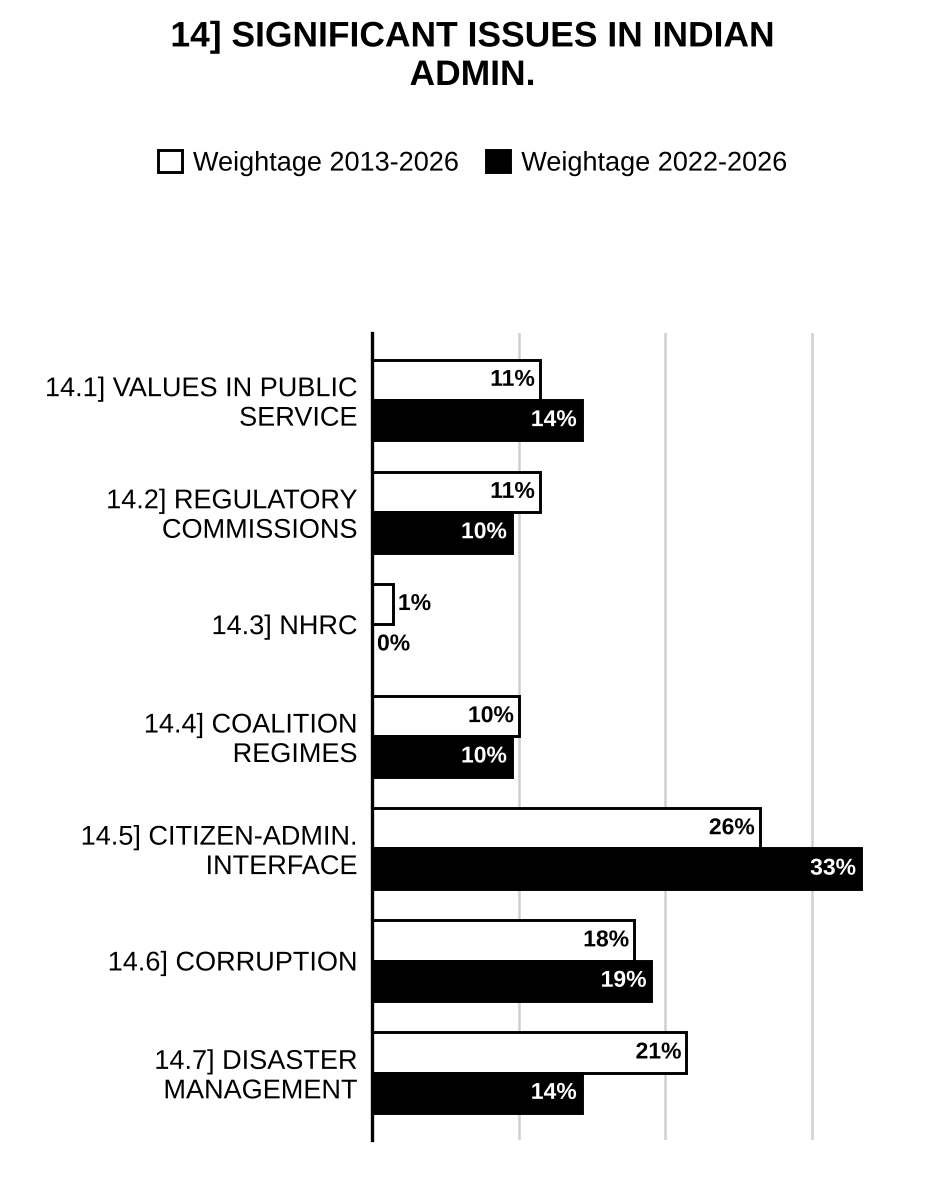
14.1] Values in public service
8 questions
Do you agree that code of ethics and code of conduct for ministers would help in upholding higher standards of their constitutional and ethical conduct? Explain. [2023/10m/150w/5e]
In India, for the upliftment of majority of people, governmental intervention remains a central fact of life. Nevertheless, the effective implementation of policies depends on the ethical values of Public Servants. Discuss. [2022/20m/7a]
Recent market approaches to public services present serious challenges to traditional and state-sponsored public service values. Evaluate the statement in the context of Indian administration. [2021/20m/4b]
“In a democratic polity, any conception of ethics and integrity in public life must encompass not only politicians and civil servants but also citizens.” Discuss. [2016/20m/8b]
Assess the role of honest and upright civil servants in regulatory and development administration in India. Give examples to substantiate your arguments. [2014/20m/6a]
“Values of Indian administration must be rooted in the Preamble of the Indian Constitution.” Discuss. [2009/30m/8a]
Comment on: “Values, more than techniques are the eventual determinants of the actions of the administrators.” [2004/20m/200w/5b]
“Between social background and administrative culture, it is the latter that has a dominating influence on integrity in administration in the Indian situation.” Review the statement in the light of research findings in this area. [1995/60m/8]
14.2] Regulatory Commissions
7 questions
Examine the role of Telecom Regulatory Authority of India (TRAI) in protecting the interests of consumers. [2024/10m/150w/5c]
Examine the role of Securities and Exchange Board of India (SEBI) in protecting the interests of the investors in securities. [2022/10m/150w/5b]
Accountability of regulatory bodies would address the problem of over-regulation and help make them truly facilitators. Analyze the present status of regulators and suggest measures to induce accountability in the mechanism. [2019/10m/7c]
“In the Network Era the TRAI has the challenging task of protecting the Net Neutrality from digital aggression.” Comment. [2018/20m/7b]
Discuss, with suitable examples, the emerging challenges faced by the Regulatory Commissions as the arbitrating agents between the State and the market forces. [2017/20m/8a]
“National Green Tribunal is viewed by many critics as a hindrance to economic development.” Evaluate the statement and give arguments in support of your answer. [2016/10m/150w/5c]
With the creation of new regulatory agencies in the wake of liberalisation, overlapping jurisdictions and conflicts became the new trend. Is there need for the creation of a super-regulator or unified regulator? [2010/30m/8b]
14.3] National Human Rights Commission
4 questions
National Human Rights Commission is handicapped by its jurisdictional limitations of not being able to investigate the cases of violation of human rights by the armed forces. Discuss. [2021/10m/6c]
“The National Human Rights Commission has done a commendable job in developing a sense of responsibility among organizations towards the protection of human rights.” Comment on this assessment. [2009/30m/7a]
“The role played by the National Human Rights Commission in maintaining and preserving dignity of India’s citizens has been satisfactory and up to the expectations.” Elucidate. [2006/60m/2]
Comment on: “The National Human Rights Commission is unable to play its role effectively due to various hindrances.” [2004/20m/200w/1b]

Preparing for Prelims too?
Our UPSC Prelims Topic-wise PYQ eBook covers every Prelims question with detailed explanations, so you can see exactly where UPSC asks from.
View the BookDownload Free Sample14.4] Problems of administration in coalition regimes
8 questions
Critically examine the problems of administration in coalition regimes. [2024/10m/8c]
The dynamics of coalitions vary with the nature of leadership, political parties and contemporary political conditions. Analyze. [2023/10m/150w/5c]
The Speaker of the State Assembly has assumed a significant role in formations and dissolutions of governments. Examine under the circumstances of coalition governments with examples. [2020/20m/4b]
“In the coalition era with elusive majority of a single party in the State Legislature, the role of the Governor becomes even more challenging.” Discuss. [2018/20m/3b]
“The Centre-State relations have acquired new dimensions in recent times due to several political parties being in power at the Centre and the States.” (Second Administrative Reforms Commission) Do you agree? Give reasons to support your arguments. [2014/10m/150w/1e]
“From coalition government to one-party dominance is a big change that is bound to affect the governmental system.” Explain why and how. [2014/10m/150w/5e]
Is there a need to dispense with the Office of the Governor? Examine in the context of coalition governments. (In about 150 words) [2013/10m/150w/3c]
“The Chief Minister symbolizes ruling power structure and is the real executive head of the State Government.” Discuss the above statement in the light of his position in a Coalition Government. [2005/60m/2]
14.5] Citizen administration interface
25 questions
Centralized Public Grievance Redress and Monitoring System (CPGRAMS) does not effectively address local level issues. Give your opinion. [2025/20m/6a]
Do you think ‘Aadhaar’ initiative has promoted inclusive governance and administrative credibility? Throw light. [2025/20m/6b]
India has significantly advanced in its development goals, increased efficiency in the public sector and unlocked innovation in private sector by adopting the approach of building Digital Public Infrastructure. Elucidate. [2023/20m/3a]
Citizens charters in India have not succeeded in their objectives in making administrative system citizen centric. Do you agree? Give reasons. [2022/10m/150w/5c]
Ideally citizen-administration interface is supposed to be based on trustworthiness and purposefulness, in reality it is observed to be plagued by suspicion, conflicts, stresses and strains. Do you agree? Elaborate. [2020/10m/8c]
Comment on: “The RTI has started its journey, but is far from its destination.” In the view of the statement, examine the present status of the RTI movement. [2019/10m/150w/5b]
‘Sevottam Scheme’ had great potential to reform service delivery, but opportunity is frittered away. Comment. [2019/10m/6c]
“Autonomy of civil society is crucial for responsive and effective administration.” Examine the statement. [2018/10m/2c]
“Effective public grievance redressal requires administrative commitment. But process reengineering can help prevent some grievances.” Discuss. [2018/20m/8a]
Do you think that the Public Service Guarantee Acts passed by various State Governments are an extension of the Citizen Charters? Give reasons. [2017/10m/150w/5d]
“The Right to Information (RTI) has started its journey but is far from its destination.” Comment. [2017/10m/6c]
“The Right to Information Act is a path-breaking legislation which signals the march from darkness of secrecy to dawn of transparency.” What hurdles do the citizens face in obtaining information from the government? Explain how the reluctance of the government to part with information under R.T.I. can be addressed. [2016/20m/7a]
“Information Communication Technology (ICT) improves the quality of public service delivery, but fails to check bribery.” Comment. [2015/10m/150w/5e]
“Public Administration today tends to be less public in quantitative terms, but more responsive to public needs than before in qualitative terms.” Examine with reference to citizen-centric administration. [2013/10m/150w/5a]
Indian administration is yet to fully appreciate and adopt the benefits of Information Technology. Elucidate. [2012/15m/7a]
“The weakest aspect of Indian administration is the grievance redressal machinery.” Discuss. [2009/20m/200w/1c]
Do you agree with the view that Citizens’ Charters in India have not succeeded in their objective of making the administrative system citizen-centric? Analyze and give your suggestions in this regard. [2009/30m/6b]
‘Right to Information Act has led to greater transparency and accountability of administration.’ Comment. [2008/20m/200w/5d]
“If information is power, nothing can perhaps empower a citizen more than the secret and developmental informations held by various public authorities.” Analyse the merits and demerits of RTI Act, 2005 in the light of this statement. [2007/60m/6]
Define Civil Society. Is it an effective organ to control administrative machinery? Comment. [2007/10m/8b]
Comment on: “A distinctive feature of the Indian administration, since Independence, has been the noticeable efforts undertaken to make the administrative system effectively reach and respond to citizens’ grievances.” [2003/20m/200w/5c]
“Information technology, if properly used, can bring about sweeping changes in the nature of governance in India.” Discuss the current status and future possibilities about the use of information technology in the governance of India. [2003/60m/8]
“Indian administration is yet to fully appreciate and adopt the benefits of ‘the information technology’.” Elucidate. [2001/30m/7b]
Do you think that our administration is sensitive to public grievances? Discuss the existing grievances redressal mechanism and give suggestions for enhancing its capabilities. [2000/60m/6]
Comment on: “The machinery of administrative tribunals has been provided for the purpose of speedy and cheap justice against official excesses.” [1997/20m/200w/5d]
14.6] Corruption and administration
17 questions
‘Zero tolerance against Corruption’, commitment of Government of India has multi-pronged approach. Critically analyse. [2026/10m/7c]
In 2011, India ratified the United Nations Convention Against Corruption (UNCAC). Evaluate the existing legal framework for fulfilling this commitment. [2023/20m/8b]
Examine the role of Lokpal in ensuring transparency and accountability in Indian administration. [2022/10m/8c]
“There are adequate legal mechanisms to address corruption and malpractices in administration, but they have failed to curb the menace to any noticeable degree.” In the light of this statement, discuss the efficacy of the institution of Lokayukta in Indian States. [2020/20m/8a]
Minimal accountability being the dominant norm in the political system, the Lokpal can only be an ideal institution with limited effectiveness. Explain. [2019/20m/6b]
“The ‘policy of non-action’ regarding the institutional mechanisms and legal provisions to eradicate corruption is a feature of Indian administration.” Critically examine. [2017/20m/8b]
“Information Communication Technology (ICT) improves the quality of public service delivery, but fails to check bribery.” Comment. [2015/10m/150w/5e]
“The basic ethical problem for an administrator is to determine how he/she can use discretionary power in a way that is consistent with democratic values.” Comment with reference to corruption in administration. (In about 250 words) [2013/20m/250w/8b]
‘Corruption is more of an environmental than an administrative problem.’ Discuss. [2012/12m/150w/5c]
“The performance of Lok Ayuktas in various States has been uneven.” Comment with examples. [2011/20m/200w/1b]
(i) “One Lok Pal, howsoever strong it may be, cannot eliminate corruption in the politico-administrative system in India.” Comment. (15) (ii) “Grievance redressal system is perhaps the weakest link in India’s civil service management.” Comment. (15) [2011/30m/6a]
“Lok-Ayuktas are judicial institutions without adequate teeth.” Comment. [2006/60m/7]
“The Lokayuktas in States have not succeeded in tackling mal-administration, while the Bill on Lokpal still faces stiff opposition on the floor of the Parliament.” Comment. [2005/60m/8]
Comment on: “The performance of Lok Ayuktas in Indian States do not create a very positive impression.” [1999/20m/200w/5c]
“Only a systematic-ecological approach to the study of corruption in India can help us understand its causes and dimensions.” Comment. [1999/30m/7b]
Comment on: “Corruption is more of an environmental than an administrative problem.” [1998/20m/200w/5c]
Trace the origin of the Lokayukta plan and comment on its working. [1997/60m/8]
14.7] Disaster management
15 questions
Community based Disaster Risk Management is a response to the gaps within the existing Disaster Risk Management strategy. Evaluate. [2026/10m/6c]
Artificial Intelligence (AI) has emerged as an innovative tool in disaster management. Illustrate with examples. [2025/10m/8c]
Disasters can push the world’s poorest deeper into poverty. Do you think that a comprehensive strategy to deal with such vulnerabilities is required? [2023/10m/7c]
In past two decades India’s public policy on Disaster Management has shifted its focus from rescue, relief and rehabilitation efforts to holistic management of disaster. Analyse. [2021/20m/8a]
Examine the National Health Policy in the context of the current pandemic situation. Identify the problems and suggest improvements. [2020/20m/4a]
The National Policy on Disaster Management envisages a paradigm shift from hitherto reactive post-disaster relief centric regime to more pro-active and enabling environment. Examine the responses of State Governments in this regard. [2019/20m/7a]
“Disaster preparedness and management has become an important component of district administration in India.” Discuss with suitable illustrations. [2017/20m/7a]
Explain how the National Disaster Management Plan (NDMP) provides a framework and direction to the government agencies for all phases of disaster management cycle. [2016/20m/6b]
“Municipal governance in India is not sufficiently prepared to meet the challenges of frequent natural disasters.” Elucidate the statement and add your own suggestions. [2015/20m/8a]
“Bureaucratic agencies, characterized by established procedures, specialization, leadership, clear objectives, are not ideal to handle disaster management.” Examine with reference to the need for administrative flexibility in managing disasters. (In about 250 words) [2013/20m/250w/2a]
(i) Identify the different conceptual categories of disasters. (15) (ii) Write a note on the new culture of disaster management. (15) [2011/30m/8a]
“Disaster insurance is desirable but not an easy proposition to implement.” Illustrate with suitable examples. [2011/30m/8b]
It is argued that the Bhopal gas disaster and the response pattern to it reflect multiple vulnerabilities relating to systems of corporate social responsibility, governance at local, state and central levels, and legal safeguards and liabilities. Comment on this assessment. [2010/30m/8a]
Comment on: “India has failed to devise a long-term strategy for drought management.” [2009/20m/200w/5a]
‘In India, there appears to be more disaster of management than management of disaster.’ Comment. [2008/20m/200w/5b]

Strengthen your GS papers
Our UPSC Mains Topic-wise & Year-wise PYQ eBook (2013–2026) maps every GS question to the syllabus, so you know what UPSC asks and how often.
View the BookDownload Free Sample« Previous: Law and Order Administration | Next: Other Questions »
Back to: Public Administration Optional PYQs – Topic-wise | Also see: Public Administration Optional year-wise question papers
Last updated: 30 October 2026