
Here are all 59 Public Policy questions asked in UPSC Public Administration Optional Paper I from 1995 to 2026, arranged under the 3 topics of the official syllabus. Within each topic the latest questions come first.
Each question ends with a code such as [2024/15m/3b] – the year, the marks, the word limit (where UPSC set one) and the question number in the paper.
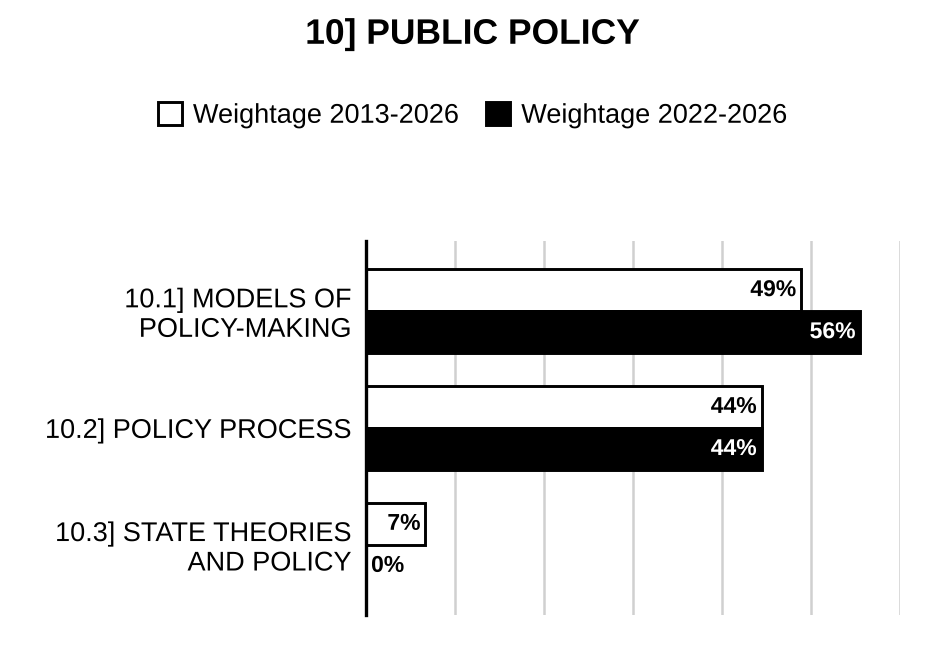
10.1] Models of policy-making and their critique
25 questions
The objective of policy sciences is to develop policy knowledge for better policy-making. Comment. [2026/10m/150w/5a]
Rationality in policy-making is a challenge, and its absence is a predicament for the policy process. Examine. [2026/15m/7b]
Policy analysis process is limited if possible outcomes and alternate potential policies are neglected. Discuss. [2025/10m/150w/5c]
Evaluate the role and scope of tacit knowledge and personal experience as an important source of knowledge in policy making process. [2025/15m/8b]
“Cost-benefit analysis is of great help to the policy makers in framing policies and providing advice on developing public policy.” Examine. [2023/10m/150w/5c]
‘Lindblom regarded rational decision-making as an unattainable goal.’ In the light of the statement, suggest measures to avoid policy failures. [2022/15m/6c]
“Maximum social gain” in public policy making is an attractive goal which is rarely found in practices. Discuss. [2019/10m/150w/5c]
“In Public Policy Making, ‘Rationalism’ is the opposite of ‘Incrementalism’.” Examine. [2016/10m/150w/5e]
“In the appreciative systems of policy makers, goals are subsidiary to norms and values.” (Vickers). Explain. [2015/10m/150w/5d]
“The concept of political feasibility in policy alternative is a probabilistic concept and is related to each policy alternative.” In the context of the above statement analyse Dror’s contribution. [2015/20m/8a]
“The Output Studies Approach to public policy analysis overstresses the rational techniques and allocative dimension of public policy.” Analyze the statement. [2014/15m/6b]
According to Y. Dror, “The Science of Muddling through is essentially a reinforcement of pro-inertia and anti-innovation ideas in policy-making”. Comment. [2014/15m/8b]
“Public interest is still inadequate as a ground concept to evaluate public policy.” Discuss. [2013/25m/4b]
“The policy process was not structured in the way required by bureaucratic planning.” “Arguably, incrementalism now stands most in contrast to neo-liberal nationality that impose markets against both gradual change and democratic liberalism.” Analyse these two statements. [2013/20m/7b]
Suppose the Government of India is thinking of constructing a dam in a mountain valley girded by forests and inhabited by ethnic communities. What rational techniques of policy analysis should it resort to for coping with likely uncertainties and unforeseen contingencies? [2013/20m/8b]
‘Policy judgements comprise reality judgements, value judgements and instrumental judgements’ [Geoffrey Vickers]. Elucidate. [2012/12m/150w/1e]
Would you agree with Bachrach and Baratz that along with decisions, non-decisions are also part of policy? Give reasons for your answer. [2012/20m/7c]
Critically examine the following statements in the field of Policy Sciences. (i) The instrumentalist paradigm posits a conservative tendency in public policy making. (15) (ii) Dror’s Optimal Model is a fusion of the economically rational model with the extra-rational model. (15) [2011/30m/7b]
“Yehezkel Dror’s normative models of policy making tend to be academic in perspective with poor operational utility.” Comment. [2009/20m/200w/5d]
Define the term ‘civil society’. How does civil society influence the public policy? [2006/60m/3]
Public Policy is not an independent variable and human history shows little evidence of systematic learning from policy experience. Discuss. [2004/20m/200w/1d]
Policy is a decision driven model of research use. Explain. [2004/20m/200w/5a]
“Public policy is what politics is about.” Substantiate. [2002/20m/200w/5b]
“All policy-making is decision-making, but all decision-making is not policy-making.” Elaborate. How does a policy emanate and what course does policy-making in government follow? [1998/60m/8]
Sketch an overview of the State of Public Policy Analysis as it is most likely to interest those who have a public administration perspective. [1996/60m/8]

Preparing for Prelims too?
Our UPSC Prelims Topic-wise PYQ eBook covers every Prelims question with detailed explanations, so you can see exactly where UPSC asks from.
View the BookDownload Free Sample10.2] Processes of policy: conceptualisation, planning, implementation, monitoring, evaluation and review, and their limitations
31 questions
Unless there is a sound mechanism for policy evaluation, policy formulation process remains redundant. Examine. [2024/15m/8c]
“Public policy-making is an effort to apply the methods of political analysis to policy areas but has concerns with processes inside the bureaucracy and stakeholders.” Discuss. [2023/20m/7a]
Policy evaluation contributes fundamentally to sound public governance. Discuss. [2022/10m/150w/5b]
Failure of public policies has often been attributed to problems of implementation, while implementors question the policy design. Discuss the contestation. [2022/15m/8c]
Policy problems are increasingly tending towards being wicked. Discuss the capacity and preparedness of the State to tackle such problems. [2021/20m/7a]
The successful attainment of SDGs objectives largely depends upon the wisdom, experience and farsightedness of the actors involved and their willingness to cooperate in the implementation process. Analyze. [2021/20m/8a]
Groups work to elevate issues on the policy agenda or seek to deny other groups the opportunity to place issues. In this background, discuss the role of interest groups in agenda setting in the developing countries. [2021/15m/8b]
“The strength of Public Administration is in its exploration of the complexities and nuances of public policy making and implementation.” Discuss. [2020/10m/150w/1a]
Have political realities thwarted the move towards evidence based policy making? Critically examine. [2020/15m/6c]
“Performance Management Framework enables a clear line of sight between planning, measuring and monitoring performance.” Critically analyse. [2020/15m/8b]
“A public policy without the active involvement of people in its formulation, implementation and evaluation is only a facade.” How can this anomaly be corrected? [2018/15m/8c]
“Of all the processes involved in public policy, implementation is of greatest importance.” Examine the impediments in policy implementation. [2017/15m/8c]
Comment on: “The term policy implementation is in some respects preferable to the label public administration.” Argue. [2015/10m/150w/1e]
How far do you agree with the view that the growing influence of media comes in the way of agenda-setting by the Government? [2015/15m/4c]
“Policy analysis is incomplete without taking into account policy delivery.” Argue. [2015/15m/6c]
‘Our normal expectation should be that new programs will fail to get off the ground and that, at best, they will take considerable time to get started. The cards in this world are stacked against things happening’ [Pressman and Wildavsky]. Comment. [2012/12m/150w/5d]
‘Policy is being made as it is being administered and administered as it is being made.’ Comment. [2011/20m/200w/5b]
“Public administration can be portrayed as a wheel of relationships focussed on the formulation and implementation of public policy.” Explain. [2010/20m/200w/5d]
“Cost-benefit analysis is a very unsatisfactory view of evaluating public policy.” Comment. [2010/20m/8c]
“… even if policies are well-organized, efficiently operated, widely utilized, adequately financed and supported, we may still ask, so what? Do they work? … What about their costs, outputs and impact?” Discuss. [2009/60m/8]
“Laxity in monitoring and evaluation can render even the best policies infructuous.” Discuss. [2008/20m/200w/5a]
“Implementing a public policy is a process of discovering what works and what does not.” Examine. [2007/20m/200w/5d]
“Nothing comes across more strongly than the great naivete about policy implementation.” Discuss. [2006/20m/200w/5c]
Give an assessment of the processes of policy formulation and discuss the problems of policy implementation. [2005/60m/7]
Comment on the role of public administration in policy making and its implementation. What are the other factors influencing the policy process? [2003/60m/7]
Elucidate the political process of policy formulation. Bring out its distinguishing features in developing countries. [1999/60m/8]
Comment on: “Policy implementation in Less Developed Countries needs to be effective.” [1998/20m/200w/5d]
“All policy-making is decision-making, but all decision-making is not policy-making.” Elaborate. How does a policy emanate and what course does policy-making in government follow? [1998/60m/8]
“Policy-making does not end once a decision is made. The implementation of the decision can have just as great an impact on public policy as the decision itself.” Discuss. [1997/60m/8]
Comment on: An attack has been made on the “top down” character of the kind of implementation studies and an alternative “bottom up” approach has been developed. [1996/20m/200w/5a]
Explain how factors such as communications, resources, self interests and bureaucratic structures affect implementation of public policies. [1995/60m/6]
10.3] State theories and public policy formulation
3 questions
Has policy analysis become a major source of legitimation of status quo in political and social order? Discuss. [2020/10m/150w/5c]
“Globalization is impacting the context of national policy making. The national policy agenda is becoming international.” Explain. [2020/20m/7a]
Comment on: “Policies determine politics as governments constrain.” Attempt a critique of this statement. [2014/10m/150w/5d]

Strengthen your GS papers
Our UPSC Mains Topic-wise & Year-wise PYQ eBook (2013–2026) maps every GS question to the syllabus, so you know what UPSC asks and how often.
View the BookDownload Free Sample« Previous: Personnel Administration | Next: Techniques of Administrative Improvement »
Back to: Public Administration Optional PYQs – Topic-wise | Also see: Public Administration Optional year-wise question papers
Last updated: 30 October 2026