
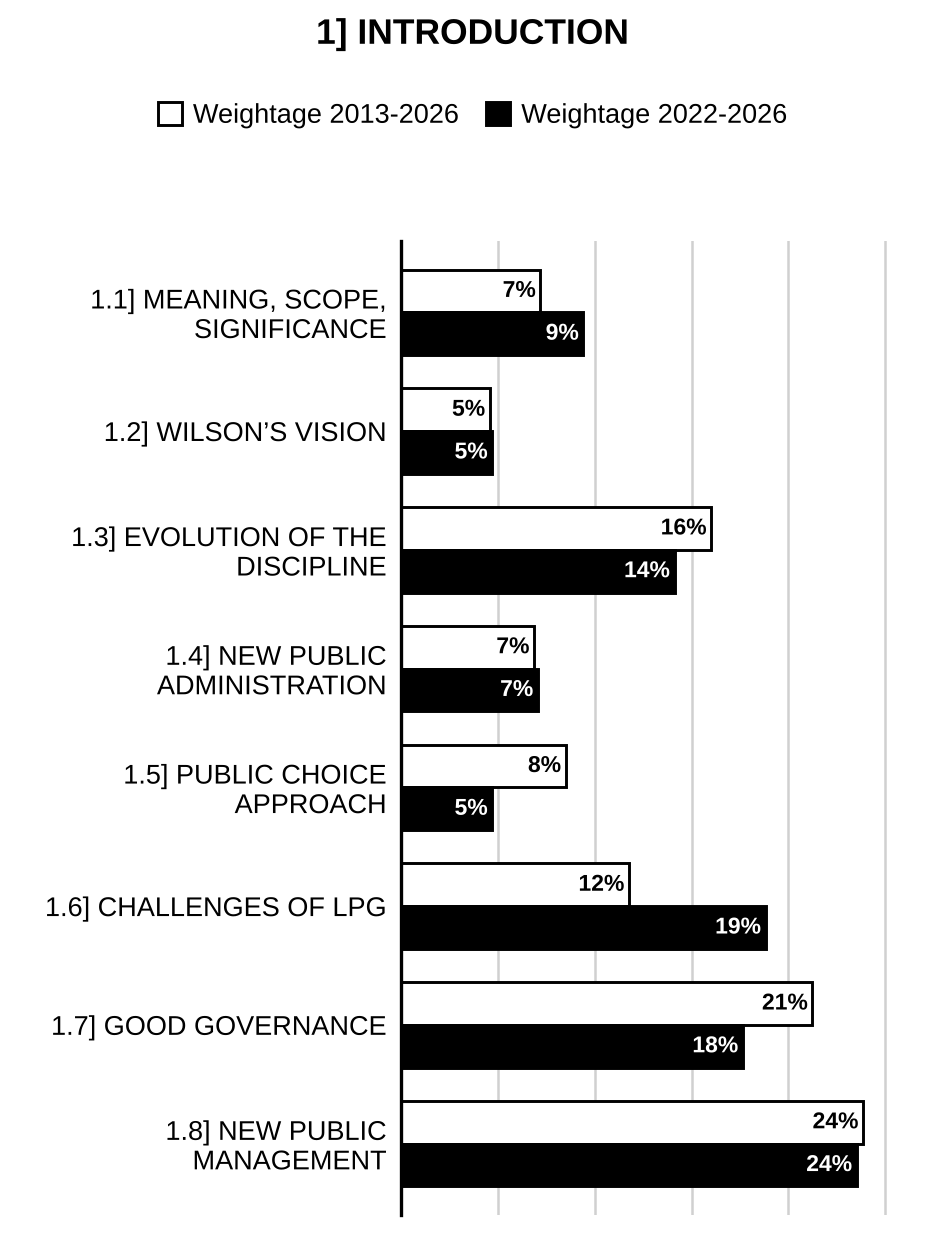
Here are all 99 Introduction questions asked in UPSC Public Administration Optional Paper I from 1995 to 2026, arranged under the 8 topics of the official syllabus. Within each topic the latest questions come first.
Each question ends with a code such as [2024/15m/3b] – the year, the marks, the word limit (where UPSC set one) and the question number in the paper.
1.1] Meaning, scope and significance of Public Administration
15 questions
Public administration horizons have been expanding to cater to the complex needs of the citizens in the globalized era. Explain. [2023/10m/150w/1a]
Public Management takes ‘what’ and ‘why’ from Public Administration and ‘how’ from Business Management. Elaborate. [2022/10m/150w/1a]
“The scope of the discipline of Public Administration is determined by what an administrative system does.” Does it mean that the scope of this discipline is boundaryless? Explain. [2018/10m/150w/1a]
“The political approach to Public Administration stresses on the values of representativeness, political responsiveness and accountability through elected officials to the citizenry” (David H. Rosenbloom). Comment. [2018/15m/4c]
Comment on: “Public Administration is the translation of politics into reality that citizens see everyday.” (Donald F. Kettl and James W. Fesler) Explain. [2016/10m/150w/1b]
“The study of administration should start from the base of management rather than the foundation of law.” Explain. [2010/20m/200w/1d]
“Public and Private Administrations are two species of the same genus, but they also have special values and techniques of their own.” Comment. [2007/20m/200w/1a]
“If public administration is to play a major legitimising role in governing our complex society, it needs to be more fully conceptualised.” Discuss. [2006/20m/200w/1a]
“Though there are certain points of similarity between public and private administration yet no private organisation can ever be exactly the same as a public one.” Examine. [2002/20m/200w/1a]
‘“Publicness” of Public Administration in an ideal democratic government remains the ultimate value in theory and practice.’ Elucidate. [2001/20m/200w/1a]
Comment on: “A science of administration would be a body of formal statements describing invariant relationships between measurable objects, units, or elements. Unquestionably, administrative research has produced definite precepts and hypotheses that are applicable to concrete situations.” – (Fritz Morstein Marx) [2000/20m/200w/1b]
Comment on: “The scope of administration is determined by the scope of government functions which is decided politically.” [1998/20m/200w/1a]
Comment on: “In the science of administration, whether public or private, the basic ‘good’ is efficiency.” [1997/20m/200w/1a]
Comment on: “The scope of Public Administration is ever expanding.” [1996/20m/200w/1a]
Comment on: A theory of public administration means in our time a theory of politics also. [1995/20m/200w/1a]
1.2] Wilson’s vision of Public Administration
8 questions
“Politics-administration dichotomy debate is still alive.” Comment. [2024/10m/150w/1a]
“Political and administrative systems have reciprocal relationship.” Discuss. [2018/15m/3b]
“Even after 130 years of its publication, Woodrow Wilson’s essay ‘The Study of Administration’ continues to have great relevance even today.” Comment. [2017/10m/150w/1a]
Comment on: “The field of Public Administration is a field of business.” (Woodrow Wilson) [2009/20m/200w/1a]
“Calling Woodrow Wilson, the father of Public Administration is doing injustice to equally or even more eminent contributions made prior to him.” Comment. [2008/20m/200w/1a]
“Administrative questions are not political questions.” Discuss. [2005/20m/200w/1a]
The administrator needs autonomy and discretion in much the same way as the politician needs control and intervention. Discuss. [2004/20m/200w/5d]
Comment on: “The basic question in the relationship between political and permanent executives is the separation of facts and values at the operational level.” [1999/20m/200w/1b]
1.3] Evolution of the discipline and its present status
18 questions
Different paradigms of public administration deal with the questions of ‘How’ and ‘Why’, but do not negate the centrality of the discipline. Discuss. [2026/20m/2a]
“The administrative state is the creation of a power to bind us, with rules … that are not made by legislature.” Discuss the constitutionality of the administrative state and its future. [2022/20m/2a]
Behavioural approach has been questioned on the basis of its utility in the analysis of administrative problems. Discuss the weaknesses of the approach and the shifts made therein. [2021/20m/2a]
Public administration has been viewed as a socially embedded process of collective relationship, dialogue and action. Examine the statement in light of the consensus achieved in the Third Minnowbrook Conference. [2021/15m/2b]
“Public Administration is constantly being reinvented because it is contextual.” Elaborate. [2019/10m/150w/1a]
Dwight Waldo in his book, The Administrative State emphatically mentions that the roots of administrative theory lie in political theory. Critically examine Waldo’s contention. [2018/20m/2a]
“With every major transformation in the applied world of Public Administration, the study of Public Administration has grown in scope and intensity.” Discuss the relationship between the evolution of the discipline and profession of Public Administration. [2017/20m/4a]
Waldo’s ‘The Administrative State’ provides a fundamental challenge to some of the orthodox premises. Explain. [2015/10m/150w/1a]
What are the implications of the post-structuralist perspective on the discrete aspects of Public Administration, coming from its epistemological positions? [2014/10m/150w/1a]
How did traditional public administration “resolve a fundamentally irresolvable problem — creating an administration strong enough to be effective but not so strong enough to endanger accountability”? [2013/10m/150w/1a]
How would you trace the development of Public Administration in terms of different paradigms from the politics/administration dichotomy of 1900–1926 to the rise of Public Administration as Public Administration after the formation of the National Association of Schools of Public Affairs and Administration (NASPAA) in the USA in 1970? [2012/30m/2a]
In the evolution of the discipline of Public Administration, Minnowbrook Conferences I, II and III reflect the discipline’s reconceptualisation and its changing values. Elucidate. [2011/30m/2a]
From Woodrow Wilson to Herbert Simon most writers on administration have taken the achievement of efficiency as the central objective. Justify the statement with references to the work of major writers. [2009/60m/4]
Give an account of major landmarks in the growth of the discipline of Public Administration in the 20th century. What are the possible trends in its growth in the first decade of 21st century? [2003/60m/2]
Describe the evolution of the discipline of public administration with special emphasis on post-1970 developments. [2002/60m/2]
“… The paradigms of public administration may be understood in terms of locus and focus.” – Golembiewski. In the light of the above statement describe the “five-paradigms” of Nicholas Henry about the evolution of the discipline of public administration. [2000/60m/2]
Examine the growth of the discipline of Public Administration as a response to the developing capitalistic system in the U.S.A. [1999/60m/2]
How far is it true to state that the bureaucratic state began to displace the ‘administrative’ state when the predominant function of the government changed from regulation to operation of business? [1996/60m/4]
1.4] New Public Administration
9 questions
Minnowbrook III emphasized the importance of empirical research in generating valuable insights for public administration and recognized the need to tailor education in the field to different regional contexts. Examine. [2023/15m/2b]
Public administration has been viewed as a socially embedded process of collective relationship, dialogue and action. Examine the statement in light of the consensus achieved in the Third Minnowbrook Conference. [2021/15m/2b]
“The Phenomenological Approach advocated by the New Public Administration has obstructed the path of theory building in Public Administration.” Comment. [2018/15m/2b]
“The New Public Administration has seriously jolted the traditional concepts and outlook of the discipline and enriched the subject by imparting wider perspective by linking it closely to the society.” (Felix A. Nigro and Lloyd G. Nigro) Elucidate. [2016/15m/2b]
In the evolution of the discipline of Public Administration, Minnowbrook Conferences I, II and III reflect the discipline’s reconceptualisation and its changing values. Elucidate. [2011/30m/2a]
Comment on: “New Public Administration is …. a revolution or radicalism in words, and (at best) status-quo in skills or technologies.” [2009/20m/200w/1b]
Minnowbrook Conference in USA identified four features crucial to ‘new public administration’. Explain. [2001/20m/200w/1b]
“The themes developed at 1988 MINNOWBROOK conference (20 years after the first conference) largely focus on the current and future visions in the field of public administration.” Elucidate. [1998/30m/3b]
Comment on: New Public Administrations are likely to be forthright advocates for social equity and would doubtless seek a supporting clientele. [1995/20m/200w/1d]

Preparing for Prelims too?
Our UPSC Prelims Topic-wise PYQ eBook covers every Prelims question with detailed explanations, so you can see exactly where UPSC asks from.
View the BookDownload Free Sample1.5] Public Choice approach
7 questions
Imperfect market and political factors limit the application of Public Choice approach. Explain. [2025/10m/150w/1a]
Is William Niskanen’s “Budget Maximising Model” relevant today? Argue. [2019/15m/6c]
“Bureau-Shaping Model has been developed as a response to the Budget-Maximizing Model.” Comment. [2016/15m/4b]
Discuss how the Public Choice Theory promotes the concept of ‘Steering’ and undermines the concept of ‘Rowing’ in visualising efficient and effective administration. [2015/10m/150w/1b]
“A variety of different organizational arrangements can be used to provide different public goods and services.” Explain the theory underlying this proposition and its potential contribution. [2013/15m/3b]
‘On a more sophisticated plane public choice is concerned with “Pareto optimality”, or at least with “Pareto improvements”.’ Comment. [2012/12m/150w/1a]
Whereas Downs’ model is largely dependent on a theory of psychological motivation, Niskanen’s model is framed by neo-classical thinking. In the light of the above, discuss the public choice approach to decision-making. [2011/30m/3a]
1.6] Challenges of liberalisation, privatisation and globalisation
8 questions
“Liberalization, Privatization and Globalization (LPG) successfully resolved the structural crisis of the welfare state with emphasis on market efficiency, undermining the social equity goals essential to public service.” Explain. [2026/20m/6a]
The objective of Liberalization, Privatization and Globalization and of New Public Management was to limit government functions and reduce public expenditure. However both functions and expenditure has increased. Account for the paradox. [2025/20m/7a]
“Globalization is impacting the context of national policy making. The national policy agenda is becoming international.” Explain. [2020/20m/7a]
“Globalization has constructed the administrative state to save and serve corporate power structure.” Discuss how transnational corporations impact government and public administration in the contemporary era. [2019/20m/3a]
“Globalisation has transformed the nature and character of State from traditional administrative Welfare State to a Corporate State.” Analyse the changes in the nature of public administration in this context. [2015/20m/2a]
Explain the impact of privatisation on public administration with special reference to the issue of user fees. [2010/20m/3a]
Explain the impact of privatisation on public administration with special reference to outsourcing technique. [2010/20m/3c]
“The advent of the concept of ‘roll back of the state’ since the nineteen eighties has been altering the role of Public Administration but certainly not diminishing its central place in human society.” Discuss. [2003/20m/200w/1a]
1.7] Good Governance: concept and application
17 questions
“There is an urgent need to incorporate the contribution of other disciplines into debates and analyses about governance, not the prevalence of disciplinary silos.” Comment. [2026/10m/150w/1a]
Have governments under governance become more transparent and accountable? Elucidate. [2026/10m/150w/1d]
The foundations of Public Administration, New Public Management and Public Governance rest on ‘rule of law’. Discuss. [2025/15m/3b]
Good governance adds normative and evaluative attributes to the process of governing. Comment. [2024/15m/2b]
“Governance is about managing self-organizing networks.” Elaborate. [2021/10m/150w/1a]
“The movement towards governance as an organizing concept for public administration and management is because the focus of administration has been shifting from the bureaucratic state to the ‘hollow state’ and ‘third-party government’.” Critically examine. [2020/20m/2a]
“Markets, hierarchies and networks represent modern governing structures in government.” Explain. [2020/10m/150w/5b]
“Collaboration and its cognates for public service delivery need to be viewed from the governance lenses.” Comment. [2020/15m/7b]
“Governance is neither a paradigm nor a panacea for all the ills of government. It may be a more useful approach when other methods fail in providing public service.” Critically evaluate. [2019/20m/2a]
With the entry of the concept of ‘good governance’ the discipline of Public Administration has shed its statist character. Explain. [2019/15m/2b]
“Good governance is ensuring respect for human rights and the rule of law, strengthening democracy, promoting transparency and capacity in Public Administration.” (Kofi Annan) In the light of the statement, critically examine the criteria of good governance as provided by United Nations and Nayef Al-Rodhan. [2016/15m/3b]
“Governance theory and the notion of governmentality have many points of convergence, but they run on parallel lines.” Comment. [2014/20m/2a]
“Not merely governance but good governance is the key factor in achieving the United Nations Millennium Goals (2000).” Explain. [2010/20m/200w/1a]
Do you think that there is a sort of paradox between e-Governance and good governance? Explain fully. [2010/20m/7b]
In what ways and how can information technology play a crucial role in effective government-citizen interaction in the context of good governance? [2005/60m/2]
Democracy and good governance are contradictions in terms. Discuss with examples. [2004/60m/2]
Elaborate the World Bank’s concept of ‘Good Governance’. [1999/30m/7b]
1.8] New Public Management
17 questions
New Public Management has actually been a transitory state in evolution from traditional Public Administration to what is here called New Public Governance. Examine. [2025/20m/2a]
New Public Governance, an emerging paradigm, is contrasted with market-based approach of New Public Management. Comment. [2024/15m/4c]
New public service celebrates what is distinctive, important and meaningful about public service. Discuss. [2022/15m/3b]
The new public service model approaches governance on the premises of an active and involved citizenship, wherein the role of public officials is to facilitate opportunities for citizens’ engagement in governance. Explain. [2021/20m/4a]
New Public Service emphasizes democracy and citizenship as the basis for public administration theory and practice. Elucidate. [2020/15m/3b]
“Accountability under New Public Management has undergone a radical change, although the focus has continued to remain on management.” Comment. [2020/15m/3c]
Has New Public Management failed in promoting a democratic polity? Analyse in the contexts of individual as a citizen and individual as a customer. [2019/15m/2c]
Comment on: Contractualism has become a favourite policy of the neoliberal forces, but not without its share of controversy. Argue. [2019/10m/150w/5a]
“New Public Service approach is an improvement over its predecessor, New Public Management.” Discuss. [2018/10m/150w/1c]
New Public Management has been branded by certain scholars as ‘Neo-Taylorism’. Is it a justified comparison? What factors have led to the decline of NPM so soon after its birth? [2017/20m/2a]
“New Public Management and post-New Public Management reforms initiatives have affected the balance between managerial, political, administrative, legal, professional and social accountability.” Analyze. [2014/20m/4a]
“New Public Management may have neither been the saviour its enthusiasts promised nor the devil its critics worried it would be.” Discuss. [2013/25m/2a]
‘A crisis of credibility’ in the administrative system can be overcome only by ‘reinventing government’. Comment. [2011/20m/200w/1a]
“New Public Management is dead; long live digital era of governance.” Comment. [2010/20m/2b]
It is said that “the perspective of public administration, developed over a century, with a tradition of management of public institutions and services has received a jolt from the novelty of New Public Management”. Bring out the core values, approaches and assumptions of traditional public administration and show how the New Public Management has attempted to change or retain them, and to what extent. [2009/60m/3]
“In the last two decades, almost all countries of the world have experienced transformations in their administrative systems.” Explain this phenomenon with examples from the developed and the developing nations in the context of New Public Management Movement. [2008/60m/2]
“The ‘New Public Management’ (NPM) is an incarnation of a new model of public sector management in response of the challenges of liberalization, international competitiveness and technological changes.” Explain. [2003/20m/200w/1c]

Strengthen your GS papers
Our UPSC Mains Topic-wise & Year-wise PYQ eBook (2013–2026) maps every GS question to the syllabus, so you know what UPSC asks and how often.
View the BookDownload Free SampleNext: Administrative Thought »
Back to: Public Administration Optional PYQs – Topic-wise | Also see: Public Administration Optional year-wise question papers
Last updated: 30 October 2026