
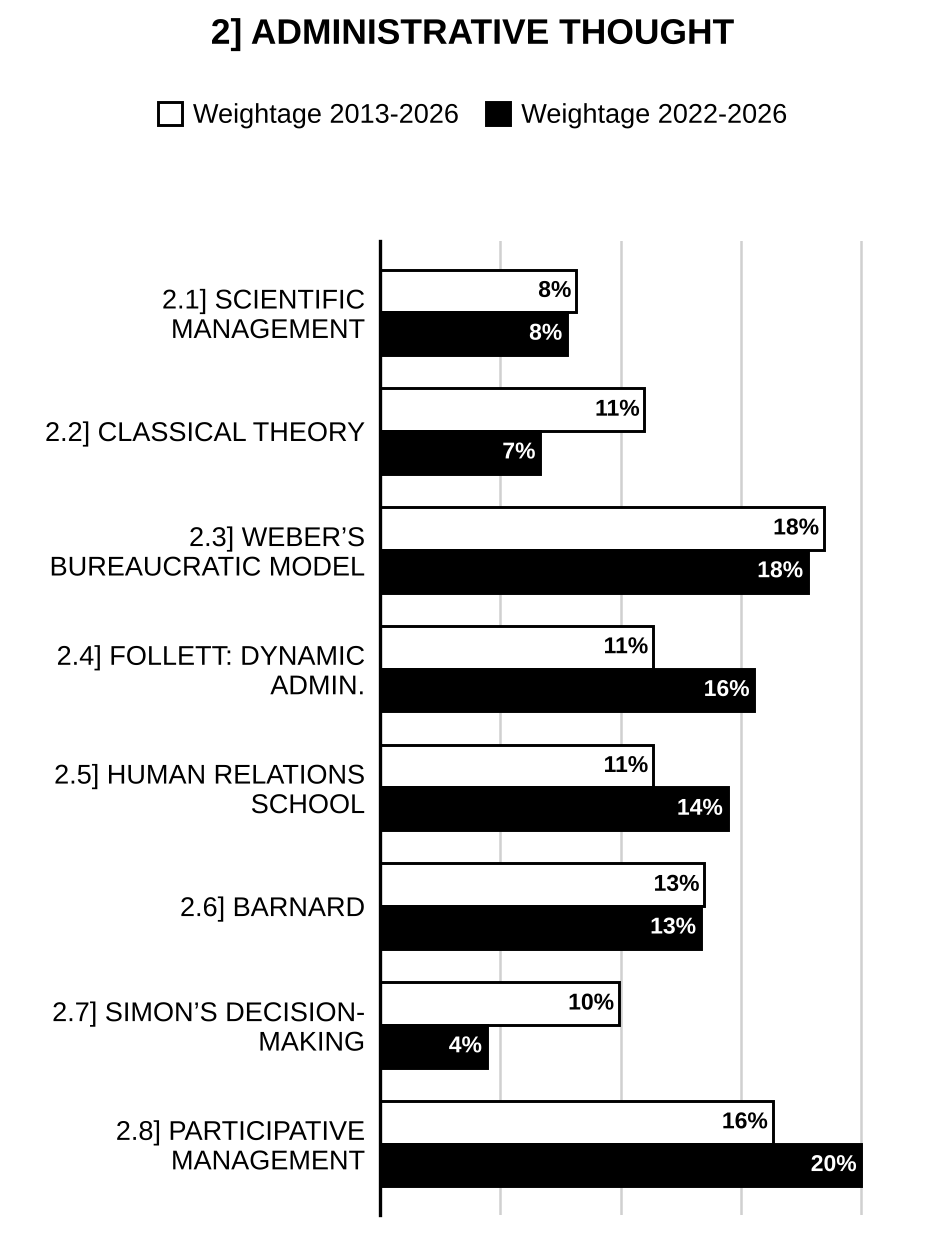
Here are all 110 Administrative Thought questions asked in UPSC Public Administration Optional Paper I from 1995 to 2026, arranged under the 8 topics of the official syllabus. Within each topic the latest questions come first.
Each question ends with a code such as [2024/15m/3b] – the year, the marks, the word limit (where UPSC set one) and the question number in the paper.
2.1] Scientific Management and Scientific Management movement
9 questions
The ideas of Frederick Taylor remain highly relevant in today’s business world, in both the public and private sectors, including the ‘gig economy’. Comment. [2026/10m/150w/1b]
Scientific Management and Human Relations theory are two distinct approaches for improving efficiency and production. Explain. [2024/15m/4b]
Fayol and Taylor had different management perspectives, while having similar goal of organizational efficiency. Comment. [2021/10m/150w/1e]
“Principles of analysis and principles of action were not differentiated in Taylor’s scientific management.” Comment. [2020/10m/150w/1b]
Comment on: “Taylorism is considered very controversial despite its popularity.” (Stephen P. Waring) Comment. [2016/10m/150w/1a]
“Taylor’s ideas need modification in the context of post-industrial economies in contemporary era.” Justify with reasons. [2014/15m/2b]
(i) In what respects is Taylor’s ‘Scientific Management’ or classical motivational theory different from the classical organizational theory expounded by Gulick, Urwick etc? (15) (ii) What light does Antonio Gramsci’s critique of Taylorism throw on its socio-psychological underpinnings? (15) [2012/30m/2b]
Comment on: “Taylor’s contribution was not a set of general principles for organising work efficiency, but a set of operating procedures that could be employed in each concrete situation to secure their application.” [2009/20m/200w/1c]
“Taylor’s scientific management ignored social and psychological factors.” Comment. [2007/20m/200w/1b]
2.2] Classical Theory
16 questions
Is Herbert Simon justified in criticizing some principles of administration as proverbs? Analyse. [2025/10m/150w/1d]
Classical Organisation Theory formed the bedrock for the modern organisation theories. Analyse. [2022/10m/150w/1d]
Fayol and Taylor had different management perspectives, while having similar goal of organizational efficiency. Comment. [2021/10m/150w/1e]
“What is distinctive about the Classical and Human Relations schools of administration is their complementarity to each other.” Analyse. [2017/10m/150w/1b]
Is Peter Drucker justified in saying, “Management principles should not tell us what to do, but only tell us what not to do”? Comment. [2014/10m/150w/1e]
“In the globalized public administration, hierarchy creates more ethical problems than it solves ….” Comment. [2013/10m/150w/1c]
“The design of the physical structure, the anatomy of the organization came first, and was indeed the principal consideration.” “An organization is a system of interrelated social behaviours of participants.” Analyse these statements and evaluate the contributions of the respective approaches to administration theory. [2013/25m/2b]
Structural theory is, by and large, grounded in classical principles of efficiency, effectiveness and productivity. Explain. [2013/25m/4a]
(i) In what respects is Taylor’s ‘Scientific Management’ or classical motivational theory different from the classical organizational theory expounded by Gulick, Urwick etc? (15) (ii) What light does Antonio Gramsci’s critique of Taylorism throw on its socio-psychological underpinnings? (15) [2012/30m/2b]
“The distinction between line and staff is relative rather than absolute.” Discuss. [2007/20m/200w/1c]
Critically examine the Classical Science of Administration with special reference to its criticism by Dwight Waldo and Robert Dahl. [2006/60m/2]
“The failure of classical science of administration lies in its capacity to confront theory with evidence.” Discuss. [2005/20m/200w/1d]
Why do all administrative organizations consider ‘hierarchy’ as the many splendoured technique? Discuss. [2001/60m/3]
Differentiate between managerial and functional aspects of co-ordination. How is co-ordination achieved? [1998/30m/3a]
Examine the basic postulates of the Human Relations Theory and show how far it differs from the classical theory of organizations. [1997/60m/2]
Comment on: Although the theory of V.A. Graicunas is admittedly crude, it is useful as reference against which variations between organizations as well as within organizations can be examined. [1996/20m/200w/1b]
2.3] Weber’s bureaucratic model, its critique and post-Weberian developments
23 questions
Bureaucratic features have remained constant in organisations despite the development of different forms under NPM and Public Governance approaches. Give reasons for the persistence of these bureaucratic features. [2026/20m/3a]
Bureaucracy constitutes the imaginary state and is the spiritualism of the State. Explain. [2025/15m/4c]
Weber’s construct of bureaucracy has served a great heuristic purpose in furthering research in the field of Comparative Public Administration. Do you agree with the statement? Give reasons. [2022/10m/150w/5c]
Neo-Weberian State involves changing the model of operation of administrative structures into a model focussed on meeting citizens’ needs. Discuss. [2021/15m/4b]
“Bureau pathology denigrates competence in organizations.” Explain. [2019/10m/150w/1b]
“The concepts of rationality and efficiency are intertwined in the bureaucratic analysis of Max Weber.” Comment. [2018/10m/150w/1b]
“The Riggsian models of Fused-Prismatic-Diffracted Societies and their administrative systems have been inspired by Max Weber’s typology of Traditional-Charismatic-Legal-Rational Authorities.” Analyse. [2017/20m/7a]
“Weberian model of bureaucracy lacks emotional validity when applied to modern democratic administration.” Comment. [2015/15m/4b]
“Adaptive, problem-solving, temporary systems of diverse specialists, linked together by coordinating executives in an organic flux—this is the original form that will gradually replace bureaucracy.” Discuss, in the light of this statement, the ‘end of bureaucracy’ thesis and its strengths and limitations. [2014/10m/150w/1b]
“Karl Marx’s interpretation of bureaucracy was rooted in the history of the nature of the State.” Evaluate. [2014/10m/150w/1c]
What is administrative elitism? How does it evolve in public administration? Elaborate your response with reference to historical examples. [2013/10m/150w/5c]
‘In the canonization of this abstract idea of ‘Staatsraison’ are inseparably woven the sure instincts of the bureaucracy for the conditions which preserve its own power in the State’ [Weber]. Explain. [2012/12m/150w/1b]
E-governance is the final arrival of Max Weber’s ‘iron cage of rationality’. Discuss. [2011/20m/200w/1c]
Consider the statements below: (i) “Technically, the bureaucracy represents the purest type of legal-rational authority.” (ii) “Bureaucracy does not represent the only type of legal authority.” Identify the theoretical context and analyse the above statements. [2009/30m/300w/2a]
“Bureaucracy can exist only where the whole service of the state is removed from the common political life of the people, its chiefs as well as rank and file. Its motives, its objectives, its policy, its standards must be bureaucratic.” Discuss. [2004/20m/200w/1a]
Weber’s ideas of impersonal detachment and esprit de corps are incompatible. Explain. [2004/60m/3]
“Weberian model of bureaucracy lacks empirical validity when applied to modern democratic administration.” Examine. [2003/20m/200w/1b]
Critically examine the models of Max Weber and Chester I Barnard with reference to ‘bureaucratic authority’. [2001/20m/200w/1d]
A fairly adequate analysis of the Administrative Organization in Government is possible when we treat ‘bureaucracy’ as a ‘structure’ and ‘administration’ as a ‘function’. Discuss. [2001/60m/6]
“It is not weak but strong bureaucracy that creates concern in democracy.” Comment. [1999/30m/3b]
Comment on: “Once fully established, bureaucracy is among those social structures which are the hardest to destroy.” [1997/20m/200w/1c]
Comment on: Bureaucracy is “a system of government the control of which is so completely in the hands of officials that their power jeopardizes the liberties of ordinary citizens.” [1996/20m/200w/1d]
Comment on: Riggs’s key concepts have alerted the researcher that Weberian bureaucracy might not be entirely predictive of behaviour in most Third World countries. [1995/20m/200w/1b]
2.4] Dynamic Administration (Mary Parker Follett)
9 questions
Mary Parker Follett pioneered the evolution of socio-psychological approach to the study of organizations. Explain. [2025/15m/2b]
Follett firmly advocated for cultivating interdependence and collaboration among individuals as the key to resolving conflicts and establishing more harmonious and all encompassing social structures. Discuss. [2023/20m/2a]
Mary Parker Follett traced the foundational value of business and enterprise on her way to understand the organism of governmental machinery. Comment. [2019/15m/4b]
“Conflict is the appearance of differences — differences of opinions and of interests” — (Mary Parker Follett). Comment. [2017/10m/150w/1c]
“Follett’s work was not directed towards the resolution of the conflict of ideas, but towards the resolution of structural conflicts between workers and capitalists.” In the light of the statement critically evaluate Follett’s idea of dynamic administration. [2015/20m/3a]
Critically examine conflict resolution according to M.P. Follett. Explain how McGregor took forward her ideas in the context of complex organizations. [2011/30m/2b]
“Mary Parker Follett was far ahead of her times.” Discuss. [2008/20m/200w/1c]
“The main problem with Mary Parker Follett’s work is that her idealism is showing.” Explain. [2006/20m/200w/1c]
In Follett’s view, “authority belongs to the job and stays with the job.” Explain. [2005/20m/200w/1c]

Preparing for Prelims too?
Our UPSC Prelims Topic-wise PYQ eBook covers every Prelims question with detailed explanations, so you can see exactly where UPSC asks from.
View the BookDownload Free Sample2.5] Human Relations School (Elton Mayo and others)
10 questions
“Formal organisations are made up of informal groups.” Discuss. [2024/10m/150w/1b]
Scientific Management and Human Relations theory are two distinct approaches for improving efficiency and production. Explain. [2024/15m/4b]
Human relationists postulate that ‘what is important to a worker and what influences his/her productivity level may not be the organisational chart but his or her associations with other workers’. Is it more relevant today? [2022/15m/2c]
“Productivity is not the result of working conditions but the result of emotional response of workers to work performed.” Are Elton Mayo’s findings relevant in contemporary organizations? [2020/15m/2c]
“What is distinctive about the Classical and Human Relations schools of administration is their complementarity to each other.” Analyse. [2017/10m/150w/1b]
“The notion of informal organization is a residual or cafeteria concept of diverse and sprawling contents.” How does Gouldner establish the need for understanding the interdigitations between the ‘formal’ and ‘informal’ organization? [2014/15m/3b]
“The design of the physical structure, the anatomy of the organization came first, and was indeed the principal consideration.” “An organization is a system of interrelated social behaviours of participants.” Analyse these statements and evaluate the contributions of the respective approaches to administration theory. [2013/25m/2b]
To what extent has the human relations movement contributed to the knowledge and practice within the field of personnel administration? [2006/60m/7]
Explain the contribution of George Elton Mayo to the development of the Human Relations School. How did behavioural scientists modify his basic findings? [2002/60m/3]
Examine the basic postulates of the Human Relations Theory and show how far it differs from the classical theory of organizations. [1997/60m/2]
2.6] Functions of the Executive (C.I. Barnard)
16 questions
Efficiency, in the specialized sense, is an organization’s capacity to offer effective inducements in sufficient quantity to maintain the equilibrium of the system. Analyze. [2023/10m/150w/1b]
Barnard posits the zone of indifference as the human condition that animates authority relationships and cooperation in modern organisations. Examine. [2022/20m/3a]
“Chester Barnard in ‘The Functions of the Executive’ injected ‘the social’ in the study of organization. Explain in this context how the executive is expected to play a much greater role than a manager.” [2019/10m/150w/1d]
“Chester Barnard’s model of ‘Contribution-Satisfaction Equilibrium’ is still considered a logical model of organisational motivation.” Do you agree? Give arguments. [2018/15m/4b]
“Executive positions imply a complex morality and require a high capacity of responsibility” — (Chester Barnard). Comment. [2017/15m/3b]
“Contemporary Organisational theory seems further afield of Chester Barnard’s Functions of the Executive than of organisational ecology.” Examine the statement in the light of ecological elements in Barnard’s thought. [2015/15m/2b]
“Decisions are not made by ‘organizations’, but by ‘human beings’ behaving as members of organizations.” How do Bernard and Simon conceptualize the relation between the decisions of the individual employee and the organizational authority? [2013/20m/3a]
The Systems Approach is relevant even today for organisational analysis. Discuss how Chester Barnard and David Easton adopted this approach in their respective areas of study. [2011/30m/3b]
Comment on: “The Barnard-Simon Theory of Organisation is essentially a theory of motivation.” [2009/20m/200w/1d]
“Organisation is a system of consciously coordinated activities or forces of two or more persons.” Comment. [2005/20m/200w/1b]
Critically examine the models of Max Weber and Chester I Barnard with reference to ‘bureaucratic authority’. [2001/20m/200w/1d]
‘The inculcation of belief in the real existence of a common purpose is an essential executive function.’ Comment. [2001/20m/200w/5a]
Comment on: “… a more thorough consideration leads to the understanding that communication, authority, specialisation and purpose are all aspects comprehended in coordination.” – (Chester I. Barnard) [2000/20m/200w/1c]
Why is it that the behavioural approach to the study of organisations is a continuous phenomenon? Discuss Chester Barnard’s contributions to this approach. [1998/60m/2]
Show how Barnard while analyzing the multiplicity of satisfactions, clearly identifies four specific inducements. [1996/30m/3a]
Comment on: Authority has been defined in part as a “character of a communication in a formal organization.” [1995/20m/200w/1c]
2.7] Simon’s decision-making theory
16 questions
Is Herbert Simon justified in criticizing some principles of administration as proverbs? Analyse. [2025/10m/150w/1d]
“The process of decisions …… is largely technique of narrowing choices.” Explain. [2023/10m/150w/1c]
“Two-dimensional taxonomy was used by Herbert Simon to describe the degree to which decisions are programmed or non-programmed.” Explain. [2021/10m/150w/1b]
Behavioural approach has been questioned on the basis of its utility in the analysis of administrative problems. Discuss the weaknesses of the approach and the shifts made therein. [2021/20m/2a]
Administrative man bridges the psychological man and the rational man. Explain. [2020/10m/150w/1e]
“If there is ever to be a science of Public Administration it must derive from an understanding of man’s behaviour.” Explain. [2019/10m/150w/1c]
“Herbert Simon’s book Administrative Behavior presents a synthesis of the classical and behavioural approaches to the study of Public Administration.” Explain. [2018/10m/150w/1e]
“Decisions are not made by ‘organizations’, but by ‘human beings’ behaving as members of organizations.” How do Bernard and Simon conceptualize the relation between the decisions of the individual employee and the organizational authority? [2013/20m/3a]
‘Three features characterize Simon’s original view of bounded rationality: search for alternatives, satisficing, and aspiration adaptation.’ Elucidate. [2012/20m/3a]
“Simon’s identifying decision-making as the core field of public administration appears logically acceptable but his positivist underpinning is problematic.” Critically examine the statement. [2010/40m/2a]
Comment on: “The Barnard-Simon Theory of Organisation is essentially a theory of motivation.” [2009/20m/200w/1d]
Examine the respective roles of facts and values in the decision-making process. Is it possible to make value-free decisions in government system? How can government decisions be made more rational? [2008/60m/3]
“Simon’s work has had major implications for the study of public administration and the practice of public administration professionalism.” Comment. [2006/20m/200w/1b]
The ‘decision-making scheme’ and ‘satisfying model’ of Herbert A Simon is the major component of administrative theory. Comment. [2001/60m/2]
Comment on: “Administrative efficiency is enhanced by keeping at a minimum the number of organizational levels through which a matter must pass before it is acted upon.” – (Herbert A. Simon) [2000/20m/200w/1a]
“The study of decision-making is proceeding in so many directions that we can lose sight of the basic administrative processes that Barnard and Simon were trying to describe and that, so many men have been trying to improve.” Elucidate. [1995/60m/4]
2.8] Participative Management (R. Likert, C. Argyris, D. McGregor)
11 questions
Douglas McGregor’s ‘Professional Manager’ is a rational, emotive individual whose primary role is to work through the differences and build a managerial team. Explain how his idea of the ‘Professional Manager’ is distinct from ‘Theory Y’. [2026/15m/2b]
McGregor’s ‘Theory X’ and ‘Theory Y’ provide insights into human motivation at workplace differently. Examine in detail. [2024/20m/2a]
Every human organisation shall start from System-I and ultimately end up with System-IV. Comment on Likert’s statement. [2022/10m/150w/1b]
The Participative Management School of Argyris and Likert advocates democracy within the administrative system. Will this approach be equally useful to developing countries with evolving democracies? [2017/20m/3a]
“Douglas McGregor’s Theory X and Theory Y describe two contrasting models of workforce motivation applied by managers in an organization.” Examine. [2016/20m/2a]
According to McGregor, “True professional help is not in playing God with the client, but in placing professional knowledge and skill at the client’s disposal”. In the light of the above, justify how theory Y is indicative and not prescriptive. [2014/20m/3a]
The theory of ‘organizational incompetence’ has two separate and distinct faces. Examine Chris Argyris’ views on this. [2013/10m/150w/1b]
Critically examine conflict resolution according to M.P. Follett. Explain how McGregor took forward her ideas in the context of complex organizations. [2011/30m/2b]
“In McGregor’s view, the managerial cosmology meaningfully addresses the understanding of manager and his role perceptions.” Explain. [2010/20m/200w/1b]
“The successful management leaders are found in Likert’s ‘System-4’ approach to organisational leadership.” Examine. [2010/20m/200w/1c]
Analyse McGregor’s Theory X and Theory Y. Do you agree with the view that with every passing year, McGregor’s message has become more relevant and more important? Substantiate your answer. [2007/60m/2]

Strengthen your GS papers
Our UPSC Mains Topic-wise & Year-wise PYQ eBook (2013–2026) maps every GS question to the syllabus, so you know what UPSC asks and how often.
View the BookDownload Free Sample« Previous: Introduction | Next: Administrative Behaviour »
Back to: Public Administration Optional PYQs – Topic-wise | Also see: Public Administration Optional year-wise question papers
Last updated: 30 October 2026