
Here are all 59 Rural Development questions asked in UPSC Public Administration Optional Paper II from 1995 to 2026, arranged under the 4 topics of the official syllabus. Within each topic the latest questions come first.
Each question ends with a code such as [2024/15m/3b] – the year, the marks, the word limit (where UPSC set one) and the question number in the paper.
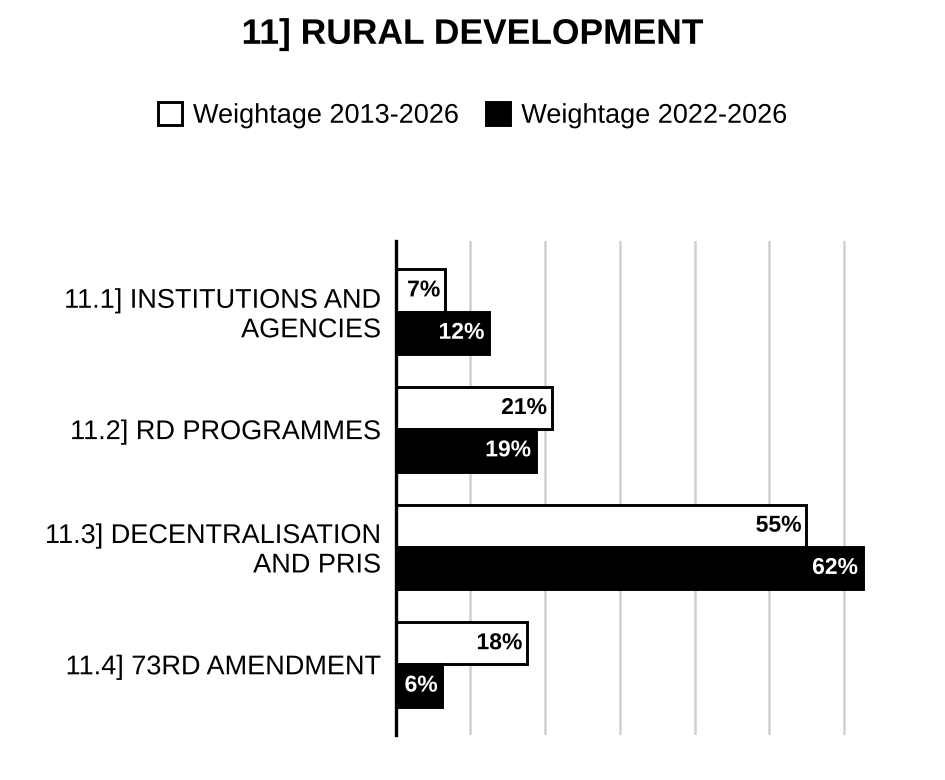
11.1] Institutions and agencies since Independence
6 questions
Disconnect between the rural development institutions and state level agencies have led to each operating in silos at both levels resulting in inefficiencies. Find the reasons. [2026/20m/7b]
“The growing prominence of NGOs in development areas is strongly related to the declining legitimacy of the State.” Explain. [2016/10m/150w/1e]
NGOs demand greater autonomy from the State and are now ‘new actors’ in development. How effective are they as instruments of decentralisation and debureaucratisation? Critically evaluate. [2012/30m/7c]
Comment on: “Non-Governmental Organisations play a catalytic role in enabling communities to define their own priorities ….” [2010/20m/200w/7a]
“NGOs are fast replacing the government in the implementation of a large number of programmes.” Elucidate. [2003/30m/7b]
“The District Rural Development Agency is presently serving as the nodal agency of rural development at the district level.” Explain. [1997/30m/7a]
11.2] Rural development programmes: foci and strategies
16 questions
“Mission Antyodaya strives to realize the vision of poverty-free India.” Examine. [2023/10m/150w/5b]
The Swachh Bharat Abhiyan is by far the most significant cleanliness campaign by the Government of India. Comment. [2023/10m/6c]
Shyama Prasad Mukherji Rurban Mission is a cluster-based approach of converging rural development efforts of different departments of the government. Comment. [2023/10m/8c]
Rural development programmes are designed to facilitate multifaceted growth of rural poor. Evaluate the role of some key rural development programmes in India in this context. [2021/20m/7b]
All weather rural connectivity scheme to even unconnected rural habitations has the potential to transform the rural economy. Do you agree? Justify. [2019/10m/150w/5e]
“Social audit has lent a critical edge to the implementation of programmes such as MGNREGA.” Comment. [2018/10m/150w/5d]
“Rural development programmes have failed to effectively address the problems of small and marginal farmers.” Analyse and give suggestions. [2018/20m/7a]
“Self-Help Groups (SHGs) have contributed to a change in the role of rural women in development—from symbolic participation to empowerment.” Discuss. (In about 150 words) [2013/10m/150w/7c]
What are the basic hurdles and pitfalls in the implementation of the National Rural Employment Guarantee Act? [2008/30m/6b]
“The special development programmes taken up for poverty alleviation with a hope that benefits of these programmes may reach to the people living below poverty line – have utterly failed to achieve its objectives.” Comment. [2004/60m/4]
Comment on: “Rural and urban development programmes have gained in importance, but implementation has been a failure.” [2002/20m/200w/1c]
“Despite the serious commitment on the part of the government, the benefits of the rural development programmes do not seem to reach the intended targets and they fail to serve fully the purpose for which they were intended.” Elucidate. [2001/30m/3b]
Comment on: “The failure of I.R.D.P. is attributed to its over-powering centralized approach.” [1999/20m/200w/5d]
Comment on: “Rural development programmes in India suffer from lack of coordination and a sound appraisal system.” [1998/20m/200w/5b]
Comment on: “Special development programmes seek to solve special problems but their successful implementation depends on complex inter-institutional linkages.” [1995/20m/200w/5c]
Comment on: “In rural development, people are the starting point, centre and end goal of all development programmes.” [1995/20m/200w/5d]

Preparing for Prelims too?
Our UPSC Prelims Topic-wise PYQ eBook covers every Prelims question with detailed explanations, so you can see exactly where UPSC asks from.
View the BookDownload Free Sample11.3] Decentralization and Panchayati Raj
24 questions
Women in panchayats challenge the established patriarchal norms and contest structural inequalities in society. Explain. [2026/10m/8c]
Gram Sabha aims to enlist community participation. Explain. [2025/10m/150w/5d]
Many elected women representatives in local governments in India, especially from marginalized backgrounds, often struggle to govern effectively. Examine. [2025/20m/7a]
The journey of transformation of local governance has been long. Examine the challenges to realise the spirit of gram swaraj. [2024/20m/6b]
Post-amendment period Panchayats have become a platform of competitive politics, but could not emerge as an agency of planning and service delivery. Examine. [2023/20m/2b]
The main objective of Panchayats (Extension to Scheduled Areas) Act, 1996 is to enable tribal society to assume control over their livelihoods and traditional rights. Critically examine the implementation of the Act. [2022/20m/8a]
No rural development strategy can succeed unless it is complemented by appropriate Panchayati Raj Institutions. Examine the statement. [2021/10m/150w/5a]
Comment on: Panchayati Raj Institutions are still plagued by State control and domination of bureaucracy. Argue your case. [2020/10m/150w/5c]
Despite the constitutional provisions for representation, the voice of weaker sections is not having the desired impact in the realms of Panchayati Raj Institutions. Critically examine. [2020/20m/8b]
The evidences suggest that the dream of deliberative democracy could not be realized in practice at the grassroot level. Evaluate the impediments in the functioning of Gram Sabha. [2019/10m/150w/5a]
“A government next-door is the government that matters most for the people.” Discuss the statement with special reference to the values of local government. [2018/10m/150w/1a]
“Effectiveness of local self-government institutions is hampered due to the lack of capacity building of the elected representatives.” Elaborate. [2017/10m/150w/1c]
“The institution of Gram Sabha has very little connection with the Gandhian spirit of direct democracy.” Critically examine. [2017/10m/150w/5a]
“Decentralised governance must serve as an instrument of realising social change and social justice.” Comment on the statement. [2015/10m/3c]
Do you think that the functioning of Panchayati Raj Institutions (PRIs), in practice, reflects genuine devolution of powers and resources? Give reasons for your answer. [2015/10m/150w/5d]
Do you think that the role of Panchayati Raj should go beyond development administration? Give reasons for your answer. [2014/10m/150w/5c]
“The second generation reforms in the Panchayati Raj institutions have changed Panchayats from an agency of development at local level into a political institution.” Discuss. [2013/10m/150w/1c]
“Use of Information and Communication Technology (ICT) in Panchayat’s functions enhances efficiency, transparency and accountability and also induces mass ICT culture.” Examine. (In about 250 words) [2013/20m/250w/4b]
“Gandhian model of decentralization is similar to the process of reinventing governance.” Analyse in the context of good governance. (In about 250 words) [2013/20m/250w/6a]
‘Panchayati Raj Institutions are still affected by State control and domination by bureaucracy.’ Do you agree? [2012/12m/150w/5e]
Local self-government in India is the interplay of several factors — historical, ideological, and administrative. Critically examine these factors. [2012/30m/6a]
“The most momentous recommendation of the Asoka Mehta Committee was the creation of a two-tier system of Panchayati Raj.” Examine the statement. [1997/30m/7b]
“The Panchayati Raj institutions at grass-roots level are ensuring greater people’s participation and involvement in development work.” Comment. [1996/30m/7b]
Comment on: “The most important feature of the second generation panchayats is their change from local developmental organization to local political institutions.” [1995/20m/200w/5b]
11.4] 73rd Constitutional amendment
13 questions
“The role of State Finance Commission in distribution of finances between state and local governments is vital.” Discuss. [2024/20m/3a]
73rd and 74th Constitutional Amendment Acts aimed at making the third tier of government more powerful and effective for democratic decentralization. Critically examine the extent to which this goal has been transformed into reality. [2021/20m/6b]
Efforts to strengthen State Finance Commissions have faced apathy of State Governments over the years, which has also affected the successive Central Finance Commissions in recommending appropriate fiscal transfers to local bodies. Substantiate the answer with examples. [2019/20m/7b]
“The goals of good governance will remain utopian if local governments, responsible for providing all basic services directly to the citizens, are not empowered as mandated by the 73rd and 74th Constitutional Amendment Acts.” Critically evaluate the status of empowerment of the local bodies. [2016/20m/6a]
“The objectives of fiscal devolution to local bodies as mandated by the 73rd and 74th Constitutional Amendment Acts has been derailed by the actual working of the State Finance Commissions.” Comment. [2016/20m/7b]
The 13th Finance Commission highlighted an indispensable need to improve the finance of rural and urban level bodies. Does this make local bodies more accountable in the discharge of their functions? [2014/20m/7b]
“The 73rd Amendment, it is felt, may accentuate fiscal indiscipline by establishing between States and Local Governments a system of transfers similar to the one in place between the Central and State Governments.” (World Bank) Comment. (In about 250 words) [2013/20m/250w/7a]
“73rd Constitutional Amendment has provided permanent structural framework to PRI’s resulting into silent social revolution.” Comment. [2007/60m/3]
“The 73rd and 74th Constitutional Amendments are major landmarks in India’s Constitutional History and Local Governance.” Comment. [2006/20m/200w/1c]
“Even after a decade of having adopted the 73rd Amendment to the Constitution, the Panchayat Raj institution still faces a number of problems towards making it a strong, and vibrant unit of Government.” Comment. [2005/60m/4]
The role of local self-government in the state administration is of considerable importance. Evaluate the statement in the context of the 73rd and 74th amendments made. [2002/60m/4]
“The State Finance Commission under Panchayat Raj Law is designed to ensure regional balance in the distribution of State and Central Funds.” Comment. [1998/60m/8]
Examine the provisions of the 73rd and 74th Constitutional Amendments from the point of view of the autonomy of the local bodies. [1996/60m/6]

Strengthen your GS papers
Our UPSC Mains Topic-wise & Year-wise PYQ eBook (2013–2026) maps every GS question to the syllabus, so you know what UPSC asks and how often.
View the BookDownload Free Sample« Previous: Administrative Reforms Since Independence | Next: Urban Local Government »
Back to: Public Administration Optional PYQs – Topic-wise | Also see: Public Administration Optional year-wise question papers
Last updated: 30 October 2026