
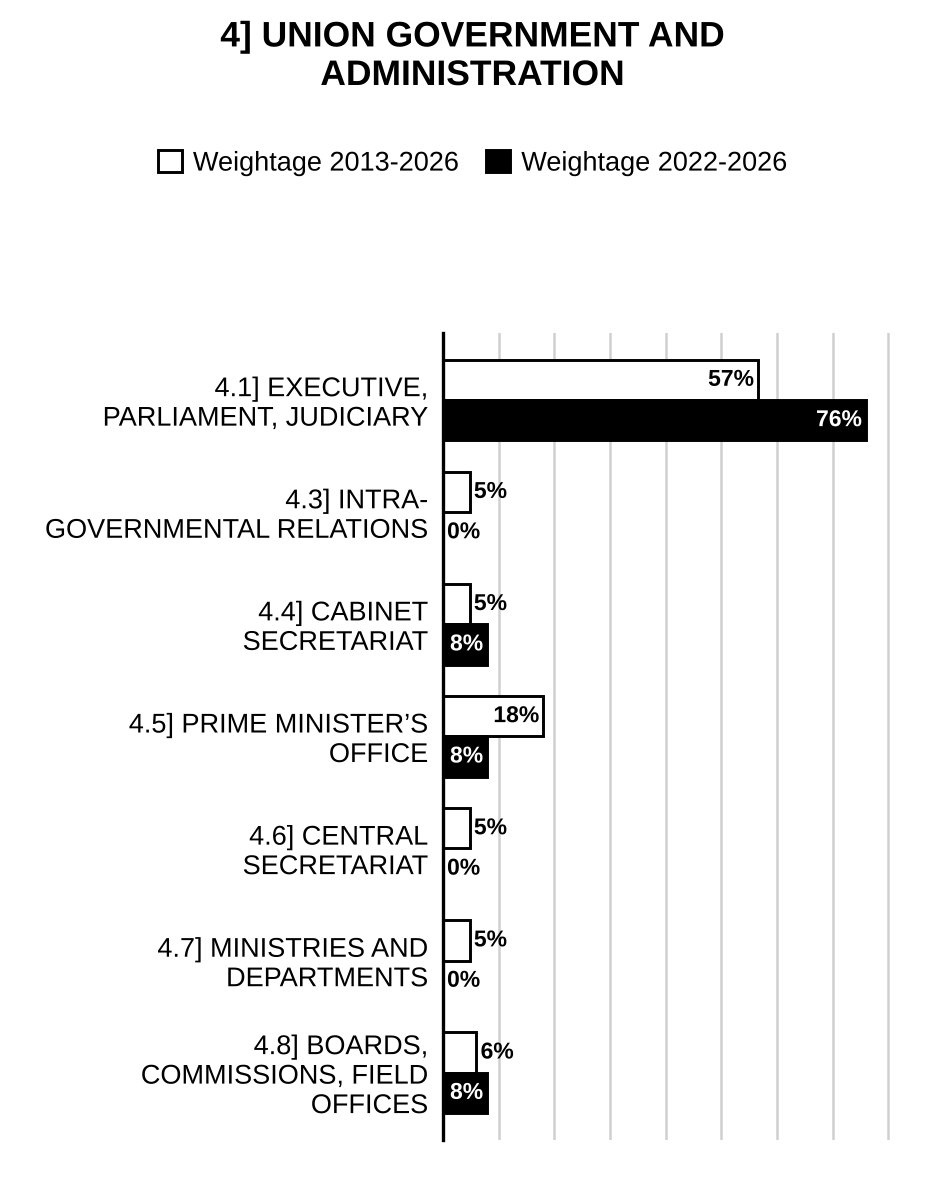
Here are all 70 Union Government and Administration questions asked in UPSC Public Administration Optional Paper II from 1995 to 2026, arranged under the 7 topics of the official syllabus. Within each topic the latest questions come first.
Each question ends with a code such as [2024/15m/3b] – the year, the marks, the word limit (where UPSC set one) and the question number in the paper.
4.1] Executive, Parliament, Judiciary: structure, functions, work processes
38 questions
The collegium system of appointments to higher judiciary has been the cornerstone of independence of judiciary. It has remained as the subject of debates in the recent past. Discuss. [2024/20m/4b]
The Ninety-First Constitutional Amendment Act successfully right-sized the Council of Ministers both at Union and State levels. Comment. [2023/10m/150w/1c]
“Parliamentary democracy in India envisages elected head as the real executive of a State.” Discuss. [2023/10m/150w/1e]
“Indian Prime Minister is more empowered than his British counterpart in the Westminster model of democracy.” Elucidate. [2023/20m/2a]
Former Chief Justice of India, Dipak Misra observed: “An efficient judiciary is the hallmark of a great nation.” Comment. [2023/10m/2c]
“The Indian judicial system has failed to deliver justice expeditiously.” Examine the challenges faced by the judiciary and suggest measures to overcome them. [2022/20m/4a]
Parliamentary control over administration is no substitute for judicial control. Comment. [2022/10m/6c]
The role and status of the Speaker in parliamentary system have their foundation in the Speaker’s stance on neutrality. Comment. [2021/10m/150w/1d]
Parliamentary committees are at the deliberative core of parliamentary work which is crucial for refining legislations. Elucidate. [2020/10m/150w/1c]
The spirit of democratic values requires that the independence of judiciary remains absolute. It is high time that the All India Judicial Service (AIJS) was created. Elaborate. [2020/20m/3b]
Comment on: There has been an opinion that the ethos of Indian Judicial System continue to be colonial. Suggest measures for raising the level of judicial excellence for achieving speedy justice. [2019/10m/150w/1d]
“Judicial overreach to a large extent is a consequence of ineffective executive.” Examine. [2018/20m/4b]
Do you think that ‘All India Judicial Service (AIJS)’ would contribute to timely delivery of justice to the citizens? Argue your case. [2017/10m/150w/1e]
“The absence of congruence of views on appointments to judiciary between the Supreme Court and the Union Government has had an adverse impact on the judicial system.” In the light of the above statement, examine the proposal to constitute an All India Judicial Service (AIJS). [2016/20m/4a]
“Ordinance-making power of the Executive needs to be suitably restrained.” Examine it critically. [2015/10m/150w/1d]
Discuss the arguments for and against the National Judicial Appointments Commission Act, 2014. [2015/20m/4a]
“Judicial review of administrative tribunal’s decisions defeats the very objective of establishing tribunals.” Comment with reference to Central Administrative Tribunal. (In about 150 words) [2013/10m/150w/4c]
‘Judges should not govern the country. They can lay down a law, not interfere with governance.’ Discuss. [2012/12m/150w/1b]
In the exercise of his/her functions, the President of India is a mere ‘Convenient working hypothesis’. Do you agree with this view? Justify your reasoning with illustrations. [2012/30m/2b]
‘Parliament is an independent institution, not to be seen as an extension of government or of a party.’ Elaborate. [2012/20m/3c]
Does the emergence of an Empowered Group of Ministers at the Central level impair the doctrine of Cabinet responsibility? [2010/20m/200w/1c]
“In an era of hung parliaments the power of the President expands, more so when the incumbent decides to be assertive.” Comment on the statement with reference to the situation in India during the last two decades. [2010/30m/4a]
“…….. Judges and Courts have creatively reinterpreted their statutory authority and expanded their own power and enhanced their standing vis-à-vis the legislature and executive.” Critically examine this assessment. [2010/30m/4b]
Comment on: “Public Interest Litigation (PIL) has undergone several changes since its inception in 1980s.” [2010/20m/200w/5a]
“The President of India acts like grand-parent in a family. If younger generation does not follow his/her advice, he/she is just unable to do anything.” Comment. [2007/20m/200w/1c]
Comment on: “Not the Potomac, but the Thames, fertilizes the flow of Yamuna.” In the light of the statement comment on the symbolic institution of the President of India. [2006/20m/200w/1d]
“Indian Prime Minister should not only be accountable to the Indian Parliament but should appear to be so.” Comment on the accountability of the Prime Minister to the Indian Parliament in the context of extra-constitutional power. [2006/60m/3]
Comment on: “By taking some offices out of the jurisdiction of the Office of Profit Act, the Government of India has doubly assured the public mind of its duplicity.” [2006/20m/200w/5c]
Comment on: “The veto-power of the Indian President is a combination of the absolute, suspensive and pocket veto.” [2005/20m/200w/1b]
Comment on: “Presidents of India prior to the passage of 42nd and 44th amendment could afford to be more assertive.” [2004/20m/200w/1c]
Comment on: “Despite all the powers that he has, the Indian Prime Minister cannot become a dictator.” [2003/20m/200w/1c]
Comment on: “The Prime Minister stands out as the most powerful authority even today.” [2001/20m/200w/1c]
Comment on: “Though the dictatorship of the Cabinet is a stark reality in modern times, it does not mean that the Cabinet is omnipotent.” [2000/20m/200w/1b]
Comment on: “Indian Constitution confers vast legislative powers on the President.” [2000/20m/200w/1d]
It is said that the image and influence of Indian Parliament have suffered a serious decline in recent years. How far do you agree with this view-point? [1999/60m/2]
Comment on: “Art. 78 of the Constitution confers Executive Power on the President.” [1998/20m/200w/1b]
“Rather than describing the Prime Minister’s position through phrases, it is better to examine how the office of the Prime Minister has actually evolved over time.” Explain. [1996/60m/2]
Comment on: “While discussing the President’s position in the Constitution, the model of the British monarch being impracticable and the model of the French Presidency having been ruled out, the compromise model had to fall back upon some such device as the German one.” [1995/20m/200w/1c]
4.3] Intra-governmental relations
1 question
“Management of intra-governmental relations is as important as that of inter-governmental relations.” Examine its impact upon the performance of the government. [2014/20m/4a]
4.4] Cabinet Secretariat
10 questions
“The smooth transaction of business in Ministries and Departments depends on the role played by Cabinet Secretariat.” Discuss. [2022/10m/150w/1c]
“The attached offices and subordinate offices are integral to the functioning of the Cabinet Secretariat.” Discuss. [2018/10m/150w/1c]
Comment on: “The status and functioning of the Cabinet Secretariat face a stiff challenge from the Prime Minister’s Office (PMO).” Argue both in favour and against the contention. [2017/10m/150w/1b]
Critically examine the variables in the composition and functioning of Cabinet Committees. [2012/12m/150w/1c]
“The respective roles of the Cabinet Secretary of the Government of India and of the Chief Secretary of a State are similar in certain respects, and dissimilar in other.” Explain. [2009/30m/6a]
“The Cabinet Secretariat provides the eyes and ears for the Prime Minister to keep in touch with the process of official business in Central Government.” Comment. [2005/30m/3a]
“The leadership qualities of a civil servant are tested most during his tenure as the Cabinet Secretary – a dream-post for every bureaucrat.” Elucidate. [2000/30m/3a]
“The rise of the Prime Minister’s Secretariat and the Cabinet Secretariat in India during the past three decades is an indication of the growing centralisation of policy and decisional authority in the position of the Prime Minister.” Examine. [1999/60m/4]
“The efficiency of the Cabinet depends to a large extent on the Cabinet Secretariat.” Elucidate. [1997/30m/3a]
“The essential purpose of Cabinet Committee is to relieve the Cabinet of some burden of work.” Discuss. [1996/30m/3a]

Preparing for Prelims too?
Our UPSC Prelims Topic-wise PYQ eBook covers every Prelims question with detailed explanations, so you can see exactly where UPSC asks from.
View the BookDownload Free Sample4.5] Prime Minister’s Office
10 questions
“It should be people’s Prime Minister Office (PMO), it can’t be Prime Minister’s PMO.” Comment. [2024/10m/150w/1d]
The Prime Minister’s Office has become a powerful institution in itself by virtue of its role in decision-making on strategic issues of utmost importance. Examine the statement. [2021/10m/150w/5d]
“Strong PMO is anti-thesis to the feature of collective responsibility of Council of Ministers.” Examine the issues in relation to the position of PMO vis-a-vis Council of Ministers in the light of this statement. [2019/20m/3a]
Comment on: “The status and functioning of the Cabinet Secretariat face a stiff challenge from the Prime Minister’s Office (PMO).” Argue both in favour and against the contention. [2017/10m/150w/1b]
“Dominant centralized administration is correlated with decisive and authoritative leadership provided by the Prime Minister’s office.” Explain with suitable examples since independence. [2016/20m/2b]
The functional role of the Prime Minister’s Office (PMO) depends on the Prime Minister’s policy orientation, personality and style of administration. Comment on the statement with suitable examples. [2014/10m/150w/1c]
Discuss the evolution of the role of the Prime Minister’s Office (PMO) since independence. [2011/30m/2a]
Comment on: “A strong PMO is a salvation for any Indian Prime Minister, but concentration of power is a danger to democracy.” [2005/20m/200w/1d]
“The rise of the Prime Minister’s Secretariat and the Cabinet Secretariat in India during the past three decades is an indication of the growing centralisation of policy and decisional authority in the position of the Prime Minister.” Examine. [1999/60m/4]
“Rather than describing the Prime Minister’s position through phrases, it is better to examine how the office of the Prime Minister has actually evolved over time.” Explain. [1996/60m/2]
4.6] Central Secretariat
4 questions
“Central Secretariat is the nodal agency for administering the Union subjects and establishing coordination among the various activities of the government.” Discuss. (In about 250 words) [2013/20m/250w/3b]
“The central secretariat is a policy formulating, co-ordinating and supervisory agency besides being the principal executive agency of the government.” Explain. [2002/30m/3a]
“The Central Secretariat is thus today encumbered with non-essential work and has, for a large part, become an unwieldy and over-staffed organization.” Elucidate. [1999/30m/3b]
“The Secretariat system of work has lent balance, consistency and continuity to the administration and serves as a nucleus for the total machinery of a ministry.” Explain. [1995/30m/3a]
4.7] Ministries and Departments
4 questions
What factors have led to the expansion of the role of the Ministry of Home Affairs? How can it coordinate its affairs more effectively with the Ministry of Defence? [2016/20m/3a]
Comment on: “Administrative talent of a Minister determines his ‘success’.” [2009/20m/200w/5d]
There is a separate Central Ministry or Department on each subject allocated to State List. Does it mean supremacy of the Union Government or an emphasis on development administration? Analyse. [2007/60m/2]
Explain the role and structure of the Ministry of Home Affairs of the Government of India. What are the challenges being faced by this Ministry? Give suggestions for enhancing the capacity of this organization to meet these challenges. [1998/60m/4]
4.8] Boards, Commissions, attached offices and field organizations
3 questions
Examine the significance of field organizations in enhancing policy implementation of projects like MGNREGA and Swachh Bharat Mission. [2025/10m/150w/1e]
To strengthen the Election Commission of India and its commissioners is the need of the hour. Suggest measures to make it more independent and impartial. [2020/10m/3c]
“The attached offices and subordinate offices are integral to the functioning of the Cabinet Secretariat.” Discuss. [2018/10m/150w/1c]

Strengthen your GS papers
Our UPSC Mains Topic-wise & Year-wise PYQ eBook (2013–2026) maps every GS question to the syllabus, so you know what UPSC asks and how often.
View the BookDownload Free Sample« Previous: Public Sector Undertakings | Next: Plans and Priorities »
Back to: Public Administration Optional PYQs – Topic-wise | Also see: Public Administration Optional year-wise question papers
Last updated: 30 October 2026