
Here are all 45 Law and Order Administration questions asked in UPSC Public Administration Optional Paper II from 1995 to 2026, arranged under the 6 topics of the official syllabus. Within each topic the latest questions come first.
Each question ends with a code such as [2024/15m/3b] – the year, the marks, the word limit (where UPSC set one) and the question number in the paper.
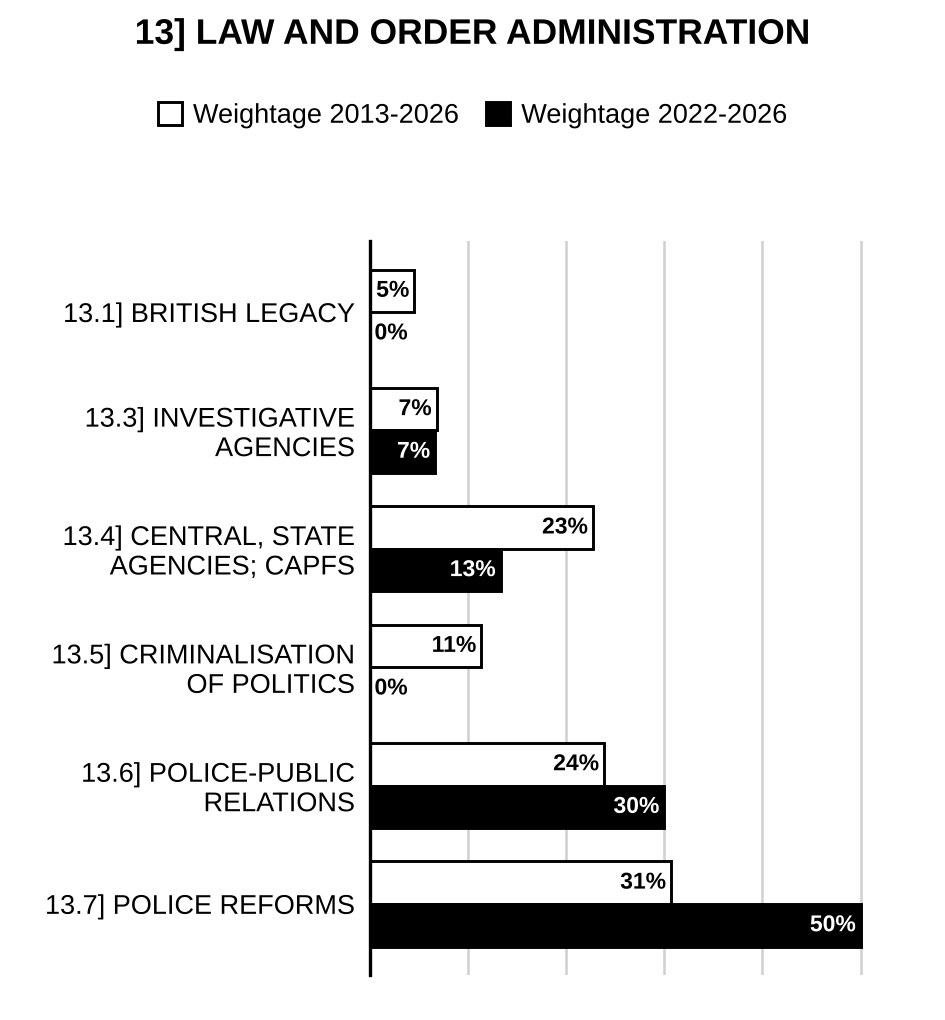
13.1] British legacy
2 questions
Critically examine the statement: ‘Thana’ (Police Station) as the last bastion of the waning British administrative legacy in India. [2014/10m/4c]
“The design of the Indian Police was to subjugate the Indian People in the aftermath of 1857.” Analyse in the context of the Indian Police Act of 1861. [2013/10m/150w/5c]
13.3] Investigative agencies
2 questions
National Investigation Agency (NIA) is playing an important role in countering terrorism. Comment. [2024/10m/7c]
Discuss critically the salient features of the National Investigation Agency (NIA) regarding its purposes and jurisdiction. [2015/20m/8b]
13.4] Role of Central and State agencies including para military forces in maintenance of law and order and countering insurgency and terrorism
11 questions
“The withdrawal of AFSPA from Tripura has sent a positive signal across the State and North-Eastern Region.” Do you think that now it is an appropriate time to take a more rational policy decision in this matter. [2023/20m/6b]
Even though the law and order administration is a State subject, it is paradoxical that the Central agencies—NIA or paramilitary forces under the Union Government—have restricted the powers of State Governments. Discuss. [2019/20m/8b]
“The AFSPA debate reveals that the Indian paramilitary forces are caught between the imperatives of national security and protection of human rights.” Discuss. [2018/10m/150w/5e]
In view of the contemporary internal scenario should ‘law and order’ be made a part of the Concurrent List of the Constitution of India? Justify your opinion. [2017/20m/7b]
Discuss the significance and role of the Central Paramilitary Forces in maintaining law and order and countering insurgency as well as terrorism. [2015/20m/7b]
Do you think that the Central para-military police forces have proven more effective than the State police service? Give your answer objectively in a critical vein. [2014/10m/8c]
“Even though law and order administration is a State subject in the Indian Constitution, it is paradoxical that the para-military and other kinds of security forces under the Union Government have grown in recent years.” Critically analyse the statement. [2012/20m/8b]
Comment on: “The role played by Central and State Governments in maintaining law and order is inadequate and unmatched to growing criminalization.” [2005/20m/200w/5d]
Comment on: “Maintenance of law and order is a State subject but the Union Government can deploy armed forces in any State.” [2000/20m/200w/5a]
“In the midst of political and socio-economic challenges, the law and order administration has become both difficult and delicate.” Explain. [1999/30m/7a]
Comment on: “The word ‘Police’ in the title of the Central Reserve Police Force and the Indo-Tibetan Border Police is a misnomer.” [1997/20m/200w/5b]

Preparing for Prelims too?
Our UPSC Prelims Topic-wise PYQ eBook covers every Prelims question with detailed explanations, so you can see exactly where UPSC asks from.
View the BookDownload Free Sample13.5] Criminalisation of politics and administration
6 questions
The increasing criminalization of politics is a major threat to the basic fabric of Indian democracy. Comment. [2021/10m/4c]
“Institutional change is a necessary but not a sufficient condition for reducing criminalisation of politics.” Examine. [2018/20m/8b]
“There is both criminalisation of politics and politicisation of criminals in India.” Examine and identify the challenges they cause for law and order administration. (In about 250 words) [2013/20m/250w/8a]
Comment on: “The role played by Central and State Governments in maintaining law and order is inadequate and unmatched to growing criminalization.” [2005/20m/200w/5d]
Comment on: “Criminalisation of politics has been responsible for the problems related to law and order in our nation.” [2004/20m/200w/5d]
“Criminalization of politics in India has been extended to politicization of criminals.” Comment. [2003/30m/7a]
13.6] Police-public relations
9 questions
Smart Policing and Community Policing programmes have been initiated to address socio-technological challenges in law and order. Discuss. [2025/10m/6c]
Police-Public relations are poor in India. What measures are required to strengthen these relations? [2024/20m/8a]
The effectiveness of law and order administration depends on cooperative attitudes of people towards police, than bringing reforms in the structure and procedures of law and order machinery. Do you agree? Give reasons. [2022/20m/8b]
Police-public relations in India need to be improved. Suggest measures to strengthen relations between police and public. [2021/10m/7c]
The police-public interface is punctuated with distrust and fear. Suggest how the police can reform its image in the eyes of the public. [2019/10m/4c]
Critically examine the concept of community policing as a tool for improving public-police relations. [2015/10m/150w/5a]
“Police-Public relations are a story of insincere efforts made on both sides.” Elaborate. [2014/10m/150w/5d]
“Laws are enacted without involving the police in the conception stage, with the result implementation of these laws leaves much to be desired.” Examine the role of police in protection of children. (In about 250 words) [2013/20m/250w/3a]
“Community policing has become a victim of elite capture.” Discuss the concept of community policing and bring out the implications of the above statement. [2011/30m/6b]
13.7] Reforms in Police
15 questions
Ethical and privacy issues limit the emerging use of Artificial Intelligence (AI) by police to combat cyber crimes. Comment. [2026/10m/150w/5e]
Supreme Court of India in Prakash Singh case laid the foundation for effective police reforms in India, but the states have frittered the opportunity. Discuss. [2026/20m/7a]
Smart Policing and Community Policing programmes have been initiated to address socio-technological challenges in law and order. Discuss. [2025/10m/6c]
The separation of police investigation and prosecution has its own benefits and challenges. Analyse in context of recent developments. [2024/20m/7a]
The government response to the Supreme Court’s judgement on Police Reforms has been lackadaisical. The reasons are multiple and multidimensional. Discuss. [2023/20m/7b]
There has been a long-standing demand for separation of police investigation from prosecution. Analyze its merits and demerits. [2020/10m/150w/5e]
Police needs to be made accountable and freed from the grip of politics. It is a big challenge not only for law and order but also for the development of the country. Critically examine. [2020/20m/7b]
“The image of Indian Police can be improved if its structure and orientations are transformed radically.” Do you agree? Elaborate. [2017/10m/7c]
Is training of police in India still a reflection of the colonial mindset? Give reasons for your answer. [2016/10m/150w/5d]
“Police reforms in India have remained a contentious issue.” Critically analyse. [2016/10m/8c]
Compare and contrast the Padmanabhaiah, Ribeiro and Malimath Committee Reports. [2012/25m/8a]
“The theme of Police Reforms continues to haunt the Parliament.” In the light of this statement, discuss the state of Criminal Justice System administration in India. [2011/30m/4a]
“Law and order problems of the twenty-first century cannot be tackled through legislations and structures of the nineteenth century.” Give suggestions for transforming the law and order machinery at the State level. [2009/30m/2a]
Do you think that the Indian police legislation, structure, technology, attitudes and behaviour are appropriate to meet the law and order problems in the country? What fundamental changes would you suggest in these realms to make the Central and the State police forces more effective in their role-performance? [1998/60m/7]
“The work of crime prevention has gone down in the priority list of police activities in recent years.” [1996/30m/7a]

Strengthen your GS papers
Our UPSC Mains Topic-wise & Year-wise PYQ eBook (2013–2026) maps every GS question to the syllabus, so you know what UPSC asks and how often.
View the BookDownload Free Sample« Previous: Urban Local Government | Next: Significant Issues in Indian Administration »
Back to: Public Administration Optional PYQs – Topic-wise | Also see: Public Administration Optional year-wise question papers
Last updated: 30 October 2026