
Here are all 51 Administrative Behaviour questions asked in UPSC Public Administration Optional Paper I from 1995 to 2026, arranged under the 5 topics of the official syllabus. Within each topic the latest questions come first.
Each question ends with a code such as [2024/15m/3b] – the year, the marks, the word limit (where UPSC set one) and the question number in the paper.
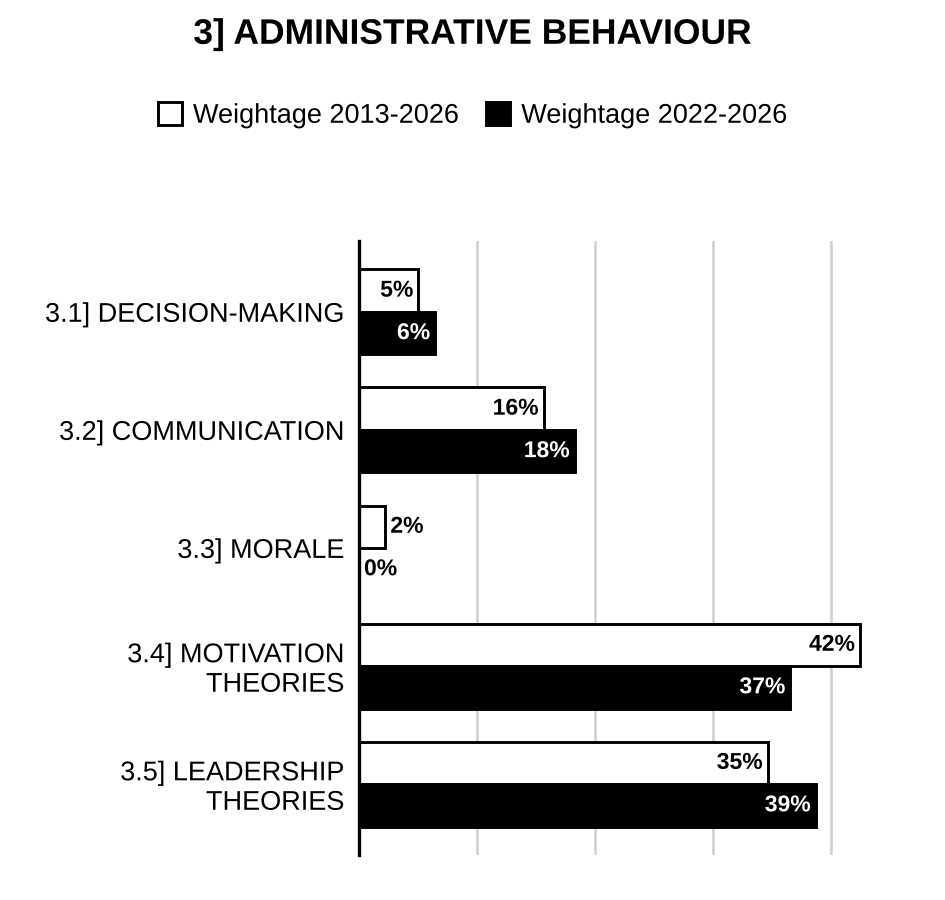
3.1] Process and techniques of decision-making
7 questions
The fine art of decision-making is not making decisions that others can make. Comment. [2025/10m/150w/1b]
“The process of decisions …… is largely technique of narrowing choices.” Explain. [2023/10m/150w/1c]
“Information constitutes the life-blood of the functioning of an organisation.” Explain the utility and significance of communication in decision-making. [2015/15m/3b]
Examine the respective roles of facts and values in the decision-making process. Is it possible to make value-free decisions in government system? How can government decisions be made more rational? [2008/60m/3]
“Information constitutes the life-blood of the functioning of organization.” In the light of this statement, explain the utility and importance of communication in decision-making. [2000/60m/3]
Comment on: “‘Consensus’ and ‘Unanimity’ are used as styles in decision-making.” [1998/20m/200w/1d]
“The study of decision-making is proceeding in so many directions that we can lose sight of the basic administrative processes that Barnard and Simon were trying to describe and that, so many men have been trying to improve.” Elucidate. [1995/60m/4]
3.2] Communication
11 questions
A transparent organisation keeps the staff in the loop. Describe. [2026/10m/150w/1c]
New communication technology has not only enabled more robust public engagement with the government, but also serves as a new means of internal organizational teamwork. Discuss. [2026/15m/6c]
“Grapevine is a necessary evil.” Examine. [2024/10m/150w/1c]
Strategic communication ought to be an agile management process. Discuss the conceptualization of strategic communication for the government actions. [2022/15m/3c]
“Communication represents the ‘Nerves of Government’” (Karl Deutsch). How can the communication system in the government be made more effective, responsive and motivational? [2018/20m/3a]
“Information constitutes the life-blood of the functioning of an organisation.” Explain the utility and significance of communication in decision-making. [2015/15m/3b]
‘The nature and role of communication in administration indicates that “Communication is authority”.’ Comment. [2001/20m/200w/1c]
“Information constitutes the life-blood of the functioning of organization.” In the light of this statement, explain the utility and importance of communication in decision-making. [2000/60m/3]
Comment on: “Communication holds the organisation together.” [1998/20m/200w/1b]
Comment on: Authority has been defined in part as a “character of a communication in a formal organization.” [1995/20m/200w/1c]
“Much of what the recruit learns in an organization is communicated after the fashion of Bentham’s ‘dog law’.” Discuss. [1995/30m/3a]

Preparing for Prelims too?
Our UPSC Prelims Topic-wise PYQ eBook covers every Prelims question with detailed explanations, so you can see exactly where UPSC asks from.
View the BookDownload Free Sample3.3] Morale
3 questions
“Morale can drive an organization forward or can lead to employees’ discontent, poor job performance and absenteeism.” Examine. [2016/10m/150w/1c]
What is meant by morale? There is a belief that “morale and productivity go hand in hand and higher the morale, higher the productivity.” Do you agree? Substantiate. [2007/60m/3]
What is morale? State its significance and suggest methods to foster and sustain morale in an organization. [2003/60m/4]
3.4] Motivation theories: content, process and contemporary
16 questions
Individuals’ perception of fairness and equity at the workplace motivates them to give their best. How can fairness and equity be reinforced to improve productivity in an entity? Discuss. [2026/15m/2c]
Abraham Maslow propounded the theory of needs, which identified the basic needs that human beings have in order of their importance. McClelland believes that we all have three motivators, and individuals with different motivators exhibit distinct characteristics. Critically examine. [2026/20m/4a]
ERG theory of motivation attempts to reconceptualise the theory of Hierarchy of Needs. Comment. [2024/20m/4a]
“Intrinsic motivation in comparison to extrinsic motivation leads to enhanced performance and creativity.” Examine. [2023/15m/3b]
“Two-factor theory entails certain factors in workplace resulting in job satisfaction, while others, if absent, lead to dissatisfaction.” Discuss. [2023/15m/4b]
Examine the approach of public service motivation as an inducement to bring the desired level of efficiency in public service delivery. [2021/10m/150w/1c]
“‘Performance information use’ is a form of organizational behaviour that is influenced by individual, job, organizational and environmental factors.” Critically analyse. [2020/20m/3a]
“The content and process theories of motivation have the same focus but are different in approaches.” Do you agree? Give reasons. [2020/15m/4b]
“Abraham Maslow’s ‘Hierarchy of Needs’ and Frederick Herzberg’s ‘Two-Factor theory’ have commonalities in the analysis of human motivation.” Comment. [2017/15m/2b]
What is the nature of psychological contract pursued by organizational management through authority and the employees through exertion of upward influence? [2013/15m/3c]
Read the following instances carefully and suggest what specific perspectives on organizational psychology of motivation would help the concerned organization to reconcile the needs of the following four persons with the needs of the organization: (i) Mr. A comes to his office with clocklike punctuality; does his work with impeccable honesty and integrity; takes order from above gladly; responds well to overtures by peers; but neither mixes with anyone himself nor seeks anyone’s company. What is more, he seems quite happy in his isolation. (ii) Mr. B is an efficient charge-hand at the welding shop. He is very outgoing and makes friends fast, but falls out with them very fast too. He is, however, easily pacified when anyone asks him to calm down in the name of the organization. (iii) Dr. C is completely happy and absorbed when he is teaching in the classes, and does not at all mind when his workload gets heavier and covers new areas. But he gets angry when the finance section raises objections about his medical bills; and is furious that the higher administration is yet to give him full tenure. (iv) Mr. D is a metallurgist in the forge shop of the steel plant, and has received honours for his innovativeness in modifying conventional alloys. He also paints well and values his painting skills far more than his metallurgy and is extremely unhappy that the company house journal did not finally carry his water sketch on its front cover. [2013/30m/8a]
‘Man’s motives … in different subparts of the same organization may be different’ [Edgar Schein]. Discuss. [2012/12m/150w/1c]
“Motivation theory is not synonymous with behaviour theory. The motivations are only one class of determinants of behaviour while behaviour is almost always motivated, it is also almost always biologically, culturally and situationally determined as well.” Comment. [2004/20m/200w/1b]
Compare Abraham Maslow’s theory of motivation and Herzberg’s motivation-hygiene theory. Do you think that they are universally applicable? If so, why? If not, why not? [2002/60m/4]
“Frederick Herzberg’s Two-factor theory is more or less an extension of Abraham Maslow’s theory of motivation.” Explain. [1997/30m/3a]
“The interest or power group base provides a member of an organization with negotiable goods that can be cashed in for recognition, status and rewards.” Examine. [1995/30m/3b]
3.5] Theories of Leadership: traditional and modern
14 questions
In conflict situations in organizations, leadership migrates to the aggressive and relegates the emotionally matured to the background. Discuss. [2025/20m/3a]
Leadership is not only about taking credit for success but also owning up and being accountable for failures. Elucidate. [2025/15m/4b]
“Reddin model of leadership added third dimension to the existing two basic dimensions of leadership identified by Ohio Studies and Blake and Mouton.” Elucidate. [2023/20m/4a]
Transformational leadership requires high degree of coordination, communication and cooperation. Explain. [2022/15m/2b]
“Leadership is seen as dealing with change, whereas administration is viewed as coping with complexity.” In this context, discuss the contextuality of leadership and administration for the success of organisations. [2022/20m/4a]
Nothing in public administration is more important, interesting or mysterious than leadership. Analyze the statement in the context of strategic leadership. [2021/15m/4c]
“A leader is a people’s developer” (Napoleon). Which aspects of subordinates’ development can be positively influenced by a leader? Discuss. [2018/10m/150w/1d]
“Leaders do the right things; managers do them rightly” — (Warren Bennis). Is this distinction by him valid? Explain. [2017/10m/150w/1d]
“Blake and Mouton defined leadership styles based on two dimensions — concern for people and concern for production.” In the light of the statement, discuss the Managerial Grid Model. Explain with reason which one of the styles is the best. [2016/20m/4a]
Do you agree with the view that the charismatic approach of the mid-1970s is a “new version” of the Classical Trait Theory of Leadership? Give reasons. [2015/10m/150w/1d]
Leadership is the ‘influential increment over and above mechanical compliance with the routine directives of the organization’ [Katz and Kahn]. Analyze. [2012/12m/150w/1d]
“The successful management leaders are found in Likert’s ‘System-4’ approach to organisational leadership.” Examine. [2010/20m/200w/1c]
Comment on: “Leaders do the right things; managers do them rightly.” (Bennis) Comment. [2008/20m/200w/1b]
Comment on: “That is to be a successful administrator one must have a catholic curiosity.” [1997/20m/200w/1b]

Strengthen your GS papers
Our UPSC Mains Topic-wise & Year-wise PYQ eBook (2013–2026) maps every GS question to the syllabus, so you know what UPSC asks and how often.
View the BookDownload Free Sample« Previous: Administrative Thought | Next: Organisations »
Back to: Public Administration Optional PYQs – Topic-wise | Also see: Public Administration Optional year-wise question papers
Last updated: 30 October 2026