
Management Optional PYQs Topic-wise for UPSC Mains (1995–2026) are listed below unit by unit, in the order of the official syllabus – 1594 questions in all. Click any unit to open all its previous year questions, arranged topic-wise with the latest first.
Paper I
| Unit | Topic (click to open PYQs) | Sub-topics | Questions | Link |
|---|---|---|---|---|
| 1 | Managerial Function and Process | 10 | 95 | Click here → |
| 2 | Organisational Behaviour and Design | 9 | 171 | Click here → |
| 3 | Human Resource Management | 14 | 128 | Click here → |
| 4 | Accounting for Managers | 12 | 101 | Click here → |
| 5 | Financial Management | 13 | 141 | Click here → |
| 6 | Marketing Management | 17 | 150 | Click here → |
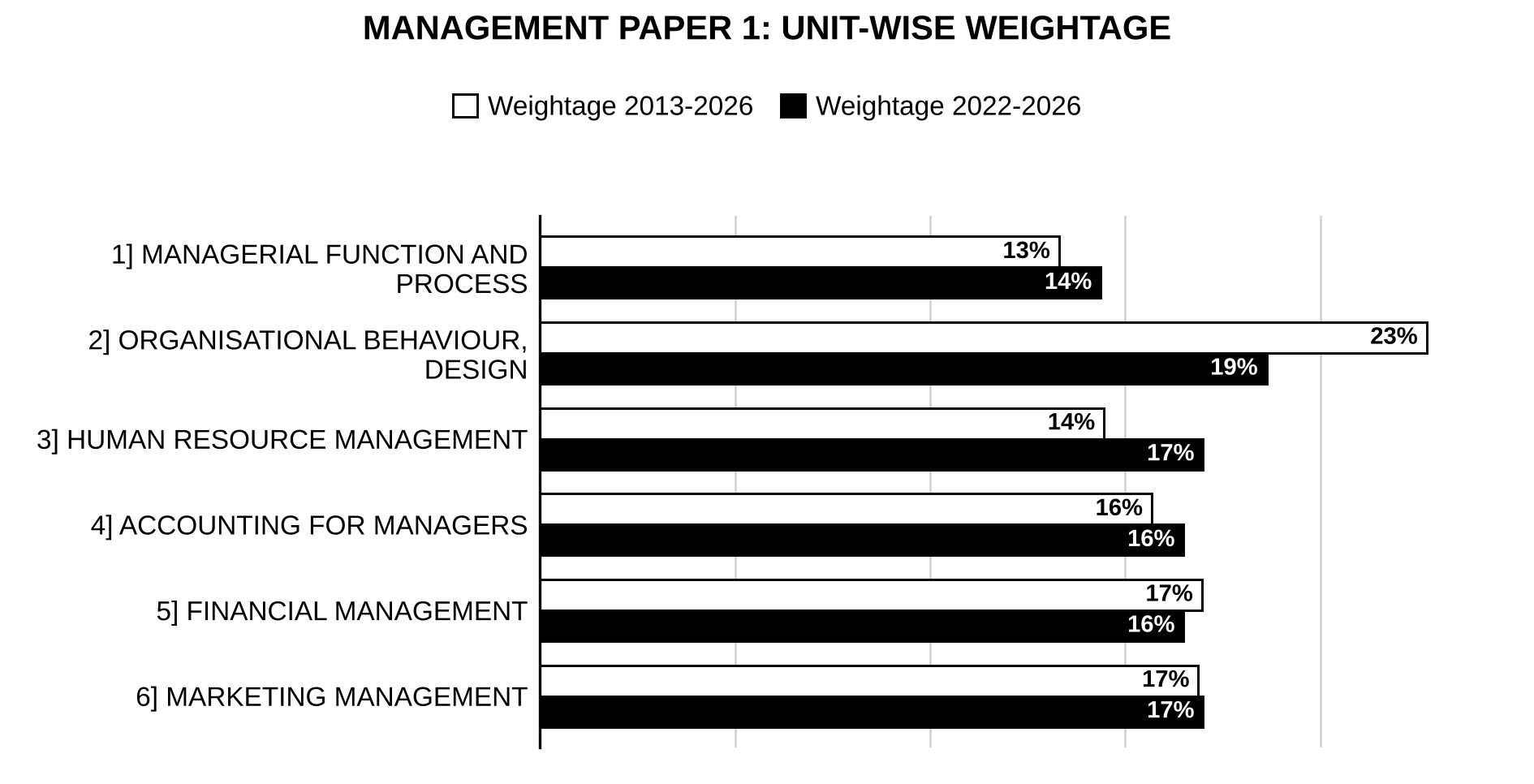
Trend: Marks are spread fairly evenly across the six units, each taking roughly 13–23% of the paper. Organisational Behaviour and Design has been the largest unit since 2013 (about 23%), led by individual processes such as personality, perception and motivation (topic 2.2) and by leadership, power, conflict and communication (2.3), though its share has eased to about 19% in 2022–2026. Human Resource Management has gained (about 17% in 2022–2026), with training and development and industrial relations asked more often. In Accounting for Managers, financial statement analysis (ratios, fund and cash flow) is the most frequent topic, while Financial Management and Marketing Management hold steady at about 16–17% each.

Preparing for Prelims too?
Our UPSC Prelims Topic-wise PYQ eBook covers every Prelims question with detailed explanations, so you can see exactly where UPSC asks from.
View the BookDownload Free SamplePaper II
| Unit | Topic (click to open PYQs) | Sub-topics | Questions | Link |
|---|---|---|---|---|
| 1 | Quantitative Techniques in Decision-Making | 10 | 138 | Click here → |
| 2 | Production and Operations Management | 15 | 176 | Click here → |
| 3 | Management Information System | 9 | 111 | Click here → |
| 4 | Government Business Interface | 12 | 100 | Click here → |
| 5 | Strategic Cost Management | 12 | 141 | Click here → |
| 6 | International Business | 20 | 142 | Click here → |
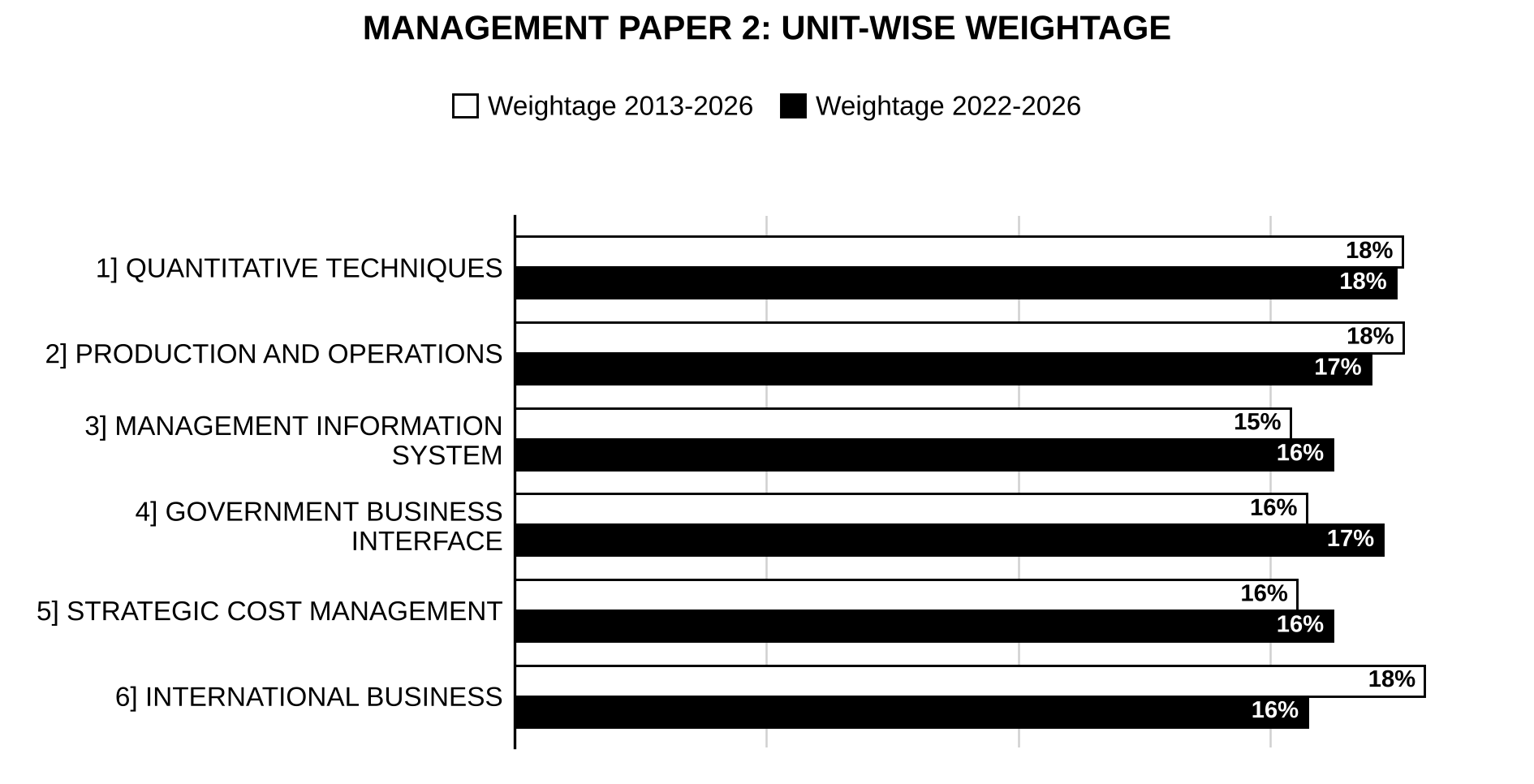
Trend: All six units carry similar weight, about 15–18% each, in 2013–2026 and in the last five years. Linear programming (topic 1.10) is the single most-asked topic of the paper, and the numerical units (Quantitative Techniques; Production and Operations Management) together take over a third of the marks. Strategic analysis tools such as BCG, GE and Porter’s five forces (5.5) recur every year; in MIS, e-business and e-governance, data resources and ERP lead. In International Business, foreign investment (6.15), India’s foreign trade policy and regional economic cooperation have risen sharply in 2022–2026, and small-industry policy (4.3) has gained in Government Business Interface.
More questions
Other questions (outside the present syllabus) – 14 questions
How this collection is organised
Considering the changing exam pattern over three decades, we felt it necessary to declare some practices we’ve adopted in this collection.
Units and topics follow the official syllabus, which has six units in each paper – Paper 1: 1 Managerial Function and Process, 2 Organisational Behaviour and Design, 3 Human Resource Management, 4 Accounting for Managers, 5 Financial Management, 6 Marketing Management; Paper 2: 1 Quantitative Techniques in Decision-making, 2 Production and Operations Management, 3 Management Information System, 4 Government Business Interface, 5 Strategic Cost Management, 6 International Business. Each unit’s text is divided into topics (for example Paper 1 – 5.5 Capital budgeting). Where a unit has many questions, they are further divided by these topics.
Up to 2007 the papers followed an older syllabus: Paper 1 also had quantitative techniques and managerial economics, and Paper 2 covered marketing, production, finance and human resources. These older questions are placed by their content under the present syllabus, in whichever paper the topic now belongs (for example, a 2003 Paper 1 regression question is under Paper 2 – 1.6, and a 1997 Paper 2 marketing question under Paper 1 – unit 6). From 2008 every question stays in its own paper.
Questions on areas the syllabus does not name separately are placed under the nearest topic: for example, motivation theories under individual processes (Paper 1 – 2.2), industrial relations and trade unions under organisational climate and industrial relations (3.11), CVP and break-even analysis under marginal costing (4.12), payoff tables and decision trees under decision theory (Paper 2 – 1.8), CPM/PERT under project management (2.10), JIT and lean production under world class manufacturing (2.9), and Porter’s five forces, BCG and GE matrices under tools of strategic analysis (5.5).
Some questions cover more than one topic. We’ve kept such questions in each topic of relevance. Questions from the older papers that fit no topic of the present syllabus (managerial economics, monetary and fiscal policy, dynamic programming and the like) are kept under “Other Questions (Outside the Present Syllabus)” at the end of the paper concerned.
Where a case or a set of data is followed by its own sub-questions with separate marks, the case is given once and its sub-questions follow, each with its own code.
Graphs at the start of each paper show the weightage of every unit in that paper, and graphs for each unit show the weightage of its topics. Weightage is the share of marks asked from a unit or topic, compared for 2013–2026 (white bars) and the last five years, 2022–2026 (black bars). A question placed under two topics has its marks split equally between them.
Each of the topicwise question is suffixed by a question code like this [2024/20m/2a]. This code indicates a) year in which the question was asked, b) maximum marks the question carried, c) prescribed word limit (where UPSC set one, e.g. 150w) and, d) the question number in actual paper, in given order.
Until 2012, each paper carried 300 marks (60 per question); since 2013 each paper carries 250 marks (50 per question). Where a question offered more parts than were to be answered (“answer any three” of four parts, up to 2009), every part is included with its own marks. The available copies of the 1995–2000 and 2008 papers print no marks; their codes assume the pattern of those papers (60 per question, divided equally between its parts, and 20 for each part of an “any three” question).
2016–2026 papers are transcribed from the official UPSC question papers and 2009–2015 from scans of the printed papers. No scan of the 1995–2008 papers is available; they are taken from retyped copies (tables flattened in those copies have been rebuilt from their figures). For 2008 only part of Paper 1 (Questions 1–5 and 8) could be found, and no copy of Paper 2.
The wording and figures of the questions are as printed, including the papers’ own grammar.
Spotted an error? Use the “Report an Error” box at the end of any page – we review every report and update the page.

Strengthen your GS papers
Our UPSC Mains Topic-wise & Year-wise PYQ eBook (2013–2026) maps every GS question to the syllabus, so you know what UPSC asks and how often.
View the BookDownload Free SampleLast updated: 30 October 2026