
Here are all 141 Financial Management questions asked in UPSC Management Optional Paper I from 1995 to 2026, arranged under the 13 topics of the official syllabus. Within each topic the latest questions come first.
Each question ends with a code such as [2024/15m/3b] – the year, the marks, the word limit (where UPSC set one) and the question number in the paper.
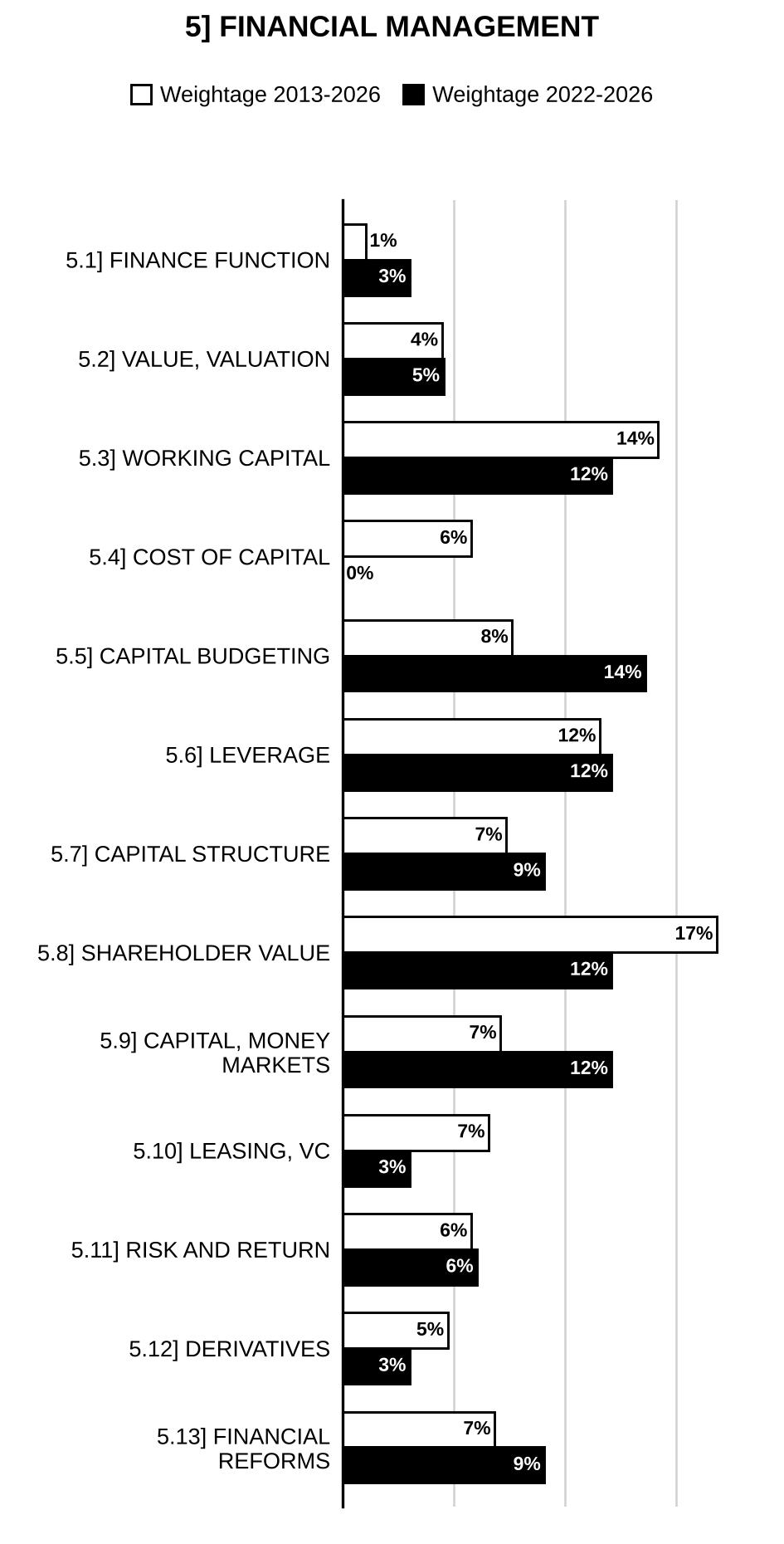
5.1] Goal of the finance function
2 questions
Discuss on the objectives and categories of decisions of the finance function in an organization. [2023/10m/5a]
An optimal combination of the decisions relating to investment, financing and dividends will be to maximize the value of the firm, to its shareholders. Discuss with examples. [2004/60m/3]
5.2] Value, return and valuation
7 questions
A ₹ 100 par value bond bearing a coupon rate of 8% will mature after 5 years. Interest is payable quarterly. What is the value of the bond, if the discount rate is 12%? (Chart given for reference)
[Figure: Chart printed with the question (two pages, rotated) – “Present value Interest Factor PVIF (r, n) = ” and “Present Value Interest Factor for an Annuity PVIFA (r, n) = ”, each for rates 1% to 13% and periods n = 0–20, 25, 30] [2022/15m/6b]
What is the relationship between bond prices and interest rate? How does one calculate yield to maturity (YTM) on a bond? Define discount bonds, zero coupon bonds and premium bonds. [2018/10m/150w/5b]
The India Times reported yesterday that ABS Ltd. earned (profit after tax) ₹ 200 crore during the year ending yesterday and paid out a dividend of ₹ 100 crore during the same period. The report also mentioned that the firm’s return on equity (ROE) is 20%. Answer the following questions assuming that the firm will maintain the same dividend payout ratio forever: (i) What is the firm’s earnings growth rate? (ii) What will next year’s earnings be? (iii) What will next year’s dividend be? (iv) What is the estimate of market value (market capitalization) of ABS Ltd., if market considers 15% as the required rate of return on equity (cost of equity) of ABS Ltd? [2018/10m/150w/5c]
What is ‘present value’ of money? Why and how this concept is applied in capital investment decisions? [2013/15m/300w/7c]
Segmentation hypothesis of capital market. [2010/20m/200w/5a]
Explain, with brief illustrations, the expectation hypothesis of bond valuation. [2010/30m/6b]
Time value of money. [2009/20m/200w/5b]
5.3] Working capital management
22 questions
Explain the paradoxical nature of liquidity as both a safeguard and a potential drag on corporate performance by examining the delicate equilibrium between security and opportunity cost in cash management decisions. [2025/10m/5b]
A proforma cost sheet of a company provides the following data:
| Cost per unit | ₹ |
| Raw material | 52.00 |
| Direct Labour | 19.50 |
| Overheads | 39.00 |
| Total Cost | 110.50 |
| Profit | 19.50 |
| Selling Price | 130.00 |
The following is the additional information available:
| Average raw material in stock | one month |
| Credit allowed to debtors | two months |
| Time lag in payment of wages | one and a half weeks |
| Overheads | one month |
One fourth of the sales are on cash basis. Cash Balance is expected to be ₹1,20,000. You are required to prepare a statement showing the working capital needed to finance a level of activity of 70,000 units of output. You may assume that production is carried on evenly, throughout the year and wages and overheads accrue similarly. [2024/20m/6a]
What are some early signs of cash flow problems? [2023/10m/7b]
Highlight the major factors that need to be considered for a proper assessment of the quantum of working capital required by a firm. [2021/15m/8b]
What purpose do the Baumol model, Miller-Orr model and Orgler’s model serve? Briefly describe the similarities and differences between these models. [2020/20m/8a]
Explain briefly the costs and benefits associated with holding inventory. What are the considerations determining the maximum level and minimum level of inventory? [2019/10m/150w/5c]
Explain the Miller-Orr model of cash management. How is this model helpful in determination of appropriate cash balance? [2017/10m/150w/5d]
Explain the operating cycle concept of working capital. How is a close study of operating cycle helpful in the management of working capital? Explain. [2017/15m/6c]
“Finance manager is always faced with the dilemma of liquidity vs. profitability.” Explain the concept of liquidity and profitability. [2016/10m/150w/5c]
Discuss three approaches to working capital management. Give examples from real-life scenario to illustrate your answer. [2015/15m/7b]
Is working capital different from management of cash? In what ways? What are the factors which influence working capital requirements? Discuss the models of cash management. [2007/60m/2]
Cash Management Models. [2001/20m/200w/1b]
Working capital management deals with decisions regarding the appropriate mix and level of current assets and current liabilities. Elucidate the statement along with describing the factors which are taken into account in determining the working capital needs of the firm. [2001/60m/2]
Role of ‘Operating cycle’ in determining the size of working capital. [2000/20m/200w/5c]
In what ways do the objectives of management of cash influence credit and collection policies of management of accounts receivable? How does a change in average collection period (ACP) affect the flows of cash? [2000/60m/6]
What are the considerations that decide the size of working capital in a concern? [1999/30m/9a]
Give your views on management of cash, inventories and receivables. [1999/30m/9b]
What is cash budgeting? What is its purpose? Why is it that despite cash budgeting some of the enterprises in India are reportedly facing liquidity crisis? How can the problem of liquidity crisis be overcome? [1998/30m/7a]
How is size of working capital determined? Do you think the working capital required by any enterprise is a static amount? Give detailed reasons for your answer. [1998/30m/9a]
How is the size of working capital determined? Give appropriate example. [1997/30m/8b]
Examine critically the effects of inflation on working capital management. [1996/30m/8b]
How can the appropriate level or working cash balance be determined? How does uncertainty affect this problem? [1995/30m/9b]
5.4] Cost of capital
8 questions
What are the common misconceptions surrounding cost of capital in practice? How would you dispel them? [2020/10m/5a]
What is the significance of cost of capital in capital budgeting? Is the cost of preference shares lower than the cost of equity shares? State reasons for your answer. [2019/10m/8b]
Atul Mahindra Ltd. has the following capital structure:
| Type of Financing | Book Value | Market Value |
| 8% Non-Convertible Debentures (NCD) | 5,00,000 | 5,00,000 |
| 7.5% Preference Share Capital | 12,00,000 | 10,00,000 |
| Equity Share Capital | 8,00,000 | 10,00,000 |
| Total | 25,00,000 | 25,00,000 |
Atul Mahindra Ltd. is in the 40% tax bracket. The risk-free rate of return is 8% and the expected market risk premium is 7%. The equity beta of Atul Mahindra Ltd. is 1.00. Calculate the weighted average cost of capital for Atul Mahindra Ltd. [2018/10m/8c]
“Equity capital and Retained earnings provide cost-free capital.” Do you agree with this statement? Explain the methods for determining their costs. [2017/20m/7a]
Cost of Capital and Investment Decisions. [2013/10m/150w/5a]
Cost of equity is a required rate of return. [2000/20m/200w/5b]
Assess the validity of the statement that cost of capital calculation and determining financial structure of a firm are inter-related functions. [1997/30m/8a]
How is the weighted average cost of capital calculated? What weights should be used in its calculation? [1996/30m/8a]
5.5] Capital budgeting
16 questions
A manufacturing enterprise is evaluating a long-term investment proposal aimed at modernizing its production facilities. The project entails a substantial capital outlay on fixed assets, along with an additional investment in working capital to sustain operational activities throughout the project period. The management intends to assess the proposal using the Net Present Value (NPV) method, taking into account all relevant cash flows, including terminal recoveries. The project details are as follows:
| Initial investment in fixed assets | ₹8,00,000 |
| Additional working capital requirement (fully recoverable at the end of the project) | ₹1,00,000 |
| Project life | 4 years |
| Scrap value of assets at the end of Year 4 | ₹50,000 |
| Annual cash inflows | ₹3,00,000 |
| Cost of Capital | 10% |
Answer the following:
(i) Calculate the Net Present Value (NPV) of the project by appropriately considering the initial investment, working capital commitment, annual cash inflows and terminal cash recoveries. [2026/10m/7b(i)]
(ii) Based on the computed NPV, evaluate the financial feasibility of the project and justify your recommendation. [2026/4m/7b(ii)]
(iii) Discuss the significance of incorporating working capital requirements and terminal cash inflows in capital budgeting decisions and explain how their omission may affect project appraisal outcomes. [2026/6m/7b(iii)]
Distinguish between ‘Total Cash Flow’ and ‘Incremental Cash Flow.’ What are the limitations of Incremental Cash Flow? Also explain the treatment of sunk cost and allocated overheads in cash flows. [2024/10m/5c]
What is modified internal rate of return (MIRR)? What are the pros and cons of MIRR vis-a-vis IRR & NPV? [2022/15m/7b]
Compare ‘Net Present Value’ (NPV) method and ‘Internal Rate of Return’ (IRR) method of evaluating capital investments. Which of the two methods is superior and why? [2018/15m/6b]
Cost of Capital and Investment Decisions. [2013/10m/150w/5a]
What is ‘present value’ of money? Why and how this concept is applied in capital investment decisions? [2013/15m/300w/7c]
Contrast the IRR and NPV methods. Under what circumstances may they lead to (i) comparable recommendations, and (ii) give conflicting recommendations? In the latter situation, which method should be used to select project and why? Elucidate with appropriate examples. [2012/20m/6b]
Capital Budgeting. [2006/20m/200w/1a]
Net Present Value v/s Internal Rate of Return. [2000/20m/200w/1c]
Why should risk be considered while appraising the projects for investment decisions? Explain the methods used for adjustment, and incorporation of risk in capital expenditure (capital budgeting). [2000/60m/8]
Discuss various techniques of capital budgeting using suitable projects where these techniques are most appropriate. [1999/60m/6]
How is capital expenditure proposal appraised? How should one choose between modernisation, expansion and diversification? How can the related risks be minimised? [1998/30m/7b]
The management of a company has adopted a policy of sacrificing the present investment opportunities yielding say 20% return per annum with a view to invest, some 8 years later expecting 40% annual return. Comment on the wisdom of this policy giving both favourable and unfavorable aspects. [1998/30m/9b]
Explain Incremental Cost and incremental Revenue/Income. Discuss their role in appraising investment (capital expenditure) projects. [1997/30m/7b]
Under what circumstances do the net present value and internal rate of return methods differ? What method would you prefer and why? [1995/30m/7b]
The certainty equivalent approach is theoretically superior to the risk adjusted discount rate. Do you agree? Give reasons. [1995/30m/8b]
5.6] Financial and operating leverage
10 questions
ABC Technologies, a company producing high-tech components, is considering a significant expansion of its production capacity. This expansion will involve substantial fixed costs in new machinery and equipment, and they are also considering increasing their debt financing. The following information is available:
Current Situation:
| Fixed Operating Costs | ₹20,00,000.00 |
| Variable Operating Costs per unit | ₹50.00 |
| Selling Price per unit | ₹150.00 |
| Current Production and Sales | 50,000 units |
| Current Interest Expense | ₹10,00,000.00 |
Expansion Plan:
| Increased Fixed Operating Costs | ₹35,00,000.00 |
| Increased Interest Expense | ₹18,00,000.00 |
| Expected increase in Production and Sales | 20,000 units |
(i) Calculate the current and projected Degree of Operating Leverage (DOL), Degree of Financial Leverage (DFL) and Degree of Combined Leverage (DCL). (ii) Analyse the impact of the expansion plan of ABC Technologies on operating and financial risk. Discuss the trade-offs involved. (iii) Evaluate the sensitivity of the company’s Earnings Per Share (EPS) to change in sales volume, considering both the current and projected leverage levels. (iv) Discuss the factors that ABC Technologies should consider when determining the optimal level of financial and operating leverage, especially in the context of high-tech industry’s volatility. (v) Given that ABC Technologies is considering alternative financing options, such as issuing equity instead of increasing debt, explain how this decision would impact the company’s financial leverage and overall risk profile. [2025/20m/7b]
Sunder Ltd. is planning an expansion programme which will require ₹30 crores and can be funded through one of the three following options: 1. Issue equity shares of ₹100 each at par 2. Raise a 15% loan, and 3. Issue 12% preference shares The present paid up capital is ₹60 crores and the annual EBIT is ₹12 crores. The tax rate may be taken at 30%. After the expansion plan is adopted, the EBIT is expected to be ₹15 crores. Calculate the EPS under all the three financing options indicating the alternative giving the highest return to the equity shareholders. Also determine the indifference point between the equity share capital and the debt financing (i.e. option 1 and option 2 above) [2024/20m/7a]
A firm has sales of ₹ 20,00,000, variable cost of ₹ 14,00,000, fixed cost of ₹ 4,00,000 and debt of ₹ 10,00,000 at 10% rate of interest. Calculate the operating, financial and combined leverages. If the firm wants to triple its earnings before interest and tax (EBIT), how much of a rise in sales would be needed on a percentage basis? [2019/15m/8c]
“Leverage serves as a tool which cuts both ways. On one hand it increases the risk and on the other it provides an opportunity to increase return on investment.” Critically examine this statement. [2017/20m/8c]
Explain the concept of ‘operating leverage’, ‘financial leverage’ and ‘combined leverage’ with the help of suitable examples. [2015/15m/6a]
A pushcart vendor and a vegetable store vendor have identical sales and operating profit (i.e. profit before interest and tax):
(i) Using assumed numbers, calculate the degree of operating leverage for the two businesses. [2014/10m/8b(i)]
(ii) Which of the two businesses can have a higher financial leverage? [2014/10m/8b(ii)]
Usefulness of operating leverage and indifference point in designing capital structure. [2012/12m/150w/5d]
“Operating and financial leverage are symmetric in behaviour.” Critically examine the statement from risk-analysis point of view. [2010/30m/6a]
Complementary relationship of financial and operating leverages. [2000/20m/200w/5a]
Define and explain the significance of operating and financial leverage analysis for a financial executive incorporate profit and financial structure planning. [1996/30m/7a]

Preparing for Prelims too?
Our UPSC Prelims Topic-wise PYQ eBook covers every Prelims question with detailed explanations, so you can see exactly where UPSC asks from.
View the BookDownload Free Sample5.7] Design of capital structure
8 questions
What are the factors that need to be kept in mind while designing the capital structure of a firm? [2023/10m/6b]
A Ltd’s EBIT is ₹ 10,00,000. The company has 12%, ₹ 30 lakhs debentures. The equity capitalization rate, i.e., is 20%. Compute the following:
(i) Market value of equity and value of firm [2023/12m/7a(i)]
(ii) Overall cost of capital [2023/8m/7a(ii)]
Mohan Ltd. has earnings before interest and taxes (EBIT) of ₹ 5,00,000. The firm currently has an outstanding debt of ₹ 20,00,000 at an average cost, of 12%. Its cost of equity capital, is estimated to be 18%. (i) Determine the current value of the firm using the traditional approach. (ii) Determine the firm’s overall capitalization rate, . (iii) The firm is considering to issue the capital of ₹ 10,00,000 in order to redeem ₹ 10,00,000 debt. The cost of debt is expected to be unaffected. However, the firm’s cost of equity capital is to be reduced to 16% as a result of decrease in leverage. Would you recommend the proposed action? [2019/20m/6c]
What is the pecking order theory of financing? Compare it with the trade-off theory of capital structure. [2018/10m/150w/5a]
“The success of a company depends on its well-planned capital structure.” Examine. [2017/10m/150w/5c]
The overall capitalization rate of the firm () does not change with any degree of financial leverage. Elucidate and debate. [2003/60m/2]
The traditional principles of sound financial planning of a new enterprise seem to yield to new innovative design as is evident from a new petrochemical company’s issue of convertible debentures worth several hundred crores. How far do you think this is desirable in the control of Indian economy. You are to discuss only the pros and cons of traditional financial planning vis-a-vis innovative financial planning. [1998/30m/8a]
Assess the validity of the statement that cost of capital calculation and determining financial structure of a firm are inter-related functions. [1997/30m/8a]
5.8] Shareholder value creation
20 questions
Examine the causes, consequences and management of corporate distress. Evaluate restructuring strategies for organisational recovery and sustainability. [2026/10m/150w/5b]
How does globalization influence corporate financial policy and strategy? Discuss the challenges and opportunities that multinational corporations face in managing their finances across different countries and currencies. [2025/15m/6b]
What are the primary causes of corporate distress? Highlight the appropriate restructuring strategies that can be adopted to deal with different causes of corporate distress. [2022/15m/8b]
Explain the Modigliani-Miller hypothesis of dividend irrelevance. Also critically examine the assumptions underlying the irrelevant hypothesis. [2019/15m/6b]
What is value-based management? Explain the ‘value drivers’ and ‘key managerial processes’. [2016/10m/150w/5d]
What are the macro-factors prevailing in the global economy that lead to mergers and acquisitions? [2016/20m/7c]
“Dividend increase sends good news about cash flows and earnings. Dividend cuts send bad news.” Elucidate with examples. Also discuss factors affecting dividend policy. [2015/20m/8a]
Under what conditions should a firm pay cash dividend or bonus shares? [2014/10m/6c]
Management of Corporate distress and restructuring. [2013/10m/150w/5c]
Explain the ‘Value drivers’ and ‘Key managerial processes’ relevant to value-based management. [2013/20m/300w/6a]
What is meant by corporate financial models? Critically analyse the conditions for the use of corporate financial models. [2013/15m/300w/6c]
Approaches of Walter and Lintner towards dividend policy. [2012/12m/150w/5a]
What are the various approaches on deciding product pricing? Discuss the concept and method of computing EVA in business. [2012/20m/6a]
Relevance of Modigliani-Miller Dividend Model in Indian Context. [2008/20m/200w/5d]
To what extent are firms able to establish a definite long-run dividend policy? How do these policies affect market value of a firm’s securities? Discuss with examples. [2005/60m/2]
‘The dividend policy is irrelevant for valuation’ [2003/20m/200w/1a]
Corporate distress and restructuring strategy. [2002/20m/200w/1a]
Discuss the pros and cons of a policy of retaining profits to meet financial requirements of the firm vis-a-vis the policy of higher payout. [1997/30m/9b]
What are the determinants of the dividend policy of corporate enterprises? Does it affect the value of a firm? [1996/30m/9a]
Explain bonus shares. When are they issued? What is their rationale? [1996/30m/9b]
5.9] Capital and money markets
11 questions
Discuss the regulatory framework governing capital markets and evaluate its role in promoting transparency, protecting investors and improving market efficiency. [2026/15m/6b]
What is Money Market? Elaborate its key functions in the financial system. Include specific examples of widely used money market instruments and the institutions that deal in them. [2025/15m/8b]
Highlight the major differences between Capital Market and Money Market. [2022/10m/5b]
Define ‘money market’ and ‘capital market’. Explain primary market, secondary market and initial public offering (IPO) market. [2015/10m/150w/5c]
“The regulation of capital market has become important.” Discuss the role of SEBI in the context of recent reforms in the financial sector. [2015/20m/6b]
Raising long term funds through ‘IPO’ is better than ‘Venture Capital’. Critically analyse. [2013/15m/300w/7b]
How will you go about raising capital for a large infrastructure project and discuss the various options that you would like to explore with relevant decision criteria. [2012/20m/6c]
Describe alternative methods used by companies to finance long-term capital needs. What is the role of capital markets vis-à-vis venture capitalists? What role can the Government play to promote new enterprises? [2009/60m/7]
Capital Market. [2005/20m/200w/1a]
Syndicated placement of new equity/debenture issues is a bane of Indian securities market. Discuss the issue in the context of the latest developments witnessed by Indian Capital market. [1998/30m/8b]
Indian capital market now extends bend national territory. Comment and examine its impact on the working of Indian Stock Exchanges. [1997/30m/9a]
5.10] Leasing, hire purchase and venture capital
12 questions
How would you choose among leasing, leveraged buying and hire-purchase? [2024/6m/8b(i)]
Under what conditions ‘sale and lease back’ is a preferable option? [2024/4m/8b(ii)]
Explain in brief the (i) Conventional; (ii) The First Chicago; and (iii) The Revenue Multiplier Valuation approaches for financial analysis of Venture Capital Investments. [2021/15m/6b]
Distinguish between leasing and hire purchase. [2020/10m/5b]
Explain the economic rationale behind leasing as a mode of financing capital assets. What are the differences between an operating lease and a capital lease? [2018/10m/2d]
Compare ‘leasing’ and ‘buying’ as alternative methods of financing. Explain with an example. [2014/10m/150w/5d]
Raising long term funds through ‘IPO’ is better than ‘Venture Capital’. Critically analyse. [2013/15m/300w/7b]
Financial framework for lease evaluation from the point of view of the lessee. [2012/12m/150w/5e]
Distinguish between conventional venture capitalist valuation method and revenue multiplier method. Describe various types of investment nurturing by venture capitalists. [2011/30m/6b]
Describe alternative methods used by companies to finance long-term capital needs. What is the role of capital markets vis-à-vis venture capitalists? What role can the Government play to promote new enterprises? [2009/60m/7]
Venture Capital. [2005/20m/200w/1d]
It makes sense for companies that pay no taxes to lease from companies that do. Explain. [1995/30m/8a]
5.11] Risk and return
9 questions
What is beta in the context of the CAPM? Explain how it measures systematic risk. Discuss the beta values and their implications for asset pricing. [2024/10m/7b]
What are the major objectives of portfolio management? List the major ratios used to evaluate a portfolio. [2023/10m/8b]
What is Capital Asset Pricing Model (CAPM)? What are its underlying assumptions? How will you distinguish between Capital Market Line (CML) and Security Market Line (SML)? [2019/10m/7b]
Explain with examples the concept of financial risk and return. [2016/15m/7b]
Explain with an illustration the method of estimating required rate of return based on CAPM. [2014/10m/150w/5e]
“Despite challenges, CAPM is widely used because it is a practical equilibrium model.” Comment. Discuss the major elements of CAPM. [2011/30m/4b]
Discuss the misconceptions surrounding the efficient market hypothesis. Explain the alternative paradigm of ‘noise trading and arbitrage’. [2009/60m/4]
Management of risk in business. [2006/20m/200w/5a]
Capital Asset Pricing Model. [2004/20m/200w/1a]
5.12] Financial derivatives
8 questions
What is a Futures Contract? Why do exchanges require future contracts to be marked to the market? [2022/10m/5c]
What is a swap? What are the common types of swaps? How are these investments induced? [2021/10m/5c]
What are Option Greeks and what is their significance? [2020/15m/7b]
Financial Derivatives–Options and Futures. [2013/10m/150w/5b]
Financial derivatives as tools of managing financial risk. [2012/12m/150w/1d]
Explain Back-Scholes Option Pricing Model, with the help of suitable illustrations and discuss its applications. [2011/30m/6a]
Synthetic loan. [2010/20m/200w/5c]
Exchange-trade rupee Future [?]. [2008/20m/200w/5a]
5.13] Recent reforms in the financial sector
8 questions
Critically discuss the challenges and opportunities emerging from the financial sector reforms, with particular reference to the forces of globalization, technological innovation and the evolving regulatory landscape. [2026/20m/8b]
Comment on the salient features of the EASE Next Reforms. [2023/10m/5c]
“Financial sector reforms in India were introduced as a part of the liberalization policy of nineties and subsequent reforms were a move in the right direction but inadequate.” Explain. Identify the weaknesses in the present financial system. How can these be overcome? [2020/15m/8b]
“The regulation of capital market has become important.” Discuss the role of SEBI in the context of recent reforms in the financial sector. [2015/20m/6b]
What do you understand by ‘Capital Adequacy’? Why is it important for financial sector reform? [2014/10m/150w/5c]
What policy measures have been taken during the Post liberalisation period to enhance competitiveness of Indian financial markets? How far have these measures succeeded in this direction? [2011/30m/7b]
Credit Policy of India. [2007/20m/200w/1a]
Total deregulation while pricing the banking products is very much possible in India. Comment. [2002/60m/3]

Strengthen your GS papers
Our UPSC Mains Topic-wise & Year-wise PYQ eBook (2013–2026) maps every GS question to the syllabus, so you know what UPSC asks and how often.
View the BookDownload Free Sample« Previous: Accounting for Managers | Next: Marketing Management »
Back to: Management Optional PYQs – Topic-wise
Last updated: 30 October 2026