
Here are all 100 Government Business Interface questions asked in UPSC Management Optional Paper II from 1995 to 2026, arranged under the 12 topics of the official syllabus. Within each topic the latest questions come first.
Each question ends with a code such as [2024/15m/3b] – the year, the marks, the word limit (where UPSC set one) and the question number in the paper.
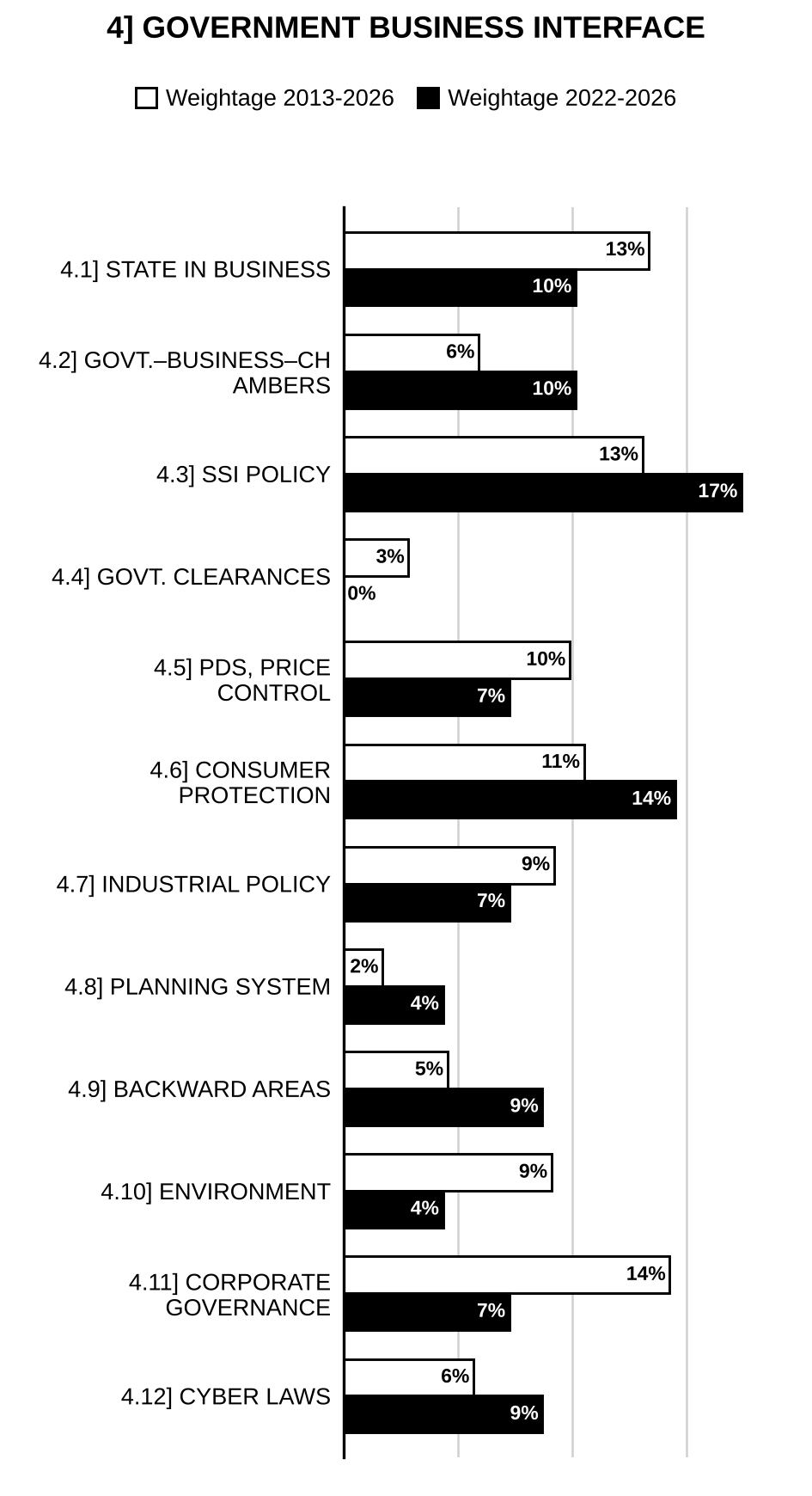
4.1] State participation in business
15 questions
“Government should not enter into business activities.” Do you agree? Explain with examples. [2025/10m/6b(i)]
Is State participation in business essential? Discuss the objectives of liberalization, privatization and globalization. [2022/10m/5a]
Using a small case study, discuss the contents of a good and workable strategic plan for management and operational control of public sector enterprises in India. [2022/10m/5e]
“Many objectives of public enterprises are not clear and are conflicting.” Discuss the statement and point out whether public enterprises have achieved the objectives laid down by the government. [2022/15m/6b]
A number of Public Sector Undertakings (PSUs) are managed and controlled by the government. Justify the State participation in business by citing suitable examples from these PSUs. Do you think that the government’s decision to monetize some of these PSUs is justified? Give reasons to support your answer. [2021/15m/7b]
(i) Discuss the ways in which State can participate in the economic life of a country. (ii) Explain the major Corporate Governance issues addressed in Clause 49 of the Listing Agreement between a company and Indian stock exchanges. [2020/15m/6c]
We have many industries and services managed and controlled by the Government and run as Public Sector Undertakings. Discuss the advantages and disadvantages of the government managing these corporations, taking examples under each category. Also give your recommendation, giving reasons why. [2018/15m/7b]
Discuss the role of the State in business activities. [2016/10m/5c]
What are public-private partnerships (PPPs)? What have been the experiences to date with effectiveness of PPPs across different segments of infrastructure sector? [2015/10m/5b]
(i) What is the role of government as: (1.1) Regulator (1.2) Promoter (1.3) Entrepreneur? (ii) What is “Whistle blowing”? What steps have been taken to protect Whistle blowers in India? [2015/20m/8c]
What do you understand by the term ‘joint sector’? What is the need for joint sector when there are other well-defined sectors to promote industrial development? What are the different types of Joint Sector Enterprises (JSEs)? What type of JSE has been found to be suitable for India? Give some examples of joint sector enterprises in India. [2013/15m/7b]
What have been the key contributions made by the Public Sector Enterprises (PSEs) to the overall growth of India’s economy? What are the main causes for their unsatisfactory performance? [2012/15m/300w/8a]
Speedy development of infrastructure is one of the important thrust areas of government policy in recent times. A particular initiative that government has taken in this regard is to engage private enterprise in infrastructure development through “Public Private Partnerships”. An example of such partnership is the “Build-Operate-Transfer (BOT)” Model which is being implemented across most of the areas of infrastructure development. It is believed that India’s success in speedy infrastructure development will depend crucially on the success of the Public Private Partnership (PPP) Model.
(a) Mention any five areas of infrastructure development where PPP Model has been implemented. [2011/5m/8i(a)]
(b) In a typical “Build-Operate-Transfer (BOT)” Model, what are the responsibilities of Government as “Owner” and the private entrepreneur as the “Concessionaire”? [2011/10m/8i(b)]
(c) In a typical “Build-Operate-Transfer (BOT)” Model, what are the major risks borne entirely by the “Owner” and by the “Concessionaire” respectively? [2011/10m/8i(c)]
(d) In which area of infrastructure development do you think the PPP Model has been most successful? Why? [2011/5m/8i(d)]
Corporatisation: Concept and its implementation in India. [2004/20m/200w/5c]
Give your opinion on financial management problems in Public Sector in India. [1999/30m/8a]
4.2] Interaction between Government, business and Chambers of Commerce and Industry in India
5 questions
“Have various Chambers of Commerce and other Industry Associations played their desired role effectively?” Critically examine. [2025/10m/5a]
“It is essential to have meaningful interaction between government and various industry and commerce associations for balanced policy making.” Do you agree? Explain giving suitable example. [2024/15m/7c]
Examine the effectiveness of different Chambers of Commerce and Industry in India. [2023/10m/8c(i)]
Discuss the various initiatives undertaken by the Indian Chamber of Commerce (ICC) to promote both national and international trade. [2021/7m/6a(iii)]
What do you understand by the term ‘public policy’? How is it classified? What are the important elements of public policy? [2013/10m/5e]
4.3] Government policy on small scale industries
11 questions
(i) Small-scale industries are facing tough challenges in India. Elaborate the factors responsible for this. (ii) Explain various consumers’ rights given under the Consumer Protection Act. Discuss the role of voluntary organisations in protecting consumers’ rights. [2026/20m/6a]
“Small-Scale Industries play a vital role in the growth of economic activities of a country.” Explain giving examples. [2025/10m/6a(i)]
How can Government initiatives expedite the growth and success of small-scale industries? Discuss. [2025/5m/6a(ii)]
“SMEs are backbone of any country’s industrial development.” Critically analyze the statement in the Indian context giving suitable examples. [2024/10m/5a]
Examine the present policies of the Government of India for promoting Small-Scale Industries in the light of upcoming competition from large, domestic and multinational companies. [2023/10m/6c(ii)]
Critically examine government’s policy with regard to Small-Scale Industries (SSIs). Highlight the role of Industrial Development Bank of India (IDBI) and National Bank for Agriculture and Rural Development (NABARD) for promotion of growth of SSIs and for overcoming their financial, managerial and operational sickness. [2022/15m/6a]
“Small scale industries have been adversely affected by the COVID-19 pandemic.” Comment on the statement. Discuss the policy measures adopted by the Government of India to rejuvenate small and medium industries in India. [2020/10m/5c]
“SMEs provide immediate large scale employment. They offer a method of ensuring a more equitable distribution of wealth and national resources.” In this context, give arguments in favour of SMEs. [2019/10m/5a]
What is the current definition of MSME sector? Discuss the contribution of SME sector in our economy. Mention five broad policy initiatives that can help growth of SME sector in India. [2018/15m/8a]
“India has corporate giants, small-scale industrial units, medium and micro enterprises. Indian regulatory bodies and funding agencies are encouraged to support all these business houses of different sizes.” In the light of the above statement, answer the following questions:
(i) Discuss the policy of the Government of India towards small-scale industries. [2017/10m/6a(i)]
(ii) What would be your suggestions for the congenial growth of all these segments of business? [2017/10m/6a(ii)]
What is the difference between “Micro”, “Small” and “Medium” enterprises in the Manufacturing Sector? What are the main arguments in support of Small Scale Enterprises in India? [2012/12m/150w/1c]
4.4] Government clearances for establishing a new enterprise
2 questions
Explain the factors that a company should evaluate to assess ‘ease of doing business in India’. [2021/5m/5d(ii)]
In the context of State participation in business, the government efforts to make business and commerce easy have been widely acknowledged. The next frontier on ease of doing business is addressing pendency, delays and backlogs in appellate and judicial areas. Suggest ways to address the “law’s delay” and boost the economy. [2019/20m/6a]
4.5] Public Distribution System and Government control over price and distribution
8 questions
What is the rationale of government control over prices and distribution? How are prices and distribution of various commodities regulated in India? [2026/15m/7b]
How does the Public Distribution System (PDS) contribute to guaranteeing food security and eradicating poverty? Also, discuss the goals of PDS. [2023/10m/6a(ii)]
“While the Public Distribution System (PDS) forms a cornerstone of government food and nutrition policy, India continues to be home to a large population of hungry and malnourished people.” Critically analyze this statement by focussing on the functioning and efficiency of the PDS in achieving food and nutritional security in India. [2021/7m/8c(ii)]
Discuss the key objectives of the Public Distribution System (PDS). How are these objectives being delivered by our existing system? Examine how efficient our PDS is and if it can be improved by involving private parties. [2018/10m/5a]
Are you in favour of government control over price and distribution through public distribution system? Justify your answer. [2017/10m/5a]
What are the main objectives of price and distribution controls of essential commodities in India? What problems do “controls” cause? What steps have been taken to strengthen and revamp public distribution system? [2015/20m/7b]
Why is it necessary to have price and distribution controls of essential commodities in India? How do these controls help manage demand and supply of commodities? What problems do ‘controls’ cause? What are the key steps taken to improve the public distribution in India? [2013/15m/7c]
Give your comments on the working of Public Distribution System and discuss the effects of changes made in past few years. [1997/30m/3b]
4.6] Consumer protection
7 questions
(i) Small-scale industries are facing tough challenges in India. Elaborate the factors responsible for this. (ii) Explain various consumers’ rights given under the Consumer Protection Act. Discuss the role of voluntary organisations in protecting consumers’ rights. [2026/20m/6a]
“Consumer Protection Act 2019 (CPA) has changed the business scenario in India.” Do you agree? Describe at least eight features of CPA giving suitable examples. [2025/15m/6c]
“Voluntary organizations play an important role in protecting consumer rights under the Consumer Protection Act (CPA).” In the light of this statement, discuss the process of involvement of NGOs giving suitable examples. [2024/15m/8b]
Critically examine the liability clauses of the Consumer Protection Act. Discuss the legal framework for holding producers and sellers liable for faulty goods and the remedies available to consumers. [2023/10m/6b(i)]
Describe the machinery available for redressal of the grievances of the consumers under the latest Consumer Protection Act. Critically evaluate the functioning of this machinery. [2020/15m/7c]
(i) Give a critical assessment of Cyber Laws in India. (ii) Who is a consumer under Consumer Protection Act? What are the basic rights of consumers? [2019/15m/8a]
“Ignorance of the consumer of her rights, lack of consumer movement and lack of due recognition to the consumer organisations have been some important factors which led to the enactment of the Consumer Protection Act, 1986.”
(i) Specify the consumer rights to be protected. [2017/5m/7a(i)]
(ii) What sort of consumer movement has the Act contemplated? [2017/5m/7a(ii)]
(iii) Discuss the role of consumer organisations in consumer protection. [2017/10m/7a(iii)]

Preparing for Prelims too?
Our UPSC Prelims Topic-wise PYQ eBook covers every Prelims question with detailed explanations, so you can see exactly where UPSC asks from.
View the BookDownload Free Sample4.7] New Industrial Policy
16 questions
“Privatisation of Industries has not achieved its objectives.” Give your critical comments. [2025/10m/6b(ii)]
Examine the impact of privatisation of PSUs on the economic development of India. [2023/10m/5a]
Is State participation in business essential? Discuss the objectives of liberalization, privatization and globalization. [2022/10m/5a]
What is the rationale behind liberalization strategies adopted by the New Industrial Policy? [2021/6m/6a(i)]
In India, it is becoming increasingly difficult to push through proposals of privatisation. Discuss the difficulties in the process of privatisation. [2019/10m/5d]
In what way is the LPG era instrumental for the comprehensive growth and development of the nation? [2017/10m/5b]
(i) Critically evaluate India’s Foreign Trade Policy and trends in recent years. (ii) Do you think the ‘Make in India’ call can bring in changes? [2016/20m/7b]
Since India’s independence, there has been a changing ideology from ‘nationalization’ to ‘privatization’. What economic factors have triggered this change? [2014/10m/5b]
What do you understand by the term ‘privatization’? What is the rationale for privatization? What have been various methods adopted for privatization in India? Does ‘disinvestment’ alone constitute privatization? [2013/10m/8c]
‘New Industrial Policy has led to the rapid growth in Gross Domestic Product (GDP), but this growth has not really been inclusive.’ Do you agree? Substantiate your answer. [2010/20m/4b]
Impact of the policy of Liberalisation. [2007/20m/200w/5d]
Clearly distinguish between privatisation and disinvestments of public sector undertakings. Also examine the impact of each of these on the Indian business. [2006/60m/6]
Discuss the concepts of privatisation and PSU disinvestments and evaluate the impact of disinvestment on corporate world. [2002/60m/6]
Status of Monopolies and Restrictive Trade Practices Commission Act (MRTPA) and Foreign Exchange Regulation Act (FERA), under Current Economic Reforms of Government of India. [1996/30m/5a]
Arguments for or against Privatisation of Public Enterprises in India. [1996/30m/5b]
New industrial Policy of Government of India could be regarded as current economic Constitution of India. How far do you agree with this view? Discuss giving special reference to Liberalisation, Privatisation and Globalisation (LPG) phenomena. [1996/60m/6]
4.8] Indian planning system
3 questions
Give a short description of historical perspective of Indian Planning System. Explain in detail the functioning of NITI Aayog in Indian Planning. [2026/15m/8c]
Write in details the circumstances that led to the origin of economic planning in India. What was the rationale for the heavy industrialisation strategy adopted during the early years of planning in India? What were the reasons that led to a change in the strategy? [2007/60m/8]
Disproportionate growth of tertiary sector in Indian economy at such an early stage of development has complicated the planning for growth. Discuss this statement in details. [1999/60m/5]
4.9] Development of backward areas/regions
3 questions
“Removing regional imbalance of industrial development should be top priority of Indian planners.” Elaborate this statement mentioning various initiatives taken by the Central and State Governments. [2024/20m/6a]
“A country can truly progress, if there is balanced regional development.” Comment on the statement and examine the present Government of India’s policies in this regard. [2023/10m/5b]
“The Government of India has been making efforts to remove the regional imbalances in development by providing incentives for setting up industries in rural areas.” Elucidate. [2021/10m/5a]
4.10] Business, Government and protection of the environment
8 questions
Analyse the New Industrial Policy clauses that support environmental preservation and sustainable growth. Discuss the programmes launched to encourage a business to adopt environment friendly practices. [2023/5m/6b(ii)]
Take the case of Hindustan Unilever Limited (HUL). Assume that HUL emphasizes on sustainability in its products and operations at global level. Are you in agreement that the company is successful because it could effectively embed sustainability into its products and operations? Give your arguments for or against the issue. [2022/10m/5b]
Explain in detail the responsibilities of Business as well as Government with regard to environment protection. Critically evaluate the outcome of the steps taken by both of the parties in this regard. [2020/15m/8c]
Should ‘green’ environmental issues form part of the corporate strategy of a business? Discuss the pros and cons. [2017/10m/6c]
How can innovative business practices, environment risk management and environment audit help contain harmful impacts of environmental damage? [2015/10m/5e]
On a cold wintry night of 2nd/3rd December, 1984 when the residents of Bhopal went to their beds, they had no inkling that many of them were doing so for the last time. Not far from them in the factory of Union Carbide (India) Ltd., a chemical reaction had already started to that end. At around midnight, this chemical reaction culminated in the leakage of deadly Methyl Isocyanate (MIC) gas from one of the tanks of the factory. A cloud of gas started enveloping the city in its lethal folds. The tragedy took an immediate toll of about 3000 lives and left thousands of citizens physically impaired. Livestock were killed, injured and affected. Businesses were interrupted. Environment was polluted and ecology was affected with flora and fauna disturbed. Settlement of compensation still continues to be problematic. Besides, health care safety and rehabilitation instruments were found inadequate. (i) What should be the strategy for environment protection? (ii) What should be the compensation policy in such cases? (iii) Explain the role of NGOs in the mitigation of pains of such an environmental damage. (iv) In what manner can such unthinkable events be incorporated in the enterprise risk management programmes? [2015/20m/6a]
“Environmental conservation can go hand in hand with economic development by keeping sustainability as the cornerstone of the policy.” Critically examine this statement. [2014/10m/6b]
Waste management and environmental protection. [2002/20m/200w/5a]
4.11] Corporate governance
15 questions
Give a fair overview of regulatory framework of corporate governance in India. [2026/10m/150w/5a]
“The role of Board of Directors is to govern and not to manage.” Comment on the statement and bring out the elements of Corporate Governance by citing examples. [2023/5m/6a(i)]
Elaborate the relationship between Corporate Social Responsibility (CSR) and Corporate Governance. Discuss how the government regulations have influenced CSR actions of large companies. [2022/10m/6c(i)]
“The past decades have witnessed a number of scandals and shareholder disputes, all of which indicate lacunae, if not lapses, in governance.” In the light of this statement, discuss the role of Indian corporate governance framework in responding to these challenges. [2021/8m/8c(i)]
(i) Discuss the ways in which State can participate in the economic life of a country. (ii) Explain the major Corporate Governance issues addressed in Clause 49 of the Listing Agreement between a company and Indian stock exchanges. [2020/15m/6c]
Discuss the relation between Corporate Governance and Corporate Social Responsibility. What steps have been taken by the government to improve Corporate Governance in India? [2019/15m/7a]
What are the salient features of the Companies Act, 2013 that would promote Business Initiatives, Corporate Governance, Corporate Social Responsibility and protect investors? [2018/15m/6b]
One of the founders of Infosys Technologies Limited has made criticisms against the Board of Management for the failure in corporate governance.
(i) What reasons has he quoted for the failure of corporate governance? Are these reasons justifiable? [2017/10m/8a(i)]
(ii) Specify the standards for good corporate governance. [2017/10m/8a(ii)]
How does the governance system affect firm performance and competitive advantage? How do powerful shareholders exacerbate the agency problem? [2016/10m/8a(ii)]
(i) What is the role of government as: (1.1) Regulator (1.2) Promoter (1.3) Entrepreneur? (ii) What is “Whistle blowing”? What steps have been taken to protect Whistle blowers in India? [2015/20m/8c]
“In the appointment of independent directors on corporate boards, it is important to ensure the ‘independence’.” Do you think that ‘independence’ is a matter of structure of the board or application of mind? Substantiate your argument. [2014/15m/7c]
What are the advantages and disadvantages of implementing Corporate Social Responsibility (CSR) for an organization? What are the well known models of CSR? Mention a few industrial organizations in India known for performing CSR functions. [2012/15m/300w/8b]
What do you understand by Corporate Governance? What factors have led to increasing emphasis on good Corporate Governance? What constitutes good Corporate Governance from the standpoint of different stakeholders? Provide a brief review of Corporate Governance practices in India. [2011/30m/8ii]
‘The system of independent directors has not worked in India.’ [2010/10m/5e]
Corporate governance is not just a buzzword or management fad but has become the need of the hour for every organization if it is to survive and thrive. Comment. What are the basics of corporate governance? How far have public sector undertakings in India been observing these basics in their governance practices? [2005/60m/7]
4.12] Cyber laws
7 questions
“Increasing cyber frauds in India are a major cause of concern.” Explain. Analyze the shortcomings of cyber laws in India. [2024/10m/5b]
Examine the legal aspects of cyber security. Discuss the legal obligations of organisations in implementing cyber security measures. [2023/10m/6c(i)]
What are the major economic impacts of cybercrime? Are the Indian cyber-laws adequate to effectively deal with cyber-security threats? Discuss. [2022/10m/6c(ii)]
(i) Give a critical assessment of Cyber Laws in India. (ii) Who is a consumer under Consumer Protection Act? What are the basic rights of consumers? [2019/15m/8a]
Discuss the merits and demerits of online payment systems and the legal and ethical issues of online business. [2016/5m/1d(ii)]
Explain the various provisions of Information Technology Act, 2000 relating to appointment, term of office, salary, resignation and removal of the Presiding Officer of the Cyber Appellate Tribunal. [2016/10m/5e]
Digital Signatures. [2010/10m/1f]

Strengthen your GS papers
Our UPSC Mains Topic-wise & Year-wise PYQ eBook (2013–2026) maps every GS question to the syllabus, so you know what UPSC asks and how often.
View the BookDownload Free Sample« Previous: Management Information System | Next: Strategic Cost Management »
Back to: Management Optional PYQs – Topic-wise
Last updated: 30 October 2026