
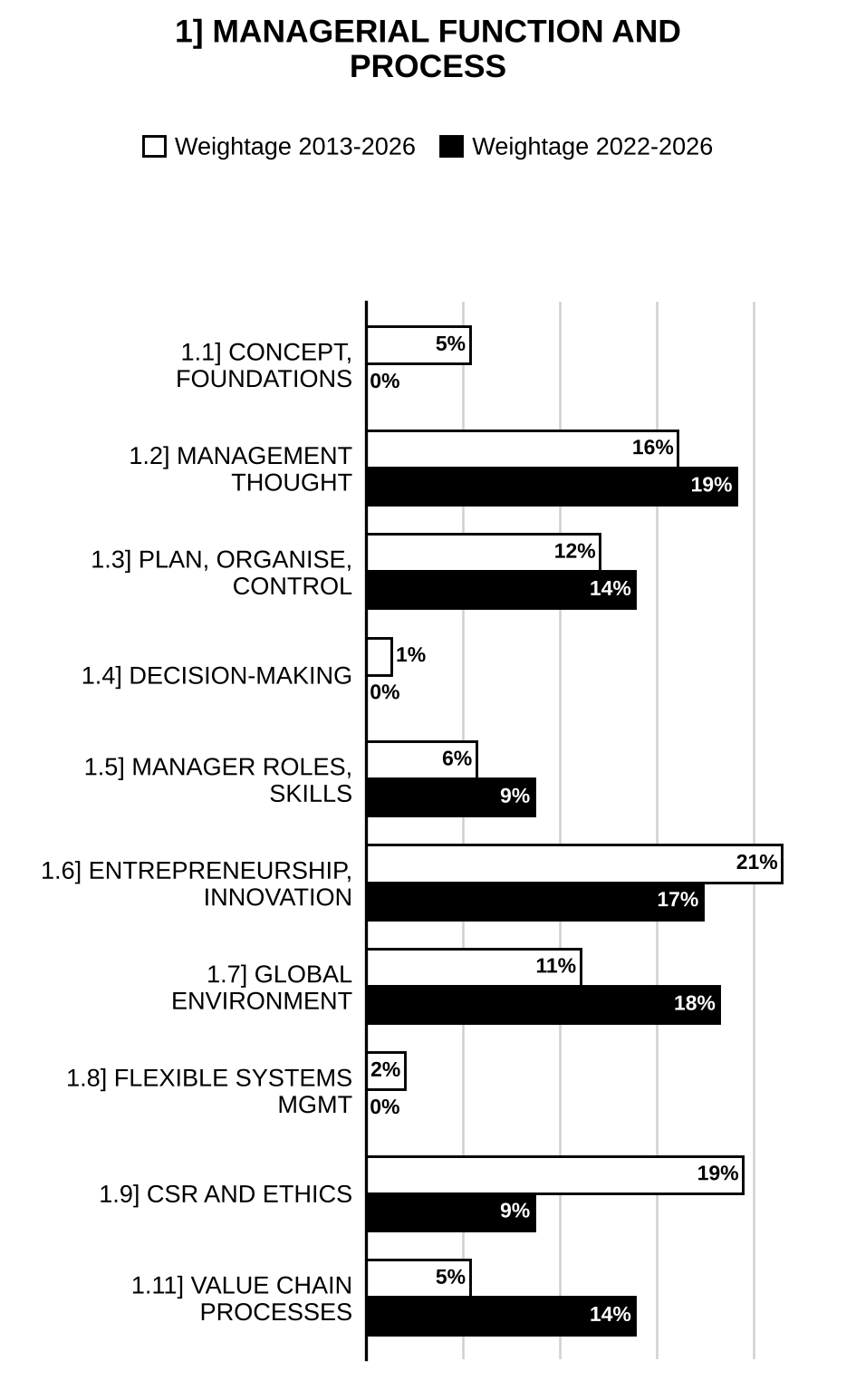
Here are all 95 Managerial Function and Process questions asked in UPSC Management Optional Paper I from 1995 to 2026, arranged under the 10 topics of the official syllabus. Within each topic the latest questions come first.
Each question ends with a code such as [2024/15m/3b] – the year, the marks, the word limit (where UPSC set one) and the question number in the paper.
1.1] Concept and foundations of management
4 questions
Do you think that there are universal principles of management that affect the success of all organizations and managers? Support your answer with suitable examples. [2019/10m/4d]
Managerial performance can be judged/measured by two parameters of effectiveness and efficiency. Can an organisation or manager with high efficiency fail? Explain why. [2018/10m/4c]
Discuss how the efficiency and effectiveness of a manager would impact organisation performance. [2014/10m/150w/1a]
‘Management is defined as attainment of organisational goals in an effective and efficient manner through its four functions’. [2013/10m/150w/1a]
1.2] Evolution of management thought
14 questions
Do modern management approaches represent a true evolution or just a modification of classical theories? Justify your answer with examples. [2026/15m/4a]
“Henri Fayol’s contributions to the field of management are very distinctive and are highly appreciated”. Analyze the statement and explain the 14 principles of Fayol. [2024/15m/3b]
What are various approaches to management? Explain characteristics and limitations of any 4 approaches to management analysis with suitable examples. [2022/10m/1b]
Explain the management concepts of Frederick W. Taylor and Henri Fayol. Identify key differences between the two and their applicability. [2022/15m/4a]
“Pre-classical theorists emphasized more on developing specific techniques to solve some identified problems. However both scientific and administrative schools of thoughts given by classical theorists were more all pervasive in their approach to organizational design.” Substantiate this statement highlighting pre-classical and classical theorists and their approaches. [2020/20m/3a]
In what respect is Henri Fayol’s contribution to management different from that of Taylor’s Scientific Management theory? Do the general management principles given by Fayol still hold good and are they relevant to the modern organizations? Justify your answer. [2019/15m/2b]
What is goal displacement? Bureaucratic organisations often suffer from goal displacement. Explain using live examples. [2018/10m/6d]
Discuss the contributions of Fayol in the development of management thought. [2017/10m/150w/1a]
Enumerate the contribution of F. W. Taylor for management thought. [2016/10m/150w/1a]
“The centre of a modern society, economy and community is not technology, nor information, nor productivity but management and managed institutions.” (Peter Drucker) Comment upon this statement and discuss in brief, new paradigms of managing business enterprises in the competitive landscape. [2008/60m/3]
Management Techniques and Management Fads. [2007/20m/200w/1a]
State the general principles of management given by Henri Fayol. Are these principles still relevant in modern organisations? Also state the features of Taylor’s research that are relevant to modern manufacturing industries. [2007/60m/2]
In one of the branches of an organisation with 200 staff (all white-collared) who cannot be considered a very docile type, where results were not up to the mark, by changing the seating pattern, increasing lighting and providing drinking water (without demand from the staff), the output increased by 80 percent. Discuss how and why this could happen. [2005/60m/8]
Management’s concern and management’s responsibility are everything that affects the performance of the institutions and its results whether inside or outside, whether under the institution’s control or totally beyond it. [Peter F Drucker] In light of the above, examine how and in what manner, the tacit assumptions underlying the theory and practices of management have witnessed marked shift over the period of the last few decades. [2004/60m/2]
1.3] Managerial functions
15 questions
Discuss the various types of “Control Mechanisms” a manager can apply in order to take his organization to desired excellence. Suggest ways to overcome resistance to control. [2024/20m/2a]
How do mission, vision and values help in developing good plan for an organization? Explain planning premises. [2023/20m/2a]
What are the differences between goals and objectives? How is management by objectives better? Discuss the improvements it brings about. [2020/10m/1c]
What is meant by ‘vision’, ‘mission’ and ‘objectives’? Briefly explain the nature and characteristics of objectives. [2018/10m/150w/1e]
Write a note on ‘Management by Objectives’ (MBO), bringing out its problems and limitations. [2016/20m/4b]
Describe the steps in strategic evaluation and control process. [2016/10m/150w/5a]
Principle of preventive strategic control. [2011/20m/200w/1b]
“The research on the effects of strategic planning generally finds it has no effect on corporate performance.” Critically examine the statement. [2010/30m/2b]
Strategic planning and implementation in the context of a business organization, and the various steps in the strategic alternatives devised by L. C. Sorrell. [2009/20m/200w/1a]
ETOP analysis. [2009/20m/200w/5a]
What do you understand by management control system? Discuss Computer integrated manufacturing and Computer aided design methods and bring out their implications for management control. [2006/60m/7]
Planning is looking ahead and Controlling is looking back. [2005/20m/200w/5a]
Management control in Service Organisation. [2002/20m/200w/5c]
Explain the concept of Management by Objectives. Management philosophy underlies this concept? [1998/30m/6a]
The concept of management by objectives is said to be as old as human civilization. Do you agree? During recent year several new dimensions have been added to this new concept. Throw light on these new dimensions and show how Indian managers can be benefited by this philosophy. [1995/60m/8]
1.4] Decision-making
9 questions
Differentiate between ‘choice making’ and ‘decision making’ in management. Explain with real-life examples. [2016/10m/150w/1c]
Concept of fit and stretch in decision-making. [2011/20m/200w/1a]
Concept of Fit and Stretch in decision-making. [2008/15m/200w/1d]
Decision making is a solution selected after analysing and examining several alternatives. Discuss and explain various types of managerial decisions. [2006/60m/3]
Programmed Decisions and Non-programmed Decisions. [2005/20m/200w/5b]
Decision making under certainty, risk and under-certainty. [2004/20m/200w/1c]
Describe a situation which you would consider as decision making under risk. Justify your answer. [2000/20m/200w/5b]
Decision-making involves choosing from among alternative solutions. Comment and explain the role of creativity in decision-making. [1996/30m/3a]
Why do managers take decisions? Explain decision making under conditions of uncertainty and risk. [1996/30m/8b]
1.5] Role of the manager and managerial skills
7 questions
Do you think that the traditional roles of managers are still relevant in today’s digital and remote work environment? Critically comment with examples. [2026/10m/150w/1a]
Elucidate the three categories of roles which a manager has to perform as suggested by Henry Mintzberg. [2024/10m/1a]
Identify key differences between a manager and a leader. Justify your answer with suitable examples. [2022/10m/1a]
What are the different types of skills leaders use in leading? Discuss the reasons why conceptual leadership skills become more important and technical skills go down in importance, at higher levels of organisation. [2018/15m/3b]
(i) Do managers require different skills at different levels of hierarchy? (ii) What is the difference between a manager and a leader? [2015/20m/3a]
Critically analyze the statement that the various psychological processes can be thought of as pieces of a jigsaw puzzle, and the personality as the completed puzzle picture. What are major attributes of a successful and efficient administrator? [2002/60m/3]
How has the role of management changed in this era of Information Technology? [2001/60m/3]

Preparing for Prelims too?
Our UPSC Prelims Topic-wise PYQ eBook covers every Prelims question with detailed explanations, so you can see exactly where UPSC asks from.
View the BookDownload Free Sample1.6] Entrepreneurship and management of innovation
17 questions
Evaluate the potentials for entrepreneurial education and training to democratize access to entrepreneurial opportunities. Can anyone learn to be an entrepreneur or are certain inherent qualities essential to become a successful entrepreneur? [2025/10m/1a]
As a Global Innovation Manager, you have been given a task of leading the new product development which will be launched across multiple international markets.
(i) Explain how you will manage the innovation process while considering cultural, economic and regulatory differences across regions. [2025/10m/3a(i)]
(ii) What strategies will you follow to foster innovation and collaboration across diverse global teams? [2025/10m/3a(ii)]
“Economic development of India will depend on the inventions carried out by entrepreneurs.” Explain. [2023/15m/4c]
Differentiate between ‘Entrepreneur’ and ‘Intrapreneur’ with suitable examples. Identify key traits of a successful entrepreneur. [2022/15m/2a]
List the various types of conceptual blocks that come in the way of thinking creatively. What is the process of innovation that firms should follow? [2021/15m/4a]
What is the relationship between Government of India’s initiative of ‘Startup India’ and entrepreneurship? Who is an entrepreneur and what kind of innovations does he or she create to create an enterprise? [2020/20m/4a]
Does India need more leaders, managers or entrepreneurs for achieving economic growth? Explain, highlighting their differences. [2018/10m/7d]
What is the relationship between entrepreneurship and innovation? Discuss different types of innovations. [2017/15m/2b]
Define the term ‘entrepreneur’. Explain the essential managerial skills for a successful entrepreneur. [2016/15m/2a]
What are the qualities of an entrepreneur? Discuss the role of entrepreneurship in organization’s success. [2015/15m/4c]
Differentiate between ‘Lateral thinking’ and ‘Vertical thinking’. How lateral thinking generates organisational creativity? [2013/20m/300w/4a]
Innovation Management in organisations. [2012/12m/150w/1b]
Entrepreneurship management. [2012/12m/150w/1c]
‘Creativity can be cultivated and is not necessarily in-born.’ Elucidate with illustrations. [2012/20m/3a]
“Creativity and innovation are inevitable instruments of excellence; yet they differ in their basic characteristics.” Analyse this statement and assess how organisations can encourage both. [2010/30m/3b]
Distinction between innovation and creativity, and how organizations can encourage both. [2009/20m/200w/1d]
Establishing a climate for organizational creativity and innovation. [2004/20m/200w/1b]
1.7] Managing in a global environment
8 questions
Analyze how a Multinational Corporation can design its global management structures to support continuous innovation in both developed and emerging markets. [2026/15m/3a]
As a Global Innovation Manager, you have been given a task of leading the new product development which will be launched across multiple international markets.
(i) Explain how you will manage the innovation process while considering cultural, economic and regulatory differences across regions. [2025/10m/3a(i)]
(ii) What strategies will you follow to foster innovation and collaboration across diverse global teams? [2025/10m/3a(ii)]
What are the factors of cross-cultural classification a global business manager of a consumer durables company should consider for managing in global environment and being successful to achieve desired profits? [2024/15m/4c]
Recent international events such as the pandemic Covid-19 and the Russian-Ukraine war significantly impacted global business environment. Briefly evaluate its impact on Indian business operations. Identify attributes and skill-sets required by a manager to operate under the prevailing global business environment. [2022/20m/3a]
‘Globalization’ seems to be at ‘cross-roads’ as increasingly large number of countries embrace ‘neo-nationalism’ based on the doctrine of ‘self-reliance’. Briefly explaining the concept of globalization, critically evaluate the impact of growing ‘neo-nationalism’ on Indian firms and suggest strategic measures for effective management. [2021/10m/1a]
How technology enables an effective and efficient management in a Globalised Economy? Explain. [2013/20m/300w/3b]
“The dynamic environmental changes of the last decade have posed considerable challenges to the international management thinking.” Elucidate. Bring out, in brief, newly evolved management concepts and paradigms to face these challenges. [2011/30m/2a]
Components of Direct action global environment. [2005/20m/200w/5b]
1.8] Flexible systems management
1 question
Discuss the concept and advantages of Flexible Systems Management. [2013/15m/300w/3a]
1.9] Social responsibility and managerial ethics
17 questions
“Ethical management is essential for long-term organisational success.” Critically evaluate the statement with examples. [2026/10m/150w/1e]
In what ways can ethical behaviour in management contribute to a company’s social responsibility efforts? How can ethical decision-making improve a company’s social responsibility outcomes? [2025/15m/2a]
Briefly explain the concept of Corporate Social Responsibility (CSR) with industry illustrations. Critically evaluate major initiatives developed by multilateral agencies to measure CSR activities. [2021/20m/3a]
Are being legal and being ethical same? Employees look at their employers in terms of distributive, procedural and interactional justice. How does violation of these affect industrial/human relations? [2020/10m/1b]
Adam Smith has stated that public interest is served best when, individual and business pursue self-interest. Milton Friedman in the same line has said that the sole purpose of business is to make profit. Explain and critically evaluate the implications of these ideas. [2020/10m/1d]
“In India, social responsibility is more in theory than in practice.” Do you agree with this statement? Support your answer with suitable examples. [2019/10m/150w/1e]
A famous economist wrote that “there is one and only one social responsibility of business – to use resources and engage in activities designed to increase its profits…”. Critically evaluate this statement in the context of increasing pressure on business to be socially responsible. [2018/15m/4b]
“A business organisation’s sole responsibility is to further the interest of its owners within the boundaries of legal framework and business organisations cannot be charged with social responsibilities.” Do you agree with the statement? Explain. [2017/20m/4b]
What is ‘whistle-blowing’? What steps have been taken to protect whistle-blowers in India? [2016/15m/8c]
Differentiate between Corporate social responsibility (CSR) and Managerial ethics. Why adoption of CSR and ethical practices have become important in the conduct of business in the recent times? [2015/10m/150w/1a]
What is Corporate Social Responsibility? Describe two CSR initiatives taken by organisations in the Indian context. [2014/15m/4b]
Why is corporate social responsibility (CSR) increasingly becoming important for businesses? [2012/10m/4b]
With suitable illustration(s), highlight the concept of corporate social responsibility in India. [2010/20m/4c]
The concept of enlightened self-interest, and how this relates to the social responsibility of a business organization. [2009/20m/200w/1b]
Organizational Philosophy and Ethics. [2004/20m/200w/5d]
Social responsibility of Business. [2003/20m/200w/1c]
Responsible business is a part of responsible society. Discuss. [1996/30m/1a]
1.11] Managerial processes on direct and indirect value chain
3 questions
How do core management processes influence each stage of the value chain? How can misalignment between them reduce overall organizational effectiveness? Illustrate your answer by giving suitable examples. [2026/20m/2a]
You have been recently appointed as the Operations Manager of a mid-sized manufacturing company. Discuss how you would manage both direct and indirect activities in the value chain to improve efficiency and add value to the final product. Enumerate your answer with suitable examples. [2025/20m/4a]
Organisation-wide value chain analysis to discover and harness ‘hidden value’ for increased organisational performance. [2012/12m/150w/5c]

Strengthen your GS papers
Our UPSC Mains Topic-wise & Year-wise PYQ eBook (2013–2026) maps every GS question to the syllabus, so you know what UPSC asks and how often.
View the BookDownload Free SampleNext: Organisational Behaviour and Design »
Back to: Management Optional PYQs – Topic-wise
Last updated: 30 October 2026