
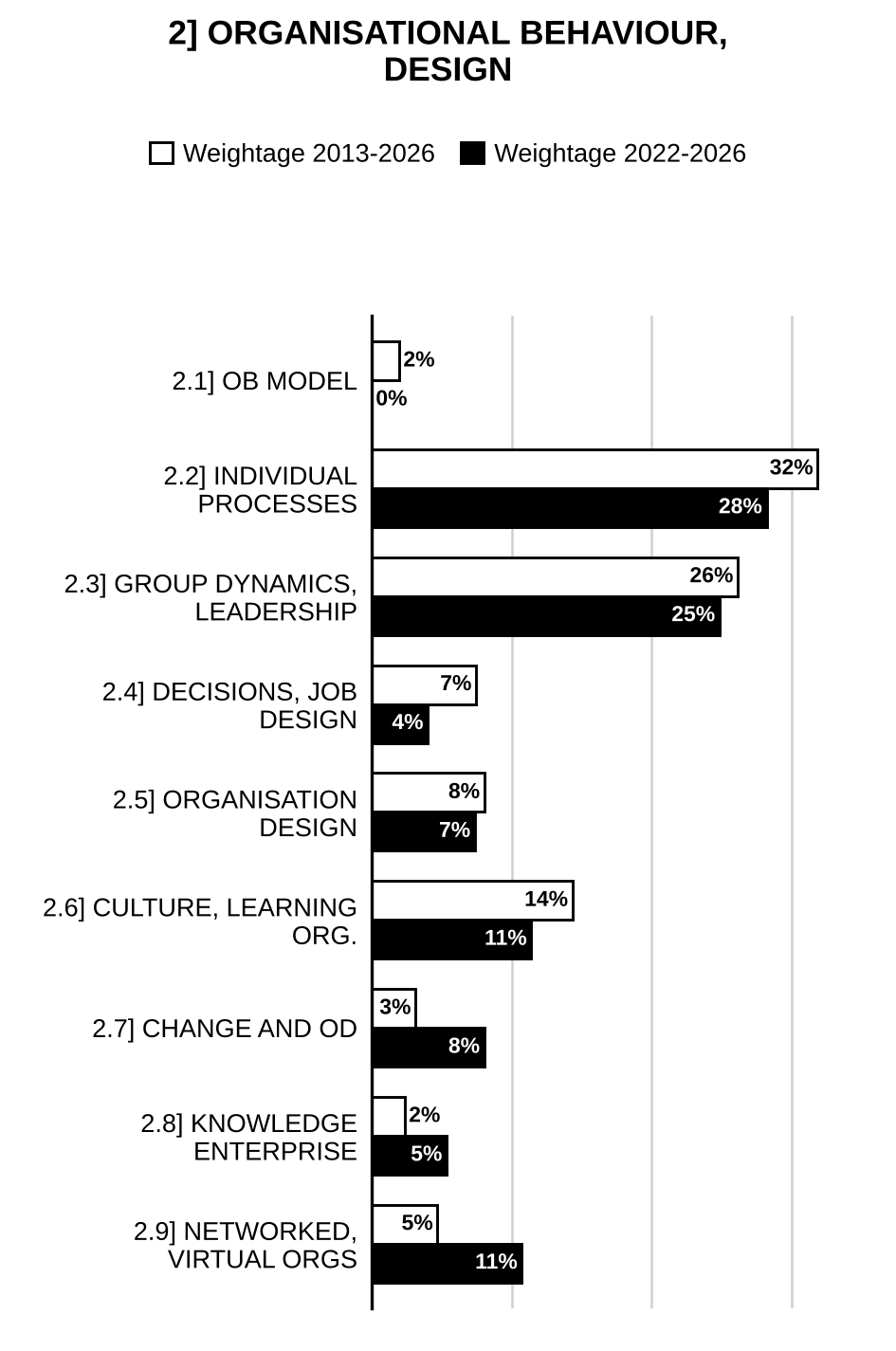
Here are all 171 Organisational Behaviour and Design questions asked in UPSC Management Optional Paper I from 1995 to 2026, arranged under the 9 topics of the official syllabus. Within each topic the latest questions come first.
Each question ends with a code such as [2024/15m/3b] – the year, the marks, the word limit (where UPSC set one) and the question number in the paper.
2.1] Conceptual model of organisation behaviour
3 questions
Organisational Behaviour is of multidisciplinary nature. Name 10 disciplines including emerging disciplines which contributed to make organisational behaviour. Give one example for each of the disciplines. [2017/15m/2c]
The conceptual model of organisational behaviour is based on micro and applied analysis of human behaviour. [2013/10m/150w/1c]
Behaviour is the function of Man and his Environment. Explain this statement. [1997/30m/1a]
2.2] Individual processes
49 questions
Discuss the relation between perception and problem solving. How does an individual’s perception of a problem affect how they approach a solution? [2025/10m/1b]
Enumerate the principles of learning and reinforcement. How can these principles be utilized by the management to enhance employee effectiveness? [2025/15m/3b]
How do practices like job rotation and job enrichment aid in the raising of employee motivation? Why do organisations find it more difficult to enhance intrinsic motivation than extrinsic motivation for their employees? [2024/10m/1c]
“Not only is stress inevitable in modern work life, it is also necessary for human progress in organisations”. Critically examine this statement. Distinguish between the levels of functional work stress in terms of their effect on employee behaviour and performance. [2024/15m/2b]
“A person can have thousands of attitudes but organizational behaviour focuses its attention on a very limited number of job-related attitudes.” Explain the different job-related attitudes. How do they differ from other non-job-related attitudes? [2023/20m/3a]
Differentiate between classical conditioning and operant conditioning. How is social learning theory an extension of operant conditioning? [2022/10m/1c]
“People’s behaviour is based on their perception of what reality is, not on the reality itself.” Comment on the statement, highlighting the importance of perception in the study of Organisational Behaviour. What are the factors that influence perception? [2022/15m/2b]
Researchers argue that challenge stressors operate quite differently from hindrance stressors. Give your views. What are the potential environmental, organizational and personal sources of stress at work? [2022/15m/4b]
What is personality? How do the big five personality traits predict work behaviour? [2021/10m/1b]
“If money does not make you happy, you are not spending it right.” Give your views on the statement in context of money being a tool for motivation. [2021/15m/3b]
How has Freud classified and explained id, ego and super-ego? How do they shape our personality? [2020/10m/1e]
There is an old saying that “individuals do not live by bread alone”. Explain its meaning in the context of employee motivation. Compare and contrast the motivation approaches that are likely to be more effective in industries employing knowledge workers and manual workers. [2020/20m/2a]
Enumerate and explain the different kinds of attitude measuring scales. What advantages does the Likert’s scale have over Thurstone’s or Guttman’s scale to measure attitude? [2020/15m/2c]
(i) Whether all types of stress are bad? Justify your answer. (ii) Discuss the role of Yoga and Meditation in managing stress. [2019/10m/150w/1c]
“Personality factors influence individual behaviour.” Do you agree? Give reasons for your answer and also give suitable examples. [2019/10m/4c]
Motivation is a simple process but the task of motivating is daunting. Herzberg’s theory is based on hygiene and motivator factors. Explain how this theory can be used to motivate employees at different levels of an organisation. [2018/15m/2b]
Explain the concept of Perception and state the factors which have a bearing on the perceptual process of an individual. [2017/10m/150w/1b]
What is Job Satisfaction? What is its relationship with employees’ intention to stay, productivity, absenteeism, turnover and accidents? Answer in the context of Knowledge Based Organisations. [2017/10m/150w/1e]
What is Motivation? How can Maslow’s Hierarchy theory be used to motivate employees in an organisation? Explain. [2017/15m/3a]
What are the potential sources and consequences of stress in the organisational context? How can we deal with them? [2017/15m/3c]
Who is the propounder of Theory ‘X’ and Theory ‘Y’ in management? What are the assumptions underlying Theory ‘X’ and Theory ‘Y’? [2016/10m/150w/1b]
“Behaviour is a problem.” Comment as perception. [2016/15m/3a]
What are the causes of work stress? How does employees’ morale affect productivity? [2016/15m/4a]
What is the relationship between Goal-Effort-Result? Explain with an example. [2014/10m/150w/1b]
Explain the relationship between values, perception, attitudes and behaviour in context of individual behaviour. [2014/20m/2b]
What is ‘Stereotyping’? How does it influence the decision-making process? [2014/15m/2c]
Describe four sources of organisational stress. How does stress impact employee behaviour? [2014/20m/4a]
Theory ‘X and Y’ model reflects the attitude of a person in performing the task. How? Does this influence the selection of the leadership style? Explain with examples. [2013/15m/300w/2b]
Explain how motivation is a function of valence, expectancy and instrumentality. [2013/15m/300w/3c]
What is Job Stress? How do you assure work-life balance in an organisation? [2013/15m/300w/4b]
What is ‘extinction’? Do you think that Managers will be able to influence subordinates and their performance by using reward, punishment and extinction? Explain. [2013/15m/300w/4c]
Describe the components and sources of attitudes and discuss the difficulties in measuring attitude. [2011/30m/3b]
How can knowledge workers be motivated? What techniques are corporate enterprises in India employing in recent years to attract and retain knowledge workers? [2011/30m/8b]
“We don’t see things as they are, we see things as we are.” Explain in the context of organisational behaviour. [2010/30m/2a]
Briefly discuss Maslow’s theory of motivation. How is this theory different from the Herzberg’s theory? Which one of these theories, in your opinion, explains the human behaviour? [2005/60m/3]
Coping strategies for job stress exist at both the individual and the organizational levels. Summarize and evaluate these various strategies for preventing and/or more effectively managing stress. [2003/60m/3]
Halls stages of personality development. [2002/20m/200w/1a]
Critically analyze the statement that the various psychological processes can be thought of as pieces of a jigsaw puzzle, and the personality as the completed puzzle picture. What are major attributes of a successful and efficient administrator? [2002/60m/3]
The Satisfaction – Productivity controversy. [2000/20m/200w/1a]
Describe the most comprehensive theory of personality and discuss its role in understanding employee behaviour. [1999/60m/2]
Analyze the content theories of motivation and discuss their relevance in the multicultural context of Indian society. [1999/60m/3]
How can the employee morale be raised? Explain main techniques of motivation. [1999/30m/11b]
Discuss Maslow’s Theory of Need Hierarchy. [1998/30m/6b]
In the absence of a sound reward and punishment system motivation of employees is likely to be a big casualty. Discuss and give your views on the reward and punishment systems in large Indian organizations. [1998/30m/11b]
How do socio-psychological factors influence man’s behaviour at work? [1997/30m/1b]
Assuming that you are a human resource specialist, why should it be important for you to understand employee motivation? Explain motivation to work in terms of expectancy theory. Give some practical applications of the theory you could use to motivate employees. [1996/30m/11a]
Make a comparative study of the contributions of Herzberg, McGregor and Macclelland in the field of management. Under Indian conditions which of these have more relevance? [1995/60m/1]
Generally four categories of employees are found in an organization. These are: (i) those who are willing to work and are also competent (ii) those who are not willing to work but are competent (iii) those who are willing to work but are not competent (iv) those who are not willing to work and are also not competent As supervisor, how would you deal with each of the above mentioned categories of employees? Use your knowledge of theories of work motivation and leader ship in deciding on a plan of action. Also give rationale for your proposed action. [1995/60m/7]
Analyze the significance of job satisfaction, status pay and authority pay as motivational factors, What type of mix you would recommend in your organisation? [1995/30m/11a]
2.3] Dynamics of organisation behaviour
57 questions
(i) What leadership styles, according to you, are more effective in an innovation-driven organisation? (ii) “Leaders often switch between different leadership styles.” Do you agree? Discuss. [2026/15m/3b]
How do leadership theories help in developing successful leaders? [2025/15m/4b]
In the present day organisations, which bases of power, coercive or persuasive, have proved to be more effective and why? Support your answer by taking suitable examples. Comment critically upon the desirability of multiplying power in organisations through empowerment. [2024/15m/4b]
“Dependency is increased when the resource you control is important, scarce and non-substitutable.” Comment on the above statement in the light of the fact that the most important aspect of power is that it is a function of dependency. [2023/10m/1b]
Enumerate the different conditions needed for conflict to arise. How does the channel chosen for communication have an influence on stimulating conflict? [2023/10m/1c]
“Does delegation of authority mean loss of power or enhancement of power?” Critically explain. [2023/15m/3b]
Identify key differences between a manager and a leader. Justify your answer with suitable examples. [2022/10m/1a]
What are the central tenets and main limitations of behavioural theories of leadership? How can leaders have a positive impact on their organizations through building trust and mentoring? [2022/15m/3b]
Enumerate the nine most identified power tactics. Discuss their relative effectiveness. [2021/15m/2b]
“Conflict is a naturally occurring phenomenon with both positive and negative effects depending on its management.” In the light of this statement, explain the different conflict management techniques. [2020/15m/4c]
“It is said that an organization devoid of power and politics is lifeless.” Do you agree? Give reasons for your answer. How can power and politics in an organization be positively moulded for better performance? [2019/15m/3c]
Explain the relationship between ‘role’ and ‘goal’. Differentiate between role conflict and role ambiguity. What effects do these have on the working of the organisation? [2018/15m/3a]
What are the different types of skills leaders use in leading? Discuss the reasons why conceptual leadership skills become more important and technical skills go down in importance, at higher levels of organisation. [2018/15m/3b]
Are the concepts of employee engagement and empowerment different? What are the benefits of employee empowerment? [2018/15m/8a]
Explain five ways of employee empowerment in modern smart governmental organisations. [2017/10m/150w/1c]
Discuss contingent and transformational leadership styles with suitable examples from government and private sectors. [2017/10m/150w/1d]
Define Conflict. What are Intrapersonal and Interpersonal conflicts? How can these be resolved? Give examples. [2017/20m/2a]
What is power? Discuss different sources of power. Give suitable examples. [2015/10m/150w/1e]
(i) Do managers require different skills at different levels of hierarchy? (ii) What is the difference between a manager and a leader? [2015/20m/3a]
Are leaders born or made? Explain. What is transformational style of leadership? Support your answer with examples. [2015/15m/4a]
Distinguish between ‘Authority’ and ‘Power’ with an example. How can empowerment enhance individual performance? [2014/10m/150w/1c]
What is ‘Situational Leadership’? Suggest the leadership style that is relevant for different levels of maturity of subordinates. [2014/20m/3c]
How has technological advancement influenced communication and relationships amongst organisational members? [2014/15m/4c]
Empowerment of people for efficient and effective functioning in Teams. [2013/10m/150w/1e]
‘High internal locus of control exhibits more political behaviour in an organisation.’ Discuss. [2013/20m/300w/2a]
Theory ‘X and Y’ model reflects the attitude of a person in performing the task. How? Does this influence the selection of the leadership style? Explain with examples. [2013/15m/300w/2b]
Dysfunction of organizational conflict. [2011/20m/200w/1c]
“No organization is good or bad. It is the leader of the organization who makes it so.” In the context of this statement, briefly discuss the basic attributes which a leader must have to make an ordinary employee extraordinary and enhance organizational success. [2011/30m/4a]
Strategies of gaining power. [2011/20m/200w/5b]
Managerial Grid. [2011/20m/200w/5c]
Cultural barriers in communication. [2010/20m/200w/1a]
What are the five sources of power, as listed by French and Raven, exercised by managers to influence the behaviour of individuals in an organisation? [2010/20m/4b]
Outline some of the characteristics of super-teams and self-managed teams. Discuss guidelines for making teams more effective. “Conflict is normal and natural when different people attempt to act in an integrated way.” Discuss this statement and suggest ways to deal with conflicts within teams. [2009/60m/3]
Transformational Leadership and Global Environment. [2008/15m/200w/1a]
Avoidance of Conflicts and Transactional Analysis. [2008/15m/200w/1c]
“Successful managers are motivated to seek power. However, they don’t want this power for personal gain or for the thrill they might experience from wielding power over others. Instead good managers have a socialized power orientation.” Elucidate this in the context of present day socio-economic and political environment. [2008/60m/2]
High Performance Leadership. [2007/20m/200w/1c]
Define Group. Point out its characteristics. Explain five stages of group development. Does this development process make sense when applied to groups to which you have belonged? [2007/60m/3]
There exist certain barriers to communication that tend to distort the message and directly retard the success of managers in the performance of their tasks. Discuss this statement and suggest the appropriate measures to overcome these barriers. [2006/60m/2]
Managerial Grid. [2005/20m/200w/1c]
Communication is the major shaping force in an organization. [Chester Barnard] Elucidate this statement. What are key elements in inter personal Communication processes? Discuss in brief, the common barriers to effective inter personal Communication. How may these be overcome? [2005/60m/4]
Enumerating the major challenges being faced by the traditional leadership theory, explain the concept of transformational or charismatic leadership. Discuss the extent to which it can ensure organizational results in the context of current Indian corporate scenario. [2004/60m/3]
Illustrate and evaluate conflict management strategies employed by decision makers. Use a conflict situation you have encountered or are familiar with to aid your response. [2002/60m/7]
Group Dynamics. [2001/20m/1d]
There are two broad categories of leaders, namely creative and dominant. Elucidating these kinds comment on the well researched observation that: When most of the organizations come to be led by dominant leaders, the decay of the society is certain. [2000/60m/3]
Organization behaviour specialists assume that empowerment is the key to successful total quality organization. Build a case for or against this observation using suitable examples. [1999/60m/1]
What do you mean by conflict management and management of change and development? [1999/30m/12a]
Discuss the Leadership styles as propounded by Rensis Likert and Blake and Mouton. [1998/60m/7]
What causes conflict in organizations? Discuss the methods of conflict resolution. [1998/60m/8]
One can witness different types of managerial styles in Indian enterprises. Each one with a history of success and failure. Discuss the statement with relevant examples. [1998/30m/12a]
What are the different stages involved in the conflict process. [1997/30m/3a]
Discuss the role of Johari Window in resolving inter personal conflict. [1997/30m/3b]
A successful chief executive claims that his door is always open and that he will always meet any staff member or employee who asks to see him. Discuss this attitude and some of its more important consequences, in the light of the statement. Leadership is situational. [1996/30m/1b]
Discuss Likert’s System 1–4 approach to leadership. Which of these leadership styles is advocated by Likert and why? [1996/30m/2b]
How do superior-subordinate relations distort communication? What are the barriers that reduce effectiveness of communication? [1996/30m/3b]
Filtering of information between supervisors and employees often results in good news going up and bad news going down the organisation. Explain and illustrate. [1996/30m/10b]
Generally four categories of employees are found in an organization. These are: (i) those who are willing to work and are also competent (ii) those who are not willing to work but are competent (iii) those who are willing to work but are not competent (iv) those who are not willing to work and are also not competent As supervisor, how would you deal with each of the above mentioned categories of employees? Use your knowledge of theories of work motivation and leader ship in deciding on a plan of action. Also give rationale for your proposed action. [1995/60m/7]
2.4] Organisational processes
9 questions
Illustrate how the application of core job design principles directly links to enhanced employee satisfaction and organizational efficiency. [2025/10m/1c]
How do practices like job rotation and job enrichment aid in the raising of employee motivation? Why do organisations find it more difficult to enhance intrinsic motivation than extrinsic motivation for their employees? [2024/10m/1c]
Compare the process and effectiveness of: (i) Interacting (ii) Brainstorming (iii) Nominal (iv) Electronic meeting, as group decision making techniques. [2021/20m/2a]
How does the Delphi technique of decision making work? Does it have relevance in contemporary organizational design? [2020/10m/1a]
What are the influences of organizational constraints on decision making? Are unethical decisions influenced more by individual decision-maker or the organizational work environment? Explain. [2015/20m/2c]
Explain how ‘Job Design’ would influence ‘Quality of Work Life’? [2014/15m/3b]
Describe the ‘Job Characteristics Model’ (JCM) of Job design. How it can be useful in Employee motivation? [2013/15m/300w/2c]
Write a short note on Knowledge management for creating a knowledge enterprise. How can appropriate job design impact employee empowerment for better customer service? Why change management is important for organisational performance? [2012/20m/4d]
Distinguish between Group-think and Group-shift. In what way is Delphi technique of Group Decision-making better than the Nominal Group technique? [1997/60m/2]

Preparing for Prelims too?
Our UPSC Prelims Topic-wise PYQ eBook covers every Prelims question with detailed explanations, so you can see exactly where UPSC asks from.
View the BookDownload Free Sample2.5] Approaches to organisational design
16 questions
Discuss the key determinants of organisational structure and design. Among the emerging organisational design trends, comment upon the virtual organisation design and learning organisation design formats, briefly explaining the influence of organisational design choices on employee involvement. [2024/20m/3a]
“Span of management plays important role in deciding organization structure.” Explain. [2023/10m/1a]
“Does delegation of authority mean loss of power or enhancement of power?” Critically explain. [2023/15m/3b]
Why do organizations differ in their structure and design? What is the difference between a mechanistic structure and an organic structure? [2021/10m/1d]
What are the causes of formation of informal groups in an organization? Compare formal organization with informal organization. How could informal organization be detrimental to the working of formal organization? [2020/15m/3b]
“Absolute decentralization is as hypothetical as absolute centralization.” Discuss. Explain the factors which affect the degree of decentralization. [2019/15m/3b]
Distinguish among Classical, Neo-classical and Contingency approaches to Organizational Design. Which approach in your opinion is the best? Why? [2019/10m/3d]
“Informal organizations are detrimental to the interest of formal organizations.” Comment on this statement. In what ways can managers make most effective use of informal organizations to their advantage? [2019/15m/4a]
Developing leaders through organisational structural design. [2013/10m/150w/1b]
Classical, Neo-classical and Contingency approaches to organisational design. [2012/12m/150w/1e]
Distinction between delegation and decentralization. [2006/20m/200w/1b]
Delegation and Decentralisation in an organisation. [2001/20m/1a]
Do you think that the structure of an organisation is a matter of choice of top management? If not, then explain. [2001/60m/2]
The Classical and Contemporary view on the span of control. [2000/20m/200w/1b]
Critically analyze various components of Open Systems Theory of organisation. In what way is it transparent? How is it different from the Neo-classical theory of organisation? [1997/60m/4]
Authority can be delegated but not the accountability. Comment and discuss the essentials of an effective delegation of authority. [1995/60m/6]
2.6] Organisational theory and design
15 questions
Why do you think cultural diversity is important in organisations? What strategies can be adopted by a global consulting firm to manage cultural diversity effectively? Explain. [2026/10m/150w/1c]
What is the relationship between Organisational Culture and the successful implementation of a Performance Management System? Discuss with suitable examples. [2026/20m/3c]
What are the factors of cross-cultural classification a global business manager of a consumer durables company should consider for managing in global environment and being successful to achieve desired profits? [2024/15m/4c]
How does a learning organization model integrate the strategies in the domains of individual, team and organizational learning? What are the desired behavioural changes for a learning organization as described by Senge? [2023/15m/4b]
Explain the concept of culture. Evaluate Hofstede’s cross-cultural classifications and its implications in managing under culturally diverse situations. [2021/20m/4b]
What is a learning organization? Outline the prerequisites for a creative and innovative organizational culture. How does it help the organization to survive in cut-throat competition? [2019/10m/2c]
What are the major cultural characteristics which explain differences in organisational behaviour across cultures according to Hofstede? Why is cultural adaptation important? Illustrate with the help of suitable examples. [2018/15m/6a]
What is organisational culture? How can organisational culture be built? Explain. [2017/15m/4c]
How does organizational culture influence the decision-making process? Give suitable examples to substantiate your answer. [2016/15m/2b]
How does an administrator manage cultural diversity in any organization? [2016/15m/4c]
What factors create and sustain an organization’s culture? How is culture transmitted to employees? [2015/15m/2b]
What is ‘knowledge management’? Differentiate between ‘single-loop learning’ and ‘double-loop learning’ drawing from organizational examples. [2015/20m/4b]
Explain ‘Affirmative Action’ and its implications for organisations. [2014/10m/150w/1d]
What are key ingredients of a ‘Learning Organisation’? Give an example to substantiate your answer. [2014/15m/3a]
What is a ‘learning organisation’? How do you create a ‘learning culture’ in an organisation? Explain with examples. [2012/20m/3b]
2.7] Organisational change and development
9 questions
An organisation is in the process of implementing a new initiative which is required to meet the emerging global challenges, but the employees are resisting the change. Suggest some suitable strategies that management should adopt to implement the change successfully. [2026/10m/150w/1d]
What are the main sources of resistance to organisational change? Select any two sources and outline the ways of overcoming such resistance. Comment upon the effectiveness of role negotiation as an OD intervention. [2024/10m/1b]
“Change or Die!” is the rallying cry among today’s managers. Enumerate and explain three approaches to managing organizational change. [2022/10m/1d]
“There is only one thing permanent in this world, i.e., change.” Comment on this statement. In your opinion, what is more important for a government organization–stability or change? [2019/10m/150w/1a]
Lewin’s three-step model. [2010/20m/200w/1c]
Sensitivity Training. [2005/20m/200w/5c]
Management of change. [2003/20m/200w/1a]
What do you mean by conflict management and management of change and development? [1999/30m/12a]
Why do employees offer resistance to change? How, can the resistance to change be minimized? [1996/30m/2a]
2.8] Knowledge-based enterprise
6 questions
How do advanced technologies like Artificial Intelligence and Machine Learning support Knowledge-Based Enterprises? [2025/20m/2b]
What is ‘knowledge management’? Differentiate between ‘single-loop learning’ and ‘double-loop learning’ drawing from organizational examples. [2015/20m/4b]
Write a short note on Knowledge management for creating a knowledge enterprise. How can appropriate job design impact employee empowerment for better customer service? Why change management is important for organisational performance? [2012/20m/4d]
Knowledge-based enterprises. [2009/20m/200w/1c]
“Intellectual capital is knowledge that transforms raw materials and makes them more valuable.” [Thomas A. Stewart]. [2004/20m/200w/1a]
Knowledge based enterprises. [2003/20m/200w/1d]
2.9] Networked and virtual organisations
7 questions
A company in the Information Technology (IT) sector is moving from a traditional structure to become a virtual organisation. What design changes are required in the new organisational structure and why? Support your answer with examples. [2026/15m/4c]
Discuss the key determinants of organisational structure and design. Among the emerging organisational design trends, comment upon the virtual organisation design and learning organisation design formats, briefly explaining the influence of organisational design choices on employee involvement. [2024/20m/3a]
Outline the organizational structure of a virtual organization. How does it differ from a boundaryless organization? Which type of industries is best suited to a virtual organizational setup? Explain with examples. [2023/15m/2b]
Two of the emerging organisation structures are virtual and network organisations. Are these threats to conventional organisations? Why? [2018/10m/7c]
What is network organization? Discuss the challenges involved in managing a networked organization. [2015/10m/150w/1d]
Networked and Virtual organisation. [2012/12m/150w/1a]
Networked and virtual organization. [2009/20m/200w/2a]

Strengthen your GS papers
Our UPSC Mains Topic-wise & Year-wise PYQ eBook (2013–2026) maps every GS question to the syllabus, so you know what UPSC asks and how often.
View the BookDownload Free Sample« Previous: Managerial Function and Process | Next: Human Resource Management »
Back to: Management Optional PYQs – Topic-wise
Last updated: 30 October 2026