
Here are all 101 Accounting for Managers questions asked in UPSC Management Optional Paper I from 1995 to 2026, arranged under the 12 topics of the official syllabus. Within each topic the latest questions come first.
Each question ends with a code such as [2024/15m/3b] – the year, the marks, the word limit (where UPSC set one) and the question number in the paper.
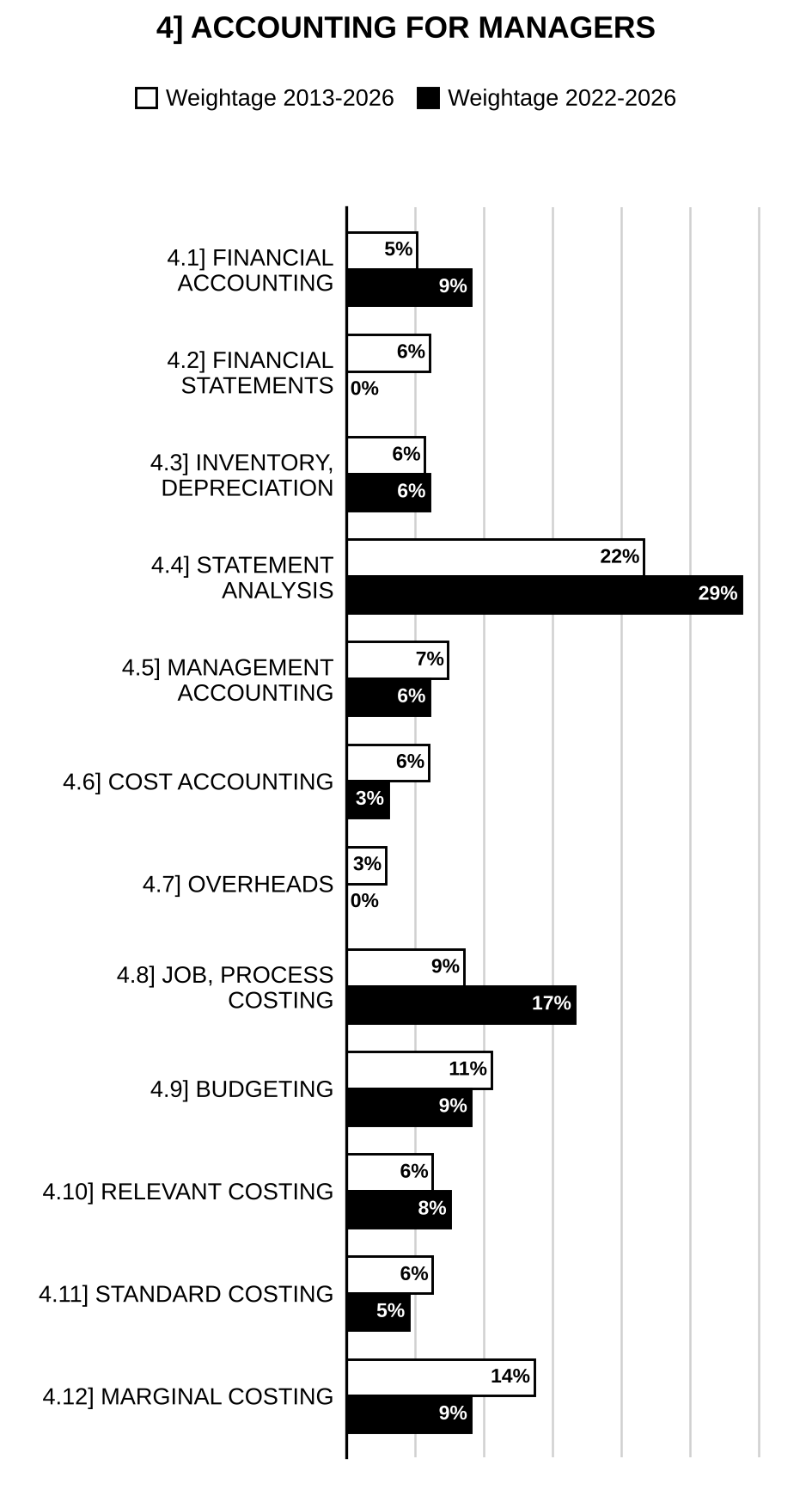
4.1] Financial accounting
6 questions
Analyse the impact of adopting historical cost and fair value methods on the reliability and relevance of financial information, especially during periods of market fluctuations and economic uncertainty. [2026/10m/150w/5a]
What is the significance of the full disclosure principle in GAAP? How does it impact financial statement presentation? [2024/10m/5b]
Elaborate on the objective of ‘Accounting Standards’ and discuss on its significance in the emergence of International Financial Reporting Standards (IFRS) as Global Standards. [2023/10m/5b]
Briefly explain the concept of conservatism by giving suitable examples. [2020/10m/6a]
What are Balance Sheet and Profit and Loss Account? What are the fundamental accounting principles? [2016/10m/150w/5e]
Hedge accounting. [2010/20m/200w/1b]
4.2] Preparation of financial statements
5 questions
How is the income summary of the last accounting period connected with the balance sheet of the future accounting periods? Explain, preferably using the balance sheet and income summary equations. [2021/15m/8a]
The selected financial data for X, Y and Z companies for the year ended March 31 are as follows:
| Particulars | X | Y | Z |
| Variable expenses as percentage of sales | 66.67 | 75 | 50 |
| Interest expenses (₹) | 5,000 | 8,000 | 17,000 |
| Degree of operating leverage | 7 | 8 | 3 |
| Degree of financial leverage | 2 | 6 | 4 |
| Income-tax rate | 35% | 30% | 40% |
(i) Prepare income statements for X, Y and Z companies. (ii) Comment on the financial position and structure of these companies. [2020/20m/6b]
What is the purpose of recording adjusting entries? Some of the items for which adjusting entries are made at the end of the accounting period are: (i) Depreciation expenses (ii) Services provided by the firm for amounts received earlier (iii) Interest payable on loan outstanding (iv) Rents due but not paid. State the adjusting entries for the above implicit transactions. If an organisation fails to pass adjusting entries for items (i) to (iv) above, what will be the impact on ‘Statement of Profit and Loss’ and on ‘Balance Sheet’? [2018/15m/7b]
What are Balance Sheet and Profit and Loss Account? What are the fundamental accounting principles? [2016/10m/150w/5e]
Why is ‘Employee Stock Option’ shown as part of equity in the balance sheet when it does not bring in cash to the firm? [2014/8m/7c(i)]
4.3] Inventory valuation and depreciation
5 questions
Explain the circumstances under which different methods of depreciation can be employed by giving suitable examples. [2022/20m/6a]
Critically evaluate the pros and cons of the various methods adopted to determine the cost of inventories. [2021/10m/5b]
Is depreciation charged due to fluctuations in the value of fixed assets? Should depreciation be provided even if the firm is in loss during the financial year? Do firms charge depreciation on fixed assets, although the market value of the assets is higher than its book value? [2019/10m/7d]
Contrast the effect of FIFO versus (weighted) average cost on ending value of inventory and pre-tax income (PBT), when (i) Prices are rising, and (ii) Prices are falling. Explain how income can be manipulated by the choice of inventory valuation method. [2018/10m/3d]
Inventory Valuation. [2009/20m/200w/6c]
4.4] Financial statement analysis
20 questions
A startup company is experiencing rapid growth in sales. However, its net income remains low. Explain the possible causes of this situation and discuss the strategies that management should employ to improve profitability. [2025/15m/6a]
Company X experienced a significant increase in its Current Ratio from 1.5 : 1.0 to 2.5 : 1.0. However, its Quick Ratio 0.8 : 1.0 remains unchanged. What could be the reasons for this divergence and what potential implication might this have for the company’s financial health? [2025/7m/8a(i)]
A company’s Debt-to-Equity Ratio decreased significantly year-over-year, while its Return on Equity (ROE) also decreased. What could be a plausible explanation for this scenario? [2025/7m/8a(ii)]
A company’s ‘Reserves and Surplus’ increased substantially during the year, but its ‘Cash and Cash Equivalents’ remained relatively flat. What could explain this situation based solely on Balance Sheet information? [2025/6m/8a(iii)]
Directors of ABC Ltd. wish to diversify. Presently, ABC Ltd. is into selling finished goods from its own godown. ABC Ltd. issued debentures on 07.04.2022 and purchased fixed assets on the very same day. The purchase prices are assumed to have remained stable during the concerned period. Following financial information is available to you. INCOME STATEMENT.
| Particulars | 2021-22 (₹) | 2021-22 (₹) | 2022-23 (₹) | 2022-23 (₹) |
| Cash sales | 30,000 | 32,000 | ||
| Credit sales | 2,70,000 | 3,00,000 | 3,42,000 | 3,74,000 |
| Less: Cost of goods sold | 2,36,000 | 2,98,000 | ||
| Gross profit | 64,000 | 76,000 | ||
| Less: Operating expenses: | ||||
| (i) Warehousing | 13,000 | 14,000 | ||
| (ii) Transport | 6,000 | 10,000 | ||
| (iii) Administrative | 19,000 | 19,000 | ||
| (iv) Selling | 11,000 | 49,000 | 14,000 | 57,000 |
| Net profit | 15,000 | 19,000 |
BALANCE SHEET
| Assets & Liabilities | 2021-22(₹) | 2021-22(₹) | 2022-23(₹) | 2022-23(₹) |
| Fixed Asset (Net Block) | – | 30,000 | – | 40,000 |
| Receivables | 50,000 | 82,000 | ||
| Cash at Bank | 10,000 | 7,000 | ||
| Stock | 60,000 | 94,000 | ||
| Total Current Assets (CA) | 1,20,000 | 1,83,000 | ||
| Payables | 50,000 | 76,000 | ||
| Total Current Liabilities (CL) | 50,000 | 76,000 | ||
| Working Capital (CA – CL) | 70,000 | 1,07,000 | ||
| Net Assets | 1,00,000 | 1,47,000 | ||
| Represented by: | ||||
| (i) Share capital | 75,000 | 75,000 | ||
| (ii) Reserve and Surplus | 25,000 | 42,000 | ||
| (iii) Debentures | – | 30,000 | ||
| 1,00,000 | 1,47,000 |
You are required to calculate the following ratios for the years 2021-22 and 2022-23: (i) Gross Profit Ratio (ii) Operating expenses to sales ratio (iii) Operating profit ratio (iv) Capital turnover ratio (v) Stock turnover ratio (vi) Net profit to Net worth ratio (vii) Receivables collection period Ratio relating to capital employed should be based on the capital at the end of the year. Give the reasons for change in the ratios for two years. Assume opening stock of ₹10,000 for the year 2021-22. Ignore taxation. [2024/25m/8a]
Given below is the data of two firms in the same industry:
| Particulars | Firm A (₹) | Firm B (₹) |
| Net Profit | 25,000 | 10,000 |
| Sales Revenue | 1,25,000 | 60,000 |
| Total Assets | 75,000 | 30,000 |
| Equity | 25,000 | 20,000 |
(i) Compute the Return on Equity (RoE) based on DuPont analysis. Which company would investors prefer? [2023/15m/6a(i)]
(ii) What are the limitations of DuPont analysis? [2023/10m/6a(ii)]
Highlight various limitations of financial statements. How can these be minimized or resolved? [2022/10m/5a]
How would you analyse the financial position of a company from the point of view of (i) An Investor; (ii) A Creditor; (iii) An Employee of the firm; and (iv) A Supplier of the firm? [2021/20m/7b]
The selected financial data for X, Y and Z companies for the year ended March 31 are as follows:
| Particulars | X | Y | Z |
| Variable expenses as percentage of sales | 66.67 | 75 | 50 |
| Interest expenses (₹) | 5,000 | 8,000 | 17,000 |
| Degree of operating leverage | 7 | 8 | 3 |
| Degree of financial leverage | 2 | 6 | 4 |
| Income-tax rate | 35% | 30% | 40% |
(i) Prepare income statements for X, Y and Z companies. (ii) Comment on the financial position and structure of these companies. [2020/20m/6b]
“Accounting ratios are mere mathematical relationships expressed between interconnected accounting figures and at times may be misleading.” Elucidate the statement with suitable examples. [2019/10m/150w/5b]
Distinguish between Cash flow and Fund flow statements of a firm. What is the significance of preparing these statements? [2019/10m/8a]
Explain direct method and indirect method of preparing statement of cash flows using the following information pertaining to Ajay Ltd:
Statement of Profit and Loss for the year ended 31/03/2017
| Sales Revenue | 90,00,000 |
| Cost of Goods Sold | 80,00,000 |
| Other Expenses | 1,50,000 |
| Depreciation Expenses | 50,000 |
| Profit Before Tax | 8,00,000 |
| Income Tax Expense | 3,00,000 |
| Net Profit | 5,00,000 |
Relevant Balance Sheet Accounts
| 31/03/2017 | 31/03/2016 | |
| Inventory | 50,000 | 70,000 |
| Accounts Receivable | 90,000 | 60,000 |
| Accounts Payable | 80,000 | 70,000 |
| Income Tax Payable | 15,000 | 20,000 |
[2018/10m/150w/5d]
Define funds from operations. How is it computed? Explain with example. [2017/15m/7b]
“Accounting ratios are mere guides and absolute dependence on them during decision making can be suicidal.” Explain. [2015/10m/150w/5a]
Explain “DuPont” analysis and its components. [2014/10m/7b]
Financial analysis is the X-ray of a business firm. Argue the statement. In your opinion, which is the best method of financial analysis? [2006/60m/2]
How would you analyse the performance of a financial institution with the help of ratios? Illustrate with assumed figures. [2002/60m/2]
Explain essential Financial Ratios exclusively useful for ascertaining profitability trends of a firm’s business. [1997/30m/7a]
Discuss the usefulness of fund flow statement for the management. Would it also be useful to outsiders? [1996/30m/7b]
A higher rate of return on capital employed implies that the firm is managed efficiently Is this true in every situation? Why or why not? [1995/30m/7a]
4.5] Management accounting
7 questions
Discuss the role of Artificial Intelligence and Data Analytics in strengthening managerial decision-making, improving performance evaluation and enhancing strategic control in management accounting. [2026/10m/150w/5c]
How does management accounting information adapt its focus and detail across different management levels and time frames to support various decisions? [2025/10m/5a]
Explain the importance of Management Accounting in financial decisions. [2017/10m/150w/5b]
“Technology is increasingly used to process accounting data.” Explain. Differentiate between Financial Accounting and Management Accounting. [2015/15m/8c]
Explain the difference between ‘Financial Accounting’, ‘Cost Accounting’ and ‘Management Accounting’. How are these inter-related? [2014/20m/6b]
Discuss the nature and types of responsibility centres. What is the budget considerations associated with each of them? [2005/60m/8]
Responsibility Centres for Management control. [2002/20m/200w/5d]
4.6] Cost accounting
4 questions
Elucidate the functional objectives of cost accounting records and delineate their key distinctions from financial accounting records. Give illustrative examples of significant cost accounting documentation and their respective applications. [2025/10m/5c]
The financial books of a company show a net profit of ₹ 2,00,324 for the year ending 31st March, 2020. The cost accounts show a net profit of ₹ 2,04,868 for the same corresponding period. The following information was revealed as a result of scrutiny of the figures of both the sets of books:
| ₹ | |
| (i) Factory overhead under-recovered in Cost A/c | 13,689 |
| (ii) Administration overhead over-recovered in Cost A/c | 12,857 |
| (iii) Depreciation charged in Financial A/c | 24,320 |
| (iv) Depreciation recovered in Cost A/c | 28,560 |
| (v) Interest received but not included in Cost A/c | 6,048 |
| (vi) Income tax debited in Financial A/c | 7,608 |
| (vii) Bank interest credited in Financial A/c | 3,520 |
| (viii) Stores adjustment credited in Financial A/c | 5,008 |
| (ix) Rent charged in Financial A/c | 3,310 |
| (x) Dividend paid recorded in Financial A/c | 1,805 |
| (xi) Loss of obsolescence charged in Financial A/c | 9,807 |
Prepare a statement reconciling the profit as per costing records with the profit as per financial records. [2020/20m/7a]
What is the purpose of reconciling Cost and Financial Accounts? Explain the causes of difference between costing profits and financial profits. [2017/15m/8a]
Explain cost accounting concepts. What are its applications in budgetary control? [2016/15m/6a]

Preparing for Prelims too?
Our UPSC Prelims Topic-wise PYQ eBook covers every Prelims question with detailed explanations, so you can see exactly where UPSC asks from.
View the BookDownload Free Sample4.7] Overhead cost and control
6 questions
“Activity Based Costing (ABC) systems are always more accurate than traditional costing systems.” Do you agree? How does ABC improve overhead assignments? [2018/10m/8d]
Define ‘overheads’. Explain the methods of absorption of overheads. [2015/15m/7c]
Identify the circumstances in which you suggest replacement of traditional overhead distribution system by the activity based costing. Explain why this system of costing is called activity based. Discuss the functions of cost drivers with illustrative examples? [2007/60m/7]
Cost drivers and their measurement. [2006/20m/200w/5d]
Application of Activity Based Costing in service-oriented Indian organisations. [2004/20m/200w/5d]
Illustrate the utility and limitations of Activity-based costing in comparison with Traditional costing. [2002/60m/7]
4.8] Job and process costing
5 questions
A manufacturing concern processes its product through Process-I during May 2026. The company seeks to evaluate production efficiency and cost allocation by applying process costing principles under the weighted average method. The following operational and cost data are available for the period:
| Units introduced into Process-I | 10,000 units |
| Cost incurred: | |
| Raw Materials | ₹1,00,000 |
| Direct Labour | ₹60,000 |
| Production Overheads | ₹40,000 |
| Normal Loss | 10% of input |
| Scrap value of normal loss | ₹5 per unit |
| Units transferred to the next process | 8,800 units |
| Closing work-in-progress | 900 units |
| Degree of completion of Closing work-in-progress: | |
| Materials | 100% |
| Labour | 60% |
| Overheads | 60% |
Assume that all materials are introduced at the beginning of the process. You are required to do the following:
(i) Compute the cost per equivalent unit for materials, labour and overheads using the weighted average method. [2026/6m/8a(i)]
(ii) Prepare the Process-I Account for May 2026, clearly showing the allocation of costs. [2026/6m/8a(ii)]
(iii) Determine the valuation of (a) Normal loss, (b) Abnormal loss or Abnormal gain and (c) Closing work-in-progress. [2026/3m/8a(iii)]
Elaborate the distinctions between job costing and process costing methodologies. Give relevant examples of industries where each approach is typically applied. Furthermore, illustrate scenarios where a hybrid costing system proves advantageous. [2025/15m/7a]
During a month, 4500 units were introduced into process A. The normal loss was estimated at 8% on input. At the end of the month, 2600 units had been produced and transferred to next process, 1400 units were incomplete and 500 units had been scrapped. It was estimated that uncompleted units had reached a stage in production as follows: Material–80% completed Labour–60% completed Overheads–50% completed The cost of 4500 units introduced was ₹ 10,500. Direct materials introduced during the process amounted to ₹ 2,400. Production overheads incurred were ₹ 3,490. Direct labour was ₹ 5,460. Units scrapped realized ₹ 3 each. The units scrapped have passed through the process, so were 100% completed as regards material, labour and overheads. Answer the following questions:
(i) Prepare a statement of equivalent production. [2023/7m/8a(i)]
(ii) Evaluate the cost of abnormal loss, finished goods and closing stock. [2023/10m/8a(ii)]
(iii) Prepare the process A account and abnormal loss account. [2023/8m/8a(iii)]
Distinguish between Job and Process costing. Also state the industries, where the above costing methods are used. [2019/10m/150w/5d]
Define Job Costing and Process Costing. In what ways is Job Costing different from Process Costing? [2017/10m/150w/5a]
4.9] Budgeting
15 questions
A company is facing declining profits, rising costs, excess inventory and cash flow problems. Explain how costing, budgeting and control techniques can be used to identify these issues and develop effective solutions. [2026/15m/7a]
Why is Budgetary control required in a business concern? What are its limitations? [2022/15m/7a]
“If sales forecast is subject to error, then there is no purpose of budgeting.” Do you agree? How can a flexible budget be used to control costs? [2021/10m/5d]
What is zero-based budgeting and how does it differ from traditional budgeting? [2020/10m/5c]
Explain cost accounting concepts. What are its applications in budgetary control? [2016/15m/6a]
What is ‘zero-based budgeting’? What are its applications? Do you think this concept can be used in the Indian financial system? [2016/15m/7a]
Explain with examples, how ‘zero-based budgeting’ can be used as an effective instrument of cost control. [2013/20m/300w/7a]
Distinguish between forecasting and budgeting. A large pharmaceutical enterprise has requested you to prepare its annual budget for the year 2011-12. What steps would you take for this purpose? [2011/30m/7a]
Zero-base Budgeting and Market-driven Economy. [2008/20m/200w/5b]
Budgetary Control and Monitoring System. [2007/20m/200w/5a]
Discuss the nature and types of responsibility centres. What is the budget considerations associated with each of them? [2005/60m/8]
Demerits and merits of Zero-Based Budgeting. [2003/20m/200w/5c]
Zero-Based Budgeting. [2001/20m/5a]
What are the merits of performance budgeting? [1999/30m/8b]
What is cash budgeting? What is its purpose? Why is it that despite cash budgeting some of the enterprises in India are reportedly facing liquidity crisis? How can the problem of liquidity crisis be overcome? [1998/30m/7a]
4.10] Relevant costing and costing for decision-making
7 questions
A company operates under the following conditions:
| Selling Price | ₹60 |
| Variable Cost | ₹50 |
| Fixed Cost | ₹1,00,000 |
| Capacity | 20,000 units |
| Expected Sales | 8,000 units |
| Shut-down Cost | ₹20,000 |
Assess whether the company should continue its operations or shut down, based on a careful evaluation of its financial and operational position. Suggest suitable justification for your decision. [2026/15m/6a]
Explain the concept of transfer pricing with suitable examples and related regulatory framework in Indian context. [2022/10m/5e]
Distinguish between ‘relevant cost’ and ‘irrelevant cost’ for decision-making purposes. [2014/10m/150w/5b]
Kanchan Machine Works has received an export order for surface finishing of 1,000 castings at the rate of Rs. 60 per casting, as against Rs. 70 per casting that is normally charged. The direct materials cost for the job is estimated to be Rs. 10 per casting. The machine hour rate is Rs. 14, calculated as follows:
| Cost Item | Rate | Remark |
| Power | Rs. 4 | Fully variable with output |
| Supplies | Rs. 3 | 80% variable with output |
| Indirect labour | Rs. 2 | 50% variable with output |
| General factory overhead | Rs. 5 | Not variable with output |
Each casting requires four hours of machining. The business has an annual capacity of 10,000 castings; 75 per cent of the capacity has been utilized and the business has committed orders for 500 castings.
(i) Estimate the incremental profit or loss from the order. [2014/14m/8a(i)]
(ii) Mention two non-financial factors that the business should consider while deciding on the order. [2014/6m/8a(ii)]
What are the criteria for deciding on the transfer pricing method used in an organisation? Discuss with reference to management control of domestic and global operations. [2003/60m/8]
Conditions under which an enterprise should buy a component instead of making it. [2000/20m/200w/5d]
Pricing of Joint Products. [1997/30m/8b]
4.11] Standard costing and variance analysis
4 questions
What is standard costing? How is it used in management accounting? How can a company differentiate between controllable and uncontrollable variances and what strategic actions can be taken based on this distinction? [2024/15m/6b]
What is Variance Analysis? What are the possible reasons for different Cost Variances? [2021/15m/6a]
What are the primary uses of a standard cost system? Distinguish between favourable and unfavourable cost (and revenue) variances. [2018/10m/4d]
Define Standard Cost and Standard Costing. How is Standard Costing useful in the effective control over the cost? [2017/15m/6a]
4.12] Marginal costing and absorption costing
17 questions
How can Cost-Volume-Profit (CVP) analysis be used to assess the effect of changes in sales volume, sales price and costs on profitability. [2024/10m/5a]
The data below relates to ABC Ltd. which makes and sells laptops.
| February | January | |
| Sales (units) | 8000 | 12000 |
| Production (units) | 12000 | 8000 |
| Selling Price per unit (₹) | 120/- | 120/- |
| Variable production cost per unit (₹) | 60/- | 60/- |
| Fixed production overhead incurred (₹) | 1,50,000/- | 1,50,000/- |
| Fixed production overhead cost per unit, being the predetermined overhead absorption rate (₹) | 10/- | 10/- |
| Selling, Distribution and Administration cost (all fixed) (₹) | 75,000/- | 75,000/- |
You are required to present comparative profit statements for each month using: (i) Absorption costing (ii) Marginal costing [2022/20m/8a]
During the current financial year, XYZ Ltd. generated a profit of ₹ 5,00,000/- on a sale of ₹ 1,05,00,000/-. The variable expenses were ₹ 55,00,000/-. Compute the following: (i) Fixed expenses of the company. (ii) Break-even sales for the current financial year. (iii) Break-even sales if variable costs increase by 20%. (iv) Break-even sales required to maintain the profit as at present, if the selling price has to be reduced by 10%. [2021/20m/7a]
Two competing retail vendors A and B are located adjacent to each other. Both occupied buildings of the same size, paid the same rent, i.e., ₹ 1,250 and charged similar prices for their products. Vendor A employed three times as many employees as B and has twice as much income as B. Other data are as follows:
| Vendor A | Vendor B | |
| Sales | ₹ 8,000 | ₹ 4,500 |
| Cost of Goods Sold | 50% of sales | 50% of sales |
| Wages | ₹ 2,250 | ₹ 750 |
You are required to answer the following questions: (i) Explain why vendor A is twice as profitable as vendor B. (ii) By how much vendor B’s sales have to be increased in order to justify the doubling of the number of employees at the same rate of pay, if B’s desired operating income is ₹ 350? [2019/15m/7c]
Why does variable costing provide more useful information than absorption costing for decision-making? What are the income relationships between absorption and variable costing when production volume differs from sales volume? What causes these relationships to occur? [2018/10m/150w/5e]
What is ‘break-even analysis’? Explain with an example the terms ‘margin of safety’ and ‘angle of incident’. [2016/20m/6c]
Differentiate between ‘marginal costing’ and ‘absorption costing’. How does marginal costing help in decision making? Explain. [2015/10m/150w/5e]
Explain the term ‘Margin of safety’ and ‘Angle of incident’. How is it related to break-even analysis? [2013/15m/300w/6b]
Marginal costing and absorption costing–their practical implications. [2012/12m/150w/5b]
Marginal costing as a tool of decision making. [2011/20m/200w/5a]
Show, with an example, how break-even point of sales can be calculated when the number of units produced is not known. [2010/20m/4a]
Absorption Costing. [2009/20m/200w/6a]
Examine the rationale and pitfalls of the assumptions built into the Cost-Volume-Profit Analysis (CVP) Model. [2004/60m/7]
Cost, Volume and Profit Analysis. [2003/20m/200w/5b]
The break-even analysis is a useful device in profit planning. Give your views. [1999/30m/7a]
Give your opinion on Sales Mix. Would it be really important for the cost-volume profit inter-relations to allocate fixed cost to individual product lines? [1999/30m/7b]
Break-even analysis is a great stuff but lacks practical realism. Discuss. [1995/30m/9a]

Strengthen your GS papers
Our UPSC Mains Topic-wise & Year-wise PYQ eBook (2013–2026) maps every GS question to the syllabus, so you know what UPSC asks and how often.
View the BookDownload Free Sample« Previous: Human Resource Management | Next: Financial Management »
Back to: Management Optional PYQs – Topic-wise
Last updated: 30 October 2026