
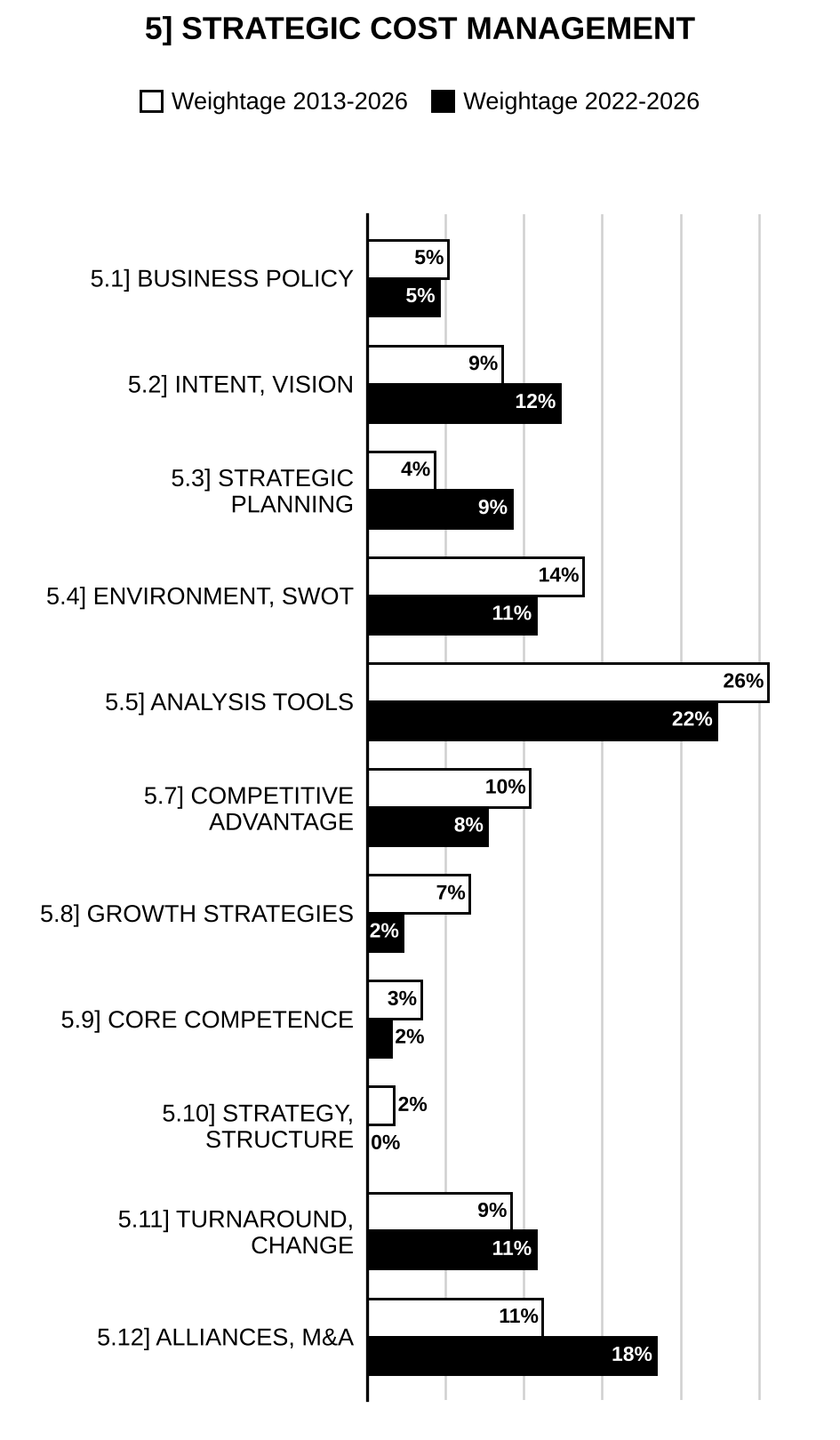
Here are all 141 Strategic Cost Management questions asked in UPSC Management Optional Paper II from 1995 to 2026, arranged under the 12 topics of the official syllabus. Within each topic the latest questions come first.
Each question ends with a code such as [2024/15m/3b] – the year, the marks, the word limit (where UPSC set one) and the question number in the paper.
5.1] Business policy and strategic management
6 questions
“Strategies are formulated and operated at different levels of management.” Discuss this statement. Explain with examples how strategies operating at different levels are integrated. [2022/15m/7a]
What do you understand by ‘Corporate policy’? How is it different from ‘Business policy’? [2016/10m/5b]
What do you understand by the term “Strategy”? Distinguish between “Business Strategy”, “Corporate Strategy” and “Product Strategy”. [2015/15m/6c]
Distinguish between ‘business strategy’ and ‘corporate strategy’. How can value chain analysis be applied to determine strengths and weaknesses at the level of ‘business’ and the ‘firm’ level? [2014/10m/5c]
What do you understand by the term “Strategy”? How do you distinguish between “Business Strategy” and “Corporate Strategy”? What role do “External Assessment” and “Internal Scrutiny” play in strategy formulation? [2012/12m/150w/1d]
Strategic planning has yielded to more comprehensive strategic management. Analyze this comment in detail. [2001/60m/6]
5.2] Strategic intent, vision, objectives and policies
14 questions
What do you mean by vision in terms of business? Explain the benefits of vision for a business organisation. [2026/10m/150w/5b]
Describe the role and characteristics of objectives with suitable examples. [2026/10m/150w/5c]
What is meant by ‘Strategic intent’? Give brief explanation of each of these concepts: (i) Stretch (ii) Leverage (iii) Fit. [2025/10m/5b]
Discuss the manner in which the following concepts aid the understanding of Strategic Management. Give suitable examples. (A) Strategic Intent (B) Concept of Stretch (C) Concept of Leverage (D) Concept of Fit. [2023/10m/7c(i)]
“A vision is too abstract to be of any practical value.” Do you agree with the statement? Justify your answer with a suitable example. Explain how objectives form hierarchy. [2021/10m/5c]
What do you understand by “Strategic Intent”? Explain the various elements in the hierarchy of Strategic Intent. [2020/10m/5a]
Mr. Kumar intends to launch a Fast Moving Consumer Goods (FMCG) firm in India dealing in the manufacture and marketing of personal care products. He has assigned the task of designing the ‘Vision’ of the firm to his Managing Director. If you were the Managing Director of the firm, what dimensions would you include and what dimensions would you avoid in the ‘Vision’ of the firm? What process would you adopt to envision the ‘Vision’? [2019/10m/5c]
In the context of business strategy analysis, what is ‘growth matrix’? How do ‘product scope’ and ‘market scope’ analysis help in developing the growth matrix for a business? How do these help define ‘mission’ of a business? [2013/10m/5a]
‘The goal of strategic planning is to maximize the profit of the enterprise.’ [2010/10m/5d]
Organisational Vision, Mission and Objectives. [2006/20m/200w/1d]
Customerization of Corporate Vision. [2005/20m/200w/1a]
Networking of Strategic Vision, Mission, Objectives and Strategies in the Strategy-Making Pyramid. [2004/20m/200w/5a]
Illustrate the importance of objectives, vision and mission in the operations of any corporation. [2002/60m/2]
Vision Statement of an organisation. [2001/20m/1b]
5.3] Process of strategic planning and implementation
6 questions
Describe the characteristics of strategy implementation. Also, discuss the major barriers to strategy implementation. [2026/15m/8b]
“Without a strategy, execution is aimless. Without execution, strategy is useless.” Comment on the statement and discuss the ways to overcome the pitfalls in strategy implementation. [2023/10m/5e]
Using a small case study, discuss the contents of a good and workable strategic plan for management and operational control of public sector enterprises in India. [2022/10m/5e]
What are generic strategies? Why can generic strategies not deliver above average performance? Discuss briefly, business strategy development process. [2018/15m/7c]
Balanced Score Card as an approach to performance measurement. [2005/20m/200w/5d]
Define strategy. What factors enter into the formulation of strategy? What steps does a chief executive take for the implementation of strategy? [1998/60m/5]
5.4] Environmental and internal analysis
20 questions
Explain the concept of SWOT analysis. Discuss, in detail with suitable examples, the external and internal business environmental factors which affect SWOT analysis. [2026/20m/7a]
Identify the sectors of environment that are currently more important in the Indian context. What sectors are likely to become more important in coming years? Explain. [2024/10m/5c]
How do companies scan the environment and analyse the same to reset the objectives and formulate strategies? Explain. [2023/5m/7a(i)]
Explain the importance of Environmental Scanning in the process of Strategic Management. Discuss the factors that need to be considered for Environmental Scanning. Prepare a comprehensive ETOP for any organisation of your choice. [2020/20m/6a]
(i) Differentiate between ‘Systematic Approach’ and ‘Processed Form Approach’ of Environmental Analysis. (ii) Evaluate the various factors which affect the Environmental Appraisal of an organisation. (iii) Do an Internal Analysis of any organisation using VRIO Framework. [2019/20m/8c]
Discuss an approach for macro-economic analysis of the business environment. How do you determine industry attractiveness? Discuss a framework for analyzing industry structure. [2018/10m/5d]
Why is it important for strategy makers to understand the difference between tangible and intangible assets? Which one is more important in creating competitive advantage and why? [2017/10m/8c]
What is Environmental Threat and Opportunity Profile? How is it prepared? Illustrate with an example. [2016/20m/6a]
Maruti-Suzuki had started operations in Haryana. Due to a variety of reasons it shifted its expansion activities by setting up a plant in Mehsana, Gujarat. Explain how each of the following resources within the company might influence its overall strategy: (i) Financial Resources (ii) Human Resource Planning. [2016/10m/7c]
What do you understand by the term “Strategy”? How do you distinguish between “Business Strategy” and “Corporate Strategy”? What role do “External Assessment” and “Internal Scrutiny” play in strategy formulation? [2012/12m/150w/1d]
Plant location. [2009/20m/7a]
Company image. [2009/20m/7b]
Financial resources. [2009/20m/7c]
Human Resource Planning. [2009/20m/7d]
SWOT Analysis. [2006/20m/200w/1a]
Techniques of Environmental Scanning. [2006/20m/200w/1b]
In conducting an environment scan in India, describe the key elements that could impact on corporate decisions. [2003/60m/2]
Operational Business Environment. [2001/20m/5c]
How do you track the impact of macroeconomic, business environment for deciding the operational environment of business? [2001/60m/8]
Explain the role of environmental scanning in the strategic decision making using suitable examples. [1999/60m/4]
5.5] Tools and techniques for strategic analysis
38 questions
What do you understand by BCG Matrix? Describe the four Quadrants of it and also discuss its Strategic Implications and Limitations with suitable examples. [2025/20m/7c]
An organization involved in automobile manufacturing wishes to exercise strategic choice at business level. How can the concept of experience curve help in it? Give suitable example. [2024/15m/6b]
“Value-Chain Analysis helps in creating competitive advantage.” Do you agree? Justify and discuss the importance of analysing linkages in value-chain. [2023/10m/7b(ii)]
Briefly discuss the meaning and utility of the following: (i) BCG matrix (ii) GEC model (iii) Turnaround strategy. [2022/15m/7b]
Discuss the Porter’s five forces of competition in an industry of your choice. Also, identify the important strategic groups in that industry and highlight the effects of such groups on the strategies of the market leader. [2022/20m/7c]
How does BCG Matrix help in portfolio planning? What are the advantages and limitations of such a portfolio analysis? [2021/10m/5e]
Identify the linkages between primary and secondary activities of Porter’s value-chain model. [2021/5m/6c(i)]
How is value-chain analysis conducted? Explain with the help of an example. [2021/5m/6c(ii)]
Describe Michael Porter’s “Five Forces Model” of Industry Analysis. Explain the way in which these forces interact with each other to unravel the industry structure. [2020/15m/7b]
A bicycle manufacturing company needs to do value chain analysis of its operations. Suggest in detail as to which method of value chain analysis should be adopted by the bicycle company. [2019/15m/6c]
Discuss an approach for macro-economic analysis of the business environment. How do you determine industry attractiveness? Discuss a framework for analyzing industry structure. [2018/10m/5d]
A conglomerate is operating in five business verticals and has reported performance as given in Table 1 below:
Table 1: Performance Data
| Business unit | A | B | C | D | E |
| Sales (in ₹ crores) | 4.0 | 18.0 | 17.0 | 35.0 | 6.0 |
| No. of competitors operating in same vertical | 6 | 20 | 16 | 3 | 8 |
| Sales of market leaders (in ₹ crores) | 8.0, 7.0, 4.0 | 18.0, 18.0, 12.0 | 17.0, 13.0, 9.0 | 35.0, 10.0, 8.0 | 28.0, 20.0, 15.0 |
| Industry growth rate (% in value) | 16.0 | 18.0 | 8.0 | 5.0 | 2.0 |
| Industry profitability, % of sales | 8.0 | 6.0 | 9.0 | 5.0 | 6.0 |
| Total size of the industry (in ₹ crores) | 23.0 | 122.0 | 84.0 | 53.0 | 73.0 |
| Business unit profitability, % of sales | 7.0 | 8.5 | 10.0 | 6.0 | 12.0 |
| % of sales of the business unit from its international operations | 0.0 | 10.0 | 40.0 | 25.0 | 50.0 |
The company is evaluating the different divisions in its portfolio and would like to consider (i) the BCG and (ii) GE-McKinsey framework to decide on which of these divisions to focus its resources and also which of the divisions to divest, giving reasons why. [2018/20m/6a]
Describe how Michael Porter’s ‘Five Forces Model’ helps in analysing a firm’s competitive advantage. Also describe the weaknesses of this model. [2016/20m/7a]
With reference to Industry Life Cycle, explain the term ‘embryonic industry’. [2014/10m/5a]
Distinguish between ‘business strategy’ and ‘corporate strategy’. How can value chain analysis be applied to determine strengths and weaknesses at the level of ‘business’ and the ‘firm’ level? [2014/10m/5c]
For years, stockbrokers with expensive computer hardware traded online and charged individual investors hefty commission to buy or sell a stock. Full-service stockbrokers such as Merril Lynch offered clients detailed research reports, recommendations and financial planning services for as much as 2.5% of the value of the order in commission. In 1994, a small discount broker K. Authaurer & Co. became the first to offer online trading over the Internet at much lower cost and commission. With rapid expansion in information and communication technology (ICT), entry of number of small companies offering clients online trading services with low commissions, America’s long bull market drew ever more individuals into stock market. By 2000, over 150 firms were offering online trading over Internet due to low entry barriers. Commissions further dropped due to intense competition. By early 1999, online brokers charged deep discount fees of $ 14.95 per market order of up to 5000 shares compared to $ 500 charged by full-service brokers for the order up to 1000 shares trading at $ 20 per share. By mid-2000s, the volume of online trading accounted for 40% of all the stock trades. Full-service brokers had to change their strategy. In 1999, Merril Lynch, a full-service broker, announced online trading service for a fee of $ 29.95 for trades up to 1000 shares. The company also shifted to a new uniform fee structure with a flat new rate allowing unlimited number of trades for many individual clients, although the company faced internal rebellion from its army of stockbrokers due to decline in income. For many of Merril’s clients, a combination of research and online trade was a better value proposition than discount online trading houses. By late 2000, NASDAQ declined in value by 60% due to multiple factors drying up the online trading. The same was the fate of other stockbrokers.
(i) Do you think that the decline in online trading was a watershed event? Comment. [2014/10m/6c(i)]
(ii) What is a good framework to analyze the changes in competitive forces to shape the competitive strategy? [2014/10m/6c(ii)]
(iii) How did change in competitive forces in the brokerage industry change the strategies required for success in the industry? [2014/10m/6c(iii)]
Four business units V, X, Y and Z of a firm P have been characterized as follows, after carrying out the Business Portfolio Analysis:
| Business Unit | V | X | Y | Z |
| Category | Dog | Cash Cow | Star | Question Mark |
(i) How will you use the ‘general electric’ framework to determine the strategic investment options for these business units? [2014/10m/8a(i)]
(ii) A competitor firm Q is keen to acquire firm P’s business unit Y and is willing to pay an attractive amount for this purpose. Should the firm P accept the offer? What are the pros and cons to firm P of selling the business unit Y to competitor firm Q? [2014/10m/8a(ii)]
In analyzing competitive strategy, what is the need to analyze the value chain of a company? Why is it necessary to analyze the competitive forces in an industry? How do these help in formulating competitive strategy? [2013/10m/5c]
Draw the Boston Consulting Group (BCG) product portfolio matrix and show on it the position of the company’s three product groups: HT fasteners, Cold extruded parts and Powder metallurgy parts. [2012/15m/200w/4b]
Use a suitable strategy analysis technique to evaluate the three growth options. Which option should the company choose? What will the company have to do to successfully implement the option? [2012/15m/200w/4d]
In general, how do you analyse the competitive forces in an industry? Which forces did Jean L experience? [2011/12m/3i]
What is Boston Consulting Group (BCG) Matrix? [2011/12m/6i]
How are products classified using the BCG Matrix? [2011/12m/6ii]
Apply BCG Matrix to classify the sample products in the table. [2011/12m/6iii]
Is the company’s product portfolio balanced? Why? [2011/12m/6iv]
What steps should the company take to ensure it doesn’t experience profitless growth? [2011/12m/6v]
BCG Matrix. [2010/10m/1b]
Any supply chain process can primarily be explained by “value chain” concept. Discuss the activities representing the value chain of any business house. [2010/20m/7a]
Describe the four strategic planning models briefly. [2009/30m/8a]
Which of these four strategic planning models would you find most useful for Air India and why? [2009/15m/8b]
Business Portfolio Analysis. [2007/20m/200w/1b]
Value Chain Analysis versus Traditional Management Accounting. [2007/20m/200w/5c]
Value chain. [2006/20m/200w/5b]
Outsourcing as a source of value creation. [2005/20m/200w/1b]
Strategy is a race to get to the position one wants to occupy. In the process, be prepared to foresake some options. [Michael Porter] Discuss this statement and explain with suitable examples the role of core competence and value chain analysis in strategy making. [2005/60m/6]
Explain the impact of value chain management in the potential areas of business for strategic cost management. [2003/60m/7]
Economic Value chain for the third millennium. [2000/20m/200w/1d]
In recent times, one framework for studying an industry has gained popularity. According to this, one assesses the competitive force operating on the industry. In addition one studies government policies also. You are asked to study Indian textile industry. Write how you would assess each of these forces. Please specify the nature of data you would collect and from the collected data how you would assess the strength of each of these forces. How would the government policies directly affect these forces? These forces are: (i) Rivalry among existing firms in the industry (ii) Bargaining power of the buyers in relation to the industry. (iii) Bargaining power of the suppliers to the industry (iv) Threat of substitutes (v) Threats of new entries to the industry. [1995/60m/4]
5.7] Competition and competitive advantage
17 questions
“Competitive advantage of a company positions it well in the industry.” Examine this statement. Select a company which is a market leader in India in a particular industry and identify the sources of competitive advantage. [2024/15m/7b]
“Low cost leadership may result in price war situations.” Comment and discuss with suitable examples as to how a company should opt for a particular generic strategy. [2023/10m/7c(ii)]
“Generic strategies help a firm to gain and sustain competitive advantage over its rivals.” Elaborate this statement by giving suitable examples for each type of generic strategy. [2021/8m/7a(i)]
What are generic strategies? Why can generic strategies not deliver above average performance? Discuss briefly, business strategy development process. [2018/15m/7c]
Jean L, a global jeans manufacturing company reached its peak sales in 1996 and then found its sales suddenly declining and within 5 years, the sales were down by 40%. A combination of good design, pursuit of new trends and savvy marketing helped competitors take share from Jean L. Jean L had focussed on jeans for men and company’s products were found to be outdated, expensive and rather unresponsive to changing market preferences. Jean L did not move its manufacturing base to low cost producing centres. The company then responded to the declining share by three steps. First, the company closed most of its plants in its home base, laid off over 6500 employees and moved manufacturing to low cost countries. Second, it attempted to stay ahead in fashion trends rather than follow them, paying much more attention to women, with a series of new designs such as “superlow” line of jeans meant to be feminine, mass marketing the jeans within three months of testing. Third, the company announced its original Spin Programme to supply custom made jeans for individual customers, using web based technology and computer controlled production equipment to implement mass customization. Today, a full stocked Jean L store carries 130 pairs of ready to wear jeans and with original Spin Programme, the choices available can leap upto 750. Jean L charged premium of 20% for this service which helped redefine its relationship with the customers, by becoming customer’s personal ‘Jean Adviser’. The company installed a device to scan the entire body of the customer to generate custom patterns that are instantly transmitted to the production plant to manufacture jeans, shirts or any type of clothing. (i) What strategy did Jean L pursue originally? Why did the strategy fail? How do you evaluate the strategic change implemented by the company? (ii) What are the generic competitive strategies that companies can adopt? Is it in the interest of a nation to allow shifting of production to low cost countries? Examine in the context of income and employment generation. [2015/20m/8a]
For years, stockbrokers with expensive computer hardware traded online and charged individual investors hefty commission to buy or sell a stock. Full-service stockbrokers such as Merril Lynch offered clients detailed research reports, recommendations and financial planning services for as much as 2.5% of the value of the order in commission. In 1994, a small discount broker K. Authaurer & Co. became the first to offer online trading over the Internet at much lower cost and commission. With rapid expansion in information and communication technology (ICT), entry of number of small companies offering clients online trading services with low commissions, America’s long bull market drew ever more individuals into stock market. By 2000, over 150 firms were offering online trading over Internet due to low entry barriers. Commissions further dropped due to intense competition. By early 1999, online brokers charged deep discount fees of $ 14.95 per market order of up to 5000 shares compared to $ 500 charged by full-service brokers for the order up to 1000 shares trading at $ 20 per share. By mid-2000s, the volume of online trading accounted for 40% of all the stock trades. Full-service brokers had to change their strategy. In 1999, Merril Lynch, a full-service broker, announced online trading service for a fee of $ 29.95 for trades up to 1000 shares. The company also shifted to a new uniform fee structure with a flat new rate allowing unlimited number of trades for many individual clients, although the company faced internal rebellion from its army of stockbrokers due to decline in income. For many of Merril’s clients, a combination of research and online trade was a better value proposition than discount online trading houses. By late 2000, NASDAQ declined in value by 60% due to multiple factors drying up the online trading. The same was the fate of other stockbrokers.
(i) Do you think that the decline in online trading was a watershed event? Comment. [2014/10m/6c(i)]
(ii) What is a good framework to analyze the changes in competitive forces to shape the competitive strategy? [2014/10m/6c(ii)]
(iii) How did change in competitive forces in the brokerage industry change the strategies required for success in the industry? [2014/10m/6c(iii)]
In analyzing competitive strategy, what is the need to analyze the value chain of a company? Why is it necessary to analyze the competitive forces in an industry? How do these help in formulating competitive strategy? [2013/10m/5c]
Read the case below and answer the questions based on it: An ice cream manufacturing company X had achieved remarkable success in the State where the company had established its manufacturing plant. Driven by the quality, easy availability, image of innovative value-added product and packaging, and very good brand promotion efforts, the manufacturer gained rapid recognition for his products in the State and soon became the dominant player in the market, even though the prices charged were higher than most of the many competing brands in the State. In fact, the company’s brand had become synonymous with the ice cream itself. Slowly the brand began gaining popularity outside the State as well. While earlier the company sold the product outside the State through select outlets, it was clear that there was strong potential for the company to expand greatly outside the State and eventually emerge as a national player. The company found that it could not hope to cash in the growing popularity of the brand by just expanding manufacturing facilities in the State and distributing the product on nationwide basis. Throughout the nation, there were numerous manufacturers of ice cream, majority of them preferred to remain as local or regional players, where they enjoyed good market positions. Very few brands had become truly national brands. Companies that operated nationally offered generally attractive prices, easy availability and convenience packaging. They had large capacities, set up manufacturing facilities at a number of locations nationwide and developed strong distribution and supply networks. They also invested heavily in building brand image nationwide. All national players faced intense competition from local/regional players as well as some niche players. (i) By what strategy did the company grow in its home State? (ii) Can it compete nationally with the same strategy or will it need to modify the strategy to emerge as a successful national player? (iii) What are the distinguishing differences between company X strategy and the strategy adopted by large national players? [2013/20m/7a]
What is the company’s break even sales? What is the company’s fixed cost? [2012/15m/200w/4c]
What are the generic competitive strategies that companies can adopt? [2011/12m/3ii]
How can a company make choice of its competitive strategy? [2011/12m/3iii]
What strategy did Jean L pursue originally? Why did the strategy fail? [2011/12m/3iv]
Discuss the concept of target costing and evaluate its relevance in the modern era of cut-throat competition in the corporate world. [2006/60m/8]
In view of the fast changing competitive landscape of the economy, Indian corporate have to focus on the next practices, not just be content with the best practices. [C. K. Prahlad] Comment on the above statement. Explain the major forces that reshape the basis for competition. What role can innovation play in making India globally competitive? [2005/60m/2]
Cost driver analysis for competitive advantage. [2003/20m/200w/5d]
Comment on the efficacy of winning competitive strategies suggested by Michael Porter. In what way these strategies influence competitive strategies based on the roles firms play in the target market? [2003/60m/3]
Target Costing. [2001/20m/5b]

Preparing for Prelims too?
Our UPSC Prelims Topic-wise PYQ eBook covers every Prelims question with detailed explanations, so you can see exactly where UPSC asks from.
View the BookDownload Free Sample5.8] Growth strategies
8 questions
(i) What do you mean by management of strategic change? Why does it happen? (ii) Define growth strategy. Discuss the types of growth strategy. [2026/15m/6b]
Explain the growth strategies of expansion, integration and diversification by citing suitable examples. Under which conditions are these strategies most suitable for adoption? [2021/12m/7a(ii)]
“Diversification involves a substantial change in business definition.” Comment on the statement. Explain the type of diversification strategies adopted by the Indian corporates and the reasons thereof. [2020/15m/8a]
(i) Discuss the various factors as to why firms are motivated to adopt the “Horizontal Integration Strategies”. (ii) Discuss the various principles by which Strategic Alliances can be managed successfully in Indian companies. [2019/15m/7c]
Explain concentric diversification and horizontal diversification citing recent examples from the Indian corporate world. [2016/10m/6b(i)]
In the context of business strategy analysis, what is ‘growth matrix’? How do ‘product scope’ and ‘market scope’ analysis help in developing the growth matrix for a business? How do these help define ‘mission’ of a business? [2013/10m/5a]
Use a suitable strategy analysis technique to evaluate the three growth options. Which option should the company choose? What will the company have to do to successfully implement the option? [2012/15m/200w/4d]
Explain why a firm might want to pursue a market penetration opportunity before pursuing one involving product development or diversification. [1996/30m/1a]
5.9] Core competence and strategic flexibility
6 questions
“Core competencies lead to sustainable competitive advantage.” Comment and give suitable examples. [2023/5m/7b(i)]
Elucidate the concept of core competency. How does it help an organisation to create competitive advantage? How do organisations identify, develop and protect its core competencies? [2018/15m/8b]
What strategic competencies are helping Maruti Suzuki to maintain its dominant position in the Indian Automobile Industry in spite of the fiercely competitive market? Discuss. [2017/10m/5e]
By what strategy was STU able to build a dominant position in the HT fastener market? Why could it not replicate this in cold extruded and powder metallurgy components? [2012/15m/200w/4a]
“Core Competence” of an organization is a concept that has often been used to explain why certain organizations have achieved success in highly competitive environments. Explain the concept of Core Competence citing a few examples of industrial firms. [2010/20m/7c]
Strategy is a race to get to the position one wants to occupy. In the process, be prepared to foresake some options. [Michael Porter] Discuss this statement and explain with suitable examples the role of core competence and value chain analysis in strategy making. [2005/60m/6]
5.10] Strategy and structure; Chief Executive and Board
2 questions
“Strategy follows structure, structure supports strategy.” Critically analyse this statement. [2021/5m/6c(iii)]
If a company starts acquiring unrelated businesses, in what ways should it change its structure and control mechanisms to manage the acquisitions? [2017/10m/5d]
5.11] Turnaround and strategic change
11 questions
(i) What do you mean by management of strategic change? Why does it happen? (ii) Define growth strategy. Discuss the types of growth strategy. [2026/15m/6b]
Define Turnaround strategies. Discuss conditions for turnaround strategies. Also discuss types of turnaround actions. [2025/10m/5c]
What are the signals which point out that a turnaround is needed? Elaborate any four turnaround actions giving suitable examples. [2024/10m/5d]
Briefly discuss the meaning and utility of the following: (i) BCG matrix (ii) GEC model (iii) Turnaround strategy. [2022/15m/7b]
Discuss the major issues involved in managing change at the time of strategy implementation. [2020/10m/5d]
What is the difference between Strategy and Tactics? Discuss the various approaches for turning around a sick company. What will be your approach for turning around Air India without going for disinvestment? [2018/10m/5c]
Given the problems associated with prescriptive strategic change, why is it important and what can be done to better manage this process? [2017/15m/7c]
Jean L, a global jeans manufacturing company reached its peak sales in 1996 and then found its sales suddenly declining and within 5 years, the sales were down by 40%. A combination of good design, pursuit of new trends and savvy marketing helped competitors take share from Jean L. Jean L had focussed on jeans for men and company’s products were found to be outdated, expensive and rather unresponsive to changing market preferences. Jean L did not move its manufacturing base to low cost producing centres. The company then responded to the declining share by three steps. First, the company closed most of its plants in its home base, laid off over 6500 employees and moved manufacturing to low cost countries. Second, it attempted to stay ahead in fashion trends rather than follow them, paying much more attention to women, with a series of new designs such as “superlow” line of jeans meant to be feminine, mass marketing the jeans within three months of testing. Third, the company announced its original Spin Programme to supply custom made jeans for individual customers, using web based technology and computer controlled production equipment to implement mass customization. Today, a full stocked Jean L store carries 130 pairs of ready to wear jeans and with original Spin Programme, the choices available can leap upto 750. Jean L charged premium of 20% for this service which helped redefine its relationship with the customers, by becoming customer’s personal ‘Jean Adviser’. The company installed a device to scan the entire body of the customer to generate custom patterns that are instantly transmitted to the production plant to manufacture jeans, shirts or any type of clothing. (i) What strategy did Jean L pursue originally? Why did the strategy fail? How do you evaluate the strategic change implemented by the company? (ii) What are the generic competitive strategies that companies can adopt? Is it in the interest of a nation to allow shifting of production to low cost countries? Examine in the context of income and employment generation. [2015/20m/8a]
How do you evaluate the strategic change implemented by Jean L? [2011/12m/3v]
Based on the model selected, outline a brief plan for revival of Air India. [2009/15m/8c]
Change is now widely recognised as the only constant factor in the life of any organisation. Under this situation, what strategy would you recommend for a global organization engaged in software development? Give the rationale of your recommendation. [2000/60m/2]
5.12] Strategic alliances, mergers and acquisitions
12 questions
Define Strategic Alliances. Discuss the reasons for strategic alliances. Also discuss types of strategic alliances with suitable examples. [2025/15m/7a]
Define Mergers and Acquisitions. Discuss the types of mergers and acquisitions. Also discuss the important issues in mergers and acquisitions with suitable examples. [2025/15m/7b]
“Strategic alliance helps in enhancing organizational capabilities.” Explain giving examples. List any three reasons for using strategic alliance. [2024/20m/8a]
Under what considerations might it be preferable to enter into a new market or a new industry through Mergers and Acquisitions (M&A) route over starting a new venture of its own for the purpose? [2023/10m/7a(ii)]
Why are mergers and acquisitions (M&As) gaining popularity among Indian corporates? [2021/5m/8b(i)]
Is it possible to take over a target company in a hostile manner? Justify your answer. [2021/5m/8b(ii)]
Despite comprehensive strategic planning, many M&As do not yield the desired results. Discuss the possible reasons for the same, citing suitable examples. [2021/5m/8b(iii)]
(i) Discuss the various factors as to why firms are motivated to adopt the “Horizontal Integration Strategies”. (ii) Discuss the various principles by which Strategic Alliances can be managed successfully in Indian companies. [2019/15m/7c]
Distinguish between “Strategic alliance” and “Joint venture”. What factors should be considered in choosing a co-venturer? [2016/10m/5d]
Do you think hostile takeovers are unethical? Why or why not? [2016/5m/6b(ii)]
Distinguish between “strategic alliance” and “joint venture”. What factors should be considered in choosing an alliance partner? [2015/10m/5d]
What is a “Strategic Alliance”? What are the different types of strategic alliances? What are their advantages and disadvantages? Distinguish between strategic alliance and joint venture. [2012/12m/150w/5c]
5.13] Strategy and corporate evolution in the Indian context
1 question
Strategic management is not a box of tricks or a bundle of techniques. It’s analytical thinking and commitment of resources to action. In light of the above observation, describe the strategic behaviour of Indian firms to catapult them into global giants. [2004/60m/6]

Strengthen your GS papers
Our UPSC Mains Topic-wise & Year-wise PYQ eBook (2013–2026) maps every GS question to the syllabus, so you know what UPSC asks and how often.
View the BookDownload Free Sample« Previous: Government Business Interface | Next: International Business »
Back to: Management Optional PYQs – Topic-wise
Last updated: 30 October 2026