
Here are all 128 Human Resource Management questions asked in UPSC Management Optional Paper I from 1995 to 2026, arranged under the 14 topics of the official syllabus. Within each topic the latest questions come first.
Each question ends with a code such as [2024/15m/3b] – the year, the marks, the word limit (where UPSC set one) and the question number in the paper.
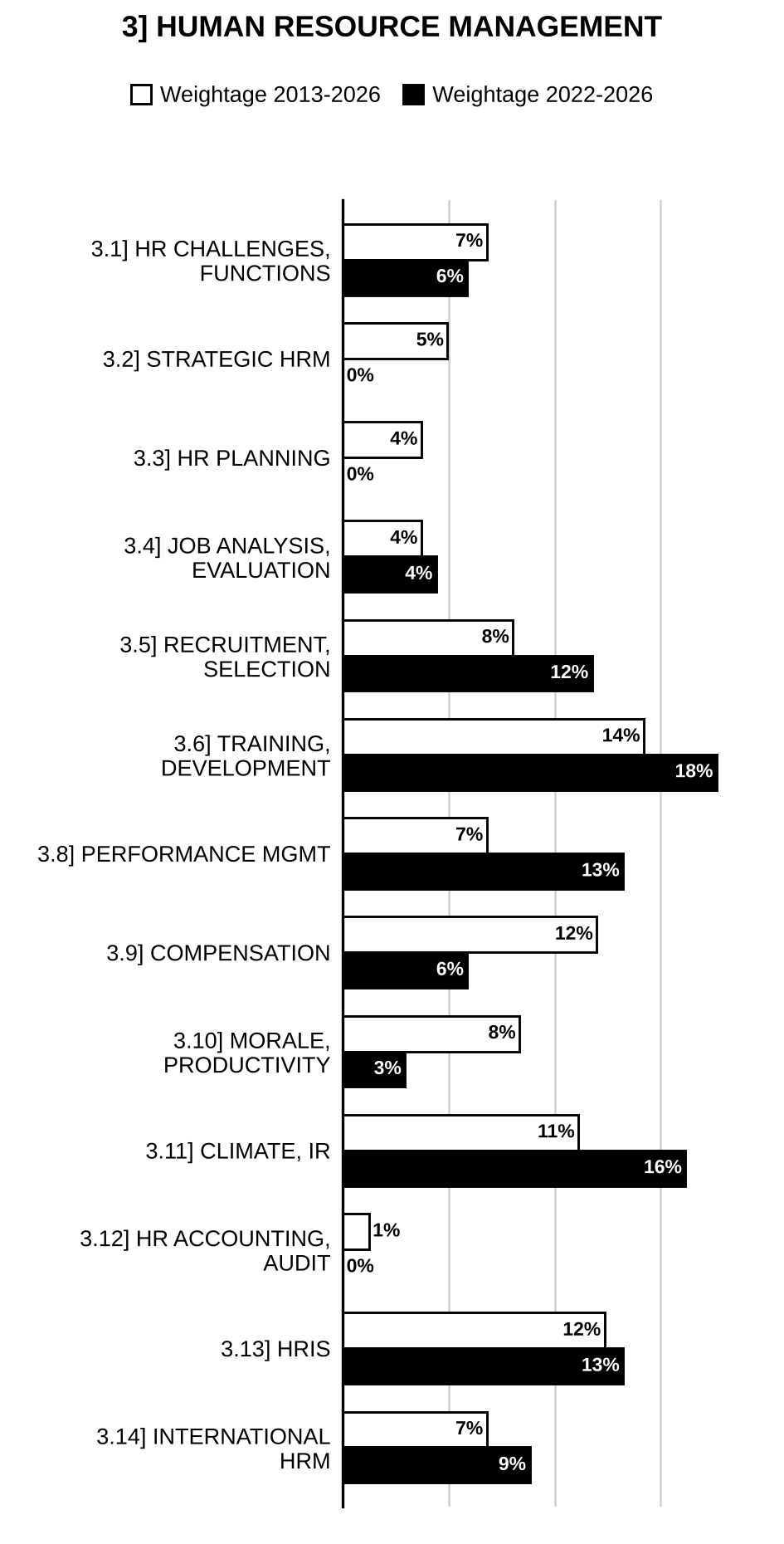
3.1] HR challenges and HRM functions
9 questions
What innovative Human Resource Management (HRM) approaches could be adopted in future to foster supportive and inclusive environment prioritizing employee well-being? [2025/10m/1d]
In the emerging scenario of IT enabled work environment, highly dynamic external business environment and changing workforce expectations, what are the future challenges for human resource management? Specify and suggest ways of managing these challenges. [2024/10m/1e]
“Human resources management is a part of every Manager’s job including that of Production Manager or President because ‘getting things done and producing results is the name of the game’.” Critically analyze the above statement. Why do big corporations require separate human resources department? [2020/15m/2b]
With the advent of Information and Communication Technology (ICT), there has been a sea-change in all the functional areas of Management. In this context, discuss the future challenges of Human Resource Management (HRM) area in the next decade. [2019/10m/3a]
Discuss three Human Resource Management challenges faced in the 21st Century. [2016/10m/150w/1d]
What is the difference between HRM and HRD? What functions HRM covers and then discuss the challenges in each identified function. What are the critical issues in implementing a 360 degree appraisal in a government system? [2012/20m/2a]
“There is need for Human Resource Development not only at micro level but also at macro level.” Evaluate the statement with reference to India. [2001/20m/200w/5c]
Will it be correct to say that Manpower management has ceased to be the exclusive responsibility of the employer? Explain clearly your answer in the context of the India situation. [1998/30m/10a]
Discuss the significance of human resources in modern industry. Why has the management of human resources become a challenging job? [1995/30m/10a]
3.2] Strategic management of human resources
3 questions
What is strategic human resource management? Explain how HR practices get aligned with corporate strategies. [2021/10m/1c]
Discuss the important trends in business. How are these trends shaping human resources management? Why is conventional human resources view being replaced by strategic HRM? [2020/15m/4b]
What is the role of human resource management in formulating business strategy? [2014/15m/2a]
3.3] Human resource planning
3 questions
Describe the major considerations in forecasting manpower requirements. What are the supply sources of the forecasted manpower? [2021/15m/2c]
Explain the challenges of Human Resource Planning in the context of demographic and technological changes. [2017/15m/4a]
What are the constituents of a total manpower planning exercise? Discuss in detail how the requirements of manpower in a large industrial enterprise may be determined. [2004/60m/8]
3.4] Job analysis and job evaluation
5 questions
What is Job analysis? Identify the advantages and disadvantages of: (i) Observation Method (ii) Structured Questionnaire Method and (iii) Diary Method. [2022/15m/3c]
How do job analysis and job evaluation enable better performance? [2016/15m/3b]
Competency mapping. [2009/20m/200w/2b]
Describe the meaning, purpose and procedure of Job analysis. [1997/30m/11b]
Differentiate between performance appraisal and job evaluation. Which one would you consider to evaluate the employee for promotional opportunities? [1996/30m/10a]
3.5] Recruitment and selection
11 questions
What are the key impacts of automation and Artificial Intelligence (AI) on recruitment and selection processes? “Along with several advantages of automation and Artificial Intelligence (AI) in recruitment and selection processes, there are some complexities as well.” Discuss. [2026/15m/2c]
How are selection criteria identified for a given job validated? How do organisations apply predictive validity and concurrent validity measures? [2024/10m/1d]
How does an organization determine the effectiveness of its recruitment process? To avoid the high cost involved in the recruitment process, what alternatives are used by organizations? Explain. [2023/15m/3c]
What are the important types of interviews? Often interviews are affected by errors that creep in the process and undermine their usefulness. What are these errors and how can these be minimized? [2020/15m/3c]
Apart from physical ability, language, intelligence and emotional stability, honesty and integrity are the two most sought after characteristics required in any candidate. Describe the techniques followed in Recruitment and Selection to check these two characteristics of honesty and integrity. [2019/10m/150w/1d]
Design a suitable recruitment and compensation policy for a manufacturing organisation in the Public Sector. [2012/20m/3c]
Something more than administering various tests for recruitment is needed for an effective recruitment policy. Explain. [1998/30m/10b]
Selection procedures may involve rejection of a large number of good candidates but it should ensure selection of persons who will not prove misfits or failures. Comment. [1997/30m/10a]
Discuss the merits of a policy which provides of recruitment from within vis-a-vis the merits of a policy for recruiting from outside: [1997/30m/10b]
Compare the relative advantages and disadvantages of various recruiting methods, such as advertising, employment agencies, personal referrals and others. [1996/30m/11b]
If you were to interview a candidate for employment what preparations would you make and with what type of information would you first acquaint yourself. [1995/30m/10b]
3.6] Training and development
15 questions
Training need assessment is one of the most important aspects of planning the training and development system for any organisation. What are the approaches that can be applied for training need assessment in case of a government organisation that is undergoing digital transformation? Describe the instructional strategies that you would recommend once the training needs have been assessed. [2024/15m/3c]
Differentiate between career, career planning, career development and career management. Who are the major stakeholders in career development? [2023/15m/2c]
Explain the kinds of signals that warn a manager about an employee requiring training. What types of training are critical for employees going on an overseas assignment? [2022/10m/1e]
What are the five traditional career stages? Which of the five stages is probably least relevant to Human Resource Management? Explain your view. [2022/20m/4c]
Most of the government officers fail to serve the purpose of overseas learning and development assignments. Suggest different interventions which can improve the return on investment on overseas training. [2019/10m/150w/1b]
How will you assess the training need of different categories of employees in a government organization? [2016/20m/2c]
What is ‘blended learning’? Discuss some recent innovations in training and development with the advent of e-learning. [2015/10m/150w/1c]
What is ‘training needs assessment (TNA)’? Discuss different methods for understanding training requirements in an organization. [2015/15m/3c]
What are the various strategic issues related to training need identification, promotion and transfer of employees in large public sector organisations? [2012/20m/2c]
Training Audit. [2009/20m/200w/6b]
Training is different from management development. Explain this statement by giving suitable examples. Discuss various methods of management development. How would you justify huge costs incurred on training and development? [2006/60m/8]
Career Development. [2005/20m/200w/5d]
Training refers to the Organisation’s efforts to improve an individual’s abilities to perform a job or organisational role whereas development refers to the Organisation’s efforts to enhance an individual’s abilities to advance in his organisation to perform additional job duties. Discuss and make a case for nature and purpose of training policy that may contribute to development. [2003/60m/8]
How would you identify the training needs for different levels in an organisation? Explain with example. [2001/30m/7a]
On the job training has its merits and limitations. Discuss and suggest how people to be appointed on managerial posts should be trained. [1998/30m/11a]
3.7] Promotion and transfer
6 questions
What are the various strategic issues related to training need identification, promotion and transfer of employees in large public sector organisations? [2012/20m/2c]
Minimizing the pain of downsizing. [2004/20m/200w/1d]
Re-deployment. [2004/20m/200w/5c]
Promotion differs from up-gradation and transfer. [2002/20m/200w/5c]
Why should an organisation have well defined promotion and reward policies and processes? Explain with examples. [2001/30m/7b]
Transfers for job enrichment. [2000/20m/200w/1c]

Preparing for Prelims too?
Our UPSC Prelims Topic-wise PYQ eBook covers every Prelims question with detailed explanations, so you can see exactly where UPSC asks from.
View the BookDownload Free Sample3.8] Performance management
11 questions
What is the relationship between Organisational Culture and the successful implementation of a Performance Management System? Discuss with suitable examples. [2026/20m/3c]
As a Performance Management Auditor, what criteria would you use to evaluate the effectiveness of a Performance Appraisal System? Do you think that appraisals enhance employee effectiveness? Explain. [2025/15m/4c]
How do variables like organisational culture and choice of performance criteria affect the design and functioning of a performance management system? What are the types of performance information you would require to effectively carry out performance management for your shop floor workers and your production manager? Critically comment on why the information requirement differs for the two situations. [2024/20m/4a]
How can the performance of a government employee be appraised? Discuss 360-degree performance appraisal method. How can the barriers in the appraisal process be removed? [2019/10m/2d]
What is the difference between HRM and HRD? What functions HRM covers and then discuss the challenges in each identified function. What are the critical issues in implementing a 360 degree appraisal in a government system? [2012/20m/2a]
Discuss the process of developing the Key Tasks and Key Result Areas (KRA) for managers and officers in a large organisation and provide appropriate weightages on each such KRAs for assessment giving reasons thereof. [2012/20m/4a]
What are the different approaches to performance management? How do companies balance between internal equity and merit-based pay? [2009/60m/8]
“India is emerging as a globe IT superwork [?]. However, it is not possible to sustain the growth in qualitative terms unless the performance management system of the orgnistation [?] are geared to meet the inherent challenges of expansion.” In the light of this statement, give outline of an ideal performance management system for the IT sector. [2008/60m/4]
Performance-Assessment Methods. [2004/20m/200w/5b]
Accurate appraisal of performance is very difficult. In the light of this statement discuss the problems in performance appraisal. [2002/60m/8]
Differentiate between performance appraisal and job evaluation. Which one would you consider to evaluate the employee for promotional opportunities? [1996/30m/10a]
3.9] Compensation management and benefits
15 questions
Broadbanding is increasingly being adopted to manage employee compensation. Illustrate with examples the benefits of broadbanding in compensation management. [2025/10m/1e]
Explain the rationale behind companies providing benefits to their employees. What effect do companies expect, benefits will have on employee morale and productivity? [2022/20m/2c]
What are the variable pay-for-performance plans? What are the criteria for the success of these plans? [2021/10m/1e]
Briefly explain the theories of compensation. What are the different types of monetary and non-monetary rewards? What are the merits and demerits of using non-monetary rewards? [2018/15m/2a]
What non-monetary compensation and benefits will you devise to increase employee productivity? [2016/10m/150w/1e]
Describe ‘pay for person’ and ‘pay for position’ in the context of Compensation and Reward Management. [2015/15m/2a]
How can flexible benefits motivate employees? Explain with two examples. [2015/15m/3b]
Explain the benefits of stock options. [2014/12m/7c(ii)]
Design a suitable recruitment and compensation policy for a manufacturing organisation in the Public Sector. [2012/20m/3c]
“The higher wage effect does not necessarily translate into higher cost.” Explain with examples from India and abroad. [2010/30m/3a]
What are the different approaches to performance management? How do companies balance between internal equity and merit-based pay? [2009/60m/8]
Compensation Packages and Retention of Employees. [2008/15m/200w/1b]
You are a Human Resource Manager of an IT-Organisation operating in India and also in Germany, Sri Lanka and Saudi Arabia. In the recent meeting of Board of Directors, the Chairman of the Company made a statement by offering peanuts you will attract monkeys only. Based on this statement he expected you to prepare a compensation plan. [2007/60m/8]
Why should an organisation have well defined promotion and reward policies and processes? Explain with examples. [2001/30m/7b]
Suggest a programme for wage administration ensuring that it does not prove demotivating. [1997/30m/11a]
3.10] Employee morale and productivity
10 questions
Explain the rationale behind companies providing benefits to their employees. What effect do companies expect, benefits will have on employee morale and productivity? [2022/20m/2c]
What do you understand by employee morale? How can it be boosted? In this context, give example of a Public Sector Undertaking (PSU). [2019/15m/4b]
What is Job Satisfaction? What is its relationship with employees’ intention to stay, productivity, absenteeism, turnover and accidents? Answer in the context of Knowledge Based Organisations. [2017/10m/150w/1e]
What is meant by ‘quality circles’? Explain the impact of quality circles on productivity. [2016/20m/3c]
What are the causes of work stress? How does employees’ morale affect productivity? [2016/15m/4a]
‘Employee morale and productivity are not mutually dependant’. [2013/10m/150w/1d]
How can knowledge workers be motivated? What techniques are corporate enterprises in India employing in recent years to attract and retain knowledge workers? [2011/30m/8b]
Employees Morale. [2007/20m/200w/5c]
Morale and Productivity. [2002/20m/200w/1b]
How can the employee morale be raised? Explain main techniques of motivation. [1999/30m/11b]
3.11] Organisational climate and industrial relations
24 questions
How has the growing service sector, especially the Information Technology (IT) sector, impacted trade unions in India? Discuss in the light of the challenges that trade unions are facing today. [2026/20m/4b]
Explain the diverse roles of the stakeholders that contribute to the framework of industrial relations within an organization. How do the interests and roles of these stakeholders conflict with each other? [2025/15m/3c]
“Workers’ education is the latent energy in economic development.” Explain the concept of workers’ education and highlight its aims and objectives. [2023/10m/1d]
What are the major collective bargaining issues in Indian industries? What do you foresee as a major issue of the future? [2023/10m/1e]
Explain Dunlop’s system approach model of industrial relations. How did Bomers extend this model for international industrial relations? [2021/15m/4c]
Are being legal and being ethical same? Employees look at their employers in terms of distributive, procedural and interactional justice. How does violation of these affect industrial/human relations? [2020/10m/1b]
Explain the meaning of disputes and causes thereof. Industrial disputes, if not resolved create dissatisfaction which finds expression in different ways. Explain the various ways of settling disputes. [2018/15m/7a]
Comment on approaches for resolution of management–workforce conflicts. [2012/10m/4c]
“Trust is the foundation for human relations and modern management approaches.” Explain. How can an organization develop present level of Trust between the management and employees and sustain it for its success? [2011/30m/3a]
Industrial Relations. [2006/20m/200w/5c]
Constituents of Organisational Climate. [2003/20m/200w/5d]
Identify preconditions for Industrial Democracy and Workers Participation in Management. How are these likely to better industrial relations? Cite some Indian experiences in support for your answer. [2000/60m/2]
Describe the developmental phases and history of Trade Unionism in India. [1999/30m/10a]
Briefly point out the characteristics of Industrial Disputes Legislation. [1999/30m/10b]
What do you understand by conciliation and adjudication? Describe these procedures fully. [1999/30m/11a]
Briefly narrate the mean characteristics of Payment of Bonus Act. [1999/30m/12b]
Workers participation in management in the present context of Indian Trade Unionism and workers education can only be a mixed blessing. Comment. [1998/30m/12b]
As per the provisions of Payment of Bonus Act, state who must pay Bonus and who need not. [1997/30m/12a]
Differentiate between grievance and conflict and describe how grievances are handled in any industrial unit. [1997/30m/12b]
Describe collective bargaining. With all the details of the process of this type of negotiations, why should there be industrial disputes every now and then? Do you have some suggestions to offer particularly in case of airlines? [1996/30m/12a]
Prepare a note on the grievances handling process in the industry. Does, it warrant improvement? Offer your comments. [1996/30m/12b]
State the requirements of a good industrial relations programme in the context of Indian environment? [1995/30m/11b]
What do you understand by the term multiplicity of trade unions? What are the problems that emerge from this phenomenon? Suggest measures to take care of interunion rivalry. [1995/30m/12a]
Describe the machinery provided under the industrial Disputes Act, 1947, for the prevention and settlement of industrial disputes. Do on think that the machinery has worked satisfactory. [1995/30m/12b]
3.12] Human resources accounting and audit
4 questions
Define Human Resource (HR) Audit. Describe the various practices followed for HR Audit. [2018/10m/150w/1d]
How will you go about in terms of organising auditing and accounting of human resources in an organisation? [2012/20m/2b]
Models in Human Resource Accounting. [2009/20m/200w/2c]
Human resource accounting. [2002/20m/200w/5d]
3.13] Human resource information system
7 questions
What kind of organisational readiness, from the human resource management perspective, is required for a successful implementation of Artificial Intelligence (AI) in Human Resource (HR) functions? Identify the possible ethical challenges that Artificial Intelligence (AI) implementation may bring. How can organisations balance process efficiency along with ethical considerations? [2026/10m/150w/1b]
What are the challenges an organization faces in integrating human resource information system with other business systems, e.g. CRM, ERP, Payroll, etc.? Suggest probable solutions to overcome these challenges. [2025/15m/2c]
Highlight the key differences between human resource information system, human resource analytics and enterprise resource planning, and give their suitable applications. Illustrate and explain a typical human resource information system framework. [2023/20m/4a]
New generation Human Resource (HR) managers are well-versed with numbers and technology. Human Resource Information System (HRIS) is one example of it. Briefly discuss HRIS. What attributes will you consider while framing an HR dashboard metrics, which can give a realistic picture of Human Resources in an organization? [2019/15m/2a]
“When managers act on better logic and evidence, their companies will trump the competition.” Critically analyse this statement in the context of analytics, big data and HR analytics. What HR decisions can be made better with HR analytics? [2018/10m/6c]
Explain the components of the technology enabled HRIS and feedback mechanism in an organisation. Do they lead to increased motivation and morale? Substantiate. [2017/20m/3b]
What is ‘human resource information system (HRIS)’? How can HRIS help in effective management of Human Resource? [2015/10m/150w/1b]
3.14] International human resource management
5 questions
What are the relevant competencies required for effective performance by an expatriate manager in an international assignment? If there is more than one candidate who is technically competent, what behavioural parameters would you consider to identify the right candidate for an expatriate assignment? Discuss. [2026/15m/2b]
How do the requisites for successful international human resource management differ from those in case of a domestic organisation? How should the challenge of managing multicultural teams be managed in international organisations? [2024/15m/2c]
Briefly explain the distinguishing features between domestic and International Human Resource Management (IHRM). Critically evaluate pros and cons of employing Host Country Nationals (HCNs), Parent Country Nationals (PCNs) and Third Country Nationals (TCNs). [2021/15m/3c]
What characteristics would you look for in selecting an expatriate manager? [2014/10m/150w/1e]
You are a Human Resource Manager of an IT-Organisation operating in India and also in Germany, Sri Lanka and Saudi Arabia. In the recent meeting of Board of Directors, the Chairman of the Company made a statement by offering peanuts you will attract monkeys only. Based on this statement he expected you to prepare a compensation plan. [2007/60m/8]

Strengthen your GS papers
Our UPSC Mains Topic-wise & Year-wise PYQ eBook (2013–2026) maps every GS question to the syllabus, so you know what UPSC asks and how often.
View the BookDownload Free Sample« Previous: Organisational Behaviour and Design | Next: Accounting for Managers »
Back to: Management Optional PYQs – Topic-wise
Last updated: 30 October 2026