
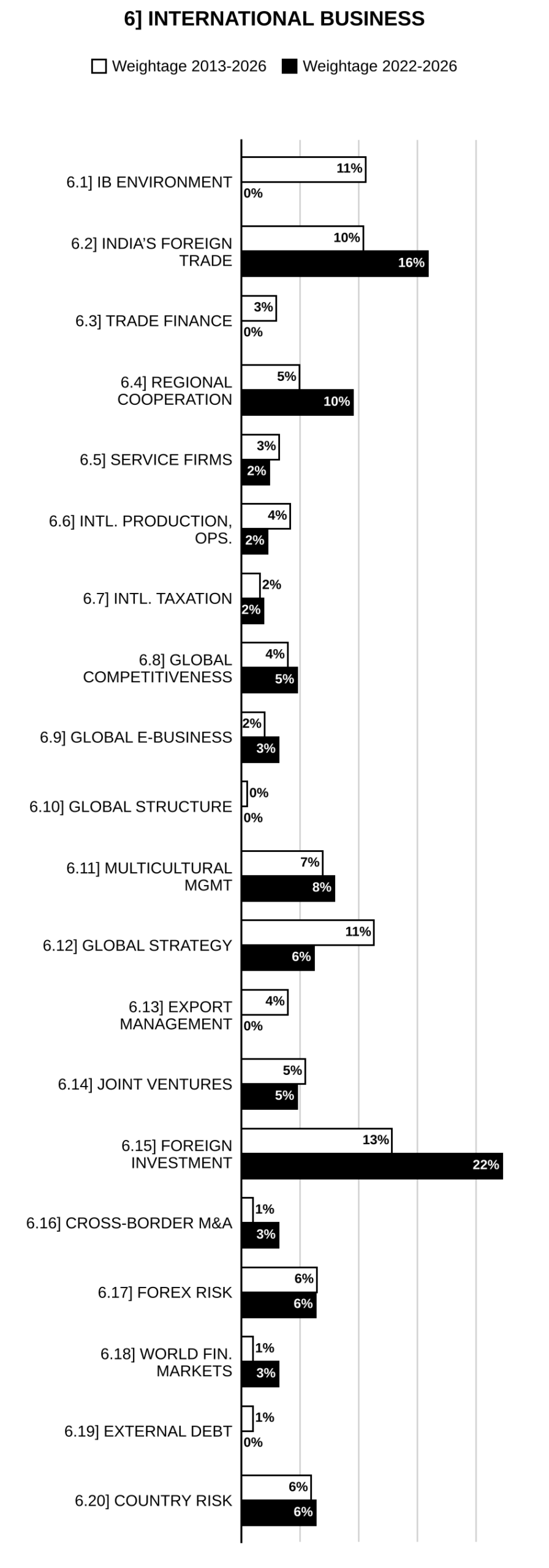
Here are all 142 International Business questions asked in UPSC Management Optional Paper II from 1995 to 2026, arranged under the 20 topics of the official syllabus. Within each topic the latest questions come first.
Each question ends with a code such as [2024/15m/3b] – the year, the marks, the word limit (where UPSC set one) and the question number in the paper.
6.1] International business environment
21 questions
“The term ‘globalisation’ assumes increasing importance in today’s techno-economic parlance.” Explain this statement in the context of the Indian economy. [2021/7m/6a(ii)]
In International Trade Theory, how is ‘Theory of Absolute Advantage’ different from ‘Theory of Comparative Advantage’? Which of these is more preferred? [2016/10m/5a]
What is “Intellectual Property”? What are the international mechanisms that help harmonize intellectual property protection across different nations? What are the methods used for valuation of intellectual property? [2015/10m/8b]
A summary of major trade partners of France in 2013 is given in the table below: Major Trade Partners of France.
| Country | Exports: Value (US $ billion) | Exports: Share (%) | Imports: Value (US $ billion) | Imports: Share (%) |
| Germany | 93.2 | 16.4 | 114.2 | 17.1 |
| Belgium | 43.6 | 7.7 | 52.4 | 7.8 |
| Italy | 40.3 | 7.1 | 47.7 | 7.1 |
| UK | 39.1 | 6.9 | 27.5 | 4.1 |
| Spain | 38.3 | 6.8 | 40.7 | 6.1 |
| USA | 35.8 | 6.3 | 43.4 | 6.5 |
| Netherlands | 23.3 | 4.1 | 28.9 | 4.3 |
| China | 19.6 | 3.5 | 53.8 | 8.1 |
In your opinion, which of the international trade theories explains the above trade patterns? Explain the above trade patterns with the theory that you think is most appropriate. [2014/20m/7a]
“Protection of intellectual property regime has been relatively weak in India.” In view of this, what measures will you recommend to strengthen and bring the intellectual property regime at par with internationally accepted framework of intellectual property protection in the context of patents, trademarks and copyrights? [2014/15m/7b]
Briefly explain the concept of ‘dumping’. Elaborate various forms of dumping and their impact on the target market. [2014/10m/8b(i)]
Explain the concept of ‘terms of trade’ and its significance. Differentiate between ‘net’, ‘gross’ and ‘income’ terms of trade. Identify the reasons for differences of ‘terms of trade’ between developed and developing countries. [2014/10m/8b(ii)]
In international trade theory, how is ‘theory of absolute advantage’ different from ‘theory of comparative advantage’? Which of these is more preferred? Why? [2013/10m/5d]
Assume two countries A and B have the same amount of resources which can be used to produce either rice or cocoa. A total of 200 units of resources are available. Country A needs 10 resources to produce 1 tonne of cocoa and 20 resources to produce 1 tonne of rice. Country B takes 40 resources to produce 1 tonne of cocoa and 10 resources to produce 1 tonne of rice. Assume a linear relationship between production and resources consumed. (i) Draw the Production Possibility Frontier (PPF) for countries A and B respectively. (ii) Assume both countries engage in trade with each other and decide to produce only that item in which they have absolute advantage. Assume they can swap 1 tonne of rice for 1 tonne of cocoa and the unit price of rice and cocoa are equal. Country A exports 6 tonnes of cocoa to country B and imports 6 tonnes of rice in return. What will be the change in combined output of cocoa and rice of the two countries as a result of the trade, compared to what would have been possible before specialization and trade, with each country devoting half of its resources each to produce cocoa and rice? [2013/15m/8b]
Distinguish between “competitive advantage” and “comparative advantage”. How are endowments of a country’s factors of production linked to its comparative advantage? [2011/15m/7i]
How do the factors mentioned below impact international trade: (a) Increasing returns to scale (b) Product differentiation (c) Imperfect competition (d) Irreversible investments (e) Externalities and spillover effects. [2011/25m/7ii]
How does the “Product Life-cycle Theory” explain the globalization of firms? What are the four generic strategies to compete and secure competitive advantage in global markets? What are the key requirements for a product to be a true “global” product? [2011/20m/7iii]
It is argued that India has achieved much higher rate of economic growth after its increasing globalization and integration with the world economy. Assess how and to what extent India has benefited from the process of globalization. [2010/20m/8a]
UNCTAD. [2007/20m/200w/1c]
The future of International Marketing belongs to India. Discuss this statement in view of your understanding of trends in international marketing environment and the emergence of new markets. [2007/60m/4]
Globalisation and its implications for Indian business. [2006/20m/200w/5c]
Comment on the effect of the TRIPS Agreement under WTO on Indian pharma companies with respect to their growth and development strategy. [2004/60m/8]
WTO is the Third Pillar of Global Business. Examine the statement with suitable examples. [2004/60m/4]
Issues of TRIPs. [2003/20m/200w/1c]
Define international business and bring out the differences between the domestic business and international business. [2001/30m/4a]
Do you think international business is expanding in India? If so, explain the causes for growth. [2001/30m/4b]
6.2] India’s foreign trade: policy and trends
14 questions
What are the key objectives of the latest Foreign Trade Policy of the Government of India? Explain the major schemes and initiatives taken under this policy. What would be the likely impact of this policy on Indian economy? [2026/20m/8a]
Critically evaluate India’s foreign trade since independence and identify constraints in India’s Exports Growth. [2025/10m/5d]
Critically evaluate the trends in India’s foreign trade during last ten years. [2024/10m/5e]
Critically examine the various initiatives taken by the Government of India in respect of export-import policy. Give examples from India’s trade with the Asian countries. [2022/10m/5c]
Explain the objectives around which India’s Foreign Trade Policy has been framed. Describe the strategies adopted to attain these objectives. Discuss briefly the various policy measures adopted for Trade Promotion. [2020/20m/7a]
Evaluate the various initiatives of the ‘Exports from India Scheme’ under the Foreign Trade Policy of India. List the major goods exported from India from 2016 onwards. [2019/15m/6b]
(i) Critically evaluate India’s Foreign Trade Policy and trends in recent years. (ii) Do you think the ‘Make in India’ call can bring in changes? [2016/20m/7b]
Critically evaluate the EXIM policy of India and state the key objectives of the Export-Import policy. [2016/10m/8a(i)]
‘India has a large domestic market of its own. Export-led industry has very limited scope.’ [2010/10m/5f]
Comment on the balance of India’s foreign trade. Is it sustainable in the long run? What policies would you recommend to correct the balance? [2010/20m/8b]
Evaluate the role of Indian Government in shortlisting the main problems of export marketing and also in solving these problems successfully. [1999/30m/3a]
Do you find the scope of export marketing extremely bright in the next decade? [1999/30m/3b]
In the light of our membership of the WTO, what is the role of export incentives and promotional strategies? [1996/30m/3b]
Do you think there is any place for export incentives now in India in the context of liberalization of economy and membership of WTO? Highlight the advantages or limitations, if any, arising therefrom. [1995/30m/3a]
6.3] Financing of international trade
4 questions
Explain the various financing techniques employed in foreign trade. [2021/5m/7c(i)]
What are the main features of the following documents? (A) Letter of Credit (B) Bill of Lading (C) Commercial Invoice (D) Consular Invoice (E) Insurance Certificate. [2021/10m/7c(ii)]
Explain the Export Credit Delivery System in India. [2016/10m/8c(i)]
What are the principal means of payment in foreign trade? What are the main documents used in financing foreign trade? [2015/10m/5c]
6.4] Regional economic cooperation and FTAs
8 questions
Elaborate different levels of economic integration giving costs and benefits. Discuss the role of ASEAN and SAARC in successfully promoting integration between member countries. [2024/15m/8c]
“Regional Economic Cooperation can play an important role in India’s unfavourable Balance of Trade.” Comment. [2023/5m/8a(i)]
Examine the role of dispute settlement mechanisms in FTAs. How do these mechanisms resolve conflicts and enforce trade agreements? What are the possible challenges and possible improvements in the existing dispute settlement frameworks? [2023/10m/8a(ii)]
Describe the different levels of regional economic integration. [2021/5m/5b(i)]
What are the pros and cons of ‘BREXIT’? [2021/5m/5b(ii)]
Why are Free Trade Agreements signed? What are their advantages and disadvantages? Discuss the stages of evolution of a domestic corporation to finally emerge as a global conglomerate. [2018/20m/8c]
Regional Economic Co-operation. [2005/20m/200w/1b]
Regional economic cooperation promotes trade, increases investments and leads to economic efficiency. Discuss keeping in view the present state of competitiveness of Indian industries to meet global market requirements. [2003/60m/4]
6.5] Internationalisation of service firms
3 questions
Explain the following: (i) Issues that need to be kept in mind while framing global marketing strategies (ii) Internationalisation of service firms and its challenges. [2026/15m/7c]
How can service organisations internationalise themselves? What strategies would make them successful in their endeavour? [2017/15m/7b]
India is the world’s most attractive destination for sourcing services with abundance of manpower, both skilled and semi-skilled. Explain various ‘modes’ of trading services under the GATT Agreement. Critically evaluate the conflict between developing countries including India and developed countries in international expansion of services. [2014/10m/5d]
6.6] International production and operations
5 questions
COVID-19 pandemic has impacted global logistics and supply chains. Explain how an efficient logistic function can help an international business compete more effectively in the post-pandemic global marketplace. [2022/7m/8c(ii)]
What are the similarities and dissimilarities between domestic operations management and international operations management? [2021/5m/8a(i)]
Explain the various strategic issues involved in international operations management. [2021/10m/8a(ii)]
Describe how an efficient logistic function can help an international business compete more effectively in the global marketplace. [2020/10m/5e]
Case Study XYZ Machine and Electronics Early in 2016, Shekhar Sharma, Director of Supply Management in XYZ Machine and Electronics, met his company’s President at the President’s request, to discuss reducing material costs. The meeting centred on the company’s historical position as a buyer of only domestic products due to constraints in government contracts, that had recently been removed. The company could now consider global sources. The meeting concluded with Sharma receiving authorization to explore the cost-saving potential of global sourcing. XYZ Machine and Electronics XYZ Machine and Electronics is a division of a worldwide conglomerate that specializes in precision machined products and aerospace electronics. While largely government and defence oriented, the company has one commercial aviation electronics division among its 15 autonomous operating groups. Total sales for XYZ during 2015 was approx. ₹ 15,000 crores with over ₹ 5,000 crores being spent by supply management departments of various groups. Supply management function is divided among 15 autonomous divisions. Each has its own supply management department, which reports to division management but adheres to corporate policies and procedures. There is a relatively small corporate supply management staff concerned with corporate policy and common goods and services. The Cost Reduction Objective To maintain its competitive position, XYZ needed to explore all possible ways to reduce costs. In addition to analyzing and working with its domestic suppliers, Shekhar believed it was necessary at this time to begin considering global sources. Global Sourcing Until 2016, XYZ had only purchased globally as part of an offset countertrade requirement. The other exception was the Commercial Aviation Electronics (CAE) division, which had been acquired in 2015 as a means of diversifying XYZ’s electronics markets. CAE not only had been buying from foreign sources but also had established a factory in Singapore to source and manufacture one of its product lines. CAE’s offshore experience began before being acquired by XYZ. At first, parts were purchased from Singapore and other East Asian sources. These parts were then assembled in this country. Soon CAE began to buy assemblies in East Asia and finally all factory operations were shifted to their own Singapore facility. When Shekhar contacted each of the other’s supply managers, he was surprised to discover that each one had a collection of horror stories of past attempts to establish global sources of supply and was unwilling to try again. Most of these stories centred around problems of communication, quality control, credibility and understanding. Shekhar again contacted the CAE supply manager to discuss details of the Singapore operation. Not only did the Singapore factory build a product line, but also the Singapore supply department sourced components for that product line from throughout East Asia. Initial cost savings from first buys including engineering, test fixtures and other start-up costs ranged from 10% to 18%. Subsequent purchases yielded savings in the 25% to 40% range compared to domestic sources. Quality and delivery problems were minimal. Following that conversation, Shekhar wondered what he might do next. (i) What are the problems being faced by the organisation? (ii) What choices for starting a global sourcing programme exist? (iii) Would XYZ benefit from an international supply management office in Asia? [2018/20m/3a]
6.7] International taxation
4 questions
What are the various options a firm has to minimize its global tax liability? [2022/6m/8c(iii)]
Illustrate with examples, how do MNCs set transfer pricing to take advantage of differential tax rates in different countries. [2018/10m/5b]
What are the criteria for deciding on the transfer pricing method used in an organisation? Discuss with reference to management control of domestic and global operations. [2003/60m/8]
Explain the transfer price mechanism in subsidiary and headquarters relationships in a MNC. [2001/60m/7]
6.8] Global competitiveness and technological developments
5 questions
Explain the significance of attaining global competitiveness. In what ways can technological innovations help in bringing global competitiveness? [2026/10m/150w/5e]
Critically analyse the impact of technological advancements such as Artificial Intelligence and Block-Chain on International Business Operations and Supply Chain Management. How can companies leverage these technologies to gain a competitive advantage? [2023/10m/5c]
Elucidate the factors that influence country competitiveness. [2021/5m/5d(i)]
“Indian IT companies are successful in global business.”
(i) What reasons would you focus for their success? [2017/10m/8b(i)]
(ii) In what way is the Indian manufacturing hub lagging behind IT companies in satisfying global consumers? [2017/10m/8b(ii)]
In view of the fast changing competitive landscape of the economy, Indian corporate have to focus on the next practices, not just be content with the best practices. [C. K. Prahlad] Comment on the above statement. Explain the major forces that reshape the basis for competition. What role can innovation play in making India globally competitive? [2005/60m/2]
6.9] Global e-business
2 questions
“Global e-business is being applied by business firms to achieve greater profits.” Explain this statement giving various areas of application in firms. [2024/10m/7a(i)]
“Business firms across the world are applying Global e-Business in various divisions to achieve success.” Comment on the statement and discuss the various applications of Global e-Business used by firms. [2019/10m/5b]
6.10] Global organisational structure and control
1 question
Describe the various issues involved in global organizational design. [2021/5m/8a(iii)]

Preparing for Prelims too?
Our UPSC Prelims Topic-wise PYQ eBook covers every Prelims question with detailed explanations, so you can see exactly where UPSC asks from.
View the BookDownload Free Sample6.11] Multicultural management
8 questions
Examine the ethical challenges faced by multinational corporations in operating in countries with different legal and ethical standards. Discuss the importance of ethical leadership and corporate governance in international business. [2023/10m/8b(ii)]
Outline how the culture of a country might influence the cost of doing business in that country. Illustrate with examples. [2022/7m/8b(i)]
What is ethnocentrism? How does it influence the management of multinational companies? [2022/8m/8b(ii)]
Describe the four cultural predispositions that MNCs are likely to adopt towards managing employees in global context. [2021/5m/6b(i)]
How does Hofstede’s model on cultural dimensions equip international managers with an understanding of cultures across countries? [2021/10m/6b(ii)]
Discuss Hofstede’s ‘Cross-Cultural Classification’ with reference to multicultural management and its implications on international business decisions. [2019/10m/5e]
“Multi-cultural management is a challenging task in international business.” Why? [2017/10m/5c]
Most Indians find it difficult to understand how Western people eat beef, particularly since cow gives milk and is a revered animal. Korea and other East Asian countries’ love for foods such as bloodworm soup, snake and dog meats is not easy to understand for outsiders. In India and other South Asian countries, the fairness of skin is the most important parameter of women’s beauty. There is, for example, a huge market in Indian subcontinent for fairness creams such as ‘Fair and Lovely’ which is growing annually at 25% to 35%. A large number of firms have attempted to exploit this opportunity by introducing a variety of fairness products in the market. On the contrary, most Africans are surprised at ‘fairness’ being considered a key parameter of beauty. In Africa, brands like ‘Dark and Lovely’ for personal care products are highly popular. Thus domestic marketing experiences often conflict with international reality.
(i) In view of the above, explain the concept of Self-Reference Criteria (SRC) that influence a manager’s ability to make objective decisions while operating in international firm. [2014/5m/6a(i)]
(ii) How do these impact ability of managers to perform effectively in international business? [2014/5m/6a(ii)]
6.12] Global business and marketing strategies
23 questions
Explain the following: (i) Issues that need to be kept in mind while framing global marketing strategies (ii) Internationalisation of service firms and its challenges. [2026/15m/7c]
How is Global business strategy different from International, Multinational and Transnational? Elaborate with suitable examples. [2023/5m/8b(i)]
If you were a manager in a company that operates in many countries, what criteria would you use to determine whether a technological innovation should be developed as a product for global consumers or local consumers? [2022/7m/8c(i)]
What are the issues involved in Global Marketing Strategies? Explain the reasons of failure of Global Marketing Strategies. [2020/10m/5b]
‘Ada Apparels’ is a company dealing with ready-made garments (RMG) business. The CEO of the company wants to expand his business overseas and has conveyed his decision to his Global Marketing Director. If you were the Global Marketing Manager of ‘Ada Apparels’, which all ‘Contractual Modes of Global Marketing Strategies’ would you adopt? Discuss any two contractual modes of global marketing strategies in detail. [2019/15m/8b]
Why are Free Trade Agreements signed? What are their advantages and disadvantages? Discuss the stages of evolution of a domestic corporation to finally emerge as a global conglomerate. [2018/20m/8c]
How does the management strategy of multinational companies differ from that of national companies? Explain. [2016/10m/8b]
What are various entry modes by which firms can enter foreign markets? What are their advantages and disadvantages? [2015/15m/6b]
A small Asian firm has developed some valuable new medical products using its unique biotechnology know how. It is trying to decide how best to serve the European Union. Its choices are given below. The cost of investment in manufacturing facilities will be a major one for the Asian firm, but it is not outside its reach. If these are the firm’s only options, which one would you advise it to choose? Why? (i) Manufacture the product at home and let foreign sales agents handle marketing. (ii) Manufacture the product at home and set up a wholly owned subsidiary in Europe to handle marketing. (iii) Enter into an alliance with a large European Pharmaceutical firm. The product would be manufactured in Europe by the 50/50 joint venture and marketed by the European firm. [2015/20m/7a]
Read the case below and answer the questions based on it: Long ago ABC Company had a single store in USA selling premium roasted coffee. Today it is a global roaster and retailer of coffee with over 17000 stores in over 50 countries. In 1980, the company experimented with coffeehouse format to sell the company’s premium roasted coffee and freshly brewed coffee beverages along with a variety of pastries, coffee accessories, teas and other products in tastefully designed coffeehouse setting. The company hired, trained, motivated and compensated employees for superior customer service giving stock option grants and medical benefits to even part-timers. In 1995, with over 700 stores in US, the company explored foreign opportunities and licensed its format in Japan. Realizing that pure licensing would not give it the control needed, the company set up a 50/50 Joint Venture (JV) with a local retailer XYZ. The company initially invested US $ 10 million, its first FDI. ABC transferred some employees to the Japanese operation to replicate ABC’s experience in Japan. Training of Japanese store managers, employees, design parameters of the stores, stock options for Japanese employees were all meant to replicate the ABC’s experience. By 2006, the company had 600 stores in Japan. ABC continued with its overseas expansion aggressively. In 1998, it purchased a British coffee chain with 60 retail outlets for US $ 84 million. In late 1990s, it opened stores in Taiwan, China, Thailand, New Zealand, South Korea and Malaysia. Starting initially with licensing and replication of other practices followed in Japan, the company converted several of these into JVs or wholly owned subsidiaries, partly due to funding problems of local partners. By 2002, the company expanded into Europe, beginning with a JV with largest Swiss food service company. This was followed by JVs in other countries. In 2006, the company saw a major opportunity in China, which it believed to be the largest outside USA. (i) Why did ABC become disenchanted with licensing strategy? (ii) Why does ABC prefer to expand internationally through local joint ventures? (iii) What are the advantages for ABC of entry through joint ventures over owned subsidiaries? (iv) Which theory of Foreign Direct Investment (FDI) best explains the international expansion strategy adopted by ABC? [2013/30m/6a]
By what strategy did IJK Clothing Ltd. globalize its “Ar” shirt business? What explains the phenomenal growth of “Ar” shirt business? [2012/15m/200w/7a]
Is the strategy too India centric? What efforts are needed to transform it into a truly global strategy? [2012/15m/200w/7b]
Will the strategy work when competition intensifies in branded shirt business? [2012/15m/200w/7c]
In general, what are the generic strategies by which companies can globalize? What are their advantages and disadvantages? [2012/15m/200w/7d]
How does the “Product Life-cycle Theory” explain the globalization of firms? What are the four generic strategies to compete and secure competitive advantage in global markets? What are the key requirements for a product to be a true “global” product? [2011/20m/7iii]
How would you characterize the international strategy pursued by ABM in the (i) developing world and (ii) Europe prior to 2009? [2009/20m/5a]
What would be your advice to ABM regarding the international strategy it is planning? [2009/20m/5b]
How should ABM compete with Japanese car manufacturers globally? [2009/20m/5c]
What should ABM do (i) produce global cars or (ii) produce local country-specific models? Justify your answer. [2009/20m/5d]
There is hardly any difference in the methods of determining price in domestic market and overseas market. Discuss this statement by taking suitable examples. [2006/60m/4]
Strategy for dealing with global competition. [2003/20m/200w/5a]
Suggest a suitable methodology for overseas market research for an Indian company manufacturing and marketing herbal medicine. Channel selection, role of intermediaries, export pricing and risk management are the major objectives of the proposed research. [2002/60m/4]
What precautions are essential for such a launching for export marketing operations? [1999/30m/1b]
6.13] Export management and export-import procedures
7 questions
What are the main features of the following documents? (A) Letter of Credit (B) Bill of Lading (C) Commercial Invoice (D) Consular Invoice (E) Insurance Certificate. [2021/10m/7c(ii)]
With reference to ‘Export-Import Procedures’, explain the ‘Different Variants of Bill of Lading along with their Functions’ for an export transaction. [2019/20m/7b]
Explain the legal formalities and procedures to become an exporter. [2016/15m/6c]
International Buying. [2006/20m/200w/5a]
Documentation in international business. [2002/20m/200w/1c]
One of the Engineering Companies in India well known for producing quality irrigation pumps and enjoying considerable good-will is planning for export marketing of its products. The management, however, is not fully aware of the merits gains and associated risks. Nor have they any organisational capability. Give your views in the matter and suggest how they should proceed to place their products in the export market. [1998/30m/2a]
Discuss the problems an Indian exporter has to face these days. Are these problems peculiar to Indian situation? [1997/30m/3a]
6.14] Joint ventures
6 questions
Explain Joint Venture with suitable examples. Discuss the Life Cycle of a Joint Venture. [2025/15m/8a]
Discuss key considerations of identifying a joint venture partner. Why do we go for JVs in business? What are the various types of JVs that can be formed and what would be their management challenges? [2018/15m/6c]
Distinguish between “Strategic alliance” and “Joint venture”. What factors should be considered in choosing a co-venturer? [2016/10m/5d]
Distinguish between “strategic alliance” and “joint venture”. What factors should be considered in choosing an alliance partner? [2015/10m/5d]
Read the case below and answer the questions based on it: Long ago ABC Company had a single store in USA selling premium roasted coffee. Today it is a global roaster and retailer of coffee with over 17000 stores in over 50 countries. In 1980, the company experimented with coffeehouse format to sell the company’s premium roasted coffee and freshly brewed coffee beverages along with a variety of pastries, coffee accessories, teas and other products in tastefully designed coffeehouse setting. The company hired, trained, motivated and compensated employees for superior customer service giving stock option grants and medical benefits to even part-timers. In 1995, with over 700 stores in US, the company explored foreign opportunities and licensed its format in Japan. Realizing that pure licensing would not give it the control needed, the company set up a 50/50 Joint Venture (JV) with a local retailer XYZ. The company initially invested US $ 10 million, its first FDI. ABC transferred some employees to the Japanese operation to replicate ABC’s experience in Japan. Training of Japanese store managers, employees, design parameters of the stores, stock options for Japanese employees were all meant to replicate the ABC’s experience. By 2006, the company had 600 stores in Japan. ABC continued with its overseas expansion aggressively. In 1998, it purchased a British coffee chain with 60 retail outlets for US $ 84 million. In late 1990s, it opened stores in Taiwan, China, Thailand, New Zealand, South Korea and Malaysia. Starting initially with licensing and replication of other practices followed in Japan, the company converted several of these into JVs or wholly owned subsidiaries, partly due to funding problems of local partners. By 2002, the company expanded into Europe, beginning with a JV with largest Swiss food service company. This was followed by JVs in other countries. In 2006, the company saw a major opportunity in China, which it believed to be the largest outside USA. (i) Why did ABC become disenchanted with licensing strategy? (ii) Why does ABC prefer to expand internationally through local joint ventures? (iii) What are the advantages for ABC of entry through joint ventures over owned subsidiaries? (iv) Which theory of Foreign Direct Investment (FDI) best explains the international expansion strategy adopted by ABC? [2013/30m/6a]
What is a “Strategic Alliance”? What are the different types of strategic alliances? What are their advantages and disadvantages? Distinguish between strategic alliance and joint venture. [2012/12m/150w/5c]
6.15] Foreign investment
16 questions
Distinguish between Foreign Direct Investment and Foreign Portfolio Investment. Explain the impact of each of these on the economy. [2026/15m/6c]
What is Foreign Direct Investment? Describe with suitable examples the different factors that influence Foreign Direct Investment. [2025/15m/8b]
Critically analyze the economic rationale behind Foreign Direct Investment (FDI). Do you think India has a robust policy for attracting FDI? Elaborate. [2024/15m/6c]
Do you think free entry and exit of Multinational Corporations (MNCs) is healthy for the growth of Indian economy? Discuss the business strategies of MNCs in this context. [2022/10m/5d]
Discuss the importance of Foreign Direct Investment (FDI) for developing economies like India. Should these countries go all out for attracting more FDI? [2022/8m/8a(i)]
Discuss the role of authorities created by the Government of India for streamlining the FDI movement in India. [2022/7m/8a(ii)]
Distinguish between Foreign Direct Investment and Foreign Portfolio Investment. Critically examine the existing policies adopted by the Government of India for attracting Foreign Direct Investment. [2020/20m/8b]
Discuss the Global trends in FDI. [2016/10m/8c(ii)]
How does the product-life-cycle theory explain firm’s preferences for and timing of foreign direct investment (FDI)? [2015/10m/5a]
What are the advantages and disadvantages that Multinational Corporations (MNCs) bring to a host country? How do you distinguish between MNC and Transnational Corporation (TNC)? [2013/10m/5b]
In the year 2004, inward FDI accounted for some 24% of capital formation in Ireland, but only 0.6% in Japan. What do you think explains the difference in FDI inflows into the two countries? [2013/10m/6b]
What is “Foreign Direct Investment”? What is “Foreign Portfolio Investment”? How do these differ? Explain the product life cycle theory of “Foreign Direct Investment”. [2012/12m/150w/5e]
Foreign investment in India takes place in the form of (1) Foreign Direct Investment, and (2) Foreign Portfolio Investment. Bring out your views on the merits and demerits of the two forms of investment for their impact on long-term economic development of India. [2010/30m/4a]
In the context of FDI, distinguish between ‘greenfield strategy’ and ‘alliance strategy’ with suitable illustrations. [2010/10m/4c]
Should Indian industries invest abroad when there is shortage of capital in India? Critically analyse. [2010/20m/8c]
Governments can influence firms’ decisions to invest in foreign countries. By their choice of policies, both host country and home-country governments encourage and restrict Foreign Direct Investment (FDI). An important determinant of government policy toward FDI is political ideology. Political ideology ranges from a radical stance that is hostile to FDI to a noninterventionist, free market stance – between the two extremes is an approach best described as pragmatic nationalism. Explain how the political ideology of a host government might influence the negotiations between the host government and a foreign multinational enterprise (MNE). Under what circumstances is an MNE in a powerful negotiating position vis-à-vis a host government? What costs does a developing host country pay for FDI? [2009/60m/6]
6.16] Cross-border mergers and acquisitions
1 question
Discuss the best practices for managing cross-border mergers and acquisitions. What are the lessons learned from successful and unsuccessful cross-border mergers and acquisitions? [2023/10m/8c(ii)]
6.17] Foreign exchange risk exposure management
4 questions
Elucidate the concept of Foreign Exchange Risks and Exposure. Discuss the techniques included in Managing Foreign Exchange Risks with suitable examples. [2025/20m/8c]
Explain foreign exchange risk and foreign exchange exposure. Describe the various types of foreign exchange exposures. How can foreign exchange risks be managed? [2020/15m/6b]
Global firms face three possible types of foreign currency exposure namely, Transaction, Translation (Accounting) and Economic. What are the different strategies organisations can adopt to deal with these exposure risks? [2018/20m/7a]
Elucidate the concept of ‘multilateral netting’ and explain how it influences management of cash flows in a multinational enterprise (MNE). [2014/10m/5e]
6.18] World financial markets and international banking
3 questions
Analyse the role of international financial institutions (IMF and World Bank) in facilitating global business operations. Assess their effectiveness in promoting economic development. [2023/10m/5d]
IMF and World Bank. [2004/20m/200w/1c]
Role of IMF and World Bank in the International Financial System. [2001/20m/200w/1c]
6.19] External debt management
1 question
“Managing external debt portfolio of a multinational firm is crucial to profitability, as otherwise operational efficiency will jeopardize.” Explain this in the context of enhancing corporate value. [2014/10m/8c]
6.20] Country risk analysis
6 questions
What do you understand by Country Risk Analysis? Explain the various types of Country Risk. [2026/10m/150w/5d]
“In changing political scenario, country risk analysis becomes utmost important.” Elaborate the statement giving suitable examples. [2024/10m/7a(ii)]
Discuss the various perceived risks for a company from a developed economy planning to invest in a new project in a developing and underdeveloped country. How do you propose to mitigate these perceived risks? [2018/10m/5e]
“Country risk analysis assumes that a country is a purposeful entity managed by a government.”
(i) Bring to light the major dimensions focussed in country risk analysis. [2017/10m/6b(i)]
(ii) In what way is this analysis helpful to corporate houses? [2017/10m/6b(ii)]
Press reports have constant flow of tales of political instability. Not surprisingly, managers consistently rank political stability as a major factor in evaluating the business and investment climate in a given country. Despite the fact that managers overwhelmingly believe that “political risk” is a major factor to be considered, a few multinational enterprises (MNEs) have internal assessment mechanism or have sophisticated teams that can evaluate the usefulness of assessments provided by consultants. (i) Is it correct to assume that political instability in a country equals political risk? If not, why? (ii) How would you factor in political risk in evaluating foreign investment proposal? [2015/10m/7c]
Countrywise risk analysis is a difficult task and recent events in several countries have dramatised the importance of country risk analysis. Do you agree? Substantiate your answer with examples. [2005/60m/4]

Strengthen your GS papers
Our UPSC Mains Topic-wise & Year-wise PYQ eBook (2013–2026) maps every GS question to the syllabus, so you know what UPSC asks and how often.
View the BookDownload Free Sample« Previous: Strategic Cost Management | Next: Other Questions »
Back to: Management Optional PYQs – Topic-wise
Last updated: 30 October 2026