
Tamil Literature Optional PYQs Topic-wise for UPSC Mains (2009–2026) are listed below unit by unit, in the order of the official syllabus – 925 questions in all. Click any unit to open all its previous year questions, arranged topic-wise with the latest first.
Want full papers instead? Open the Tamil Literature Optional year-wise question papers for Paper 1 and Paper 2, or the official syllabus.
Want the trends behind these questions? See the Tamil Literature Optional PYQ analysis: marks by unit, repeated questions and a paper-wise analysis for every year from 2020 to 2026.
Paper I
| Unit | Topic (click to open PYQs) | Sub-topics | Questions | Link |
|---|---|---|---|---|
| 1 | தமிழ் மொழி வரலாறு | 9 | 83 | Click here → |
| 2 | தமிழ் இலக்கிய வரலாறு | 6 | 75 | Click here → |
| 3 | பக்தி, சிற்றிலக்கியம், நவீன இலக்கியம் | 8 | 76 | Click here → |
| 4 | தமிழ் ஆய்வில் அண்மைப் போக்குகள் | 5 | 69 | Click here → |
| 5 | தமிழில் நாட்டுப்புற இலக்கியம் | 4 | 78 | Click here → |
| 6 | தமிழரின் பண்பாட்டு மரபு | 8 | 67 | Click here → |
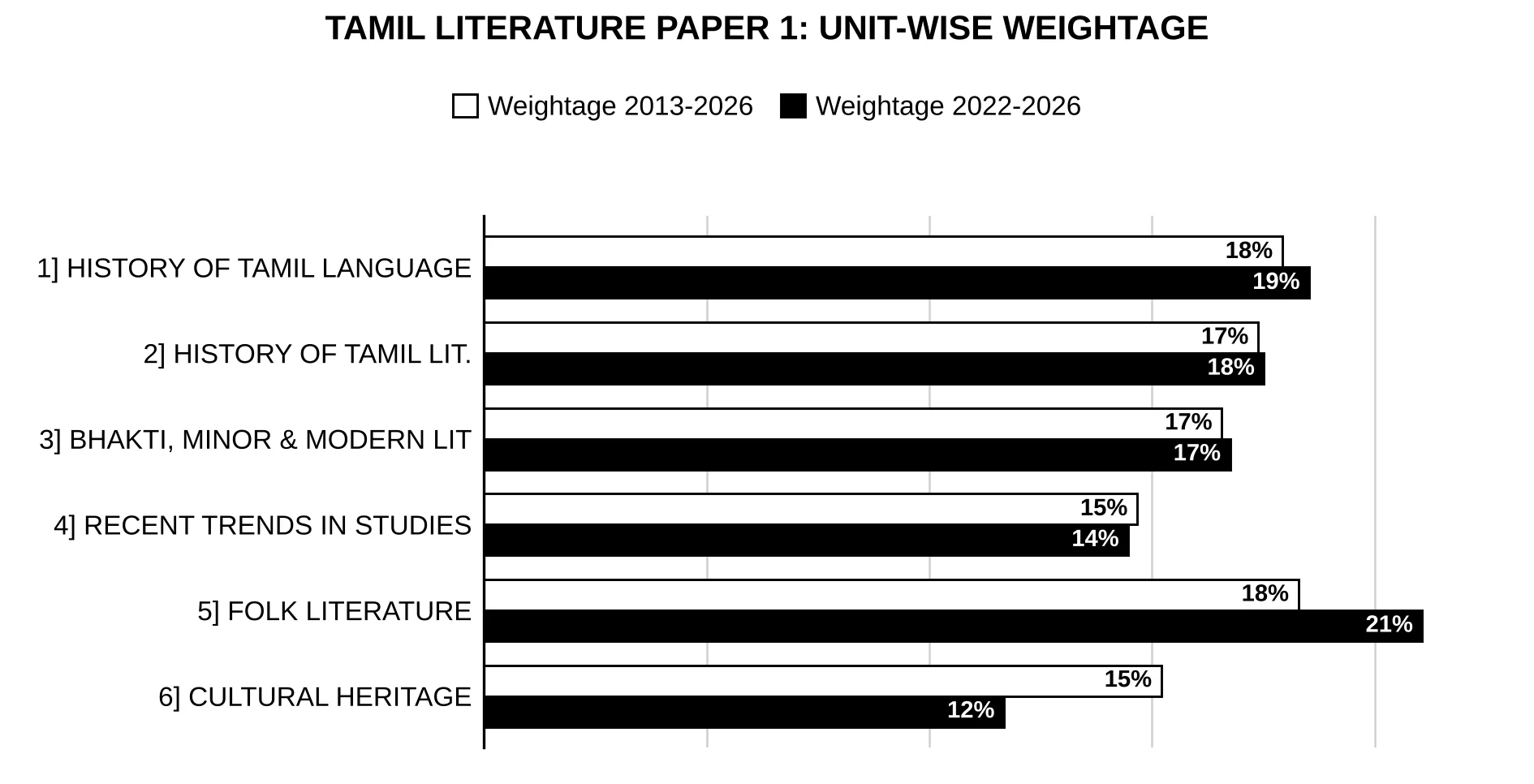
Trend: The marks are spread almost evenly over the six units. Each carries 15–18% over 2013–2026: folk literature about 18%, the history of the Tamil language and the history of Tamil literature about 17–18% each, bhakti, minor and modern literature about 17%, recent trends in Tamil studies about 15% and cultural heritage about 15%. In 2022–2026 folk literature rose to about 21% and cultural heritage fell to about 12%. In the language unit, the Indian and Dravidian language families and the place of Tamil (1.1) lead with about a fifth of the unit’s marks. Regional and social dialects (1.8) and loanwords (1.7) have gained in the last five years, and the historical study of nouns, verbs, adjectives and adverbs (1.5) has fallen from about 15% to 3%. In literary history, Silappadikaram and Manimekalai (2.6) take nearly a third, followed by the akam–puram division (2.3), Sangam literature (2.2) and ethical literature (2.5); Tolkappiyam as a work (2.1) was not asked in 2022–2026. In Unit 3 the minor literary forms (3.3), new poetry (3.7) and the bhakti literature of the Alvars and Nayanmars (3.1) lead, and bhakti rose to nearly 29% of the unit in 2022–2026. Approaches to criticism (4.1) carry about 30% of Unit 4, ahead of ullurai–iraicchi–meyppadu (4.3) and comparative literature (4.5). Ballads, songs, proverbs and riddles (5.1) are the largest folk topic at over 40%. Arts and architecture (6.6) is the largest cultural topic at about 27%, and war ethics (6.2) has risen to about 20% of the unit in the last five years.

Preparing for Prelims too?
Our UPSC Prelims Topic-wise PYQ Book covers every Prelims question with detailed explanations, so you can see exactly where UPSC asks from. Now available as a hard copy and an eBook.
Buy Hard Copy on AmazonBuy eBook (PDF)Paper II
| Unit | Topic (click to open PYQs) | Sub-topics | Questions | Link |
|---|---|---|---|---|
| 1 | பண்டைய இலக்கியம் | 3 | 101 | Click here → |
| 2 | காப்பிய இலக்கியம் | 2 | 76 | Click here → |
| 3 | பக்தி இலக்கியம் | 2 | 62 | Click here → |
| 4 | நவீன இலக்கியம்: கவிதையும் உரைநடையும் | 5 | 118 | Click here → |
| 5 | நாவல், சிறுகதை, நாடகம் | 3 | 62 | Click here → |
| 6 | நாட்டுப்புற இலக்கியம் | 2 | 52 | Click here → |
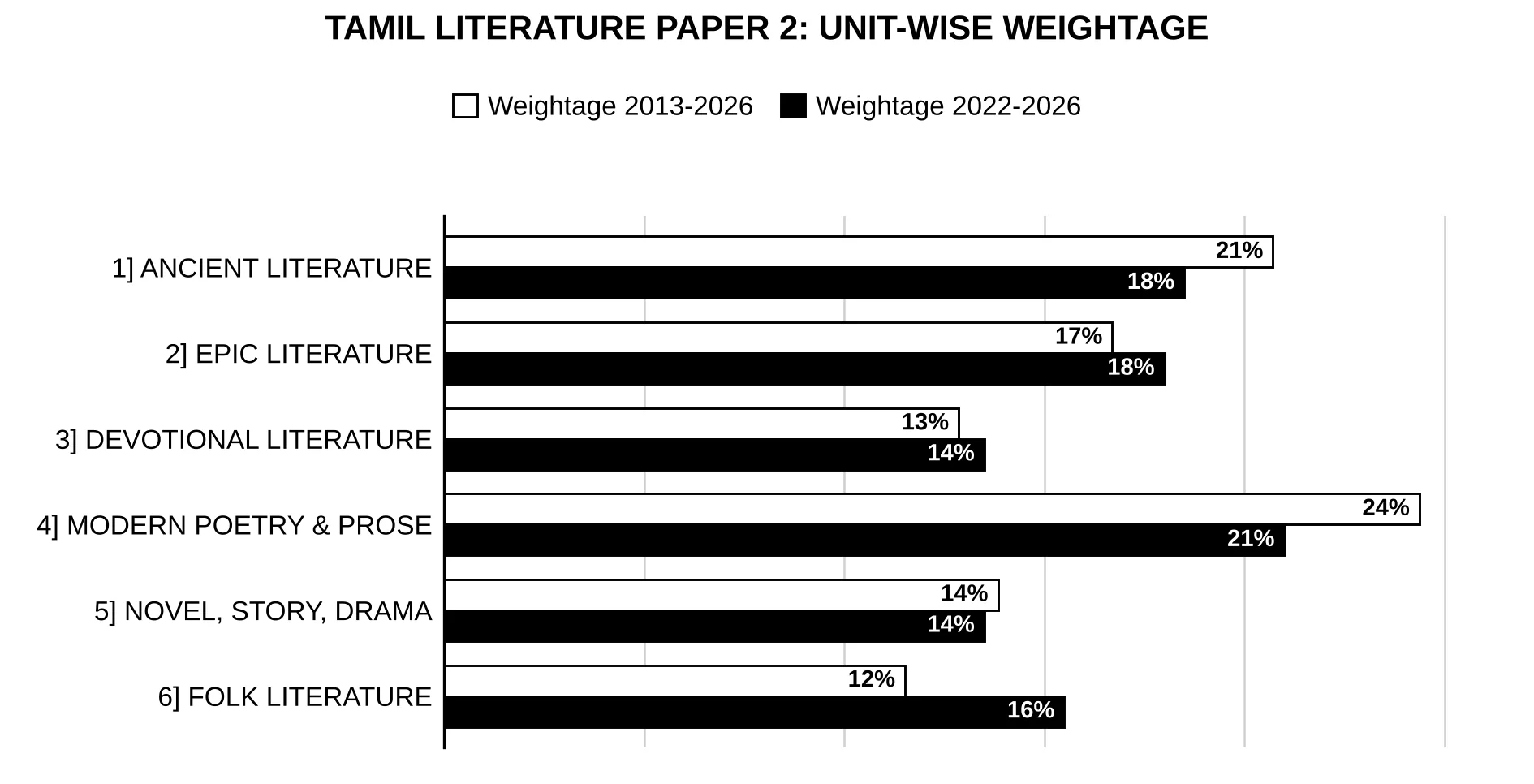
Trend: Modern poetry and prose (Unit 4) carries the largest share, about 24% (21% in 2022–2026). Ancient literature follows at about 21%, the epics at about 17%, the novel, short story and drama at about 14% and bhakti literature at about 13%. Folk literature carries about 12%, rising to about 16% in the last five years. Every prescribed text is asked almost every year. Within the units, Silappadikaram’s Madurai Kandam takes about 55% of the epic marks against Kumbakarunan Vadhai Padalam’s 45%, and Tiruppavai about 56% of the bhakti marks against Neetthal Vinnappam’s 44%. Kuruntokai, Purananuru and the Tirukkural are close over 2013–2026, but Purananuru took half of Unit 1 in 2022–2026. In the modern unit, Bharathidasan’s Kudumba Vilakku leads at about 25%, ahead of Bharathiar’s Kannan Pattu; Akilan’s Chittirappavai and Jayakanthan’s Gurupeedam take about 36% each of Unit 5 and Cho’s play about 27%; and Malaiyaruvi takes about 55% of the folk marks against Muthuppattan Kathai’s 45%.
More questions
Other questions (outside the present syllabus) – 9 questions
Frequently asked questions
How many Tamil Literature Optional PYQs are there?
There are 925 Tamil Literature Optional questions from 2009 to 2026, across Paper I and Paper II, arranged under 12 units of the official syllabus. A question that covers two topics is listed under both.
Which Tamil Literature Optional units are asked most often?
By number of questions – நவீன இலக்கியம்: கவிதையும் உரைநடையும் (Paper II, 118); பண்டைய இலக்கியம் (Paper II, 101); தமிழ் மொழி வரலாறு (Paper I, 83); தமிழில் நாட்டுப்புற இலக்கியம் (Paper I, 78). The weightage graphs on these pages compare the share of marks across periods.
What does a code like [2024/15m/3b] after a question mean?
It gives the year, the marks, the word limit (where UPSC set one) and the question number in the paper. So [2024/15m/3b] is Question 3(b) of the 2024 paper, worth 15 marks.
Where can I download the full Tamil Literature Optional question papers?
Every available paper is free as a PDF on our Tamil Literature Optional year-wise question papers page, for both Paper 1 and Paper 2.
How should we use these PYQs in our preparation?
Read the syllabus for a unit first, then go through its questions, starting with the most recent years. In Paper II, read each prescribed text in the original and note which passages and themes UPSC returns to. Practise writing answers within the word limit and time.
How this collection is organised
Units follow the official syllabus – Paper 1: 1 தமிழ் மொழி வரலாறு, 2 தமிழ் இலக்கிய வரலாறு, 3 பக்தி, சிற்றிலக்கியம், நவீன இலக்கியம், 4 தமிழ் ஆய்வில் அண்மைப் போக்குகள், 5 தமிழில் நாட்டுப்புற இலக்கியம், 6 தமிழரின் பண்பாட்டு மரபு (for example Paper 1 – 4.3 உள்ளுறை, இறைச்சி, மெய்ப்பாடு); Paper 2: 1 பண்டைய இலக்கியம், 2 காப்பிய இலக்கியம், 3 பக்தி இலக்கியம், 4 நவீன இலக்கியம்: கவிதையும் உரைநடையும், 5 நாவல், சிறுகதை, நாடகம், 6 நாட்டுப்புற இலக்கியம், with each prescribed text as a topic of its own (for example Paper 2 – 2.2 ‘கம்பராமாயணம்’ – கும்பகருணன் வதைப் படலம்). Topic names are given in Tamil.
Every passage printed for explanation (இடம் சுட்டிப் பொருள் விளக்குக) is placed under the prescribed text it is taken from. Where the paper does not name the source, it has been identified editorially from the passage itself – its diction, metre, speaker and characters; these attributions are open to correction.
Questions on writers and works in Paper 1 are placed under the period, form or movement they belong to (for example Pudumaipithan under சிறுகதை, Vanambadi poets under புதுக்கவிதை, and Bharathi or Periyar as journalists under தமிழ் இதழியல் வளர்ச்சி). Questions on Tamil in other periods than the Pallava period, on drama, and on a few other themes not in the present syllabus are kept under ‘Outside the present syllabus’.
Some questions cover more than one topic. We’ve kept such questions in each topic of relevance.
Graphs at the start of each paper show the weightage of every unit in that paper, and graphs for each unit show the weightage of its topics. Weightage is the share of marks asked from a unit or topic, compared for 2013–2026 (white bars) and the last five years, 2022–2026 (black bars). A question placed under two topics has its marks split equally between them.
Each of the topicwise question is suffixed by a question code like this [2024/10m/1a]. This code indicates a) year in which the question was asked, b) maximum marks the question carried and, c) the question number in actual paper, in given order. Word limits, where UPSC set them, appear in the Tamil instruction that precedes each question.
Until 2012, each paper carried 300 marks (60 per question); since 2013 each paper carries 250 marks (50 per question). In 2009 and 2010, Questions 1 and 5 offered four parts of which any three were to be answered (“எவையேனும் மூன்றினை”); every part is included with its own marks.
All papers are transcribed from scans of the UPSC question papers. Every page was transcribed and then checked a second time by an independent reader against the scan. The wording, spelling and punctuation are as printed, including the papers’ own misprints. Two words that could not be read with certainty on the scans (2014 Paper 1, 6a and 2018 Paper 2, 1b) are given in their most likely reading and marked [?].
Spotted an error? Use the “Report an Error” box at the end of any page – we review every report and update the page.

Strengthen your GS papers
Our UPSC Mains Topic-wise & Year-wise PYQ Book (2013–2026) maps every GS question to the syllabus, so you know what UPSC asks and how often. Now available as a hard copy and an eBook.
Buy Hard Copy on AmazonBuy eBook (PDF)Last updated: 2 November 2026