
Anthropology Optional PYQs Topic-wise for UPSC Mains (1995–2026) are listed below unit by unit, in the order of the official syllabus – 1417 questions in all. Click any unit to open all its previous year questions, arranged topic-wise with the latest first.
Want full papers instead? Open the Anthropology Optional year-wise question papers for Paper I and Paper II.
Paper I
| Unit | Topic (click to open PYQs) | Sub-topics | Questions | Link |
|---|---|---|---|---|
| 1 | Anthropology, Human Evolution and Prehistory | 8 | 163 | Click here → |
| 2 | Culture, Society, Marriage, Family and Kinship | 5 | 92 | Click here → |
| 3 | Economic Organization | 3 | 23 | Click here → |
| 4 | Political Organization and Social Control | 3 | 23 | Click here → |
| 5 | Religion | 4 | 26 | Click here → |
| 6 | Anthropological Theories | 10 | 85 | Click here → |
| 7 | Culture, Language and Communication | – | 9 | Click here → |
| 8 | Research Methods in Anthropology | 4 | 40 | Click here → |
| 9 | Human Genetics, Variation and Ecological Anthropology | 8 | 143 | Click here → |
| 10 | Concept of Human Growth and Development | 4 | 42 | Click here → |
| 11 | Fertility and Demography | 3 | 22 | Click here → |
| 12 | Applications of Anthropology | 5 | 60 | Click here → |
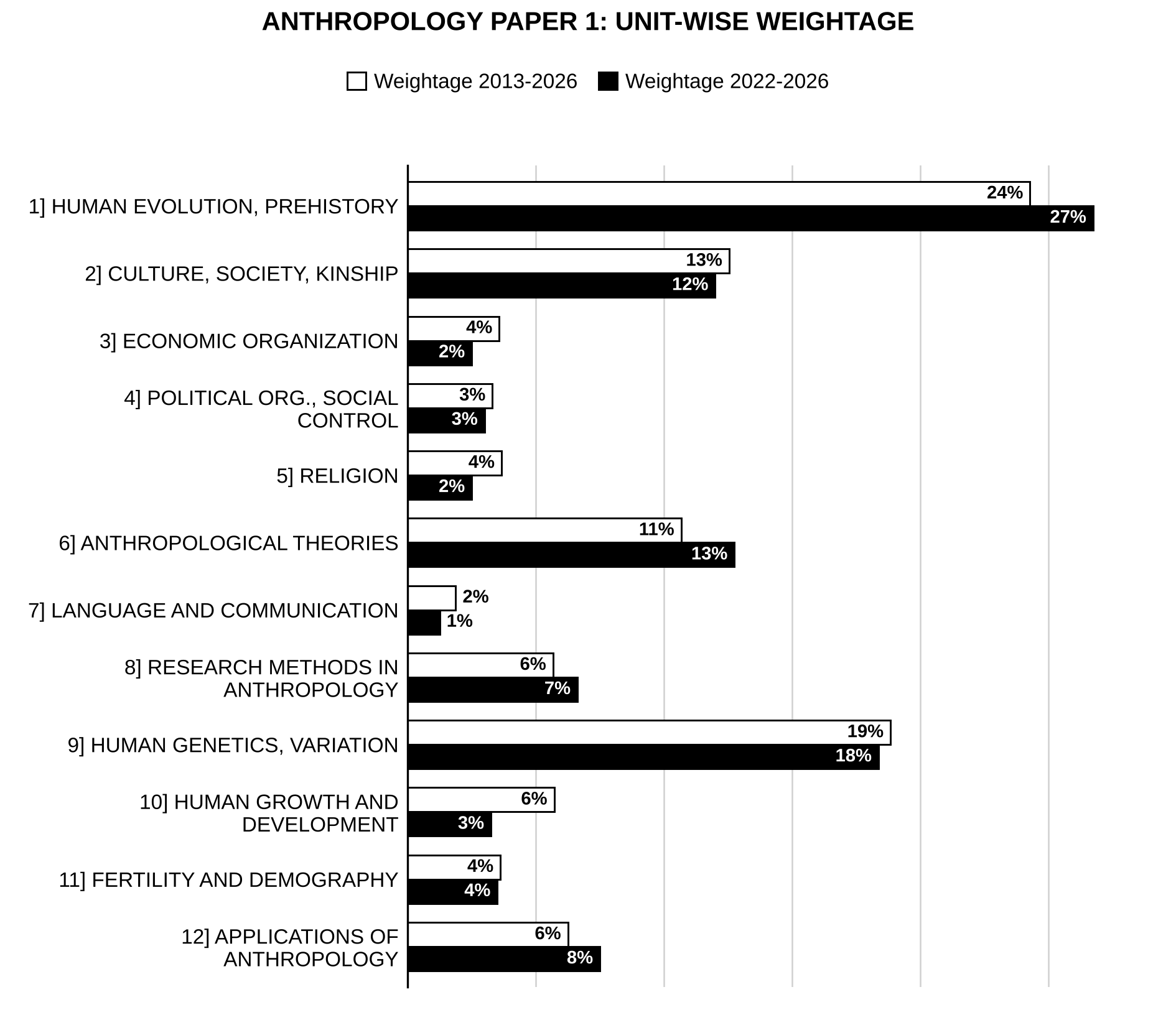
Trend: Unit 1 (human evolution, primates, fossil hominids and prehistory) is the heaviest unit, with about a quarter of the marks since 2013 and a little more in the last five years, followed by unit 9 (human genetics, race, genetic markers and ecological anthropology, about a fifth). Together with units 2 (culture, society, marriage, family and kinship) and 6 (anthropological theories), these four units carry about two-thirds of Paper I. Theories have gained in recent years, led by post-modernism, structuralism and culture-and-personality; applications (unit 12) have also risen, while human growth (unit 10) has fallen.

Preparing for Prelims too?
Our UPSC Prelims Topic-wise PYQ eBook covers every Prelims question with detailed explanations, so you can see exactly where UPSC asks from.
View the BookDownload Free SamplePaper II
| Unit | Topic (click to open PYQs) | Sub-topics | Questions | Link |
|---|---|---|---|---|
| 1 | Evolution of Indian Culture and Civilization | 3 | 104 | Click here → |
| 2 | Demographic Profile of India | 2 | 40 | Click here → |
| 3 | Traditional Indian Social System and Caste | 4 | 102 | Click here → |
| 4 | Emergence, Growth and Development of Anthropology in India | 2 | 58 | Click here → |
| 5 | Village, Minorities and Social Change | 3 | 82 | Click here → |
| 6 | Tribal Situation in India | 3 | 108 | Click here → |
| 7 | Weaker Sections, Ethnicity and Social Change | 3 | 94 | Click here → |
| 8 | Religion and Tribes; Tribe and Nation State | 2 | 25 | Click here → |
| 9 | Tribal Administration and Development | 3 | 76 | Click here → |
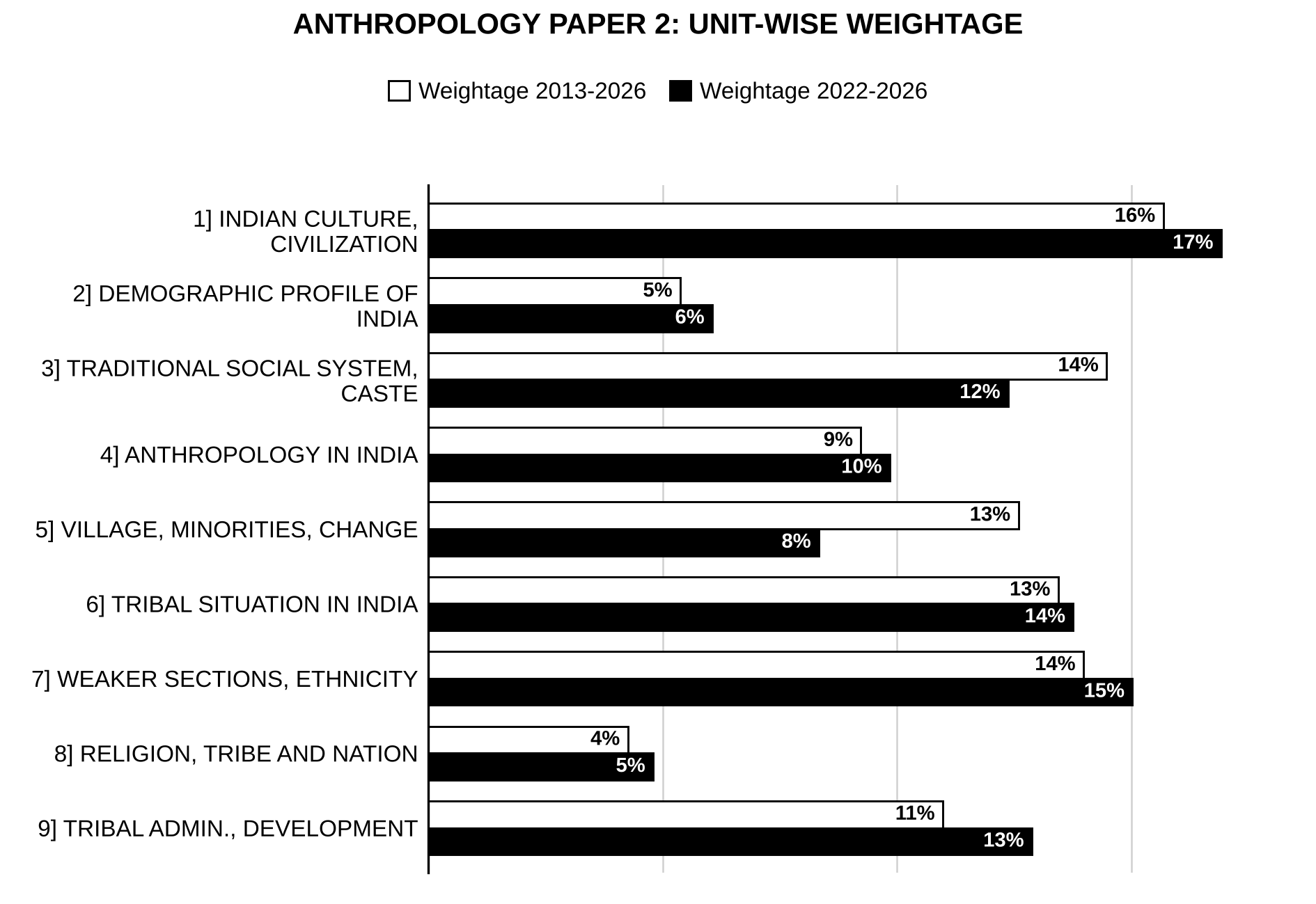
Trend: Paper II is spread more evenly. Indian prehistory and civilization with the Siwalik and Narmada evidence (unit 1), the traditional social system and caste (unit 3), weaker sections, ethnicity and tribal unrest (unit 7), the tribal situation (unit 6) and village studies and social change (unit 5) each carry 12–16% of the marks since 2013. In the last five years units 1, 7 and 9 (tribal administration and development) have gained, while village studies and social change (unit 5) and caste (unit 3) have declined.
More questions
Other questions (outside the present syllabus) – 11 questions
How this collection is organised
Considering the changing exam pattern and syllabus over three decades, we felt it necessary to declare some practices we’ve adopted in this collection.
Units and topics follow the numbering of the official syllabus. Where the notification numbers its own sub-sections (for example Paper 1 – 1.1 to 1.8 and 9.1 to 9.8; Paper 2 – 3.1 to 3.4), the topic numbers are the official numbers. Units without sub-sections in the notification (for example Paper 1 – Unit 6, Anthropological theories) are divided into topics numbered in the same style (6.1 Classical evolutionism … 6.10 Post-modernism). Where a unit has many questions, they are further divided by these topics.
A few questions, mostly from the 1995–2007 papers set on the older syllabus, fall outside the present syllabus of their paper (for example action anthropology or planning from below in Paper 1). We’ve kept them under “Other Questions (Outside the Present Syllabus)” at the end of the paper concerned.
Some questions cover more than one topic. We’ve kept such questions in each topic of relevance. Topics that the syllabus does not name separately are placed in the nearest topic: for example, tool traditions and dating methods under prehistoric archaeology; status and role under the nature of society; scholars such as S. C. Roy, N. K. Bose or Irawati Karve under contributions of Indian anthropologists; and PESA as a safeguard under constitutional safeguards.
Graphs at the start of each paper show the weightage of every unit in that paper, and graphs for the six heaviest units of each paper show the weightage of their topics. Weightage is the share of marks asked from a unit or topic, compared for 2013–2026 (white bars) and the last five years, 2022–2026 (black bars). A question placed under two topics has its marks split equally between them.
Each of the topicwise question is suffixed by a question code like this [2024/10m/150w/5e]. This code indicates a) year in which the question was asked, b) maximum marks the question carried, c) prescribed word limit and, d) the question number in actual paper, in given order. Where UPSC prescribed no word limit, that field is skipped.
Until 2012, each paper carried 300 marks; since 2013 each paper carries 250 marks. In 1997–1999 Paper 1 was set in three sections (Section I: Q1–5; Section II (a), physical anthropology: Q6–10; Section II (b), social-cultural anthropology: Q11–15), and candidates answered six questions of 50 marks each. Where marks were not printed in the available sources (1995–2007), codes follow the pattern of those papers: 25 marks for each short note and 50 for every other question in 1995–1999 Paper 1; 20 for each short note and 60 for every other question otherwise.
No complete paper has been found for 1995, 1996 and 2001–2007. Their questions are recovered from year-labelled topic-wise lists and carry the question numbers R1, R2 … in their codes; the original numbering is not known and a few questions may be missing.
Where a part of a short-notes question is only a heading, it is shown as “Write a short note on: …”, as the question paper asks. The wording of the questions is otherwise as printed.
Spotted an error? Use the “Report an Error” box at the end of any page – we review every report and update the page.

Strengthen your GS papers
Our UPSC Mains Topic-wise & Year-wise PYQ eBook (2013–2026) maps every GS question to the syllabus, so you know what UPSC asks and how often.
View the BookDownload Free SampleLast updated: 30 October 2026