
Here are all 92 Culture, Society, Marriage, Family and Kinship questions asked in UPSC Anthropology Optional Paper I from 1995 to 2026, arranged under the 5 topics of the official syllabus. Within each topic the latest questions come first.
Each question ends with a code such as [2024/15m/3b] – the year, the marks, the word limit (where UPSC set one) and the question number in the paper.
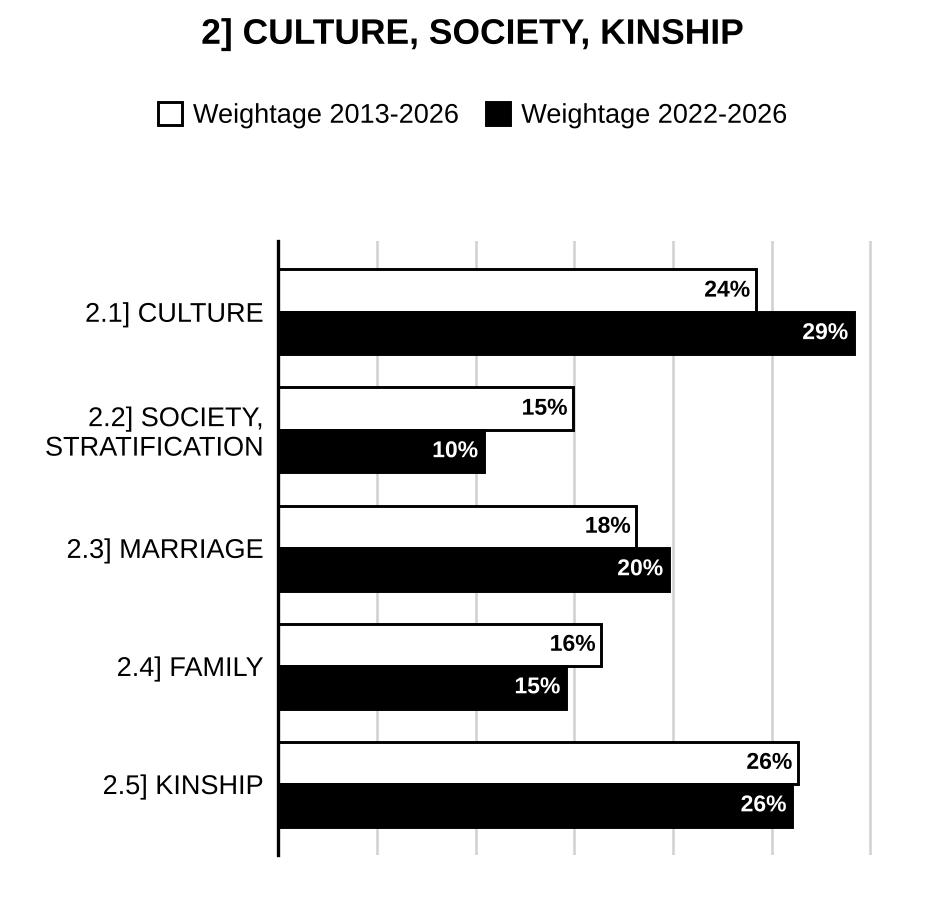
2.1] The nature of culture
22 questions
Write a short note on: Health as a cultural construct. [2026/10m/150w/1a]
Write a short note on: Culture and embodiment. [2025/10m/150w/1e]
Critically examine the drawbacks in assuming culture as an ‘integrated-closed’ system in understanding of contemporary society. [2025/15m/3b]
Write a short note on: Attributes of culture. [2024/10m/150w/1a]
Write a short note on: William Ogburn and Cultural lag. [2023/10m/150w/5e]
Discuss the historical and cultural contexts that led to superseding ethnocentrism with cultural relativism in anthropology. [2022/15m/4b]
Write a short note on: Human rights and Cultural relativism. [2020/10m/150w/1c]
Write a short note on: Cultural Relativism. [2019/10m/150w/1b]
Discuss the development of the concept of culture in Anthropology. [2017/20m/2a]
Write a short note on: Cultural Relativism. [2016/10m/150w/1b]
Is culture unique to human beings? Critically examine. [2014/15m/2b]
Why has the concept of Cultural Relativism been so dear to Anthropologists? [2013/20m/250w/2a]
Bring out the distinguishing features of culture and civilization. [2013/15m/250w/2b]
Write a short note on: Cultural relativism and subsequent violation of human rights. [2010/15m/150w/1a]
Write a short note on: Folk-Urban Continuum. [2003/20m/R3]
“Components of culture are vast and varied.” Explain this statement. [2002/60m/R10]
Write a short note on: Culture trait and Culture complex. [1999/25m/200w/11c]
Discuss the different theories which explain social and cultural changes. [1999/50m/13]
Write a short note on: Super organic view of culture. [1998/25m/200w/11b]
Elucidate the various concepts of social and cultural change indicating the specific problems involved in the change process. [1997/50m/12]
What do you understand by cultural relativistic approach and ethnocentric approach in the study of culture? Discuss the logical premises of cultural relativistic approach. [1997/50m/14]
Write a short note on: Cultural relativism. [1995/25m/R5]
2.2] The nature of society
18 questions
Examine critically the concept of social stratification as a basis for sustaining social inequality. [2024/20m/8a]
Write a short note on: Radcliffe-Brown’s ideas on status, role and institution. [2022/10m/150w/1c]
Critically evaluate different types of social stratifications with suitable examples. [2021/20m/7a]
Discuss Erving Goffman’s concept of total institutions and its relevance in contemporary society. [2020/15m/2b]
Discuss social stratification according to any three major approaches. [2019/20m/3a]
Write a short note on: Society and Culture. [2015/10m/150w/1b]
Define Status and Role. Distinguish between Ascribed and Achieved Status. [2014/15m/3c]
What are the bases of social stratification? Discuss with examples. [2012/20m/7b]
Explain the concept of ‘Status’ and ‘Role’ in Anthropology. [2012/20m/7c]
Discuss the factors affecting ethnic boundaries giving suitable examples. [2006/60m/R9]
Discuss the relationship of ethnicity and nation-state. [2005/60m/R14]
Explain Fredrik Barth’s concept of ethnic boundaries. Explain its distinction from cultural content. [2004/60m/R14]
Write a short note on: Ethnic Conflict. [2004/20m/R8]
What is ethnicity? Does ethnicity add to conflicts and tensions in the society? Illustrate. [2002/60m/R14]
Write a short note on: Social stratification. [2000/20m/200w/1c]
Write a short note on: Ethnic boundaries. [2000/20m/200w/5d]
Write a short note on: Caste mobility. [1998/25m/200w/1a]
Elucidate the salient differences between tribal social system and caste system giving suitable examples in support of your answer. [1997/50m/2]

Preparing for Prelims too?
Our UPSC Prelims Topic-wise PYQ eBook covers every Prelims question with detailed explanations, so you can see exactly where UPSC asks from.
View the BookDownload Free Sample2.3] Marriage
13 questions
Discuss ‘incest taboo’ as the basis of development of kinship systems in human societies. [2026/15m/4b]
How the study of variation in forms of marriage led to rethinking on the concepts of social reproduction, kinship and family? [2025/20m/7a]
Discuss the role of marriage regulations in traditional societies in India for strengthening social solidarity. [2023/20m/4a]
Write a short note on: Marriage Regulations and Alliance Theory. [2021/10m/150w/1b]
Explain the impact of feminist movement on universality of marriage and family structure. [2020/20m/3a]
Write a short note on: Ways of Acquiring Mate in Tribal Society. [2018/10m/150w/1e]
Discuss the different forms of preferential marriage with suitable examples from tribal societies in India. [2017/15m/2c]
Write a short note on: Incest Taboos. [2015/10m/150w/1c]
Define marriage and describe the various types of marriages in human societies. [2014/15m/3b]
Where do you situate ‘live-in relationship’ within the institution of marriage? [2013/15m/250w/2c]
Write a short note on: Ways of acquiring a spouse in simpler societies. [2012/12m/150w/1b]
Write a detailed note on polyandrous societies, citing Indian examples. [2009/30m/3b]
Write a short note on: Incest Taboos. [2006/20m/R3]
2.4] Family
13 questions
Write a short note on: Feminist movement and family. [2026/10m/150w/5c]
Define urbanization and discuss its impact on family in India with examples. [2024/15m/3b]
Write a short note on: Household and domestic group. [2022/10m/150w/5e]
Critically evaluate Lewis Morgan’s classification of family. [2021/15m/6c]
Explain the impact of feminist movement on universality of marriage and family structure. [2020/20m/3a]
Discuss the impact of urbanization and feminist movements on family in India. [2016/20m/2b]
Define family and critically examine the universality of family. [2015/15m/3a]
Discuss the impact of urbanization and feminist movement on family. [2013/20m/250w/4a]
Is family a social institution? [2012/12m/150w/5a]
What do you understand by Feminist movements? Discuss their impact on family. [2002/60m/R11]
Critically comment on the forces and factors that have brought about changes in the family structure in recent times. [1999/50m/3]
Do you agree with the view that family is a ‘universal association’? Critically examine the above statement. [1998/50m/3]
Examine family both as a social group and as an institution. Describe the functions of family and household, indicating therein the recent changes. [1996/50m/R12]
2.5] Kinship
26 questions
Discuss ‘incest taboo’ as the basis of development of kinship systems in human societies. [2026/15m/4b]
Write a short note on: Theoretical significance of Purum kinship-system. [2025/10m/150w/1b]
Write a short note on: Critical perspective on avoidance and joking relationship. [2024/10m/150w/1c]
Critically discuss A. L. Kroeber’s contribution to kinship studies. [2023/15m/8c]
Discuss how the rules of descent contradict the principles of residence in matrilineal society, mentioning suitable examples. [2022/20m/3a]
Write a short note on: Marriage Regulations and Alliance Theory. [2021/10m/150w/1b]
Write a short note on: Descent Groups. [2021/10m/150w/5d]
Explain the structural analysis of kinship as proposed by Lévi-Strauss. [2021/15m/8c]
How did Radcliffe-Brown and Levi-Strauss study kinship in terms of social structure? [2019/15m/2b]
Write a short note on: Kinship Terminology. [2018/10m/150w/1d]
Write a short note on: Bilineal and bilateral descents. [2017/10m/150w/1a]
Elucidate the determinants of Kinship terminology. [2017/15m/2b]
Write a short note on: Lineage and Clan. [2016/10m/150w/1c]
Describe the cardinal points of descent and alliance theories. [2016/20m/3a]
How do the concepts of binary opposites and exchange figure in Lévi-Strauss’ structural analysis of kinship? [2016/15m/4b]
Write a short note on: Double Descent. [2014/10m/150w/1a]
Write a short note on: Various types of descent. [2013/10m/150w/1b]
Describe the types of kinship groups formed on the basis of different principles. [2012/20m/4a]
Write a short note on: Segmentary lineage and territoriality. [2010/15m/150w/1d]
What factors are responsible for bringing about variation in residence of different societies? Explain how kinship influences man’s social life. [2010/30m/6a]
Write a short note on: Forms of descent groups. [2008/20m/200w/1c]
Define Kinship and throw light on the functional importance of Kinship in Anthropology. [2003/60m/R9]
Explain the salient features of Descent and Alliance theories. Discuss the relevance to the analysis and understanding of Social Structure. [2001/60m/R9]
Now we live more in a class than a caste. Discuss the role of kinship in this changed situation. [1998/50m/4]
Discuss the distinguishing features of unilineal, bilineal and bilateral kin groups with suitable examples. [1997/50m/3]
What is kinship system? Describe the changing roles of the system in the context of westernization in India. [1995/50m/R12]

Strengthen your GS papers
Our UPSC Mains Topic-wise & Year-wise PYQ eBook (2013–2026) maps every GS question to the syllabus, so you know what UPSC asks and how often.
View the BookDownload Free Sample« Previous: Anthropology, Human Evolution and Prehistory | Next: Economic Organization »
Back to: Anthropology Optional PYQs – Topic-wise | Also see: Anthropology Optional year-wise question papers
Last updated: 30 October 2026