
Here are all 42 Concept of Human Growth and Development questions asked in UPSC Anthropology Optional Paper I from 1995 to 2026, arranged under the 4 topics of the official syllabus. Within each topic the latest questions come first.
Each question ends with a code such as [2024/15m/3b] – the year, the marks, the word limit (where UPSC set one) and the question number in the paper.
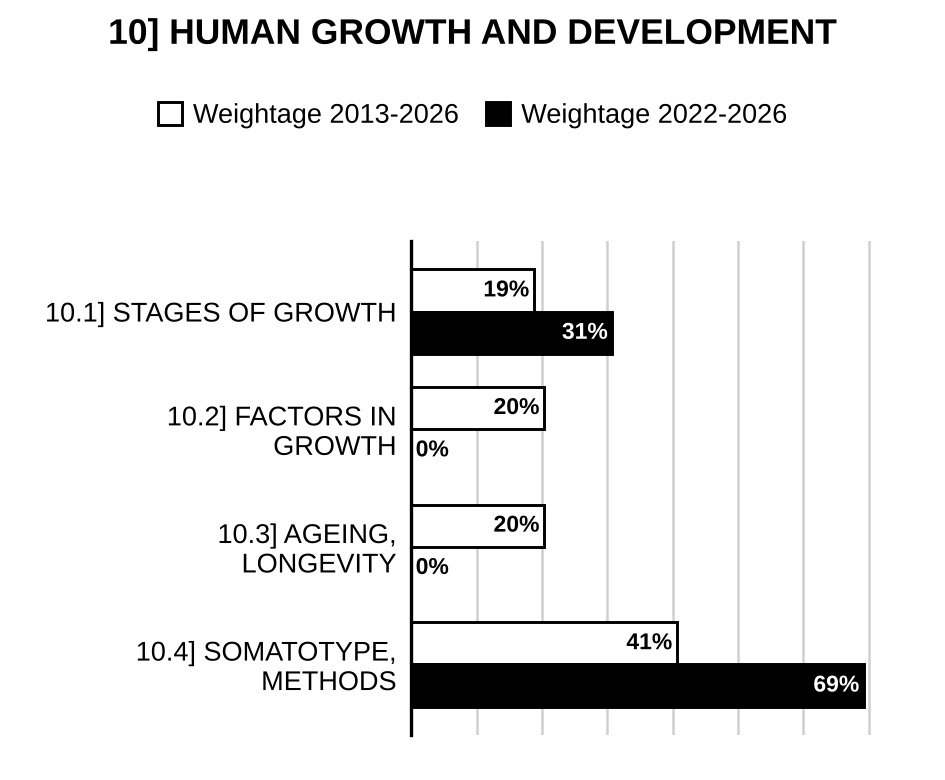
10.1] Stages of growth
8 questions
Write a short note on: Canalization and catch-up growth. [2026/10m/150w/1b]
Write a short note on: Stages of human pre-natal development. [2022/10m/150w/5c]
Write a short note on: Human adolescent growth spurt. [2021/10m/150w/5a]
What are the different stages of Growth? Describe any one of them in detail. [2014/20m/6a]
Write a short note on: Differentiation between Child Growth and Development. [2013/10m/150w/5b]
Differentiate between human growth and development and describe the various stages of human growth. [2003/60m/R13]
Write a short note on: Growth curves. [1998/25m/200w/6c]
Describe the patterns of human physical growth and development from birth to maturity. [1995/50m/R19]
10.2] Factors affecting growth and development
8 questions
Secular trend in human growth can be positive, negative or neutral. Illustrate with examples. [2020/20m/6a]
Write a short note on: Genetico-environmental factors affecting human growth. [2019/10m/150w/5e]
Discuss different factors affecting growth and development in human beings. [2016/20m/6c]
Justify “Though human growth is under tight genetic control but it is influenced by various environmental factors.” [2013/15m/250w/6c]
Differentiate between ‘growth’ and ‘development’. List the factors affecting human growth and development. [2009/30m/6a]
Critically discuss the factors affecting human growth and development. [2005/60m/R11]
Critically examine the role of nutritional, socio-economic and cultural factors on human growth and development. [2004/60m/R11]
Define growth and maturation and discuss the different factors affecting them. [2001/60m/R13]

Preparing for Prelims too?
Our UPSC Prelims Topic-wise PYQ eBook covers every Prelims question with detailed explanations, so you can see exactly where UPSC asks from.
View the BookDownload Free Sample10.3] Ageing and senescence; longevity
11 questions
Discuss the physiological and evolutionary theories of aging. [2021/15m/8b]
Write a short note on: Senescence. [2020/10m/150w/5e]
Write a short note on: Issues of Elderly and Senescence in Developing and Developed Countries. [2018/10m/150w/5e]
Discuss Ageing and Senescence. Describe either the biological or social theories of Ageing. [2014/20m/8a]
Write a short note on: Ageing and Senescence. [2013/10m/150w/5c]
Explain any two biological theories of ageing based on purposeful events. [2012/20m/7a]
Write a short note on: Senescence and socio-economics in contemporary times. [2010/15m/150w/5c]
Distinguish between ‘chronological age’ and ‘biological age’. [2009/20m/7a]
Discuss the theories of ‘Ageing’. [2009/40m/7b]
Write a short note on: Aging. [2005/20m/R7]
Write a short note on: Senescence. [1995/25m/R8]
10.4] Human physique and somatotypes; methodologies for growth studies
15 questions
What is meant by a somatotype? Discuss the Heath-Carter anthropometric method, giving its advantages over that of Sheldon’s method. How can somatotyping be applied in sports sciences? [2026/20m/2a]
What is mixed-longitudinal method of studying human growth? Discuss its merits and demerits. [2023/15m/3c]
Why Heath and Carter used anthropometric measurements instead of photographs of an individual to assess the somatotype? Elaborate their method. [2022/20m/4a]
Discuss the methods of studying human growth with their merits and demerits. [2019/15m/6c]
Describe the various methods of studying growth highlighting their merits and demerits. [2017/15m/8b]
Discuss Sheldon’s method of somatotyping. [2017/15m/8c]
Write a short note on: Longitudinal method of studying growth. [2015/10m/150w/5c]
What is an anthropometric somatotype? Describe Heath and Carter’s method of somatotyping. [2015/20m/7a]
Write a short note on: Cross-sectional methods of studying human growth. [2014/10m/150w/5a]
Describe different methods of studying human growth. [2011/30m/7a]
Define somatotype. Describe the salient features of different components of somatotype. [2011/30m/8b]
Describe various methods of studying Human Growth specifying their merits and demerits. [2006/60m/R13]
Write a short note on: Methods for the study of human growth. [2002/20m/R7]
What is meant by physical growth norms? How are these made and how do they depict the growth status of a population? [1999/50m/8]
Write a short note on: Longitudinal growth. [1997/25m/200w/6c]

Strengthen your GS papers
Our UPSC Mains Topic-wise & Year-wise PYQ eBook (2013–2026) maps every GS question to the syllabus, so you know what UPSC asks and how often.
View the BookDownload Free Sample« Previous: Human Genetics, Variation and Ecological Anthropology | Next: Fertility and Demography »
Back to: Anthropology Optional PYQs – Topic-wise | Also see: Anthropology Optional year-wise question papers
Last updated: 30 October 2026