
Here are all 94 Weaker Sections, Ethnicity and Social Change questions asked in UPSC Anthropology Optional Paper II from 1995 to 2026, arranged under the 3 topics of the official syllabus. Within each topic the latest questions come first.
Each question ends with a code such as [2024/15m/3b] – the year, the marks, the word limit (where UPSC set one) and the question number in the paper.
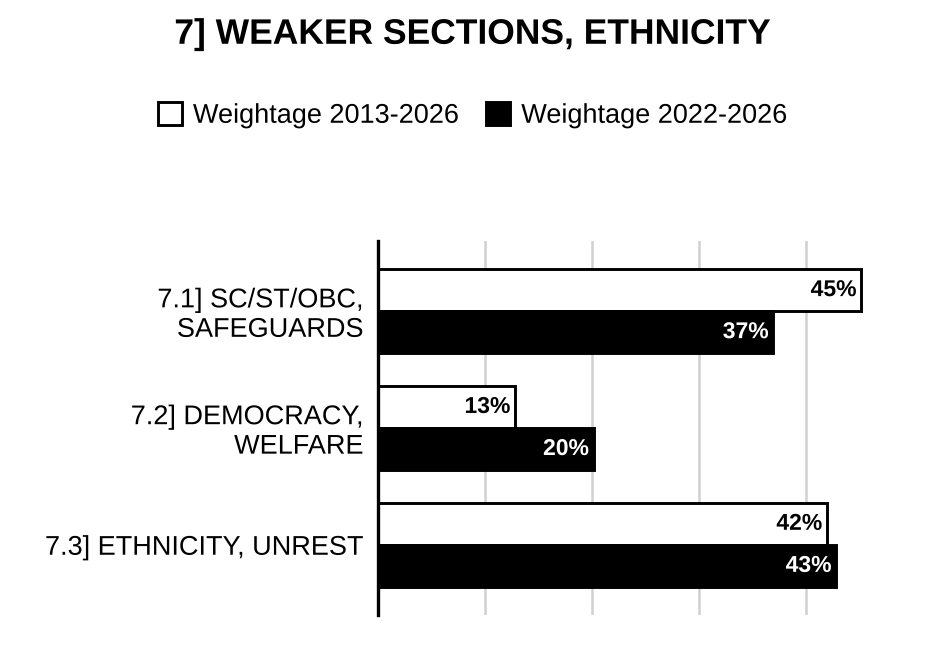
7.1] Exploitation and deprivation of SCs, STs and OBCs; constitutional safeguards
39 questions
Write a short note on: Article 371A of the Indian Constitution. [2026/10m/150w/5c]
What are the provisions given in the Constitution of India for the safeguard of the Scheduled Caste populations? [2026/15m/8c]
Trace the history and describe the methods of formulating the lists of OBCs, both at the State and National levels. [2025/15m/6c]
Write a short note on: Status of Sixth Schedule Areas. [2024/10m/150w/5d]
Write a short note on: Constitutional Safeguards for Backward Classes. [2024/10m/150w/5e]
Write a short note on: Scheduled areas. [2023/10m/150w/5a]
How are Other Backward Classes identified? Enumerating the important features, elucidate the recent changes in their social and economic life. [2023/15m/8c]
Write a short note on: Role of the Governor in the Fifth Schedule areas. [2022/10m/150w/5d]
Discuss the issues and solutions related to the Scheduled Caste and the Scheduled Tribe populations in India. [2022/15m/7b]
Write a short note on: Politics of recognition and deprivation. [2021/10m/150w/5e]
Describe the provisions under 6th Schedule of Indian constitution. [2020/15m/4c]
Discuss the effect of job reservation in alleviating unemployment among the tribal people of India. [2020/15m/6c]
Critically evaluate the state of implementation of the constitutional safeguards for the scheduled castes. [2020/15m/7c]
What are the constitutional safeguards to protect the interests of the Indian tribes? [2019/15m/8c]
Write a short note on: OBCs among non-Hindu communities. [2018/10m/150w/1d]
Discuss the salient features of PESA Act of 1996 and attempt a comparison with the features of the VI Schedule. [2018/15m/7c]
Critically discuss the constitutional safeguards for the Scheduled Castes. [2017/15m/2c]
Write a short note on: Other Backward Class. [2017/10m/150w/5c]
Examine the factors responsible for the exploitation of scheduled castes in India. [2016/20m/7a]
Write in detail various provisions provided by the Constitution of India for the scheduled tribes under Vth and VIth Schedules. [2016/20m/8a]
Discuss how constitutional provisions in India have built-in mechanisms for dealing with the problem of land alienation in tribal areas. [2015/20m/3a]
Critically compare ‘Affirmative Action’ of USA and ‘Protective Discrimination’ for Scheduled Tribes in India. [2015/15m/4c]
Write a short note on: Role of Governor in Fifth Schedule Areas. [2015/10m/150w/5e]
Write a short note on: Social and economic marginalization of tribal people. [2014/10m/150w/5b]
Critically examine the constitutional provisions for safeguarding the interests of Scheduled Tribes in India. [2014/20m/6a]
Comment on: Fifth Schedule and Sixth Schedule of the Constitution are built on the foundations laid by the colonial Government. – Discuss. [2013/20m/250w/6a]
Discuss the Social disabilities suffered by scheduled castes. [2013/15m/250w/8c]
Using suitable examples, bring out the historical processes of the social exclusion of denotified tribes. [2012/20m/3c]
Write a short note on: Fifth Schedule of the Constitution. [2009/20m/200w/5b]
Write a short note on: Constitutional Safeguards for Scheduled Castes. [2007/20m/R6]
Write a short note on: National Commission for SCs and STs. [2004/20m/R7]
Write a short note on: Implications of recent Presidential orders relating to Scheduled Tribes and Scheduled Castes. [2003/20m/R8]
Critically examine the merits and demerits of reservation policy for the Scheduled Tribes, Scheduled Castes and Other Backward Classes. [2002/60m/R11]
Do you think that exploitation emanates from clash of self interest between groups? Discuss in the context of tribals and non-tribals. [2002/60m/R12]
Mention various developmental programmes implemented for the socio-economic well-being of Scheduled Castes. Do these programmes fulfil their aspiration? Discuss. [2001/60m/R11]
Write a short note on: Scheduled Area. [2001/20m/R5]
Write a short note on: The problems of denotified groups. [2000/20m/200w/5a]
Write a short note on: Constitutional safeguards for the Scheduled Castes. [1996/20m/R6]
Write a short note on: Distinguish between exploitation and deprivation of Scheduled Castes. [1995/20m/R5]

Preparing for Prelims too?
Our UPSC Prelims Topic-wise PYQ eBook covers every Prelims question with detailed explanations, so you can see exactly where UPSC asks from.
View the BookDownload Free Sample7.2] Social change and contemporary tribal societies
11 questions
Discuss the impact of democratic institutions on the tribal populations of India. [2026/15m/6b]
How is PESA Act empowering local self-governance and impacting women’s political participation? [2024/15m/2b]
Critically examine the impact of modern democratic institutions on contemporary tribal societies. Illustrate with suitable ethnographic examples. [2023/15m/3c]
Compare the functioning of traditional ‘Tribal Council’ with that of ‘Gram Sabha’ under PESA. [2022/15m/6b]
Describe how various tribal development programmes and plans have impacted the process of social transformation among tribes. [2016/15m/7c]
Discuss the nature of social change in tribal India under the impact of developmental programmes. [2015/15m/7b]
Write a short note on: Role of Gram Sabha under PESA. [2013/10m/150w/5b]
Write a short note on: Panchayati Raj and the tribes. [2010/15m/150w/5c]
How have modern democratic institutions influenced the Indian tribal societies? Assess. [2008/60m/7]
Illustrate, with suitable examples, the impact of development programmes on tribal and weaker sections. [2007/60m/R12]
Estimate the role of democratic institutions/organizations for the development of weaker sections and the welfare measures adopted by them. [1997/60m/7]
7.3] Ethnicity, ethnic conflicts, tribal unrest and regionalism
44 questions
Write a short note on: Tana Bhagat movement. [2026/10m/150w/1c]
Make a critical appraisal of Niyamgiri movement against mining-induced displacement. [2026/15m/4c]
Write a short note on: Regionalism and Autonomy. [2025/10m/150w/1c]
Write a short note on: Tribalism and Pseudotribalism. [2025/10m/150w/5c]
Discuss the rising ethnic conflicts in India and propose their possible remedial measures. [2025/15m/7b]
Write an essay on the life history of tribal activist and freedom fighter Birsa Munda. What was the impact of his sacrifice on tribal society? [2024/15m/4b]
Elucidate the resurgence of ethno-nationalism from an anthropological lens. [2024/15m/7c]
Distinguishing between ethnic identity and ethnicity, discuss the factors responsible for ethnic conflict in tribal areas. [2023/15m/6b]
Write a short note on: Regionalism as an opportunity and threat to national integration. [2022/10m/150w/5a]
Compare the nature of tribal movements between North-East and Central India. Briefly mention the current status of existing tribal movements in these areas. [2022/20m/8a]
Write a short note on: Cultural diversity and multiculturalism. [2021/10m/150w/5c]
Identify the causes of tribal unrest with special reference to North-East India. [2021/15m/8c]
Write a short note on: Concept of Ethnicity. [2020/10m/150w/5e]
Discuss the regionalism and demand for autonomy in India from Anthropological perspective with respect to Kashmir/Nagaland/Bodoland/Gorkhaland agitation. [2020/20m/8a]
What has been the contribution of tribal people to the Indian Independence movement? [2019/15m/2b]
Write a short note on: Ethnicity and regionalism. [2019/10m/150w/5a]
Discuss with appropriate examples how tribal unrest may be understood as emerging out of an incompatibility between tribes and the nation-state. [2019/20m/8a]
Discuss the various factors resulting in tribal unrest in various parts of India. [2018/15m/7b]
Write a short note on: Ethnicity and regionalism. [2017/10m/150w/5b]
The role that regionalism plays in demand for autonomy among Indian tribes. [2016/10m/150w/5a]
Write a short note on: Rights over resources and tribal unrest. [2015/10m/150w/1e]
What are the significant factors responsible for tribal unrest? [2014/15m/7b]
Discuss the rise of ethno-nationalism among Indian tribes with specific example. [2014/15m/7c]
Write a short note on: Government Action towards Left Wing Extremism. [2013/10m/150w/5a]
Write a short note on: Ethnic movements in India. [2013/10m/150w/5d]
Examine the impact of non-tribal contact on socio-cultural institutions of tribal people with suitable examples. [2013/15m/250w/8b]
Using ethnographic examples, point out how gender relations have changed over time among Central Indian tribes. [2012/20m/4b]
Write a short note on: Left-wing extremism and tribals in India. [2011/15m/150w/5d]
Analyse the factors influencing tribal regionalism, citing Indian examples. [2010/30m/8b]
Write a short note on: Tribal unrest in Central India. [2009/20m/200w/5c]
Write a short note on: Concept of Ethnicity. [2008/20m/200w/5b]
Write a short note on: Revivalistic Movements. [2008/20m/200w/5d]
Discuss the anthropological understanding of rising ethnicity among Indian tribes in the context of nation-building. [2007/60m/R13]
Critically review Tana Bhagat Movement – its causes and effects. [2006/60m/R13]
Classify the tribal movements in contemporary India in a regional perspective and analyse the contributive factors. [2004/60m/R13]
Write a short note on: Detribalization. [2004/20m/R6]
What is regionalism? Evaluate how regionalism has stimulated political movements in India. [2003/60m/R13]
Identify the causes and consequences of major tribal movements in India. [2003/60m/R14]
Write a short note on: Detribalization. [2001/20m/R6]
Write a short note on: Birsa Movement. [2001/20m/R7]
Assess the political and economic role of tribal and rural movements in the creation of the new states of Uttaranchal, Jharkhand and Chattisgarh. [2000/60m/7]
Write a short note on: Jharkhand Movement. [1999/20m/200w/5c]
To what extent is ethnicity responsible for the tribal movements in India? Elaborate with suitable examples. [1995/60m/R13]
Write a short note on: Identify the factors responsible for regionalism in contemporary India. [1995/20m/R7]

Strengthen your GS papers
Our UPSC Mains Topic-wise & Year-wise PYQ eBook (2013–2026) maps every GS question to the syllabus, so you know what UPSC asks and how often.
View the BookDownload Free Sample« Previous: Tribal Situation in India | Next: Religion and Tribes; Tribe and Nation State »
Back to: Anthropology Optional PYQs – Topic-wise | Also see: Anthropology Optional year-wise question papers
Last updated: 30 October 2026