
Here are all 82 Village, Minorities and Social Change questions asked in UPSC Anthropology Optional Paper II from 1995 to 2026, arranged under the 3 topics of the official syllabus. Within each topic the latest questions come first.
Each question ends with a code such as [2024/15m/3b] – the year, the marks, the word limit (where UPSC set one) and the question number in the paper.
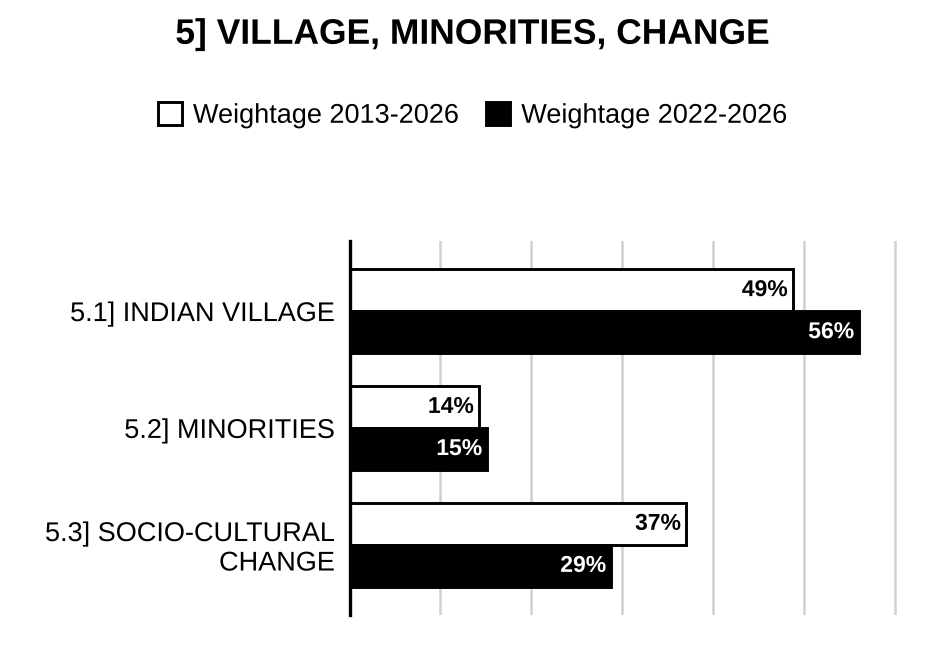
5.1] Indian village
33 questions
Critically examine the salience of F. G. Bailey’s study on Bisipara village of Odisha. [2026/20m/3a]
Write a short note on: Caste domination, factionalism and political power. [2025/10m/150w/1b]
“The village was not merely a place where people lived; it had a design in which were reflected the basic values of Indian civilization.” Who said this? Elaborate. [2025/20m/6a]
Write a short note on: Digitisation of rural economy. [2024/10m/150w/1a]
Write a short note on: Village as little republic. [2023/10m/150w/5c]
Assess the contributions of S. C. Dube in Indian village studies. [2022/15m/3b]
“Globalisation, on one hand has provided opportunities and on the other hand thrown challenges to Indian villages.” Elucidate. [2022/20m/4a]
Write a short note on: Factionalism and politics in rural India. [2021/10m/150w/1e]
Examine how structural transformation in economy is affecting traditional social relationships in agrarian society. [2021/20m/8a]
Discuss the impact of Globalization on Indian villages. [2020/15m/4b]
Describe the different settlement patterns in rural India. [2020/15m/8c]
Identify the theoretical concepts that have emerged out of village studies in India. [2019/20m/6a]
Describe the impact of industrialization on the economic and social aspects of India’s villages. [2019/15m/6c]
Discuss the impact of market economy on rural villages. [2018/15m/2c]
Examine the colonial administrators’ view that Indian villages can be considered as ‘little republics’. [2018/15m/3c]
Write a short note on: Agrarian social structure. [2018/10m/150w/5c]
Give a critical evaluation of any one anthropological village study in India. [2017/15m/6c]
Describe the traditional patterns of settlement of Indian villages. [2016/15m/3c]
Explain Indian village as a social system with suitable examples. [2016/20m/6a]
Examine the contribution of village studies towards the understanding of Indian social system. [2015/20m/6a]
Discuss the impact of globalization on village economy in India. [2015/15m/6b]
Comment on: Indian farmers are not slow to react to economic opportunities. – Discuss the statement. [2013/15m/250w/4a]
Examine the impacts of green revolution on rural poor. [2013/15m/250w/6c]
How has globalization impacted agrarian relations in the last two decades? [2012/20m/4c]
Discuss the contributions of S. C. Dube towards the understanding of the Indian village. [2010/15m/3c]
Describe the significant contributions of village studies in India to the understanding of social transformations. [2009/60m/4]
Analyse how the village studies contributed in understanding the Indian Social System. [2004/60m/R11]
Write a short note on: Globalisation and Indian peasantry. [2004/20m/R5]
What do you understand by Green Revolution? What are its economic and ecological dimensions? [2002/60m/R10]
Write a short note on: Village studies in India. [2002/20m/R4]
Evaluate various changes in social organization of India’s villages due to impinging pressures of the market economy on them. [2001/60m/R9]
‘Village studies are crucial in the understanding of Indian life and culture.’ Who were the pioneer anthropologists to undertake such studies? Give a comprehensive picture of any one of them. [1998/60m/6]
Bring out the impact of industrialization on rural population in India. Illustrate your answer with suitable examples. Suggest appropriate measures for the solution of the problems encountered. [1996/60m/R12]

Preparing for Prelims too?
Our UPSC Prelims Topic-wise PYQ eBook covers every Prelims question with detailed explanations, so you can see exactly where UPSC asks from.
View the BookDownload Free Sample5.2] Linguistic and religious minorities and their social, political and economic status
11 questions
Define minority. Elaborate the patterns of linguistic and religious minorities in India. [2025/15m/8b]
Write a short note on: Safeguards for linguistic minorities in India. [2022/10m/150w/1d]
Delineate the constitutional safeguard for religious minorities in India. [2021/15m/8b]
Write a short note on: Linguistic minorities in India. [2020/10m/150w/5d]
What are the Social and Political problems of religious minorities in India? [2020/20m/6a]
Discuss the social, political and economic status of Muslims in India. [2017/15m/3c]
Discuss the problems faced by religious minorities in India. [2015/15m/2c]
What are the issues and socio-economic problems arising out of being a religious minority? Discuss. [2007/60m/R10]
Linguistic and religious minorities are particularly vulnerable to political manipulations. Comment. [2005/60m/R11]
Discuss the socio-economic status of religious minorities in India. Identify their role in politics. [2003/60m/R11]
Distinguish between the characteristics and problems of linguistic and religious minorities in India. Give examples of conflicts generated by such considerations and steps to resolve them. [2000/60m/4]
5.3] Indigenous and exogenous processes of socio-cultural change
38 questions
Write a short note on: Characteristics and communication between Little and Great Traditions. [2025/10m/150w/1e]
Compare and contrast the approaches of M. N. Srinivas and L. P. Vidyarthi to social change in village India. [2024/15m/3b]
“Sanskritization is a culture-bound concept.” Critically comment to assess the strength and limitation of this concept in developing a theoretical framework to study social change. [2023/20m/3a]
Write a short note on: Westernisation and Modernisation. [2022/10m/150w/1e]
Discuss the role of Panchayati Raj Institutions in transforming traditional power hierarchy in rural India. [2021/15m/4b]
Write a short note on: Ethnic media and social awareness. [2021/10m/150w/5b]
Write a short note on: ‘Khap’ Panchayat. [2020/10m/150w/1e]
Write a short note on: Concept of Sanskritisation. [2020/10m/150w/5a]
Discuss the impact of media on the social life of Indian villages. [2019/15m/3b]
Write a short note on: Panchayati Raj as a facilitator of social inclusion in rural society. [2019/10m/150w/5b]
Discuss how the elements of Little and Great Traditions combine in the emergence of social/political/religious movements, giving any one example to illustrate the issue. [2019/20m/7a]
Write a short note on: The impact of Panchayati Raj institutions in rural areas. [2018/10m/150w/5d]
Write a short note on: Modernization. [2018/10m/150w/5e]
Discuss the impact of media as an instrument of social change. [2017/15m/4c]
Discuss the impact of Panchayati Raj institution on the empowerment of rural women in India. [2017/15m/7b]
How is process of tribe-caste continuum different from Sanskritization? Comment. [2016/15m/4b]
Examine the nature of interplay of little and great traditions in the context of globalization. [2016/15m/6b]
Write a short note on: Panchayati Raj Institution and Social Change. [2015/10m/150w/1d]
Examine the social implications of media and communication technology. [2015/20m/2a]
What do you understand by dynamics of caste mobility? How did the concept of Sanskritization contribute to its functionality? [2015/20m/8a]
Write a short note on: Great tradition and Little tradition. [2014/10m/150w/1c]
Write a short note on: Critique of the concept of Great and Little Tradition. [2011/15m/150w/1d]
“Modernity has entered Indian character and society, but it has done so through assimilation, not replacement.” Discuss. [2011/30m/2a]
Write a short note on: Universalization and Parochialization. [2010/15m/150w/1b]
Assess the contributions of M. N. Srinivas towards Indian Anthropology in general. Add a note on his understanding in the context of studying social mobility in India. [2010/30m/4a]
Write a short note on: Sanskritization. [2009/20m/200w/1c]
What are the various exogenous processes of socio-cultural changes in Indian Society? [2009/20m/3b]
Critically examine the concepts of Little and Great Traditions for understanding the Indian Villages. [2008/60m/4]
Critically review the processes of social changes the contemporary Indian society is undergoing. [2006/60m/R12]
Write a short note on: Panchayati Raj. [2005/20m/R5]
Write a short note on: Sanskritisation and Westernisation. [2002/20m/R5]
Write a short note on: Traditional culture as concept. [2001/20m/R2]
Write a short note on: Great Traditions. [1999/20m/200w/1b]
Distinguish between sanskritization and desanskritization. Critically examine impact of sanskritization on social mobility in India. [1999/60m/4]
Write a short note on: Folk-Urban Continuum. [1998/20m/200w/1a]
Discuss the impact of modernization on the tribal and rural peoples in India. [1998/60m/7]
Write a short note on: Universalization and Parochialization. [1997/20m/200w/1d]
Write a short note on: Little and Great traditions. [1996/20m/R4]

Strengthen your GS papers
Our UPSC Mains Topic-wise & Year-wise PYQ eBook (2013–2026) maps every GS question to the syllabus, so you know what UPSC asks and how often.
View the BookDownload Free Sample« Previous: Emergence, Growth and Development of Anthropology in India | Next: Tribal Situation in India »
Back to: Anthropology Optional PYQs – Topic-wise | Also see: Anthropology Optional year-wise question papers
Last updated: 30 October 2026