
Here are all 102 Traditional Indian Social System and Caste questions asked in UPSC Anthropology Optional Paper II from 1995 to 2026, arranged under the 4 topics of the official syllabus. Within each topic the latest questions come first.
Each question ends with a code such as [2024/15m/3b] – the year, the marks, the word limit (where UPSC set one) and the question number in the paper.
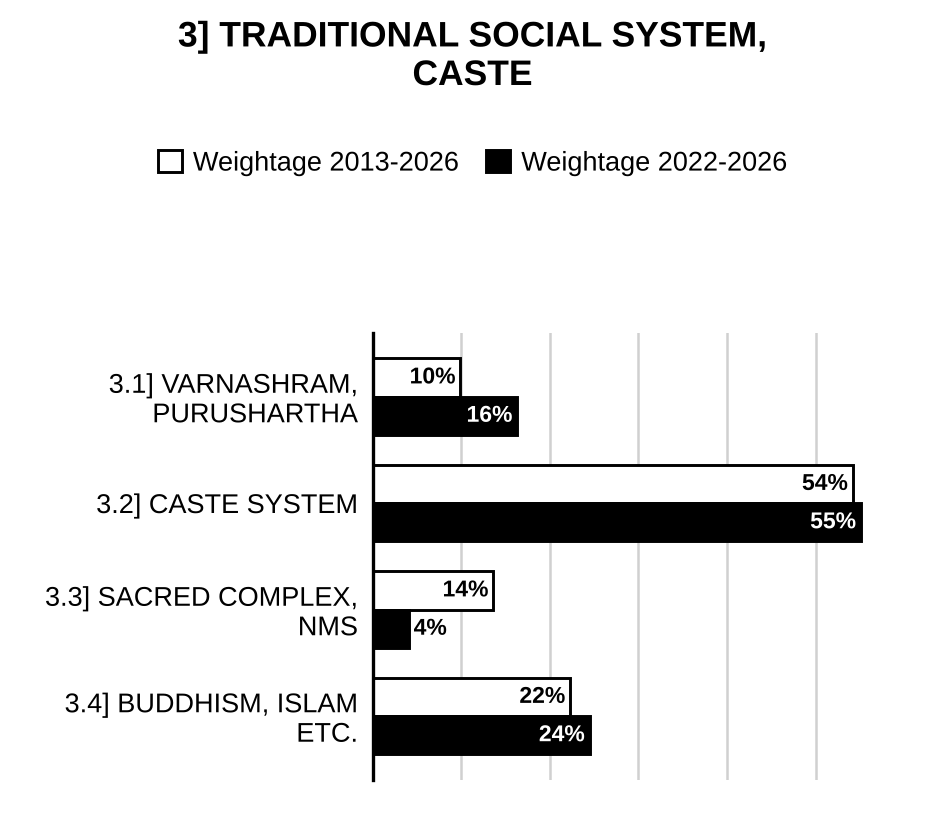
3.1] Structure and nature of traditional Indian social system
22 questions
Write a short note on: Varnashrama and its contemporary relevance. [2025/10m/150w/5d]
Write a short note on: Interface between Purushartha and Ashrama. [2023/10m/150w/1b]
Write a short note on: Karma and Rebirth. [2023/10m/150w/5e]
Write a short note on: Dharma versus Religion. [2022/10m/150w/1c]
Write a short note on: Purushartha and righteous living today. [2021/10m/150w/1a]
Write a short note on: Use of doctrine of Karma and rebirth in justifying the Varna system. [2019/10m/150w/1d]
Write a short note on: Philosophy behind Purusharthas. [2018/10m/150w/1b]
Write a short note on: Varnashram and the concept of Rina. [2017/10m/150w/1c]
Write a short note on: Philosophy behind Purushartha. [2011/15m/150w/1a]
Write a short note on: Purushartha. [2007/20m/R2]
Write a short note on: Karma. [2006/20m/R4]
Write a short note on: Varnashram. [2005/20m/R2]
Trace the broad unifying features of the traditional Hindu society in the anthropological perspective. [2004/60m/R10]
Write a short note on: Significance of Purushartha. [2003/20m/R2]
Write a short note on: Concept of Rina and Rebirth. [2002/20m/R2]
Write a short note on: Concept of Karma in relation of caste. [2000/20m/200w/1b]
Point out the salient features of traditional joint family system in India. Trace causes for its disintegration in recent decades. [1999/60m/3]
Discuss the basis of Indian Social System. Do you find any change today? [1998/60m/3]
Write a short note on: Concept of rebirth in Hindu Social System. [1997/20m/200w/1a]
Examine the role of joint family in Hindu social system and its impact on caste system. [1997/60m/6]
Write a short note on: Importance of Karma in Hindu social system. [1996/20m/R3]
Explain the concept of “Rina” according to the Hindu Scriptures. What were the mechanisms suggested by the scholars to repay the “Rinas”? [1995/60m/R9]
3.2] Caste system in India
49 questions
What are the major debates related to the concept of jajmani system? [2026/20m/2a]
Does caste as a social category exist among the non-Hindu communities in India? Illustrate your answer with suitable examples. [2026/15m/7b]
Write a short note on: Caste domination, factionalism and political power. [2025/10m/150w/1b]
What are the different types of caste mobility in India? Highlight the various factors responsible for it. [2025/20m/4a]
Discuss the theories on origin of caste system and its criticism in India. Differentiate between caste, class and race. [2024/15m/7b]
Write a short note on: Jajmani system: continuity and change. [2023/10m/150w/1c]
Is caste mobility a recent phenomenon? Discuss in the light of Indological and Empirical context. [2023/15m/4c]
Is annihilation of caste possible? Discuss the future of caste system in the light of various proactive measures taken by the Indian State. [2023/20m/6a]
Critically describe Dr. B. R. Ambedkar’s argument on the origin of Indian caste system. [2022/15m/2c]
Write a short note on: Relevance of tribe-caste continuum. [2021/10m/150w/1b]
Write a short note on: Caste and social capital. [2021/10m/150w/1d]
Discuss the characteristics of caste system in India. [2020/20m/3a]
Explain the reasons of caste violence in India with suitable examples. [2020/20m/4a]
Write a short note on: Concept of ‘Dominant’ caste. [2020/10m/150w/5c]
Write a short note on: The Jajmani system and contemporary market economy. [2019/10m/150w/1e]
Based on historical and contemporary evidences discuss the future of caste system in India. [2018/15m/3b]
Discuss the view that caste is not social stratification, but a system of hierarchy. [2018/15m/4c]
Explain the significance of tribe-caste continuum in the present context. [2018/15m/8b]
Discuss the impact of market economy on the Jajmani system. [2017/20m/3a]
Relevance of caste in contemporary Indian politics. [2016/10m/150w/1c]
Examine the structural and cultural theories of caste system in India. [2016/20m/3a]
How is process of tribe-caste continuum different from Sanskritization? Comment. [2016/15m/4b]
What do you understand by dynamics of caste mobility? How did the concept of Sanskritization contribute to its functionality? [2015/20m/8a]
Critically examine the concept of tribe-caste continuum and its relevance in contemporary India. [2015/15m/8b]
Write a short note on: Tribe-Caste continuum. [2014/10m/150w/1b]
Do you think caste persists in contemporary India? Critically discuss. [2014/15m/2c]
Define the concept ‘Dominant Caste’ and examine its relevance in the contemporary Indian village with suitable examples. [2014/20m/3a]
Discuss how Louis Dumont explained caste system. [2013/10m/150w/1d]
What is Jajmani system? Examine the views on Jajmani system as an egalitarian as well as exploitative system. Give reasons for its decline. [2013/25m/375w/3b]
Examine the criticisms on the concept of dominant caste. [2013/15m/250w/4b]
Critically examine the prevalence of caste ideology among religious minorities in the Indian context. [2012/30m/6a]
Briefly comment on the linkage between: (i) Gender and Customary Law; (ii) Gender and Caste. [2012/20m/8c]
Discuss the relevance of the concept of Dominant Caste in the context of Contemporary Indian Society. [2011/15m/2c]
Critically examine the theories of Origin of Castes. [2011/30m/4b]
Examine the role of the caste system in the present political context. [2010/15m/4b]
Is the present political system strengthening the caste system? Discuss. [2010/15m/4c]
Discuss the salient features of the prevalent hypotheses on the future of the caste system in India. [2009/30m/2a]
Bring out the various features and the importance of the ‘dominant caste’ concept. [2009/20m/3a]
Is Tribe-Caste Continuum a reality or myth? Discuss. [2008/60m/3]
Write a short note on: Jajmani System. [2007/20m/R3]
Write a short note on: Tribe-Caste Continuum. [2004/20m/R3]
Write a short note on: Caste as a pattern of social stratification. [2003/20m/R3]
Write a short note on: Tribe-caste continuum. [2000/20m/200w/1c]
Define the Jajmani system. Analyse the changes in the relationship between caste and occupation in contemporary rural society. [2000/60m/3]
Write a short note on: Dominant Caste. [1999/20m/200w/1d]
Write a short note on: Jajmani System. [1998/20m/200w/1b]
Write a short note on: Significance of Varna and Caste. [1997/20m/200w/1c]
Examine the role of joint family in Hindu social system and its impact on caste system. [1997/60m/6]
Write a short note on: Distinguish between varna and caste. [1995/20m/R2]

Preparing for Prelims too?
Our UPSC Prelims Topic-wise PYQ eBook covers every Prelims question with detailed explanations, so you can see exactly where UPSC asks from.
View the BookDownload Free Sample3.3] Sacred complex and nature-man-spirit complex
14 questions
Write a short note on: Nature-Man-Spirit-Complex. [2026/10m/150w/5d]
Explain the impact of the concept of nature-man-spirit complex on sustainable use of natural resources with suitable examples. [2021/20m/3a]
Critically examine the contributions of Makhan Jha and B. N. Saraswati to the study of sacred complexes in India. [2018/20m/7a]
Write a short note on: Nature-man-spirit complex. [2017/10m/150w/1e]
Write a short note on: Sacred complex as dimension of Indian civilization. [2015/10m/150w/1b]
Describe the concept of ‘Sacred Complex’ with an ethnographic example. [2014/15m/2b]
Examine Nature-Man-Spirit complex as an ecological concept. [2013/15m/250w/2a]
Discuss the significance of study of religious centres to the understanding of Indian civilization. [2013/20m/250w/2c]
Write a short note on: Sacred Geography. [2012/12m/150w/1a]
Write a short note on: Nature-Man-Spirit complex. [2009/20m/200w/1b]
Write a short note on: Sacred complex. [2005/20m/R3]
Write a short note on: Nature-Man-Spirit complex. [2001/20m/R3]
Write a short note on: Sacred Complex. [1999/20m/200w/1c]
Write a short note on: Maler’s perception of the habitat. [1995/20m/R3]
3.4] Impact of Buddhism, Jainism, Islam and Christianity on Indian society
17 questions
Write a short note on: Syro-Malabar Christians. [2024/10m/150w/1c]
Write a short note on: Religious pluralism and social solidarity. [2023/10m/150w/1e]
Discuss the basic tenets of Jainism and its impact on Indian society. [2023/15m/2c]
Write a short note on: Varna and Buddhism. [2022/10m/150w/1b]
Critically examine ‘Indigenisation of Christianity’ in India. [2022/15m/4c]
Discuss the impact of Islam on Indian Society. [2020/20m/2a]
What has been the impact of non-Hindu religions on the emancipation of Scheduled Castes in India? [2019/15m/8b]
Explain the impact of Buddhism and Jainism on Indian society. [2018/20m/4a]
Explain how Buddhism influenced the economic and cultural transformations of Indian society. [2017/20m/4a]
Impact of Jainism on Indian society. [2016/10m/150w/1d]
Write a short note on: Islam and Matriliny. [2015/10m/150w/5b]
Discuss the contribution of Islam to the composite culture of India. [2014/15m/3b]
Write a short note on: Sufi tradition of Islam. [2013/10m/150w/1a]
Write a short note on: Impact of Islam on Indian society. [2005/20m/R4]
Write a short note on: Buddhism, Christianity and Scheduled Castes. [2004/20m/R4]
Evaluate the impact of Buddhism, Jainism, Islam and Christianity on Indian society and culture in anthropological terms. [2003/60m/R10]
Account for the emergence of new religions in India in the 6th century B.C. [1998/60m/4]

Strengthen your GS papers
Our UPSC Mains Topic-wise & Year-wise PYQ eBook (2013–2026) maps every GS question to the syllabus, so you know what UPSC asks and how often.
View the BookDownload Free Sample« Previous: Demographic Profile of India | Next: Emergence, Growth and Development of Anthropology in India »
Back to: Anthropology Optional PYQs – Topic-wise | Also see: Anthropology Optional year-wise question papers
Last updated: 30 October 2026