
Here are all 104 Evolution of Indian Culture and Civilization questions asked in UPSC Anthropology Optional Paper II from 1995 to 2026, arranged under the 3 topics of the official syllabus. Within each topic the latest questions come first.
Each question ends with a code such as [2024/15m/3b] – the year, the marks, the word limit (where UPSC set one) and the question number in the paper.
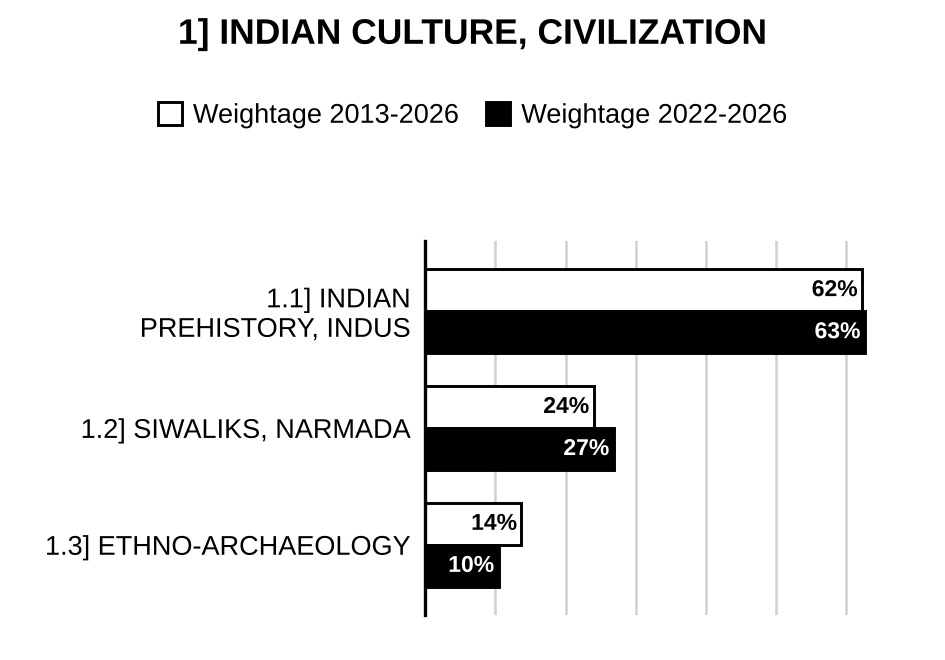
1.1] Evolution of the Indian culture and civilization
71 questions
What are the evidences available regarding crops and domesticated animals of Indus Valley Civilization? What are the views of the scholars regarding Indus script? [2026/15m/2c]
Make a critical appraisal of the mesolithic culture of Ganga basin with reference to artifacts, faunal and human skeletal remains excavated from different sites. [2026/20m/6a]
Write a short note on: ‘Soanian cultural’ tradition. [2025/10m/150w/1a]
Describe the distinctive features and distribution of Upper Palaeolithic of India. [2025/20m/3a]
Write a short note on: Lothal dockyard and international trade relations. [2025/10m/150w/5e]
Write a short note on: Origin of State Societies. [2024/10m/150w/1b]
Critically describe evidences from Rakhi Garhi and its linkages to Harappan civilization. [2024/20m/3a]
Describe the important Paleolithic sites from South India with suitable examples. What is the significance of South Indian Paleolithic cultures? [2024/20m/8a]
Write a short note on: Prehistoric rock arts from Uttarakhand. [2023/10m/150w/1d]
“Indus Valley was the first settlement of the big civilization.” Comment critically. [2023/15m/2b]
Was Mesolithic culture the first step towards sedentary way of life? Illustrate your answer by citing suitable examples. [2023/15m/3b]
Write a short note on: Pit-dwellers of Kashmir. [2022/10m/150w/1a]
Make a critical appraisal of Megalithic tradition in India with special reference to North-East India. [2022/20m/3a]
Describe briefly the proto-history of Gujarat. Discuss the significance of Gujarat proto-history in international trade. [2022/15m/4b]
Write a short note on: Harappan seals. [2021/10m/150w/1c]
Critically discuss the origin of Indus Valley Civilization. Mention the evidences of its endogenous origin from the pre-Harappan sites. [2021/20m/2a]
Give the distribution and characteristic features of Upper Paleolithic culture in India. [2021/15m/2b]
Write a short note on: Debates on ‘Aryan’ invasion. [2020/10m/150w/1b]
Discuss the characteristic features of ‘Neolithic culture’ in India. [2020/15m/7b]
Describe the Palaeolithic culture with special reference to Soanian tradition. Indicate the problems of describing the Indian Palaeolithic. [2019/20m/2a]
What kind of society may be reconstructed from the archaeological evidences of Harappan culture? [2019/20m/3a]
Write a short note on: Distribution of Neolithic sites in India. [2019/10m/150w/5e]
Explain the contribution of tribal cultures to Indian civilization. [2018/20m/2a]
Examine the regional variations of mesolithic cultures of India. [2018/20m/3a]
Write a short note on: Neolithic cultures of South India. [2017/10m/150w/1a]
Describe the salient features of chalcolithic cultures of the Deccan. [2017/15m/2b]
Describe various aspects of trade and religion of Harappan civilization. [2017/15m/4b]
Significance of Mesolithic findings from Belan Valley. [2016/10m/150w/1a]
Discuss how cultural diversity of Indian tribes has enriched its plural traditions. [2016/15m/2c]
Give a detailed appraisal of skeletal remains from Chalcolithic culture of undivided Punjab. [2016/20m/4a]
Write a short note on: South Indian Palaeoliths. [2015/10m/150w/1c]
Write a short note on: Prehistoric Rock Art of Central India. [2015/10m/150w/5a]
Discuss the significance of Harappan Civilization sites from India. [2015/15m/6c]
Write a short note on: Neolithic cultures of N-E India. [2014/10m/150w/1a]
Describe what is known of Harappan Religion. Have some of its elements continued into later Hinduism? Discuss. [2014/20m/2a]
Discuss salient features of Mesolithic culture in India with special reference to western India. [2013/10m/150w/1e]
Comment on: Indian Palaeolithic culture can neither be conceived chronologically homogeneous nor as a uniform cultural phase. – Discuss. [2013/15m/250w/2b]
Write a short note on: Palaeolithic Art. [2012/12m/150w/1e]
Write a short note on: Soan culture. [2012/12m/150w/5c]
Compare the salient features and distribution of the Middle Palaeolithic and Upper Palaeolithic cultures in India. Add a note on the tool traditions of the Upper Palaeolithic period. [2012/30m/7b]
Write a short note on: Iron Age in Gangetic region. [2011/15m/150w/1c]
Describe the characteristic features of Mesolithic Cultures in India. [2011/30m/3a]
Discuss the significance of Sohan in Indian Prehistory. [2011/30m/4a]
Write a short note on: Neolithic culture in India. [2010/15m/150w/1a]
Write a short note on: Urban planning in Harappan culture. [2010/15m/150w/1d]
Comment in detail on the socio-cultural life of the people of the Indus Valley Civilization. [2010/15m/3a]
Examine Gordon Childe’s statement, “Neolithic culture is a revolution”. [2010/15m/3b]
Examine the contribution of Mesolithic culture to the rise of Neolithic culture. [2009/10m/2c]
Write a short note on: ‘Langhnaj’ [2008/20m/200w/1a]
Write a short note on: Neolithic Culture. [2007/20m/R1]
Write a short note on: Burzahom. [2006/20m/R1]
Write a short note on: Mesolithic culture in India. [2005/20m/R1]
Discuss the economic basis of Indus Civilisation. What were the factors of its decline? [2005/60m/R9]
Write a short note on: Typo-technology of Indian Palaeolithic Culture. [2004/20m/R1]
Write a short note on: Town planning in Indus cultures. [2003/20m/R1]
Critically examine the contributions of tribal cultures to the development of Vedic culture. [2003/60m/R9]
Name a few Chalcolithic sites in India and describe their most salient features. [2002/60m/R8]
Write a short note on: Ecological adaptation during Mesolithic. [2001/20m/R1]
Critically examine evidence of Upper Paleolithic in India. Discuss its characteristics. [2001/60m/R8]
Write a short note on: Criteria of civilization. [2000/20m/200w/1d]
Describe the geographical spread of Indus valley civilization. What were the causes of its decline? [2000/60m/2]
Write a short note on: Proto-Neolithic. [1999/20m/200w/1a]
Critically examine various sources of India’s culture and civilization. Also distinguish between primary and secondary civilization. [1999/60m/2]
Write a short note on: Sohanian Tradition. [1998/20m/200w/1c]
Describe the socio-cultural characteristics of the Neolithic period in India with suitable examples. [1998/60m/2]
Write a short note on: Dating methods in Prehistory. [1997/20m/200w/1b]
Describe the distinguishing characteristic features of South Indian Megaliths and compare these with either Central Indian or North-eastern India Megaliths. [1997/60m/2]
Write a short note on: Components of cultures and its link with civilization. [1997/20m/200w/5a]
Discuss the cultural characteristics of Upper Palaeolithic period. Indicate its genesis and development in Indian context pointing to distribution and chronology. [1996/60m/R8]
Write a short note on: Genesis of urbanization in India. [1995/20m/R4]
Bring out the salient features of Lower Palaeolithic Culture complex in the Peninsular and extra-Peninsular India. [1995/60m/R8]

Preparing for Prelims too?
Our UPSC Prelims Topic-wise PYQ eBook covers every Prelims question with detailed explanations, so you can see exactly where UPSC asks from.
View the BookDownload Free Sample1.2] Palaeo-anthropological evidences from India
20 questions
Write a short note on: Seed Eaters Model of hominid differentiation. [2026/10m/150w/1b]
Write a short note on: Debate regarding the phylogenetic position of Narmada Man. [2026/10m/150w/5b]
Discuss the palaeoanthropological significance of Siwaliks of India giving its subdivisions, fossil primate fauna and major primate fossil localities. [2025/20m/2a]
Write a short note on: Taxonomic status of Ramapithecus in the light of Ramapithecus-Sivapithecus controversy. [2025/10m/150w/5b]
Write a short note on: Ramapithecus-Sivapithecus debate. [2023/10m/150w/5b]
“Siwalik deposits show a variety of Neogene fossil primates.” Critically examine. [2023/15m/6c]
What are the arguments for excluding Narmada Man from Homo erectus category? [2022/15m/2b]
Discuss the morphological features and phylogenetic position of Ramapithecus. [2021/15m/2c]
Write a short note on: ‘Narmada’ Man. [2020/10m/150w/5b]
Write a short note on: Phylogenetic position and morphological features of Ramapithecus. [2019/10m/150w/1a]
Describe the salient features of Sivapithecus. [2018/15m/2b]
Describe the salient features of Ramapithecus. [2017/15m/3b]
Delineate the salient characteristics of ‘Narmada Man’ and examine its phylogenetic significance. [2016/15m/2b]
Describe the palaeoanthropological fossil finds from Siwalik hills. Examine the contribution of Siwalik fossils to palaeoanthropological knowledge. [2015/15m/3c]
Describe the evolutionary significance of the fossil finds of the Narmada Basin. [2014/15m/4b]
Examine the debates related to Ramapithecus. [2013/10m/150w/1c]
Write a short note on: Narmada Man. [2012/12m/150w/1c]
Write a short note on: Sivapithecus. [2010/15m/150w/1c]
Write a short note on: Importance of the Siwaliks in Anthropology. [2009/20m/200w/1d]
Write a short note on: Paleoanthropological significance of Narmada Man. [2008/20m/200w/1c]
1.3] Ethno-archaeology in India
13 questions
Discuss with examples, how general comparative analogy has been used for ethnoarchaeological studies in India. [2026/15m/3c]
Write a short note on: Artisan tribes of Jharkhand. [2024/10m/150w/1d]
Write a short note on: Material culture and archaeology. [2023/10m/150w/1a]
Discuss the importance of Ethnoarchaeology in reconstructing the Past citing Indian examples. [2020/15m/3b]
Write a short note on: Ethno-archaeological analysis of hunting activities of contemporary tribal communities. [2019/10m/150w/1b]
Write a short note on: Ethnoarchaeology as a research strategy. [2018/10m/150w/1e]
Write a short note on: Ethno-archaeology. [2017/10m/150w/1d]
Discuss the relevance of art and craft traditions in the understanding of Indian archaeology. [2017/15m/8b]
Ethno-archaeological evidences for the survival of hunting-gathering traditions in India. [2016/10m/150w/1e]
Discuss the importance of the ethno-archaeological approach to the study of indigenous craft in India. [2014/15m/3c]
Write a short note on: Commodification of Tribal Art. [2012/12m/150w/5b]
Write a short note on: New Archaeology. [2009/20m/200w/1a]
Write a short note on: Concept of Ethnoarchaeology. [2008/20m/200w/1d]

Strengthen your GS papers
Our UPSC Mains Topic-wise & Year-wise PYQ eBook (2013–2026) maps every GS question to the syllabus, so you know what UPSC asks and how often.
View the BookDownload Free Sample« Previous: Applications of Anthropology | Next: Demographic Profile of India »
Back to: Anthropology Optional PYQs – Topic-wise | Also see: Anthropology Optional year-wise question papers
Last updated: 30 October 2026