
Here are all 76 Tribal Administration and Development questions asked in UPSC Anthropology Optional Paper II from 1995 to 2026, arranged under the 3 topics of the official syllabus. Within each topic the latest questions come first.
Each question ends with a code such as [2024/15m/3b] – the year, the marks, the word limit (where UPSC set one) and the question number in the paper.
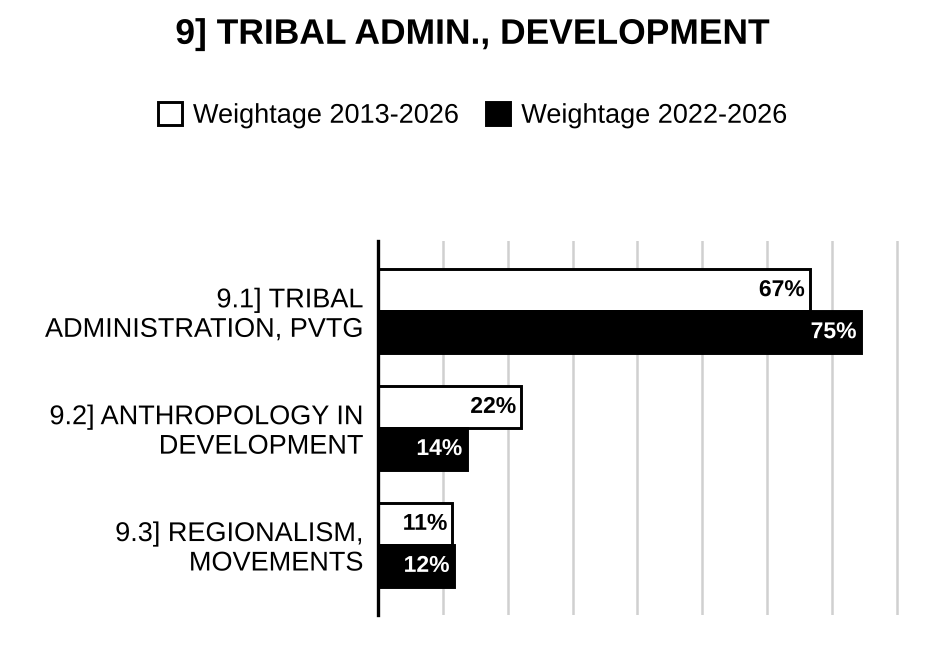
9.1] Tribal administration, policies and programmes
48 questions
Write a short note on: Particularly Vulnerable Tribal Group (PVTG) of the islands. [2026/10m/150w/1d]
‘Dharti Aaba Janjatiya Gram Utkarsh Abhiyan aims to meet some of the Sustainable Development Goals’. Discuss. [2026/15m/2b]
Write an account on the contribution of Verrier Elwin in developing policies for the tribal populations in post-independent India. [2026/20m/4a]
Write an account on Development Action Plan for Scheduled Tribes (DAPST). [2026/15m/7c]
Write a short note on: Verrier Elwin’s philosophy with respect to Arunachal Pradesh. [2025/10m/150w/1d]
Discuss the role of NGOs in the socioeconomic and political development of weaker sections and the manner in which they facilitate other stakeholders. [2025/15m/6b]
What are the identifying criteria for PVTGs in India? Examine their current status, nomenclature and distribution. [2025/15m/8c]
Critically discuss the recent welfare measures initiated by the Government for the Particularly Vulnerable Tribal Groups (PVTGs). Comment why PVTGs were erroneously called Primitive Tribal Groups (PTGs). [2024/20m/2a]
Elucidate the problems faced by Particularly Vulnerable Tribal Groups and the major challenges in the formulation of special programmes for their development. [2023/20m/4a]
Elucidate the shifting terrains of India’s tribal policies in colonial and post-colonial periods. [2023/20m/7a]
Discuss the objectives of Integrated Tribal Development Projects (ITDPs). How far have these objectives been achieved? [2022/20m/6a]
Discuss the views of G. S. Ghurye and Verrier Elwin on the approach towards tribal populations. What are the policies of the Government of India towards Indian tribal populations? [2022/20m/7a]
Discuss the interventions made by the Non-Governmental Organizations for empowering tribal women. [2021/15m/7c]
Describe the functions of Tribal Research Institutes in India. [2020/15m/6b]
Critically assess the existing plans and programmes meant for tribal welfare. [2019/15m/3c]
Identify some special programmes for particularly vulnerable Tribal Groups (erstwhile PTGs). [2019/15m/4c]
Critically discuss the role of NGOs in tribal development. [2019/15m/6b]
Write a short note on: Particularly Vulnerable Tribal Groups (earlier known as PTG) [2017/10m/150w/5d]
Discuss the emergence, salient features and limitations of Tribal sub-plan. [2017/15m/6b]
Give a critical appraisal of any one tribal development programme during XIIth Five-Year plan. Give your suggestions for any improvement in the programme. [2017/15m/7c]
Critically examine the role of NGOs and missionaries in transformation of scheduled tribes in Central India. [2016/15m/8b]
Write a short note on: Relevance of tribal Panchsheel today. [2015/10m/150w/1a]
Recently non-government organizations have been critiqued for interfering with developmental process in tribal heartland. Critically comment. [2015/20m/7a]
Write a short note on: The concept of PTG. [2014/10m/150w/5d]
Critically evaluate the National Tribal Policy. [2014/15m/6c]
Critically examine the role of NGOs in promoting health and education in tribal areas. [2014/15m/8b]
Describe the history of tribal administration in the colonial period. [2014/15m/8c]
Comment on: Fifth Schedule and Sixth Schedule of the Constitution are built on the foundations laid by the colonial Government. – Discuss. [2013/20m/250w/6a]
Examine the relevance of Tribal Panchsheel by Jawaharlal Nehru in the light of emerging development practices. [2012/20m/3a]
Write a short note on: Tribal Panchsheel. [2011/15m/150w/5b]
Compare the approach adopted towards tribal communities during Colonial and Post-independence periods. [2011/30m/7a]
Discuss and compare the approaches towards the tribes during colonial and post-independent India. [2010/45m/7a]
Do you find any significant change in the approaches? Assess. [2010/15m/7b]
Write a short note on: NGOs and tribal development. [2009/20m/200w/5d]
What are the special problems of the Primitive Tribal Groups (PTGs)? How far have the developmental programmes of the Government been able to address these? [2008/60m/8]
Write a short note on: Role of NGOs in Development. [2007/20m/R7]
Write a short note on: Programmes for Tribal Development. [2006/20m/R8]
Elucidate the nature of changes in administration of tribal areas from colonial period to Post-Independence era in India. [2005/60m/R14]
Write a short note on: Tribal sub-plan. [2005/20m/R7]
What do you understand by the integrated tribal and rural development programmes? How would you evaluate the success or failure of these programmes? [2002/60m/R13]
Write a short note on: The role of NGOs for tribal development. [2002/20m/R7]
Write a short note on: MADA, LAMPS, TRIFED. [2000/20m/200w/5d]
Outline the historical background of tribal administration during the colonial period. Evaluate post-Independence administrative policies with special reference to states under either the Fifth Schedule or Sixth Schedule of the Constitution of India. [2000/60m/8]
Write a short note on: Tribal Sub-Plan. [1999/20m/200w/5a]
Write a short note on: I.T.D.A. [1998/20m/200w/5b]
Write a short note on: Plans and Programs of Tribal development. [1997/20m/200w/5d]
Write a short note on: Role of NGOs in literacy programme. [1996/20m/R7]
Critically evaluate various approaches to set the tribals within the mainstream of Indian civilization. In your opinion which approach is relevant in the modern context? [1995/60m/R12]

Preparing for Prelims too?
Our UPSC Prelims Topic-wise PYQ eBook covers every Prelims question with detailed explanations, so you can see exactly where UPSC asks from.
View the BookDownload Free Sample9.2] Role of anthropology in tribal and rural development
19 questions
Identify the contemporary limitations in the process of tribal development. How can anthropological knowledge contribute in this process? [2025/20m/7a]
Briefly describe the anthropological perspective on development. How have anthropologists contributed in India’s rural development? [2022/15m/8b]
Examine the strengths and weaknesses of anthropology in the context of its role in tribal and rural development. [2018/20m/8a]
Discuss the contribution of anthropology in understanding the loss of livelihood of tribal communities due to economic and ecological factors. [2017/15m/8c]
Describe how anthropological knowledge and methods are useful in rural development. [2016/15m/8c]
Examine in detail the role of anthropology in planning for tribal development. [2015/15m/4b]
Critically assess the role of anthropologists in rural development. [2014/20m/8a]
Discuss the significance of cultural and administrative factors in tribal development. [2013/15m/250w/6b]
Write a short note on: Participatory Rural Appraisal. [2012/12m/150w/1d]
Write a short note on: Indigenous Knowledge. [2012/12m/150w/5e]
Using examples, comment on how anthropology can be utilized in policy making. [2012/20m/8b]
Describe the role of anthropologists in Tribal Development. [2006/60m/R14]
Write a short note on: Role of anthropologists in rural development. [2005/20m/R8]
Anthropologists are better equipped to play an effective role in rural and tribal development. Discuss. [2004/60m/R14]
Write a short note on: Sustainable Development of Tribes. [2004/20m/R8]
Write a short note on: Sustainable Development. [1999/20m/200w/5b]
Write a short note on: Action Anthropology. [1998/20m/200w/5a]
Write a short note on: Role of Anthropologist as an Administrator. [1997/20m/200w/5c]
Write a short note on: People’s participation in tribal development. [1995/20m/R6]
9.3] Contributions of anthropology to the understanding of regionalism, communalism and ethnic and political movements
9 questions
Elucidate the difference between secularism, religiosity, religious fundamentalism and spiritualism from an anthropological perspective. [2024/15m/6b]
Elucidate the role of anthropology in nation building. Illustrate with suitable examples. [2023/15m/7c]
Write a short note on: Anthropological understanding of communalism. [2019/10m/150w/5c]
Anthropological interpretation of ethnic and political movements. [2016/10m/150w/5e]
Critically examine the concept of communalism and its relevance for multi-religious and multi-ethnic polity of India. [2015/20m/4a]
Write a short note on: Factors contributing to communalism. [2011/15m/150w/1b]
In what ways has anthropology contributed to the understanding of ethnic and political movements in India? [2009/60m/7]
Discuss the significance of the regionalism and communalism in Indian context and its role in ethno-political movements in the present political system. [1997/60m/8]
Discuss the major linguistic divisions in the Indian population. Also point out the role of language in ethno-political movements. [1996/60m/R9]

Strengthen your GS papers
Our UPSC Mains Topic-wise & Year-wise PYQ eBook (2013–2026) maps every GS question to the syllabus, so you know what UPSC asks and how often.
View the BookDownload Free Sample« Previous: Religion and Tribes; Tribe and Nation State | Next: Other Questions »
Back to: Anthropology Optional PYQs – Topic-wise | Also see: Anthropology Optional year-wise question papers
Last updated: 30 October 2026