
Physics Optional PYQs Topic-wise for UPSC Mains (1995–2026) are listed below unit by unit, in the order of the official syllabus – 1751 questions in all. Click any unit to open all its previous year questions, arranged topic-wise with the latest first.
Paper I
| Unit | Topic (click to open PYQs) | Sub-topics | Questions | Link |
|---|---|---|---|---|
| 1 | Mechanics | 12 | 234 | Click here → |
| 2 | Waves and Optics | 9 | 249 | Click here → |
| 3 | Electricity and Magnetism | 6 | 161 | Click here → |
| 4 | Electromagnetic Waves and Blackbody Radiation | 5 | 120 | Click here → |
| 5 | Thermal and Statistical Physics | 9 | 179 | Click here → |
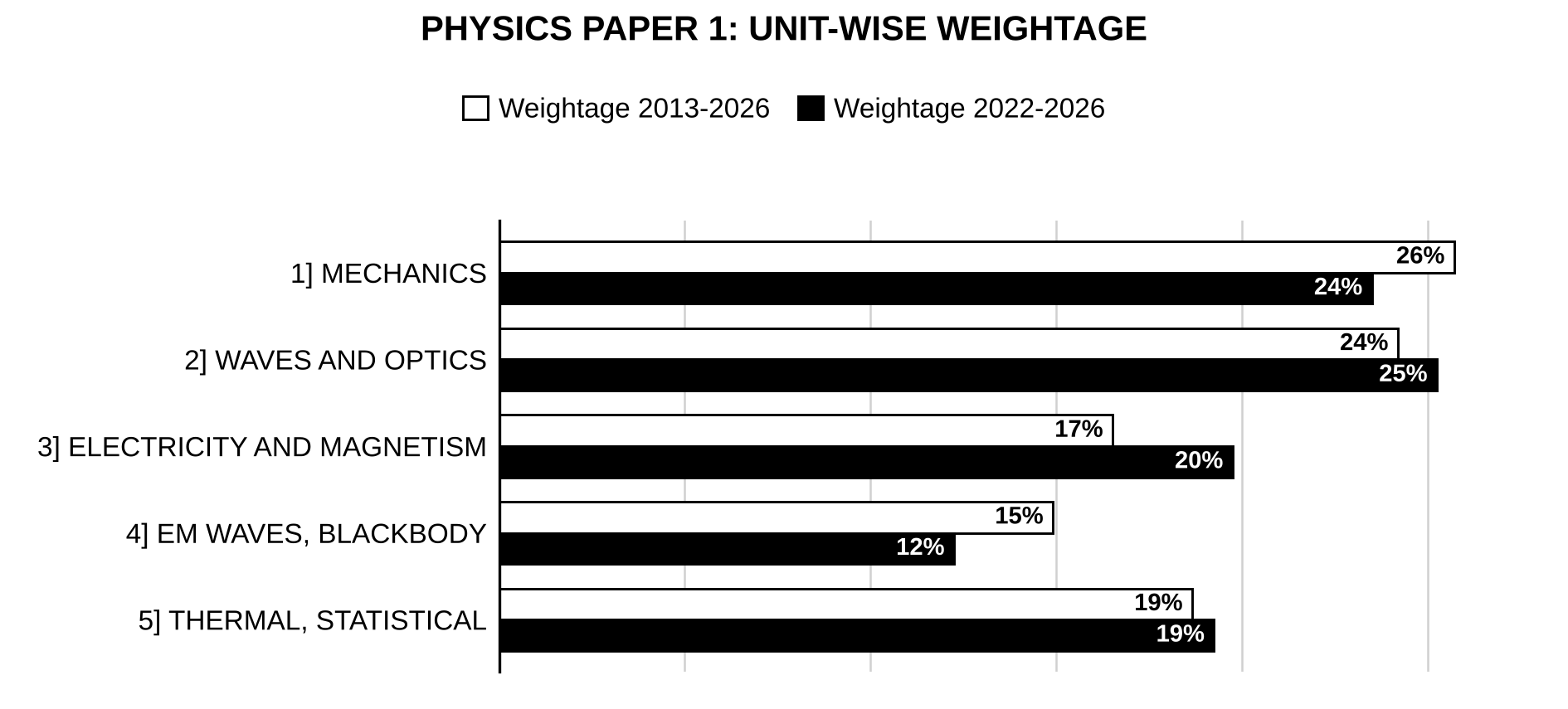
Trend: Mechanics (about 24–26% of the marks) and Waves and Optics (about 24–25%) are the two largest units of Paper I, followed by Thermal and Statistical Physics (about 19%), Electricity and Magnetism (17–20%) and Electromagnetic Waves and Blackbody Radiation (12–15%). Within the units, rigid body dynamics (topic 1.7) and relativistic kinematics and dynamics (1.12), lasers and holography (2.9), interference (2.4) and Fraunhofer diffraction (2.5), DC and AC circuits (3.6), Maxwell’s equations and EM waves (4.1), the laws of thermodynamics and entropy (5.1) and statistical distributions (5.8) have been asked most often since 2013. In 2022–2026 rigid body dynamics (1.7) has taken an even larger share, and geometrical optics (2.3), magnetic fields and induction (3.5) and EM waves at dielectric boundaries (4.3) have come up more often.

Preparing for Prelims too?
Our UPSC Prelims Topic-wise PYQ eBook covers every Prelims question with detailed explanations, so you can see exactly where UPSC asks from.
View the BookDownload Free SamplePaper II
| Unit | Topic (click to open PYQs) | Sub-topics | Questions | Link |
|---|---|---|---|---|
| 1 | Quantum Mechanics | 9 | 213 | Click here → |
| 2 | Atomic and Molecular Physics | 9 | 182 | Click here → |
| 3 | Nuclear and Particle Physics | 8 | 195 | Click here → |
| 4 | Solid State Physics, Devices and Electronics | 11 | 218 | Click here → |
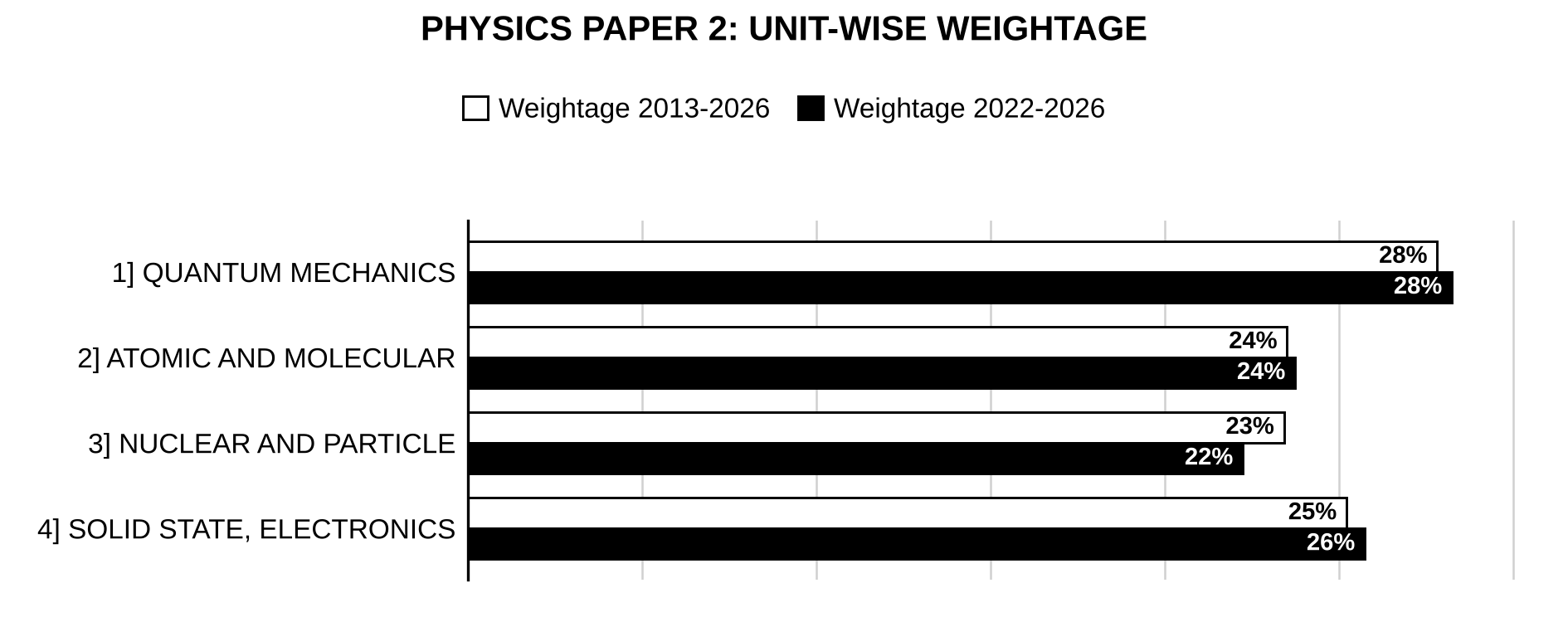
Trend: Paper II is spread fairly evenly over its four units: Quantum Mechanics is the largest (about 28%), followed by Solid State Physics, Devices and Electronics (about 25–26%), Atomic and Molecular Physics (about 24%) and Nuclear and Particle Physics (22–23%), with little change between 2013–2026 and 2022–2026. The most-asked topics since 2013 are wave-particle duality and the uncertainty principle (1.1), particle in a box (1.4) and angular momentum and the hydrogen atom (1.8), molecular spectra (2.4) and the Zeeman effect (2.3), elementary particles (3.8) and the shell model (3.4), and crystal structure and X-ray diffraction (4.1). In 2022–2026 particle in a box (1.4), spin and Pauli matrices (1.9), coupling and spectroscopic notation (2.2) and magnetism of solids (4.4) have come up more often.
More questions
Other questions (outside the present syllabus) – 20 questions
How this collection is organised
Considering the changing exam pattern over the years, we felt it necessary to declare some practices we’ve adopted in this collection.
Units follow the official syllabus – Paper 1: 1 Mechanics, 2 Waves and Optics, 3 Electricity and Magnetism, 4 Electromagnetic Waves and Blackbody Radiation, 5 Thermal and Statistical Physics; Paper 2: 1 Quantum Mechanics, 2 Atomic and Molecular Physics, 3 Nuclear and Particle Physics, 4 Solid State Physics, Devices and Electronics. The official syllabus has been divided into numbered topics (e.g. Paper 1 – 2.4 Interference) to arrange the questions.
Questions on areas the syllabus does not name separately are placed under the nearest topic: for example, the photoelectric and Compton effects and the Bohr model under wave-particle duality (Paper 2 – 1.1); acoustics and the Doppler effect for sound under waves (Paper 1 – 2.2); surface tension under fluids (1.10); Saha ionisation and stellar spectra under applications of statistical physics (5.9); particle accelerators under elementary particles (Paper 2 – 3.8); p-n junctions and diodes under semiconductors (4.6).
Until about 2007 the two papers followed an older syllabus, and some subjects (for example electricity and magnetism, electromagnetic waves and electronics) appeared in the other paper. Such questions of 1995–2007 are placed under the topic of the present syllabus, even when that topic is now in the other paper; Part III shows each paper as set. From 2009 every question is kept in its own paper.
Questions on subjects no longer in the syllabus (for example Lagrangian and Hamiltonian mechanics, Fourier transformation, acoustics and ultrasonics, X-ray spectra, and radio modulation and receivers) are placed at the end of each paper under “Other Questions (Outside the Present Syllabus)”.
Some questions cover more than one topic. We’ve kept such questions in each topic of relevance.
Every figure printed with a question is given as a complete description in square brackets – [Figure: …] – with every element, value, axis, label and connection shown, so that the question can be solved from the description. Standard tables attached to a paper are not reproduced.
Graphs at the start of each paper show the weightage of every unit in that paper, and graphs for each unit show the weightage of its topics. Weightage is the share of marks asked from a unit or topic, compared for 2013–2026 (white bars) and the last five years, 2022–2026 (black bars). A question placed under two topics has its marks split equally between them.
Each of the topicwise question is suffixed by a question code like this [2024/20m/2a]. This code indicates a) year in which the question was asked, b) maximum marks the question carried, c) prescribed word limit (where UPSC set one, e.g. 200w) and, d) the question number in actual paper, in given order.
Until 2012, each paper carried 300 marks (60 per question); since 2013 each paper carries 250 marks (50 per question). Where a compulsory question offered more parts than were to be answered (“any three” of four), every part is included with its own marks. Where a retyped copy of an older paper prints no marks for a part, the code carries the marks implied by the question. Physical constants and tables printed with the papers are not reproduced.
2016–2026 papers are transcribed from the official UPSC question papers, 2009–2015 from scans of the printed papers, 1995–2003 and 2007 from retyped copies (for most of these years only one copy could be found), and 2004–2006 from scans of printed reproductions. The 2004 Paper 2 is incomplete because a page of the only copy is missing. The 2008 papers could not be found in any source and are not included. Doubtful readings in the older copies are marked [?].
The wording, figures and data of the questions are as printed, including the papers’ own grammar and apparent misprints such as wrong units.
Spotted an error? Use the “Report an Error” box at the end of any page – we review every report and update the page.

Strengthen your GS papers
Our UPSC Mains Topic-wise & Year-wise PYQ eBook (2013–2026) maps every GS question to the syllabus, so you know what UPSC asks and how often.
View the BookDownload Free SampleLast updated: 30 October 2026