
Here are all 213 Quantum Mechanics questions asked in UPSC Physics Optional Paper II from 1995 to 2026, arranged under the 9 topics of the official syllabus. Within each topic the latest questions come first.
Each question ends with a code such as [2024/15m/3b] – the year, the marks, the word limit (where UPSC set one) and the question number in the paper.
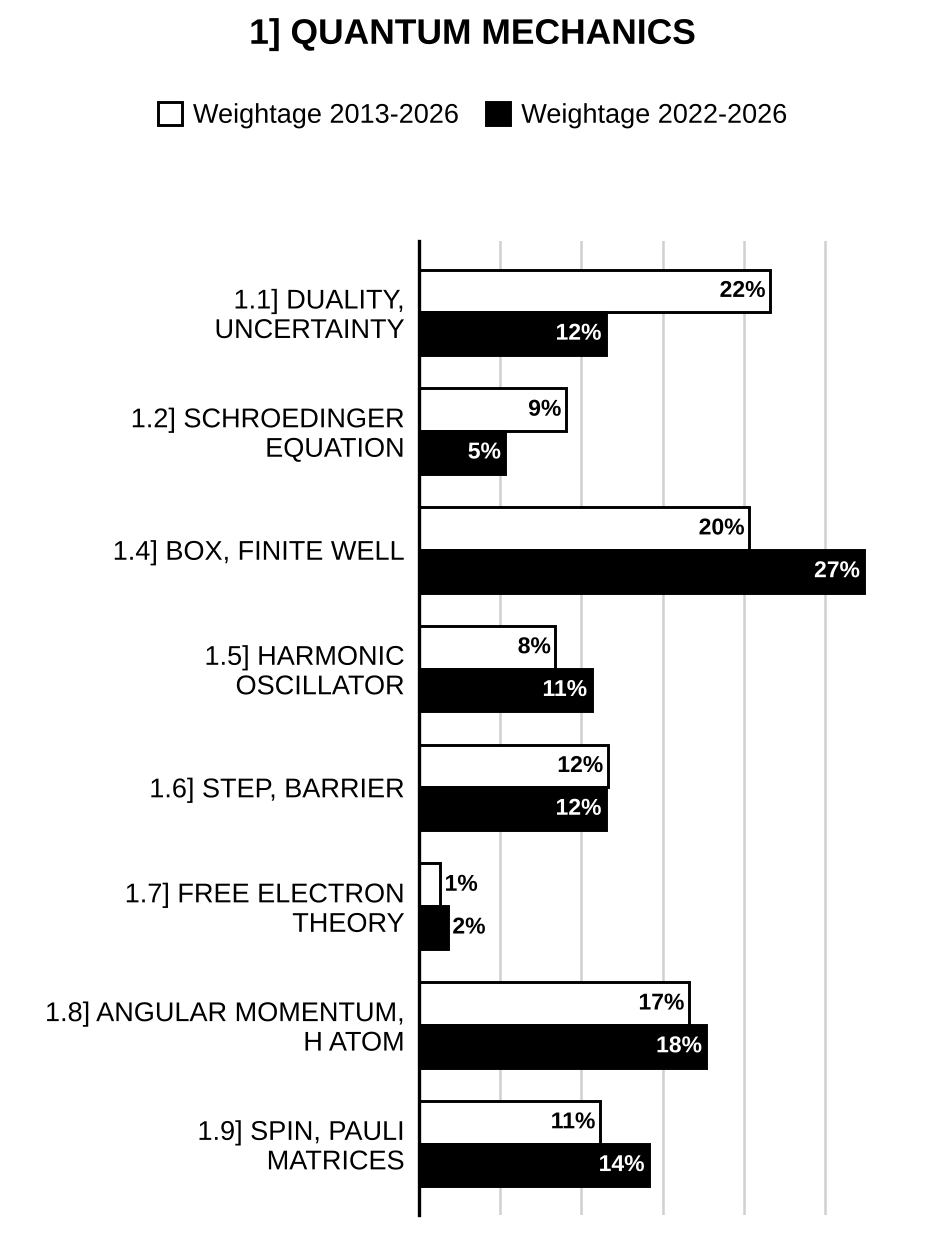
1.1] Wave-particle duality and uncertainty principle
57 questions
(i) The de Broglie wavelength of a particle in thermal equilibrium at a temperature of 27°C is . At what temperature will it be ? (ii) The wave function of a spin particle is given by . What is the probability of finding the particle in the spin-up state? [2026/10m/1a]
Are the nucleons inside the nucleus governed by the laws of quantum physics? Justify your answer. [2026/10m/5a]
Explain how the uncertainty in position is different from the uncertainty or inaccuracy of the measuring instruments. [2025/10m/1a]
Find out the difference in frequencies of Lyman-alpha line in hydrogen and deuterium atoms. [2025/15m/3a]
Is it possible for a photon to transfer all its energy to a free electron? Give reasons. [2025/5m/7b(ii)]
How is Rydberg constant related to emission wavelength of hydrogen spectrum? [2024/10m/1c]
What is de Broglie concept of matter wave? Evaluate de Broglie wavelength of Helium that is accelerated through 300 V. (Given mass of proton Mass of neutron ) [2022/10m/1a]
Find the uncertainty in the momentum of a particle when its position is determined within 0.02 cm. Find also the uncertainty in the velocity of an electron and -particle respectively when they are located within cm. [2021/15m/2b]
A particle of rest mass has a kinetic energy , show that its de Broglie wavelength is given by Hence calculate the wavelength of an electron of kinetic energy 2 MeV. What will be the value of if ? [2021/15m/4a]
Prove that Bohr hydrogen atom approaches classical conditions, when n becomes very large and small quantum jumps are involved. [2020/10m/1a]
A blue lamp emits light of mean wavelength of 4500 Å. The rating of the lamp is 150 W and its 8% of the energy appears as light. How many photons are emitted per second by the lamp? [2020/10m/1c]
A particle is described by the wave function . Calculate and for the particle, and verify the uncertainty relation . [2020/15m/2a]
Using the uncertainty principle , estimate the ground state energy of a harmonic oscillator. [2020/15m/7a]
Calculate the frequency of the electron in the first Bohr orbit of hydrogen atom. [2020/15m/8a]
Show that the mass and linear momentum of a quantum mechanical particle can be given by and , respectively, where h, and are Planck’s constant, wavelength and velocity of the particle, respectively. Comment on the wave-particle duality from these relations. [2019/10m/1a]
State and express mathematically the three uncertainty principles of Heisenberg. Highlight the physical significance of these principles in the development of Quantum Mechanics. [2019/10m/1b]
Define mathematically the Bohr radius of a hydrogen atom and show that the binding energy at state n of this atom can be given by where Z is the atomic number of H atom. Calculate the numerical values of a and of H atom. [2019/15m/2b]
Estimate the size of hydrogen atom and the ground state energy from the uncertainty principle. [2019/15m/2c]
Calculate the radius of electron orbit for in ground state. [2018/10m/1e]
A beam of 4.0 keV electrons from a source is incident on a target 50.0 cm away. Find the radius of the electron beamspot due to Heisenberg’s uncertainty principle. [2017/10m/1a]
Estimate the de Broglie wavelength of the electron orbitting in the first excited state of the hydrogen atom. [2017/10m/1c]
Find the energy, momentum and wavelength of a photon emitted by a hydrogen atom making a direct transition from an excited state with to the ground state. Also find the recoil speed of the hydrogen atom in this process. [2016/10m/1a]
A typical atomic radius is about m and the energy of -particle emitted from a nucleus is at most of the order of 1 MeV. Prove on the basis of uncertainty principle that the electrons are not present in nuclei. [2016/10m/1c]
Using uncertainty principle, calculate the size and energy of the ground state of hydrogen atom. [2016/10m/1e]
The series limit wavelength of Balmer series in hydrogen spectrum is experimentally found to be 3646 Å. Find the wavelength of the first line of this series. [2016/10m/2b]
Establish that: [2015/5m/1d(i)]
The energy levels of a hydrogen atom are given by where . Show that . [2015/5m/1d(ii)]
Find the deBroglie wave length of (i) a neutron and (ii) an electron moving with a kinetic energy of 500 eV. () [2014/10m/1a]
The mean life time of Lambda () particle is s. What will be the uncertainty in the determination of its mass in eV? [2014/10m/1b]
In a series of experiments on the determination of the mass of a certain elementary particle, the results showed a variation of , where is the electron mass. Estimate the lifetime of the particle. [2013/10m/1a]
Show that the velocity of electron in the first orbit of hydrogen atom is where C is the velocity of light. (Given electronic charge Planck Constant J.s, permittivity ) [2013/15m/4c]
Use the uncertainty principle to estimate the ground state energy of a linear harmonic oscillator. [2012/12m/1a]
Calculate the wavelength of de Broglie waves associated with electrons accelerated through a potential difference of 200 V. [2011/10m/1a]
Estimate the size of the hydrogen atom and the ground-state energy from the uncertainty principle. [2011/10m/1f]
Show that nucleus is a quantum system. [2011/10m/5a]
Derive Bohr’s angular momentum quantization condition in Bohr’s atomic model from the concept of de Broglie waves. [2010/10m/1a]
(i) Establish that (ii) The energy levels of a hydrogen atom are given by where Show that What exactly is R? [2009/10m/1b]
State and explain Heisenberg’s uncertainty principle. Experimental data reveal that no electron in an atom has energy greater than 4 MeV. Assuming that the radius of a nucleus is m, show using Heisenberg’s uncertainty principle that an electron cannot exist inside the nucleus. [2007/10m/1a(i)]
Calculate the de Broglie wavelength of thermal neutrons at 300 K. [2007/10m/1a(ii)]
Calculate the de Broglie wavelength of a thermal neutron at 27 °C temperature. [2006/10m/1a(i)]
Calculate the de Broglie wavelength of an electron moving with a kinetic energy of 1 MeV. [2005/10m/1a(ii)]
Calculate the wavelength of neutrons at a temperature of 20 °C. [2004/12m/1d(i)]
Explain what do you understand by Heisenberg uncertainty principle. Using this principle, determine the energy of the ground state of a one dimensional simple harmonic oscillator. [2003/10m/1a(i)]
An electron having an energy 2 eV is travelling in the region where varies as shown below: Calculate the de Broglie wavelength of the electron in regions I, II and III.
[Figure: Potential V (vertical arrow) against x, with the electron incident from the left (arrow labelled E = 2 eV). Region I (left): V = 0 (solid horizontal line). Region II (middle): a rectangular well of depth 10 eV, the depth marked by a double arrow labelled −10 eV below the V = 0 level (shown dashed across the well). Region III (right): a step of height 1 eV above the V = 0 level, the height marked by a double arrow labelled 1 eV.] [2003/10m/1a(ii)]
A 200 eV increase in the energy of an electron changes its De Broglie wavelength by a factor of two. Calculate the initial De Broglie wavelength of the electron. [2002/10m/1a(ii)]
A (of mass 207 m) is in the ground state of a muonic atom whose nucleus is Pb (Z = 82. A = 204, and radius = 7 fm). Calculate the first Bohr radius in units of the nuclear radius and the Rydberg constant in units of the Rydberg constant of the hydrogen atom. Comment on your results. [2000/20m/5a]
X-ray photons of wavelength 2.0 pm are incident on free electrons. They are scattered at an angle of 60° from the incident direction. Determine the following: (i) Momentum of the incident photon in keV/c (ii) Compton shift (iii) Kinetic energy and recoil angle of the electron. [2000/20m/5b]
The momentum of an electron is 600 keV/c. Determine its de Broglie wavelength and the phase and group velocities of its de Broglie waves. [2000/20m/5c]
Using the uncertainty principle, show that the electrons cannot exist inside the nucleus. How does then one account for the beta decay of a nucleus? [2000/10m/7a]
Using the uncertainty principle , estimate the minimum energy of a particle in a simple harmonic potential . [1999/20m/5b]
Find the de Broglie wavelength associated with an electron of energy (i) 10 eV and (ii) 10 MeV. [1999/20m/5c]
What are Compton effect and Compton wavelength? Determine Compton shift. Show that maximum Compton shift is twice the Compton wavelength. [1999/40m/6a]
Derive an expression for the Compton shift () and show that it is independent of the wavelength of incident radiation. Establish parallelism between Compton and Raman scattering. [1998/20m/5a]
Using Heisenberg Uncertainty principle, find the ground state energy and Bohr radius of hydrogen atom. [1997/20m/5a]
Describe Frank Hertz experiment to establish the quantization of energy levels. [1996/20m/5a]
Calculate the velocity and direction of recoil electron for back scattered X-ray photon of Mo of 0.707 Å in Compton effect. [1996/20m/5c]
Describe how Davisson-Germer electron diffraction experiment confirms the de Broglie hypothesis of matter wave. [1995/20m/5d]
1.2] Schroedinger equation and expectation values
22 questions
If the position and momentum operators in 1-D are represented by and respectively, calculate the commutator . [2026/10m/1d]
(i) A particle is in the normalized state which is a superposition of the energy eigenstates and with energies 10 eV and 30 eV, respectively. The average value of the energy of the particle in the state is 24 eV. Find the state in terms of and . (ii) Obtain the allowed eigenenergies of the half 1-D simple harmonic oscillator defined by the Hamiltonian Express its eigenstates in terms of eigenstates of the full 1-D oscillator. [2026/20m/2b]
A particle limited to the x-axis has the wave function between and ; the wave function elsewhere. (i) Find the probability that the particle can be found between and . (ii) Find the expectation value of the particle position. [2024/10m/1a]
Find the probability current density for the wave function Interpret the result physically. [2020/10m/1b]
Consider a Hermitian operator A with property . Show that . [2020/15m/2b]
The wave function of a particle is given as . Find the probability of locating the particle in the range . [2018/10m/1a]
Which of the following functions is/are acceptable solution(s) of the Schrödinger equation? (i) (ii) (iii) (iv) (v) Explain your answer. [2018/15m/2c]
Obtain an expression for the probability current for the plane wave . Interpret your result. [2015/10m/1a]
Write the time independent Schrödinger equation for a bouncing ball. [2015/10m/2b]
Normalized wave function of a particle is given below: Find the expectation value of position. [2015/10m/2c]
If and are the position and momentum operators, prove the commutation relation . [2014/10m/1c]
Obtain the time-dependent Schrödinger equation for a particle. Hence deduce the time-independent Schrödinger equation. [2014/20m/2b]
Consider the one dimensional wavefunction
(i) Calculate A so that is normalized. [2012/4m/1c(i)]
(ii) Using Schrödinger’s equation find the potential and energy E for which is an eigenfunction. (Assume that as , ). [2012/8m/1c(ii)]
Normalize the wave function [2011/10m/1b]
Obtain an expression for the probability current for the plane wave . Interpret your result. [2010/10m/1b]
Show that the time-dependent part of all the solutions of the Schrödinger equation in one-dimension has the structure provided the potential is not an explicit function of time. [2009/20m/2c]
Prove that Define all the terms of this relation and give its physical interpretation. [2006/30m/2b]
Write the commutation relations for the position variable x and the momentum components , , and . Explain the physical significance of these relations. [2005/10m/1a(i)]
If x and are two conjugate variables, show that [the rest of Question 2 and Questions 3 and 4 are missing from the only available source]. [2004/60m/2a]
The wave function of a particle is Find the expectation values of position (x) and momentum (p) for the particle. [2002/10m/1a(i)]
(i) Quantum theoretical methods have established themselves to explain natural phenomena in contemporary Physics. Comment. (ii) Formulate the axioms of quantum theory. (iii) State Born’s condition on a wave function. What is its physical meaning? [2001/20m/1a]
Determine the eigenvalues and eigenfunctions of the operators D + 137, . where . Assume the eigenfunction of the second operator to be a quadratic. [2000/20m/6b]
1.3] Free particle and wave packets
2 questions
Considering one-dimensional case for free particle, show that the plane wave function is the eigenfunction of a linear momentum operator and kinetic energy operator. [2006/10m/1a(ii)]
Show that the motion of a classical particle is analogous to the motion of a wave packet, which can be constructed by superposition of a large number of plane waves. Construct such a wave packet and derive an expression for its group velocity. [2002/25m/2c]
1.4] Particle in a box and finite well
35 questions
A particle of mass m is in the ground state of a 1-D box of infinite potential of length a. If the length of the box is changed to 2a symmetrically without disturbing the wave function of the particle, find the probability that the particle will be in the ground state of the new box. [2026/20m/4b]
Determine the ground state energy of an electron in an infinite potential well of width of 2 Å. [2025/10m/1b]
What is the density of states? For a relativistic particle of rest mass , prove that the density of states in the extreme relativistic limit () where = density of states, = volume of the system containing the particle, = total energy, = velocity of light and = Planck’s constant. [2025/20m/2a]
(i) Assuming the potential seen by a neutron in a nucleus to be schematically represented by a one-dimensional, infinite rigid wall potential of length m, estimate the minimum kinetic energy of the electron. (ii) Estimate the minimum kinetic energy of neutron bound within the nucleus as described above. Can an electron be confined in a nucleus? Explain. [2024/15m/2c]
(i) Using free electron theory of metals, calculate the Fermi energy level of sodium atom at absolute zero. Assume that sodium has one free electron per atom and its density is . (ii) Draw the energy level diagram and mathematical expressions for the following: I. of an electron confined in a one-dimensional box II. Linear harmonic oscillator Make a qualitative comparison of the above two cases. [2024/20m/4a]
Calculate the zero point energy for a particle in an infinite potential well for the following cases: (i) a 100 g ball confined on a 5 m long line. (ii) an oxygen atom confined to a m lattice. (iii) an electron confined to a m atom. Why zero point energy is not important for macroscopic objects? Comment. [2023/10m/1a]
A particle of mass is in a spherically symmetric attractive potential of radius . Find the minimum depth of the potential needed to have two bound states of zero angular momentum. [2023/10m/1c]
Consider the potential (a) Estimate the energies of the ground state as well as those of the first and the second excited states for (i) an electron enclosed in a box of size m. (ii) a 1 g metallic sphere which is moving in a box of size cm. (b) Discuss the importance of the Quantum effects for both of these systems. (c) Estimate the velocities of the electron and the metallic sphere using uncertainty principle. [2023/20m/2c]
A particle constrained to move along -axis in the domain has a wave function , where is an integer. Normalize the wave function and evaluate the expectation value of momentum of the particle. [2023/15m/4a]
By assuming the nucleus as a cubical box of length equal to the nuclear diameter cm, calculate the kinetic energy of the highest level occupied nucleon of iron-56 nucleus. [2023/15m/6b]
An electron in a one-dimensional infinite potential well, defined by for and otherwise, goes from to level and emits photon of frequency Hz. Calculate the width of the well. (Assume Plank’s constant J.S. and mass of electron ) [2022/10m/1b]
A particle is moving in a one dimensional box of width 50Å and infinite height. Calculate the probability of finding the particle within an interval of 15Å at the centres of the box when it is in its state of least energy. [2021/15m/2c]
For a free quantum mechanical particle under the influence of a one-dimensional potential, show that the energy is quantized in discrete fashion. How do these energy values differ from those of a linear harmonic oscillator? [2019/10m/1c]
How do you define density of states? Show that the density of states with wave vector less than in a three-dimensional cubic box of volume V can be given by in the frequency spectrum between and . Here, assume that the number of modes per unit range of k is , L being the length of each side of the cubic box. [2019/20m/2a]
Show that for free electron gas, the density of states in three dimensions (3D) varies as , and this dependence changes to for 2D (quantum well), for 1D (quantum wire) and function for 0D (quantum dot). [2018/15m/3b]
Calculate the lowest energy of an electron confined to move in a 1-dimensional potential well of width 10 nm. [2017/10m/1b]
An electron is confined to move between two rigid walls separated by m. Compute the de Broglie wavelengths representing the first three allowed energy states of the electron and the corresponding energies. [2016/10m/1b]
Calculate the density of states for an electron moving freely inside a metal with the help of quantum mechanical Schrödinger’s equation for free particle in a box. [2016/10m/4c]
Solve the Schrödinger equation for a particle in a three dimensional rectangular potential barrier. Explain the terms degenerate and non-degenerate states in this context. [2015/30m/2a]
A particle trapped in an infinitely deep square well of width a has a wave function . The walls are suddenly separated by infinite distance. Find the probability of the particle having momentum between p and p+dp. [2015/10m/4c]
Solve the Schrödinger equation for a particle of mass m confined in a one-dimensional potential well of the form: Obtain the discrete energy values and the normalized eigen functions. [2014/20m/3a]
An electron is moving in a one dimensional box of infinite height and width 1 Å. Find the minimum energy of electron. [2014/10m/3c]
Solve the Schrödinger equation for a particle of mass m in an infinite rectangular well defined by the potential Obtain the normalized eigenfunctions and the corresponding eigenvalues. [2011/25m/2a]
Calculate , where . [2011/15m/2b]
(i) Consider a positron in a box. If the energy released is 60 eV when it jumps from the third excited state to the ground state, show that the width of the potential is nearly 0.3 nm. (ii) Prove that the most probable distance of an electron from the proton (in the hydrogen atom) is the Bohr radius of the hydrogen atom. Consider only the ground state. [2009/20m/3a]
(i) Consider a particle in a three-dimensional box. Derive an expression for g(E), the density of states. (ii) Show that where g(p) is the density of states in the momentum space. Deduce that g(p) is proportional to for a free non-relativistic particle. [2009/20m/3b]
Determine the discrete energy levels and the corresponding eigenfunctions for a particle in an infinitely deep potential well inside a cube of dimension L, i.e., assume [2007/20m/3a]
The wavefunction of a particle confined in a cube of volume is given by Calculate the average values of and in the region . [2005/10m/1b(ii)]
Consider a particle of mass m in an infinite one dimensional potential well of width a. The particle is found in the state given by (i) Calculate c. (ii) If a measurement of energy is made, what are the possible results and what are the probabilities for each one of them? [2005/30m/2a]
A particle of mass m, with energy E such that , is trapped in a potential wall as shown below: Write time independent Schrodinger equation in regions (i) and (ii) . [2003/15m/2a]
A particle of mass m, with energy E such that , is trapped in a potential wall as shown below: Obtain an expression from which the energy eigen values can be determined. [2003/15m/2b]
A particle of mass m, with energy E such that , is trapped in a potential wall as shown below: Show that for at least one bound state to exist. [2003/30m/2c]
For a particle confined in a one dimensional potential well of length L the wave-function is and outside. Calculate the expectation values of x and p. [1999/20m/5d]
An infinite well potential is Solve the time independent Schrodinger equation and find the closed form expressions for the eigenvalues and eigenfunction of potential. Give a schematic representation of the first three energy levels and corresponding wave functions and probability distribution functions. Show that the zero-point energy is in accord with the uncertainty principle. [1998/60m/6]
An electron is confined in a one dimensional box 1 Å width. Draw the energy level diagram upto three energy states of [?] also draw the corresponding normalized eigen function. Derive the expressions for eigen functions and eigen values used in the calculations. Show that eigen functions are orthogonal. [1995/60m/7]

Preparing for Prelims too?
Our UPSC Prelims Topic-wise PYQ eBook covers every Prelims question with detailed explanations, so you can see exactly where UPSC asks from.
View the BookDownload Free Sample1.5] Linear harmonic oscillator
16 questions
A particle is in the ground state of a 1-D simple harmonic oscillator potential, . Calculate the position uncertainty of the particle. [2026/15m/2a]
(i) A particle is in the normalized state which is a superposition of the energy eigenstates and with energies 10 eV and 30 eV, respectively. The average value of the energy of the particle in the state is 24 eV. Find the state in terms of and . (ii) Obtain the allowed eigenenergies of the half 1-D simple harmonic oscillator defined by the Hamiltonian Express its eigenstates in terms of eigenstates of the full 1-D oscillator. [2026/20m/2b]
Find the energy of the particle of mass m moving in a potential field for which the time independent wave function is . Here b is a constant. [2024/10m/1e]
The ground state wave function of a harmonic oscillator is (i) At which point is the probability density maximum? (ii) What is the value of the maximum probability density? [2024/15m/2b]
Consider a particle of mass and charge moving under the influence of a one dimensional harmonic oscillator potential. Assume it is placed in a constant electric field . The Hamiltonian of this particle is therefore given by . Obtain the energy expression and the wave function of the th excited state of the particle. [2023/10m/1b]
Calculate the probability of finding a simple harmonic oscillator within the classical limits if the oscillator is in its normal state. Also show that if the oscillator is in its normal state, then the probability of finding the particle outside the classical limits is approximately 16%. [2021/15m/4b]
Write down the Hamiltonian operator for a linear harmonic oscillator. Show that the energy eigenvalue of the same can be given by at energy state n with being the natural frequency of vibration of the linear oscillator. Prove that energy state has a wave function of typical Gaussian form. [2019/15m/4b]
Calculate the zero-point energy of a system consisting of a mass of kg connected to a fixed point by a spring which is stretched by m by a force of N. The system is constrained to move only in one direction. [2018/10m/1b]
The general wave functions of harmonic oscillator (one-dimensional) are of the form with , and coefficients are determined by recurrence relations Corresponding energy levels are . Discuss the parity of these wave functions. What happens, if the potential for is infinite (half harmonic oscillator)? [2018/10m/1c]
Using Schrödinger equation, obtain the eigenfunctions and eigenvalues of energy for a 1-dimensional harmonic oscillator. Sketch the profiles of eigenfunctions for first three energy states. [2017/20m/2b]
A system is described by the Hamiltonian operator, show that the function is an eigen function of H. Determine the eigen values of H. [2010/30m/2a]
Solve the Schrodinger equation for a linear harmonic oscillator. Obtain the eigenvalues and the corresponding eigenfunctions. [2007/40m/2a]
The ground state wavefunction of a linear simple harmonic oscillator is Calculate the constant A and the average values of and x. Given that [2005/10m/1d(i)]
Distinguish between a classical and a quantum mechanical harmonic oscillator. Explain the existence of zero point energy. [2002/15m/2b]
A particle is in a quantum system with a parabolic potential well. (i) Using appropriate method find the ground state energy. (ii) Obtain an expression for the ground state. [2001/40m/2a]
(i) Write down the matrix representation of the energy operator of a linear oscillator. (ii) A linear oscillator is prepared in the state given by Evaluate the energy of the oscillator in this state. [2001/20m/2b]
1.6] Step potential and barrier
21 questions
Obtain the expressions for reflection coefficient () and transmission coefficient () for reflected waves and transmitted waves from an infinite thin barrier. [2025/15m/2b]
For a potential with the boundary conditions solve the Schrödinger’s equation in one dimension and find out the conditions for tunnelling. [2025/15m/2c]
Consider a stream of particles of mass each moving in the positive -direction with kinetic energy towards the potential barrier Find the fraction of particles reflected at . [2023/15m/2b]
Set up the Schrodinger’s wave equation for one dimensional potential barrier and obtain the probability of tunneling. [2022/20m/2a]
A beam of 12 eV electron is incident on a potential barrier of height 25 eV and width 0.05 nm. Calculate the transmission coefficient.
[Figure: A reference table titled “EXPONENTIAL AND HYPERBOLIC FUNCTIONS” is printed (sideways) on the same page below this part. Columns: , , , , , in two blocks: left block = .02, .04, .06, .08, then .10 to .50 in steps of .01, then .60, .70, .80, .90; right block = 1.0 to 6.0 in steps of 0.1 (e.g. = 1.0: = 2.7183, = .3679, = 1.1752, = 1.5431). Standard four-figure values; the table is not transcribed.] [2021/10m/1c]
Write the wave functions for a particle on both sides of a step potential, for : Interpret the results physically.
[Figure: Step potential: V(x) on the vertical axis and x on the horizontal axis; V(x) = 0 for x < 0 (region labelled with a circled I) and a step of height (marked by a double-headed vertical arrow) rising at x = 0 and constant for x > 0 (region labelled with a circled II).] [2020/10m/5a]
A beam of particles of energy 9 eV is incident on a potential step 8 eV high from the left. What percentage of particles will reflect back? [2018/15m/3a]
Calculate the probability of transmission of an electron of 1.0 eV energy through a potential barrier of 4.0 eV and 0.1 nm width. [2017/10m/2c]
Solve the Schrödinger equation for a step potential and calculate the transmission and reflection coefficient for the case when the kinetic energy of the particle is greater than the potential energy (i.e., ). [2016/20m/4a]
.
[Figure: One-dimensional step potential: graph of against x; for and (constant) for , the step rising at the origin, labelled 0; vertical axis labelled , horizontal axis x.]
Consider a beam of particles incident on a one-dimensional step function potential with energy as shown in the above figure. Solve the Schrödinger equation and obtain expressions for the reflection and transmission coefficients. [2013/30m/2a]
What are the limits of the reflection coefficient for and ? [2013/10m/2b]
Discuss the cases and . [2013/10m/2c]
A stream of particles of mass M and energy E is directed from left to a one dimensional potential barrier as shown in the above figure. Set up the time-independent Schrödinger equation and obtain an expression for transmission probability from region I to II. How this phenomenon helps in the understanding of -decay of nuclei?
[Figure (printed above the text of part (b)): One-dimensional rectangular potential barrier along the x-axis (arrow pointing right, labelled x). The potential is zero for x < o (region I, on the left) and for x > a (region II, on the right); between x = o and x = a there is a rectangular barrier of height (a double-headed vertical arrow inside the barrier marks ). In region I a horizontal arrow pointing right towards the barrier is labelled E (incident particles of energy E). The left edge of the barrier is at o and the right edge at a.] [2010/30m/2b]
A one-dimensional potential barrier is represented by the function Where is positive. Find the transmission coefficient for particles of mass m incident from the left on the barrier. [2007/20m/2b]
Distinguish between potential well and potential barrier. Given their illustrations. Considering one dimensional potential step, prove that sum of the reflection and transmission coefficients is unity. [2006/30m/2a]
Discuss WKB approximation and apply the same to determine the transition probability for leakage through a potential barrier. [2005/30m/2b]
Solve the one dimensional Schrodinger wave equation with potential: [2002/20m/2a]
A 500 μA beam of electrons of kinetic energy 1.5 eV [?] enter a region with a sharply defined boundary in which their energy is reduced to 10eV by a difference of potential. Determine the reflected and transmitted currents. Derive the formulae used. [2000/40m/6a]
Write down the time independent Schrodinger equation for the x < 0 and x > 0 in case of a step potential Discuss the solutions thus obtained for the case . Obtain the following relations. Where , R and T are reflection and transmission coefficients respectively. Other symbols have their usual meaning. Plot the behaviour of and with . [1997/60m/7]
An electron moving with energy E encounters one dimensional potential step as given below: Suppose the electron has the energy and is incident from (–x) direction, find the normalized wave function so corresponds to unit incident flux. [1996/30m/7a]
An electron moving with energy E encounters one dimensional potential step as given below: Solve the above problem for the case and discuss the significance of the result with the help of a suitable example. [1996/30m/7b]
1.7] Free electron theory of metals
6 questions
(i) Using free electron theory of metals, calculate the Fermi energy level of sodium atom at absolute zero. Assume that sodium has one free electron per atom and its density is . (ii) Draw the energy level diagram and mathematical expressions for the following: I. of an electron confined in a one-dimensional box II. Linear harmonic oscillator Make a qualitative comparison of the above two cases. [2024/20m/4a]
Calculate the Hall coefficient of sodium based on the free electron model. Sodium has BCC structure and the side of the cube is 4.28 Å. [2020/10m/5e]
(i) The quantum mechanical probability distribution function of an electron in the ground state of the hydrogen atom is Using the result deduce that N is proportional to . (ii) Prove that the value of at K is nearly 1 eV. Hence determine the Fermi temperature of a metal whose Fermi energy is 9.4 eV. (iii) Show that the Fermi velocity is related to the Fermi energy of electrons through the relation . [2009/20m/2b]
In the free electron theory of metals, a conductor is regarded as consisting of free electrons in a three-dimensional box. Using the results of (a), obtain an expression for the density of states,. [2007/25m/3b]
Number at non-interacting electrons are confined in a cube of volume . Obtain an expression for the Fermi energy. [2003/30m/3a]
Derive an expression for the electrical conductivity of metals on the basis of free electron theory of metals. [2002/20m/3c]
1.8] Angular momentum and hydrogen atom
34 questions
(i) The wave function of a hydrogen atom is written as . Explain the quantum numbers n, , m and mention their ranges. Show that is degenerate. (ii) The electron in the hydrogen atom is found in the state . Find the z-component of angular momentum of the electron. [2026/15m/3c]
By applying the Schrödinger’s equation to the ground state of hydrogen atom, determine the zero-point energy. [2025/15m/4b]
Show that the square of the orbital angular momentum operator () commutes with any of the components of angular momentum operator L. Is it possible to measure , , and simultaneously? Give reasons for your answer. [2024/10m/1b]
Prove that: (i) (ii) (iii) (iv) where (h is Planck’s constant) [2024/20m/2a]
Evaluate the most probable distance of the electron of the hydrogen atom in its state. What is the radial probability density at that distance? [2023/15m/4b]
The raising () and lowering () operators are defined by and respectively. Prove the following identities: (i) (ii) [2022/10m/1e]
Show that in the stationary states of the hydrogen atom. [2022/15m/2b]
Normalised wave function of hydrogen atom for state is being the Bohr radius. Calculate the expectation value of potential energy in this state. [2021/10m/1b]
Prove the commutation relation for the angular momentum: Also show that . [2020/15m/7b]
Define angular momentum of a particle and find out the three components of the angular momentum operator in Cartesian coordinates. Show that Prove that the operator can also be expressed as in spherical polar coordinates . [2019/20m/4a]
The ground state wave function for hydrogen atom is where is the Bohr radius. Sketch the wave function and the probability density as a function of the separation distance r. Calculate the probability that the electron in the ground state is found beyond the Bohr radius. [2018/20m/2a]
Prove the following identities:
(i) [2018/7m/2b(i)]
(ii) [2018/8m/2b(ii)]
Evaluate the most probable distance of the electron from nucleus of a hydrogen atom in its 2p state. What is the probability of finding the electron at this distance? [2017/20m/2a]
Explain why the square of the angular momentum and only one of the components of L are regarded as constants of motion. [2017/15m/4a]
Using dimensional analysis, explain why the angular momentum of a particle cannot be . [2015/10m/1b]
Using the commutation relations deduce the commutation relation between the components of angular momentum operator L. and [2014/20m/2a]
Using the definition of the orbital angular momentum operator, evaluate . [2013/10m/1b]
The normalized wave function for the electron in the ground state of the hydrogen atom is given by , where is the radius of the first Bohr orbit. Calculate the probability of finding the electron within a distance of the proton in the ground state. [2013/10m/1c]
Solve the radial part of the time-independent Schrödinger equation for a hydrogen atom. Obtain an expression for the energy eigenvalues. [2012/45m/2a]
What is the degree of degeneracy of the energy eigenvalues? What happens if the spin of the electron is taken into account? [2012/15m/2b]
The normalized wave function for the electron in the ground state of the hydrogen atom is given by where is the radius of the first Bohr orbit. Calculate and . [2011/20m/2c]
The normalized wave function for the electron in hydrogen atom for the ground state is where is the radius of the first Bohr orbit. Show that the most probable position of the electron is . [2010/10m/1f]
Using dimensional analysis, explain why the angular momentum of a particle cannot be . [2009/10m/1a]
(i) The quantum mechanical probability distribution function of an electron in the ground state of the hydrogen atom is Using the result deduce that N is proportional to . (ii) Prove that the value of at K is nearly 1 eV. Hence determine the Fermi temperature of a metal whose Fermi energy is 9.4 eV. (iii) Show that the Fermi velocity is related to the Fermi energy of electrons through the relation . [2009/20m/2b]
(i) Consider a positron in a box. If the energy released is 60 eV when it jumps from the third excited state to the ground state, show that the width of the potential is nearly 0.3 nm. (ii) Prove that the most probable distance of an electron from the proton (in the hydrogen atom) is the Bohr radius of the hydrogen atom. Consider only the ground state. [2009/20m/3a]
Define angular momentum, Express it in operator form and show that Explain the physical significance of this relation. [2007/10m/1b(i)]
Let be an eigenstate of and with eigenvalues and , respectively. Show that is likewise an eigenstate of and , and determine the eigenvalues. [2007/10m/1b(ii)]
Explain how the problem of the hydrogen atom could be solved using Schrodinger equation. Also derive an expression for its energy eigenvalue and discuss the associated bound states of this case. [2006/40m/3a]
Set up the time-independent Schrodinger equation for an electron moving in Coulomb field, , in polar coordinates. Solve the radial equation to get the energy eigen values. [2005/40m/3a]
A hydrogen atom is in the following state: [?].
(i) What is the probability of finding the system in the state (200)? [2004/10m/1a(i)]
(ii) What are (H) and ? [2004/10m/1a(ii)]
Show that for the ground state of hydrogen atom the mean value of r [?] is , where being Bohr radius constant. [2004/10m/1b(ii)]
Express the Cartesian components of the angular momentum L in operator form. Show that . What is the significance of this commutation relation? [2003/15m/1b(i)]
Show that the radial probability density of the ground state of the hydrogen atom has a maximum at . The ground state wave function of the hydrogen atom is given by where a is the Bohr radius. [2003/10m/1d(i)]
(i) Find the eigenstates of the angular momentum vector component [?] of a spherically symmetric system. (ii) Write down any two properties of the Pauli matrices after defining through an expression. [2001/20m/1b]
1.9] Spin and Pauli matrices
20 questions
(i) The de Broglie wavelength of a particle in thermal equilibrium at a temperature of 27°C is . At what temperature will it be ? (ii) The wave function of a spin particle is given by . What is the probability of finding the particle in the spin-up state? [2026/10m/1a]
Find the eigenvalues and eigenfunctions of a system described by Hamiltonian , where a, b are constants and is the x-component of Pauli matrix . [2026/10m/1e]
State how for spin-half particles, the spin () can be expressed by its three components , and . [2025/20m/4a]
An operator describing the interaction of two spin particles is , where and are constants, and and are Pauli matrices of the two spins. The total spin angular momentum . Show that , and can be measured simultaneously. [2023/15m/2a]
What is the spin wave function (for ) if the spin component in the direction of unit vector has a value of ? [2022/15m/3a]
Obtain the normalized eigenvectors of and matrices. [2022/15m/4c]
Using Pauli spin matrices prove that, (i) ; ; (ii) (iii) where [2021/20m/2a]
If the z-component of an electron spin is , what is the probability that its component along a direction (forming an angle with z-axis) is or ? What is the average value of spin along ? [2020/20m/3c]
Define Pauli spin matrices , and . Using these definitions, prove the following: (i) (ii) [2019/15m/3c]
Prove the following identities:
(i) [2018/7m/2b(i)]
(ii) [2018/8m/2b(ii)]
Write down the matrix representation of the three Pauli matrices , and . Prove that these matrices satisfy the following identities: (i) (ii) (iii) if and commute with Pauli matrices. [2016/20m/4b]
Write down Pauli spin matrices. Express , and in terms of Pauli spin matrices. [2014/10m/1e]
Given that , , are Pauli spin operators, prove the following relationships:
(i) [2012/6m/1b(i)]
(ii) [2012/6m/1b(ii)]
Let be the vector operator with components equal to the Pauli spin matrices , and . If and are the vectors in 3-dimensional space, prove the identity [2011/10m/1c]
Show that the Pauli spin matrices satisfy the following: [2010/10m/1c]
Show that the Pauli Spin Matrices obey the following relations: (i) (ii) (iii) The eigenvalues of and are the same. (iv) Write down the y-component of the spin angular momentum matrix corresponding to an antineutrino. [2009/20m/2a]
Using Pauli matrices , and , show that [2006/10m/1b(i)]
Show that the Pauli Matrices anti-commute. [2003/5m/1b(ii)]
(i) Find the eigenstates of the angular momentum vector component [?] of a spherically symmetric system. (ii) Write down any two properties of the Pauli matrices after defining through an expression. [2001/20m/1b]
(i) Give briefly an account on the important historical developments to establish the concept of electron spin. (ii) Write down the eigenvalue and spin state of an electron for the spin operator . * Show that the spin states of electron are orthogonal to each other. * State the spin angular momentum commutation relations. * Give the explicit forms of all the Pauli spin matrices. [2001/30m/3a]

Strengthen your GS papers
Our UPSC Mains Topic-wise & Year-wise PYQ eBook (2013–2026) maps every GS question to the syllabus, so you know what UPSC asks and how often.
View the BookDownload Free Sample« Previous: Thermal and Statistical Physics | Next: Atomic and Molecular Physics »
Back to: Physics Optional PYQs – Topic-wise
Last updated: 30 October 2026