
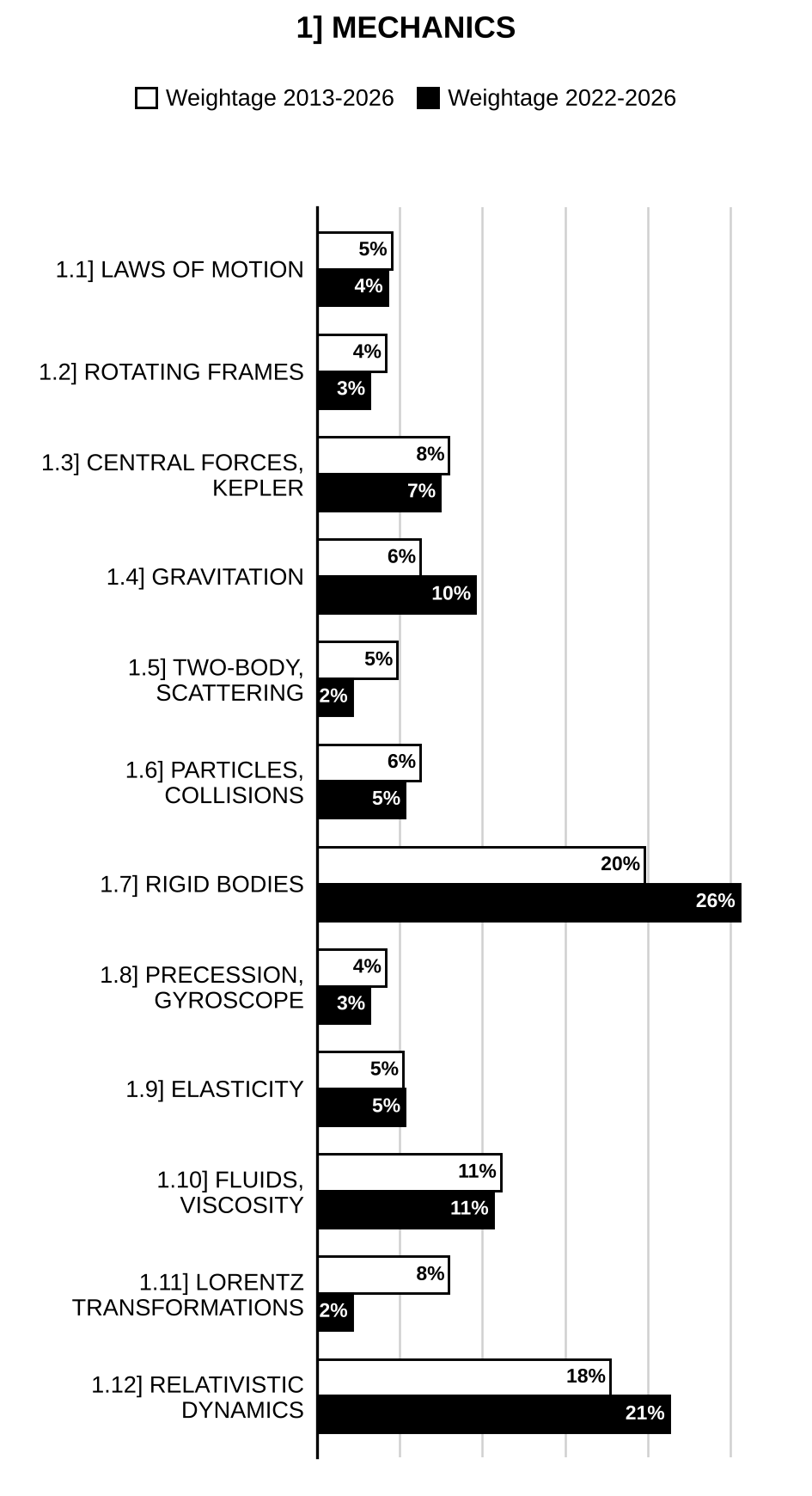
Here are all 234 Mechanics questions asked in UPSC Physics Optional Paper I from 1995 to 2026, arranged under the 12 topics of the official syllabus. Within each topic the latest questions come first.
Each question ends with a code such as [2024/15m/3b] – the year, the marks, the word limit (where UPSC set one) and the question number in the paper.
1.1] Laws of motion and conservation laws
16 questions
A particle of mass kg having an initial velocity is subjected to a retarding force proportional to its instantaneous velocity. Obtain the expression for the velocity and position of the particle as a function of time. [2024/10m/1a]
A force is given by . Determine whether or not the force is conservative. [2023/10m/1a]
A body of mass at rest splits into two masses and by an explosion. After the split the bodies move with a total kinetic energy in opposite direction. Show that their relative speed is . [2021/15m/2a]
Write down precisely the conservation theorems for energy, linear momentum and angular momentum of a particle with their mathematical forms. [2015/10m/1a]
If the forces acting on a particle are conservative, show that the total energy of the particle which is the sum of the kinetic and potential energies is conserved. [2013/20m/2a]
A projectile of mass M explodes, while in flight, into three fragments. One fragment of mass travels in the original direction of the projectile. Another fragment of mass travels in the opposite direction and the third fragment of mass comes to rest. The energy E, released in the explosion, is 5 times the kinetic energy of the projectile at explosion. What are the velocities of the fragments? [2012/15m/4d]
Derive an equation of motion for a variable mass. Explain how it is applied in the motion of a rocket. [2006/20m/1a]
If a single stage rocket fired vertically from rest at the earth’s surface burns its fuel in a time of 30 sec and their relative velocity [?] , what must be the mass ratio for a final velocity υ of ? [2004/20m/2c]
Using the rocket equation and its integral find the final velocity of a single stage rocket. Given that (i) the velocity of the escaping gas is 2500 m/s, (ii) the rate of loss of mass is [?]. (where ) is the initial mass and 0.27 is the final mass). [2002/20m/1a]
How do we infer the law of conservation of linear momentum from Newton’s laws of motion? A stationary bomb explodes and on explosion, it fragments into three parts. Two of these part which are of equal masses fly apart perpendicular to each other with a velocity of 60 m/s each. The third part has a mass four times the other two. Find the magnitude and the direction of the velocity of the third part. [1999/20m/1a]
Consider the motion of a rocket in a gravitational field and derive an expression for its final velocity when the fuel burns at a constant rate till it is fully consumed. [1999/20m/3a]
The two atoms in a molecule of a gas interact according to the potential [?] r being the separation distance between the two atoms. Determine A and B if the potential energy at the equilibrium separation . [1998/20m/1a]
A block A of mass 6 kg is placed on a plane inclined to the horizontal at an angle 30°. It is joined to another block B of mass 18 kg by means of a massless string going round a pulley. B hangs vertically. The pulley can be approximated as a uniform circular disc of mass 2 kg and radius 10 cm. The string from A to the pulley is parallel to the plane. The kinetic friction coefficient is . Calculate the acceleration of B and the tensions in the two segments of the string. [1998/20m/5a]
Motion of rocket. [1997/20m/8b]
The potential energy of a particle is given by Obtain the positions of stable equilibrium. [1995/20m/1b]
A stream of liquid of density and speed v is directed against a plane surface at an angle with the normal to the surface. After striking the surface the liquid spreads over it. Find the pressure on the surface. [1995/20m/2b]
1.2] Rotating frames
11 questions
Consider two frames of reference and having a common origin . The frame is rotating with respect to the fixed frame with a uniform . A projectile of unit mass at position vector is moving with . Calculate in the rotating frame the following forces on the projectile: (i) Euler’s force (ii) Coriolis force (iii) Centrifugal force. [2022/15m/2a]
Derive the expression for Coriolis force and show that this force is perpendicular to the velocity and to the axis of rotation. What is the nature of this force? [2016/10m/1b]
How does one obtain the angular velocity of the Earth about the North Pole with respect to a fixed star as ? Explain your method of calculating the above value. [2015/10m/1c]
Suppose that an S′-frame is rotating with respect to a fixed frame having the same origin. Assume that the angular velocity of the S′-frame is given by where t is time and the position vector of a typical particle at time t as assumed in S′-frame is given by Calculate the Coriolis acceleration at t = 1 second. [2013/10m/1b]
Calculate the horizontal component of the Coriolis force acting on a body of mass 0.1 kg moving northward with a horizontal velocity of at 30° N latitude on the Earth. [2013/15m/2c]
Derive the relation , where is the velocity of a particle located at in a fixed frame of reference S and that as observed in a frame S’ rotating with angular velocity with respect to S but having the common origin. [2007/25m/2a]
Show, using the above relation, that the equation of motion of the particle in S gets modified in S’ giving rise to various fictitious forces. Identify the coriolis force and describe its effect on the flow of rivers. [2007/20m/2b]
For a freely falling body from the height ‘h’ on the surface of the earth in the northern hemisphere with a latitude θ, show that the deviation of the body towards east at the final stage is given by [?], where ω is the angular velocity of the earth and ‘g’ is the acceleration due to gravity. [2004/20m/2b]
Obtain the equation of motion of a particle moving relative to a rotating frame of reference. Explain the term representing coriolis force in this expression. [2001/20m/2b]
Coriolis force and its effects. [1997/20m/8a]
Define Coriolis force. Obtain an expression for the Coriolis force. How does it account for the whirling of winds in opposite directions in Northern and Southern hemispheres? [1996/20m/5d]
1.3] Central forces and Kepler’s laws
25 questions
Consider a particle of mass in two dimensions experiencing a central force , where is a positive constant and is the radius vector of the particle relative to the force center. (i) What is the angular momentum of the particle relative to the force center? Show that is conserved. (ii) Write down the system of equations of motion in two dimensions in polar coordinates. Reduce this system to a one-equation problem and find the equation for the effective potential energy . [2026/15m/4c]
Briefly discuss the Kepler’s laws of planetary motion. [2024/5m/2a(i)]
Two satellites and of same mass are orbiting the Earth at altitudes and , respectively, where is the radius of the Earth. Assuming their orbits to be circular, calculate the ratios of their kinetic and potential energies. [2024/5m/2a(iii)]
An electron is moving under the influence of a point nucleus of atomic number . Show that the orbit of the electron is an ellipse. [2022/10m/1a]
A particle moving in a central force field describes the path , where and are constants. If the mass of the particle is , find the law of force. [2021/10m/1a]
(i) What is a central force? Give two examples of the central force. (ii) Show that the angular momentum () of the particle in a central force field is a constant of motion. [2019/10m/150w/1a]
If a particle of mass m is in a central force field , then show that its path must be a plane curve, where is a unit vector in the direction of position vector . [2018/10m/1a]
Express angular momentum in terms of kinetic, potential and total energy of a satellite of mass m in a circular orbit of radius r. [2017/10m/1a]
A body moving in an inverse square attractive field traverses on elliptical orbit with eccentricity and period . Find the time taken by the body to traverse the half of the orbit that is nearer the centre of force. Explain briefly why a comet spends only 18% of its time on the half of its orbit that is nearer the sun. [2016/10m/2c]
A charged particle is moving under the influence of a point nucleus. Show that the orbit of the particle is an ellipse. Find out the time period of the motion. [2014/15m/4b]
A particle describes a circular orbit under the influence of an attractive central force directed towards a point on the circle. Show that the force varies as the inverse fifth power of distance. [2013/15m/4a]
A particle is moving in a central force field on an orbit given by , where k and are positive constants, r is the radial distance and is the polar angle. Find the force law for the central force field. [2012/20m/3a]
A particle is moving in a central force field on an orbit given by , where k and are positive constants, r is the radial distance and is the polar angle. Find . [2012/20m/3b]
A particle is moving in a central force field on an orbit given by , where k and are positive constants, r is the radial distance and is the polar angle. Find the total energy. [2012/20m/3c]
Prove that the time taken by the earth to travel over half of its orbit separated by the minor axis remote from the sun is two days more than half a year. Given, the period of the earth is 365 days and eccentricity of the orbit = 1/60. [2011/10m/2b]
A planet revolves around the Sun in an elliptic orbit of eccentricity e. If T is the time period of the planet, find the time spent by the planet between the ends of the minor axis close to the Sun. [2010/10m/2b(i)]
Using the Lagrangian for the system of a planet and the Sun obtain the equation of motion. Use them to get the equations for the orbit. [2002/30m/2a]
Determine equation of trajectory for a particle under central force ‘F’, the magnitude of which is given by where A and B are positive constants. [2001/20m/2a]
Neptune’s period of revolution is 165 yr. What is the average radius of Neptune’s orbit in terms of the Sun-Earth distance? [2000/20m/4b]
Write short notes on any three of the following: (i) Geostationary satellites (ii) Applications of Bernoulli’s equation (iii) Thermodynamic potentials (iv) Forced oscillations (v) Carnot cycle (vi) Holography. [1999/60m/8]
Prove that the path of particle moving in a central force field is a plane curve and that the angular momentum of the particle remains constant in time. [1998/20m/6b]
A particle is moving under a central force field. Obtain the equations of motion and prove that in such a field the areal velocity of the particle remains constant. [1997/20m/2a]
Moving in a closed elliptical orbit, Halley’s comet goes round the Sun once every 75 years. At its point of closest approach its distance from the Sun is km. If mass of the Sun is kg. what will be the greatest distance of the comet from the Sun? [1997/20m/3a]
A satellite has apogee and perigee heights above the surface of earth as 4000 km and 640 km respectively. Calculate the eccentricity of the orbit and semi-major axis. Radius of the earth is 6400 km. [1996/20m/1b]
State Kepler’s laws and prove that for elliptical orbits the square of the period of a satellite is proportional to the cube of the semi-major axis. [1995/20m/2c]
1.4] Gravitational field and potential
13 questions
Derive the expression for the gravitational self-energy of a uniform solid sphere of mass M and radius R. [2025/10m/1b]
Show that the escape velocity on the surface of the Earth is given by , where and is the radius of the Earth. [2024/5m/2a(ii)]
Calculate the gravitational self-energy of the Earth. Given: Mass of Earth and the Radius of Earth [2023/10m/1b]
Derive the expressions for gravitational potentials at a point (I) outside the spherical shell, (II) inside the spherical shell. [2023/10m/2a(i)]
Calculate the escape velocity of a body of mass 10 kg from the surface of Moon . Mass of Moon Radius of Moon [2023/10m/2a(ii)]
The radius of the Earth is m, its mean density is and the universal gravitational constant is . Calculate the gravitational potential on the surface of the Earth. [2021/10m/4b]
A rocket starts vertically upward with speed . Then define its speed v at a height h in terms of , h, R (radius of Earth) and g (acceleration due to gravity on Earth’s surface). Also calculate the maximum height attained by a rocket fired with a speed of 90% of the escape velocity. [2020/10m/1a]
Use Gauss’s theorem to calculate the gravitational potential due to a solid sphere at a point outside the sphere. Calculate the amount of work required to send a body of mass m from the Earth’s surface to a height R/2, where R is the radius of the Earth. [2018/15m/2a]
The density inside a solid sphere of radius a is given by , where is the density at the surface and r denotes the distance from the centre. Find the gravitational field due to this sphere at a distance 2a from its centre. [2014/10m/1a]
Two bodies of masses and are placed at a distance d apart. Show that at this position where the gravitational field due to them is zero, the potential is given by [2009/10m/1c]
Consider a spherical shell of mass M and radius R. Calculate the potential due to this shell at a point P when the point is (i) outside the shell and (ii) inside the shell . If the spherical shell is now replaced by a uniform solid sphere of same mass and radius, what will be its potential at the same external point? [2009/15m/2a]
The tides in oceans on Earth are produced by gravitational pull of the Sun and the Moon. The pull due to Sun is much greater than the pull due to Moon. Explain, why tides due to Sun are only about 0.4 times as high as that due to Moon. The mass of the Sun is times the mass of the Moon and the distance between Sun and Earth is 400 times the distance between Moon and Earth. The radius of the Earth is m. [1997/20m/1a]
A satellite is launched into a circular orbit close to the surface of the earth. Find an expression for the additional velocity that has to be imparted to the satellite to overcome the gravitational pull. [1995/20m/1d]
1.5] Two-body problem and scattering
12 questions
Prove that the separation of two colliding particles is same, when observed in centre of mass and laboratory systems. [2023/10m/3b(i)]
Show that the cross-section for elastic scattering of a point particle from an infinitely massive sphere of radius R is . What is the inference of this result? [2019/10m/2c]
Draw a neat diagram to explain the scattering of an incident beam of particles by a centre of force. [2015/10m/3a]
Show that the differential scattering cross-section can be expressed as where s is the impact parameter and is the scattering angle. [2015/15m/3b]
Discuss the problem of scattering of charged particle by a coulomb field. Hence, obtain an expression for Rutherford scattering cross-section. What is the importance of the above expression? [2014/25m/4a]
With an appropriate diagram, show that in the Rutherford scattering, the orbit of the particle is a hyperbola. Obtain an expression for impact parameter. [2011/10m/1a]
Considering the scattering of α-particles by the atomic nuclei, find out the Rutherford scattering cross-section. Explain the physical significance of the final expression. [2005/40m/2a]
Derive the relationship between the impact parameter and the scattering angle for the scattering of an particle of charge +2e by a nucleus of charge +Ze. Calculate the impact parameter for an angle of deflection of 30° if the kinetic energy of the alpha particle is J. [2002/30m/2b]
Define scattering cross-section. A charged particle of mass m and charge is scattered by another charged particle of charge at rest. Deduce the expression for the scattering cross-section. [2001/20m/2c]
Distinguish between elastic and inelastic collision. Find the minimum distance an -particle with kinetic energy of 0.4 Mev can approach a stationary but free Lithium nucleus in a head-on collision. [1999/20m/3b]
A particle of mass moving with a velocity undergoes an elastic collision with a particle of mass at rest, in laboratory-frame. After the collision the first particle moves at a certain angle to the direction of its initial velocity, and this angle is in laboratory-frame and in centre of mass-frame. If the ratio of masses is a, show that and are related as [?]. [1996/20m/2a]
A Particle of mass m, moving with an initial velocity is acted on by a central repulsive inverse-square force, . Show that the scattering angle depends on the impact parameter b as . [1996/20m/3b]
1.6] Systems of particles and collisions
18 questions
Show that the kinetic energy of a system of particles is given by where is the total mass, is the velocity of the centre of mass, is the velocity of the particles about the centre of mass and is the mass of the th particle. [2024/10m/1b]
A particle of mass collides with another particle of mass at rest. The particles and travel at angles and , respectively, with respect to the initial direction of . Derive the expression for the maximum value of . [2022/15m/2b]
Determine the location of the centre of mass of a uniform solid hemisphere of radius R and mass M from the centre of its base. [2020/10m/1b]
A block of mass m having negligible dimension is sliding freely in x-direction with velocity as shown in the diagram. What is its angular momentum about origin O and its angular momentum about the point A on y-axis?
[Figure: Right-handed axes x, y, z with origin O (z axis drawn obliquely towards the viewer). Point A lies on the y-axis at a height l above O (distance l marked between O and A). A small hatched block of mass m sits on the x-axis to the right of O, with an arrow v pointing in the +x direction above it.] [2018/10m/1b]
A rod of length L has non-uniform linear mass density (mass per unit length) , which varies as ; where is a constant and S is the distance from the end marked ‘O’ (as shown in the figure). Find the centre of mass of the rod.
[Figure: A thin rod of length L lying along the axis with its end O at the origin; axes (along the rod, to the right), (vertically up) and (dashed, oblique into the page) drawn from O; the length L is marked below the rod from O to its far end.] [2018/15m/2b]
A ball moving with a speed of 9 m/s strikes an identical stationary ball such that after the collision the direction of each ball makes an angle 30° with the original line of motion. Find the speed of the balls after the collision. Is the kinetic energy conserved in this collision? [2017/15m/4a]
(i) The distance between the centres of the carbon and oxygen atoms in the carbon monoxide (CO) gas molecule is m. Locate the centre of mass of the molecule relative to the carbon atom. (ii) Find the centre of mass of a homogeneous semicircular plate of radius . [2016/10m/1a]
Prove that as a result of an elastic collision of two particles under non-relativistic regime with equal masses, the scattering angle will be 90°. Illustrate your answer with a vector diagram. [2013/5m/2b]
Consider a uniform half-sphere of radius R and mass M. The half-sphere is supported by a frictionless horizontal plane as shown in the figure. The half-sphere lies in the region .
[Figure: Solid hemisphere with its flat circular face horizontal and uppermost (the rim drawn as an ellipse, back half dashed) and its curved surface below. Origin O at the centre of the flat face; the z-axis points vertically upward from O and the y-axis horizontally to the right through O along the flat face; R marks the radius of the flat face. The lowest point of the curved surface rests on a horizontal supporting plane A (drawn as a thick black slab), below the origin on the vertical axis. Legend: “O = Origin”, “A = Supporting plane”.]
Find the centre of mass of the half-sphere. [2012/15m/4b]
What is centre of mass? Show that the total linear momentum of a system of particles about the centre of mass is zero. [2006/10m/2b]
How are linear and angular momenta related to each other? Considering a system of mass points under the influence of forces derived from potentials only, prove that the generalised linear momentum is conserved. Establish further that the angular momentum of the above system is also conserved if the potential is centrally symmetric. [2005/20m/1a]
A block of mass m, attached to an ideal massless spring of force constant k, is at rest on a smooth horizontal floor. A second block of mass 2 m, moving with an initial velocity strikes the free end of the spring. The collision is one dimensional and elastic. (i) Calculate the maximum compression of the spring. (ii) What are the velocities of the block long time after the collision? [2003/20m/1a]
The mass of the Moon is about 0.13 times the mass of the Earth. The distance from the centre of the Moon to the centre of the Earth is 60 times the radius of the Earth. Taking the Earths radius to be 6378 km. find out the distance of the centre of mass of the Earth – Moon system from the centre of the Earth. [2000/20m/1b]
Ram and Shyam are two skaters weighing 40kg and 60 kg respectively. Ram travelling at 4 m/s meets Shyam travelling at 2 m/s in opposite direction and collides head-on. (i) If they remain in contact what is their final velocity? (ii) How much kinetic energy is lost? [2000/20m/5d]
A smooth sphere A of mass m and speed u impinges obliquely on a sphere B of mass M (M > m) at rest. The velocity of A before collision makes an angle with the line of centres at the time of impact. Show that A is deflected through a right angle if e is the coefficient of restitution. [1998/20m/1b]
Show that the angular momentum of a particle located at position relative to the origin of co-ordinates is given by where is the linear momentum of the particle. Using this result prove that the angular momentum of a system of particles can be expressed as the sum of their angular momentum around the centre of mass and the angular momentum around the origin of a single particle of mass equal to the total mass of the system located at the centre of mass. [1998/20m/4b]
In the ammonia molecule the three hydrogen atoms form an equilateral triangle. The distance between the centre of this triangle from each hydrogen atom is 0.939 Å. The nitrogen atom is at the apex of the pyramid with the three hydrogen atoms forming the base. The distance between the hydrogen and nitrogen atoms is 1.014 Å. Find the position of the centre of mass relative to the nitrogen atom. [1997/20m/2c]
The distance between the centres of oxygen and carbon atoms in a carbon monoxide molecule is 1.2 Å. Determine the position of the centre of mass of the molecule relative to carbon. (Assume atomic masses of carbon and oxygen as 12 and 16 respectively.) [1995/20m/5a]

Preparing for Prelims too?
Our UPSC Prelims Topic-wise PYQ eBook covers every Prelims question with detailed explanations, so you can see exactly where UPSC asks from.
View the BookDownload Free Sample1.7] Rigid body dynamics
32 questions
A uniform rod of length and mass stands vertically upright on a rough floor and then tips over. What is the rod’s angular velocity when it hits the floor? [2026/10m/1a]
Consider a large stationary cylinder of inner radius R. A smaller solid cylinder of radius r rolls without slipping inside the larger cylinder. Determine the equation of motion of the smaller cylinder. [2025/10m/1a]
A body moves about a point ‘O’ under no force, the principal moments of inertia at ‘O’ being 3A, 5A and 6A. The components of the initial angular velocity about the principal axes are , and . Find the components , and for large values of time t. [2025/20m/2a]
A cube of mass M and side ‘a’ is rotating with angular velocity around one of its edges, which is, say, along the x-axis. Obtain the expressions for its angular momentum and kinetic energy. (Given that the , and ) [2025/20m/3c]
Show that the angular momentum of a rigid body consisting of particles of masses , , rotating with an instantaneous angular velocity about an axis passing through the origin of the coordinate system is given by , where is known as the inertia tensor. [2024/20m/2b]
The quantities of rotatory motion are analogous to those of translatory motion. Write the corresponding equations of translatory and rotatory motion. [2023/5m/2c(i)]
Describe the theorems of perpendicular and parallel axes in case of a plane lamina. [2023/10m/2c(ii)]
Determine the kinetic energy of a thin disc of mass 0.5 kg and radius 0.2 m rotating with 100 rotations per second around the axis passing through its centre and perpendicular to its plane. [2023/5m/3b(ii)]
A homogeneous right triangular pyramid with the base side and height is shown below. Obtain the moment of inertia tensor of the pyramid:
[Figure: Right-angled tetrahedron (pyramid) with one vertex at the origin O of x, y, z axes; the other three vertices lie on the axes: on the x-axis at distance a from O, on the y-axis at distance a from O, and on the z-axis at height 3a/2 above O. The edges along x and y are labelled a, the vertical edge along z is labelled 3a/2; the base (in the xy-plane) is the right triangle with legs a, a.] [2022/20m/3a]
(i) Define moment of inertia and radius of gyration of a body of mass rotating about an axis. State and prove Parallel Axis theorem on moment of inertia. (ii) A sphere of mass 0.5 kg rolls on a smooth surface without slipping with a constant velocity of 3.0 m/s. Calculate its total kinetic energy. [2021/20m/4a]
Obtain expressions for the moment of inertia of a solid cone about its (i) vertical axis and (ii) axis passing through the vertex and parallel to its base. [2020/20m/2a]
Write down Euler’s dynamical equations of motion (no derivation) of a rigid body about a fixed point under the action of a torque. Show that the kinetic energy of the torque-free motion is constant. [2019/10m/2b]
Define moment of inertia and explain its physical significance. Calculate the moment of inertia of an annular ring about an axis passing through its centre and perpendicular to its plane. [2017/20m/2a]
Four solid spheres , , and , each of mass and radius , are placed with their centres on the four corners of a square of side as shown in the figure below:
[Figure: A square ABCD with A at top-left, B at top-right, C at bottom-right and D at bottom-left; a small sphere (circle) centred at each corner; each of the four sides is labelled b (AB, BC, CD, DA).]
Calculate the moment of inertia of the system about one side of the square. Also calculate the moment of inertia of the system about a diagonal of the square. [2016/20m/2a]
Show that the moment of inertia of a circular disc of mass M and radius R about an axis passing through its centre and perpendicular to its plane is . [2015/15m/2c]
If and I be the Moments of Inertia of a body about an axis passing through an arbitrary origin and about a parallel axis through the centre of mass respectively, show that , where is the position vector of the centre of mass with respect to the arbitrary origin and M is the mass of the body. [2014/10m/1b]
Consider a rigid body rotating about an axis passing through a fixed point in the body with an angular velocity . Determine the kinetic energy of such a rotating body in a coordinate system of principal axis. If the Earth suddenly stops rotating, what will happen to the rotational kinetic energy? Comment in detail. [2014/25m/2a]
A body turns about a fixed point. Show that the angle between its angular velocity vector and its angular momentum vector about a fixed point is always acute. [2014/15m/2b]
Show that the kinetic energy and angular momentum of the torque free motion of a rigid body is constant. [2013/10m/1a]
Calculate the moment of inertia of a solid cone of mass M, height h, vertical half-angle and radius of its base R, about an axis passing through its vertex and parallel to its base. [2012/12m/1c]
A rigid body is spinning with an angular velocity of about an axis parallel to the direction passing through the point A with , where O is the origin of the coordinate system. Find the magnitude and direction of the linear velocity of the body at point P with . [2012/12m/1e]
Imagine that a rigid body is rotating about a fixed point with angular velocity . Assuming that the coordinate axes coincide with the principal axes, if T stands for kinetic energy and G for external torque acting on the body, show that [2011/10m/1b]
Determine the number of degrees of freedom for a rigid body– (i) moving freely in space of three dimensions; (ii) having one point fixed; (iii) having two points fixed. [2011/30m/2a]
A uniform solid sphere of radius R having moment of inertia I about its diameter is melted to form a uniform disc of thickness t and radius r. The moment of inertia of the disc about an axis passing through its edge and perpendicular to the plane is also equal to I. Show that the radius r of the disc is given by . [2010/10m/1a]
Show that for any rigid body consisting of at least three particles, not arranged in one straight line, number of independent degrees of freedom is six. Define Euler’s angles , and to describe the configuration of such a rigid body. Consider two frames of reference, one fixed to the body and the other to the space defined as and respectively. Show that the angular momentum of the rigid body in the two frames are related by where is the angular velocity of rotation. [2009/30m/2b]
The angular momentum of a rigid body comprising of N particles and rotating with angular velocity is given by: where the origin coincides with the centre of mass. Express the components of in terms of components of the inertia tensor. Hence, show that the most general free rotation of a spherical top is a uniform rotation about an axis fixed in space. [2007/15m/2c]
Derive Euler’s equations of motion for a rigid body rotating about a fixed point under the action of a torque. When a rigid body is not subjected to any net torque, write down Euler’s equations of motion of the body with one point fixed. [2006/25m/2c]
What do you mean by the moments and products of inertia? Show that the angular momentum vector is related to the angular velocity components by linear transformation relations. [2004/20m/2a]
Write the Euler’s equations for the rotational motion of a rigid body with one point fixed, under the action of torque N. Apply these equations to discuss the rotational motion of a symmetrical top in the absence of any force other than the reaction at the fixed point. [2003/30m/2a]
A star of the size of our sun having a radius of km and having a mass 2 times as that of the sun is rotating at a speed of one revolution every 10 days. If the star undergoes a gravitational collapse to a neutron star of radius 10 kms, assuming that the star is a uniform sphere at all times, calculate the rotation speed of the neutron star. The moment of inertia of solid about its diameter is where M and R are the mass and radius of the solid sphere respectively. [2001/20m/1b]
Show that the combined effects of translation of the centre of mass and rotation about an axis through the centre of mass are equivalent to a pure rotation with the same angular speed about an axis through the point of contact of a rolling body. [2000/20m/5b]
Starting from the definition of angular momentum of a single particle, obtain an expression for the angular momentum of a rotating rigid body. Hence, discuss the time derivative of the angular momentum and deduce the law of conservation of momentum. [1999/20m/2b]
1.8] Molecular rotations, precession, top and gyroscope
13 questions
Consider a symmetric top of mass , with its tip held fixed, rotating in a gravitational field. Assuming that the origins of the fixed and body coordinate systems coincide, determine the Lagrangian of the top. Are there any angular momenta which are conserved? If yes, find their expressions. [2026/15m/2c]
(i) Find the moments of inertia of rigid diatomic molecule about different axes of symmetry through the centre of mass. (ii) A proton is 1837 times heavier than an electron. Find the centre of mass of hydrogen atom. [2019/15m/2a]
Where do you find the applications of gyroscope? A top of mass 0.200 kg is made up of a thin disc of radius 0.12 m. It is pierced in the centre and a pin of negligible mass is mounted normal to its plane. The pivot under the disc is 0.03 m long. The top is made to spin with its axis making an angle with the vertical and a precessional angular speed of 2 rad/s. Calculate the angular speed with which it spins. [2019/15m/4c]
A diatomic molecule can be considered to be made up of two masses and separated by a fixed distance r. Derive a formula for the distance of centre of mass, C, from mass . Also show that the moment of inertia about an axis through C and perpendicular to r is , where . [2017/15m/2b]
What are Eulerian angles? A body with rotational symmetry about an axis is rotating under gravity about a point on the axis without friction. What are the quantities remaining constant during the motion? Find them in terms of suitable Eulerian angles. Explain ‘precession’ and ‘nutation’ of such a body. [2010/25m/2a]
Write the Euler’s equations for the rotational motion of a rigid body with one point fixed, under the action of torque N. Apply these equations to discuss the rotational motion of a symmetrical top in the absence of any force other than the reaction at the fixed point. [2003/30m/2a]
An aeroplane makes a complete half circle of 50 m radius towards left when flying at 200 km / hour. The rotary engine and the propeller of the plane weigh 400 kg having a radius of gyration of 30 cm. The engine rotates at 2400 rpm clockwise viewing from the rear. Find the gyroscopic couple on the aircraft. [2000/20m/2b]
A top is spinning about its axis of symmetry. If its spin angular momentum is large compared to the change caused by the applied torque the top precesses. If it is not spinning, the top would tip over Show what happens in between, when the top spins slowly. Derive an approximate expression for the angular speed of the precessional motion. [2000/20m/3b]
Explain the precession of a spinning top and show that precessional angular velocity is independent of the angle of inclination. A top is spinning with 20 rev/s about an axis inclined at 30° with the vertical. Its radius of gyration is 5 cm. The centre of mass is cm from the pivot point. Calculate the frequency of precession. [1999/20m/2a]
Gyroscope. [1998/20m/8a]
Explain precessional motion of a top. A solid sphere of radius 2 cm and mass 50 gm has a thin nail of length 5 mm fixed perpendicular to its surface. When this sphere spins like a top with a speed of 20 rev./second, what will be its precessional speed? [1997/20m/2b]
What are precession and nutation? Show that the angular velocity of precession is related to the angular momentum and external torque as Assume . [1995/20m/3b]
Gyroscope. [1995/20m/8e]
1.9] Elasticity
6 questions
A solid shaft of mass M, length and radius r is to be replaced by a lighter hollow shaft of the same length and having the same ratings of , where is the couple and is the angle of twist. Estimate the percentage reduction in mass of the hollow shaft if the outer radius of the shaft is twice the inner radius. Assume the material of the new shaft is same as that of the replaced shaft. [2025/15m/4c]
State and explain the Hooke’s law of elasticity. Briefly discuss the features of stress-strain diagram for the behaviour of a wire undergoing increasing stress. [2024/10m/3c(i)]
A light rod of length 100 cm is suspended from the ceiling, horizontally by means of two vertical wires of equal length tied to its ends. One of the wires is made of steel and its cross-section is 0.05 sq. cm and the other is of brass of cross-section 0.1 sq. cm. Find the position along the rod at which a weight may be hung to produce (i) Equal stresses in both the wires, (ii) Equal strain in both the wires. Young’s modulus of elasticity of brass and steel are and respectively. [2021/15m/2b]
A rubber cord 1 mm in diameter and 1 m long is fixed at one end and a weight of 1 kg is attached to the other end. If the Young’s modulus of rubber is , then find the period of the vertical oscillations of the weight. [2020/10m/1c]
A shaft of diameter 8 cm and length 5 m is transmitting power of 8 kW at 300 revolutions per minute. If the coefficient of rigidity of the material of the shaft be , then calculate the relative shift between the ends of the shaft. [2020/15m/2b]
Show that the Young’s modulus , modulus of rigidity and Poisson’s ratio are related by the equation . [2016/10m/1c]
1.10] Fluid flow and viscosity
25 questions
A cardiologist reports to her patient that the radius of the left anterior descending artery of the heart has narrowed by 10%. What percent increase in the blood pressure is required to maintain the normal blood flow through this artery? Assume that the viscosity of the blood and the length of the artery remain unchanged. [2026/10m/1b]
Explain the Poiseuille’s equation for the rate of flow of a liquid through a capillary tube. From this, show that if two capillary tubes of radii and having lengths and , respectively, are connected in series, the rate of flow of the liquid is given by where is the pressure across the arrangement and is the coefficient of viscosity of the liquid. [2024/10m/3c(ii)]
Define streamline flow of a fluid. Using the equation of continuity for an isotropic fluid, find different components of total energy per unit volume. [2023/15m/4b]
Consider the diagram below with a water flow rate . Derive the expression for in terms of the difference in the manometer heights and the cross-section areas and :
[Figure: Venturi meter: a horizontal pipe of cross-section (labelled on the inlet and outlet sides) narrows smoothly to a throat of cross-section and widens back to ; water flows from left to right with flow rate entering at the left and leaving at the right. A vertical manometer tube rises from the wide section () and another from the throat (); the water column in the tube on the wide section stands higher than that in the throat tube by .] [2022/15m/4a]
A capillary tube having 1.0 mm diameter, 20 cm in length is fitted horizontally to a vessel in which alcohol is kept fully up to the neck. Density of alcohol is . The depth of the centre of the capillary tube below the surface of alcohol is 40 cm. Find the amount of alcohol that will flow out of the capillary tube in 10 minutes. Coefficient of viscosity of alcohol is . [2021/10m/1b]
(i) How does Reynolds number help in the study of fluid motion? (ii) In a horizontal pipeline of uniform area of cross-section, the pressure falls by between two points separated by a distance of 1 km. Calculate the change in kinetic energy per kg of oil flowing at these points. Density of oil . [2019/10m/150w/1b]
Two capillary tubes of lengths and with internal radii r and 2r respectively are connected in series. Water flows through them in streamline. If the pressure difference across the first capillary is P, find the pressure difference across the second one. [2018/10m/2c]
A water drop of radius 0.04 mm is falling through air. If the coefficient of viscosity for air is poise, find its terminal velocity. If 100 such drops coalesce, what will be the new terminal velocity? [2018/10m/2d]
State and explain Stokes’ law. A drop of water of radius 0.01 m is falling through a medium whose density is 1.21 kg/m³ and . Find the terminal velocity of the drop of water. [2017/15m/2c]
A horizontal pipe of non-uniform bore has water flowing through it such that the velocity of flow is 40 cm/s at a point where the pressure is 2 cm of mercury column. What is the pressure at a point where the velocity of flow is 60 cm/s? (Take, and density of water = 1 g/c.c.) [2016/10m/4a]
Using Poiseuille’s formula, show that the volume of a liquid of viscosity coefficient passing per second through a series of two capillary tubes of lengths and having radii and is obtained as where p is the effective pressure difference across the series. [2015/15m/2b]
Define coefficients of viscosity and kinematic viscosity of a fluid. What are Poise and Stokes? [2015/10m/4a]
Write down Poiseuille’s formula and mention its limitations in analyzing the flow of a liquid through a capillary tube. [2015/10m/4b]
A sphere of radius R moves with velocity in an incompressible, non-viscous ideal fluid. Calculate the pressure distribution over the surface of the sphere. Do you think that a force is necessary to keep the sphere in uniform motion? [2014/10m/1c]
With an appropriate diagram, deduce the velocity profile for streamline flow of a liquid through a capillary of circular cross-section. Deduce also the fraction of liquid which flows through the section up to a distance from the axis, where a is the radius of the capillary. [2011/20m/2c]
When a sphere of radius r falls down a homogeneous viscous fluid of unlimited extent with the terminal velocity , the retarding viscous force acting on the sphere depends on the coefficient of viscosity , the radius r and its velocity . Show how Stokes’ law was arrived at connecting these quantities from the dimensional considerations. [2010/10m/2b(ii)]
Show that the total energy per unit mass of liquid flowing from one point to another without any friction remains constant throughout the displacement. [2009/10m/1a]
Obtain Poiseuille’s equation for a viscous fluid flowing through a narrow tube of radius r and length l. If a spherical body of radius a is allowed to move at a speed through the same fluid of viscosity , show that the viscous force will increase with the speed linearly. [2009/15m/2c]
Using Bernaulli’s principle indicate how to compute the thrust on a rocket produced by the escape of its exhaust gases. [2000/20m/2a]
Discuss the Reynolds number for describing the stability of fluid flow, Air streams horizontally across an aeroplane wing of area and weighing 300 kg. The air speed is 60 m/s and 40 m/s over the top surface and under the bottom surface respectively. Find (i) the lift on the wing and (ii) the net force on it, given that the density of air is equal to . [1999/20m/4c]
A steel ball 1.00 mm in diameter at constant speed of in a large vessel filled with oil. Calculate the dynamic viscosity of oil. Given density of steel = and that of oil = . Deduce the mathematical relation needed for the calculation. [1998/20m/3c]
Distinguish between streamline and turbulent motion. Define Reynolds number. When a sphere of radius 1.2 mm moves in glycerine, the laminar flow observed if the velocity of sphere does not exceed . At what minimum velocity of sphere of radius 5.5 cm will the flow in water become turbulent? The viscosities of glycerine and water are 13.9 P and 0.011 P respectively. The density of glycerine is . [1997/20m/5a]
A spherical body of mass ‘m’ and radius ‘a’ is falling through a viscous fluid. If it started from rest and is coefficient of viscosity of the fluid obtain an expression for its velocity as function of time. What is meant by relaxation time? On what factors will it depend in this case? [1996/20m/2b]
State Bernoulli’s theorem. A horizontal pipe has a cross-section of 10 in one region and 5 in another. The pressure of water in the two regions is and respectively. Calculate the amount of water flowing through the pipe per minute. [1996/20m/7b]
Distinguish between stream-line motion and turbulent motion. Hence define Reynold’s number. A sphere of radius 0.1 cm moves through glycerine. A laminar flow is observed when the velocity of the sphere does not exceed 15 cm/s. At what minimum velocity of a sphere of radius 5 cm will the flow in water become turbulent? Viscosity coefficient for glycerine p and for water p, and density of glycerine = 1.2 gm/cc. [1995/20m/2a]
1.11] Michelson-Morley experiment and Lorentz transformations
26 questions
What are the consequences of Lorentz transformations on length and time when observed from a frame moving at relativistic velocities? [2023/10m/1c]
An observer detects two explosions, one that occurs near him at a certain time and another that occurs 2.0 ms later 100 km away. Another observer finds that the two explosions occur at the same place. What time interval separates the explosions to the second observer? [2021/10m/1c]
What do you understand by length contraction? Calculate the percentage length contraction of a rod moving with a velocity 0.8 c in a direction inclined at 60° with respect to its own length. [2020/15m/2c]
(i) A reference frame S′ moves with respect to rest frame S with a uniform velocity ‘v’ parallel to x-direction. Show from Lorentz transformation that two events simultaneous () at different positions () in S frame are not in general simultaneous in S′ frame. (ii) The mean life of meson is s. Calculate the mean life of a meson moving with a velocity of 0.8 c, where c is the velocity of light. [2019/15m/2d]
A rod of length is kept at rest in plane of its rest frame making an angle with axis. What is the length and orientation of the rod in a laboratory frame (x, y) in which the rod moves to the right with velocity v?
[Figure: Laboratory axes x (horizontal) and y (vertical) from the lab origin. A primed frame has dashed axes: y′ (vertical, dashed, with arrow) standing on the x-axis to the right of the y-axis, and x′ (dashed, with arrow) running along the x-axis from the foot of y′. Point A lies on the x′/x axis to the right of the y′ axis. A rod AB rises from A to the upper right, making angle with the x′ axis; B is the upper end; its length is marked by a double-headed arrow alongside the rod.] [2018/15m/4a]
Describe Michelson-Morley experiment and show how the negative results obtained from this experiment were interpreted. [2017/10m/1b]
Prove that is invariant under Lorentz transformation. [2017/10m/4b]
Calculate the percentage contraction in the length of a rod in a frame of reference, moving with velocity in a direction (i) parallel to its length and (ii) at an angle of 30° with its length. What is the orientation of the rod in the moving frame of reference in case (ii)? [2016/20m/2b]
Derive the relativistic length contraction using Lorentz transformation. [2013/10m/2d]
A spaceship measures 50 m in length on ground and it measured a length of 49.7 m in space as observed from the ground. Find out the speed of the spaceship. [2011/10m/1c]
What is the significance of the null result of Michelson-Morley experiment? Does it disprove the existence of ether? Justify. [2010/10m/1c]
Show that a four-dimensional volume element is invariant to Lorentz transformation. [2009/10m/1d]
State the postulates of the special theory of relativity and based on these obtain Lorentz as well as inverse Lorentz transformations. Hence, obtain an expression to conclude that a moving clock runs more slowly than a stationary clock. [2007/35m/3a]
An unstable particle has a lifetime of 5 μs [?] in its own frame of reference and is moving towards the earth at a speed of 0.8 C. What will be the lifetime of the particle to an observer on the earth? [2007/10m/3b]
Prove that two successive Lorentz transformations are equivalent to another Lorentz transformation. Hence write down the Einstein’s velocity addition relation. [2006/20m/1b]
Show that the length L of an object moving with a velocity is given in the direction of motion by where is the proper length and c is the velocity of light in free space. What will be the shape of a spherical ball while moving under relativistic regime? [2005/20m/3a]
An observer A sees two events at the same space point () and separated in time by s. Another observer B sees them to be separated by s. What is the separation in space of the two events as observed by B? What is the speed of B relative to A? [2002/20m/3c]
The mass of muon at rest is 207 where is the electron rest mass (0.511 MeV). The mean life time at rest for muon is 2.2 μs. The life time of muon emerging from an accelerator is measured in the laboratory as 6.9 μs. Estimate the speed of these muons in the laboratory. [2001/20m/1c]
A person in a spaceship is holding a rod of length of 0.5 m, the space ship is cruising at a speed V parallel to the earths surface. What does the person in the space ship notice as the rod is rotated from parallel to perpendicular to the space ships motion? What does an observer on earth’s surface notice? [2001/20m/3a]
What is ‘Lorentz Contraction’? A spaceship of rest length 100 mm takes 4 μs to pass an observer on Earth. What is its velocity relative to the Earth? [2000/20m/1a]
Prove that the expression is invariant under Lorentz transformation. [1999/20m/1d]
Describe the set-up of Michelson-Morley experiment. Why was a fringe shift expected in it? How are its negative results understood? [1999/20m/6c]
A meson travels towards the earth’s surface from high up in atmosphere with a speed of 0.99 C. It decays after travelling a distance of 6 km. In what time does the meson decay as measured by observers in reference frames (i) bound to the earth and (ii) bound to the meson itself. [1998/20m/5d]
The coordinates of an event in an inertial frame S are . What will be the coordinates of this event in another inertial frames S′ moving with a velocity 0.6 c in + x-direction with respect to S. The origins of the two frames were coincident at [1996/20m/5a]
The density of gold in its proper frame of reference is [?]. Determine its density in a frame of reference where its velocity is 0.9c. c is velocity of light in free space. [1995/20m/7b]
Michelson-Morley experiment. [1995/20m/8b]
1.12] Relativistic kinematics and dynamics
37 questions
The energy of a photon is expressed as , where is the Planck’s constant and is the frequency of the photon. The momentum of the photon is , where is the speed of light. Show that if a photon scatters from a free electron (of mass ), the scattered photon has energy where is the angle through which the photon scatters. Also, show that the electron acquires a kinetic energy [2026/20m/3a]
A pion at rest decays into a muon and a neutrino (see the figure):
[Figure: Before: the pion shown as a dot at rest. After: two dots moving apart in opposite directions – the muon with an arrow pointing upward (slightly to the left) and the neutrino with an arrow pointing downward (slightly to the right). No numerical values are shown.]
Find the velocity of the muon. [2026/15m/3b]
A particle of rest mass 1 kg and velocity of magnitude collides with a particle of mass 2 kg at rest. After collision the two particles coalesce and form a single particle of mass M and velocity V. Determine M and V. [2025/10m/1c]
A charged -meson with rest mass of at rest decays into a neutrino and a -meson of rest mass . Find the kinetic energy of the -meson and the energy of the neutrino. ( is the rest mass of the electron) [2024/10m/1c]
Consider three inertial frames of reference , and . Let move with a velocity with respect to and move with a velocity with respect to . Both velocities are in the same direction. Write down the transformation equations relating with and also those relating with . Hence obtain the relations between and . (The direction of velocity is chosen along the -axis as per convention) [2024/15m/4c(i)]
A galaxy in the constellation Ursa Major is receding from the Earth at 15000 km/s. If one of the characteristic wavelengths of light emitted by the galaxy is 550 nm, what is the corresponding wavelength measured by astronomers on the Earth? [2024/5m/4c(ii)]
Show that for very small velocity, the equation for kinetic energy, becomes , where notations have their usual meanings. [2022/10m/1d]
Two spaceships approach each other, both moving with same speed as measured by a stationary observer on the Earth. Their relative speed is . Determine the velocity of each spaceship as measured by the stationary observer on the Earth. [2022/15m/4c]
(i) Calculate the mass and momentum of a proton of rest mass kg moving with a velocity of , where is the velocity of light. If it collides and sticks to a stationary nucleus of mass kg, find the velocity of the resultant particle. (ii) Calculate the mass of the particle whose kinetic energy is half of its total energy. Find the velocity with which the particle is travelling. [2021/15m/3c]
Derive the relativistic expression for kinetic energy by considering mass variation with velocity. Hence, establish the relation between momentum (p) and energy (E) for a relativistic particle; . [2020/20m/4a]
Two -particles A and B emitted by a radioactive source R travel in opposite directions, each with a velocity of 0.9 c with respect to the source. Find the velocity of B with respect to A (Here c is the velocity of light). [2019/15m/4a]
A star is receding with a speed of 3000 km/s and emitting spectral line of hydrogen, of wavelength 656.1 nm. What would be the wavelength observed by an observer on the Earth? [2018/10m/5c]
Given a proton for which measured in the laboratory. What are the corresponding relativistic energy and momentum? Take, g. [2016/10m/4b]
Prove mathematically that the addition of any velocity of a particle to the velocity of light in free space merely reproduces the velocity of light in free space only. [2015/10m/1b]
Show that the rest mass energy of an electron is 0.51 MeV (use the standard values of the physical parameters). [2015/10m/3c]
A mirror is moving through vacuum with a relativistic speed v in the x-direction. A beam of light with frequency is normally incident (from ) on the mirror. (i) What is the frequency of the reflected light expressed in terms of , c and v? (ii) What is the energy of each reflected photon? [2014/25m/3a]
In question 3(a), if the average energy flux of the incident beam is (watts/m²), what is the average energy flux of the reflected beam? [2014/15m/3b]
Show that a particle of rest mass , total energy E and linear momentum satisfies the relation where c is the velocity of light in free space. [2013/10m/1c]
A particle of rest mass kg, disintegrates into two particles of rest masses kg and kg. Show that the energies and of these two parts after disintegration satisfy the condition while moving in opposite directions with equal linear momenta. Give necessary mathematical derivation. [2013/15m/4b]
Two identical relativistic particles of rest mass m and kinetic energy T collide head-on. What is the relative kinetic energy, i.e., the kinetic energy of one in the rest frame of the other? [2012/12m/1a]
If a photon of frequency collides with an electron of mass at rest, it will be scattered at some angle with a new frequency . Show that the change in wavelength is related to the scattering angle by the formula where is known as the Compton wavelength. [2010/20m/3a]
Obtain the relativistic equation for aberration of light using velocity transformation equations. [2009/20m/3c]
A body of rest mass is moving in the positive direction at a velocity of 0.6 C relative to the laboratory frame. Calculate the components of the four dimensional momentum vector in the laboratory frame and in the frame of an observer who is travelling in the positive x-direction at a speed of 0.8 C relative to the laboratory frame. [2007/20m/1c]
Prove that two successive Lorentz transformations are equivalent to another Lorentz transformation. Hence write down the Einstein’s velocity addition relation. [2006/20m/1b]
The source S′ moves along the x′-axis at a speed v, and emits light at an angle θ′ to the x′-axis of its own frame. In the S-frame the emitting angle with the x-axis is θ. Here x and x′-axes are coincident. Show that the exact relativistic aberration formula can be derived from the velocity transformation relations. [2006/25m/3a]
Show that the mass–energy relationship in relativistic kinematics can lead to the equation where E is the total energy of the particle of rest mass , linear momentum p and moving with a velocity ; c is the velocity of light in free space. [2005/20m/1b]
A meson of rest mass π comes to rest and disintegrates to a muon of rest mass μ and a neutrino of zero rest mass. Show that the kinetic energy of motion of the muon is [2004/20m/1b]
Write down the expression for the relativistic mass of a particle moving with a velocity υ in terms of its rest mass? Establish from the above expression Einstein’s mass-energy relation . [2004/20m/3a]
An observer sees two bodies A and B having equal rest mass approach each other with equal but opposite velocities 4c/5. To a second observer , the body A is at rest. What is the velocity of the body B as seen by observer ? What are the kinetic energies of the body B in the frames of and ? [2003/20m/1b]
How does Doppler effect of light of relativistic physics qualitatively differ from its non-relativistic analogue? Calculate the Doppler shift in the frequency of a photon travelling along the y-axis. with respect to an observer moving along the x-axis with a constant speed v. [2003/20m/3b]
Two spaceships are moving at a velocity of 0.9 c relative to the Earth in opposite directions. What is the speed of one spaceship relative to the other? (c = velocity of light) [2002/20m/1b]
Derive an expression for the mass-energy equivalence using the principle of special relativity. [2000/20m/4a]
How is an electron volt connected to other units of energy like the Joule or the erg? Determine the speed of an electron of energy 1.3 Mev assuming its rest energy to be 0.5 Mev. [1998/20m/7c]
Obtain the relativistic transformation relation for density in inertial frames. Why is the equivalent energy corresponding to 1 amu of mass? [1997/20m/7a]
Mass-energy equivalence. [1996/20m/8d]
Determine the speed of an electron which has kinetic energy 1 MeV. The energy equivalent to the rest mass of an electron is 0.51 MeV. [1995/20m/1a]
In the relativistic region, compare the relative increase in velocity with the relative increase in energy of a particle. [1995/20m/5b]

Strengthen your GS papers
Our UPSC Mains Topic-wise & Year-wise PYQ eBook (2013–2026) maps every GS question to the syllabus, so you know what UPSC asks and how often.
View the BookDownload Free SampleNext: Waves and Optics »
Back to: Physics Optional PYQs – Topic-wise
Last updated: 30 October 2026