
Here are all 120 Electromagnetic Waves and Blackbody Radiation questions asked in UPSC Physics Optional Paper I from 1995 to 2026, arranged under the 5 topics of the official syllabus. Within each topic the latest questions come first.
Each question ends with a code such as [2024/15m/3b] – the year, the marks, the word limit (where UPSC set one) and the question number in the paper.
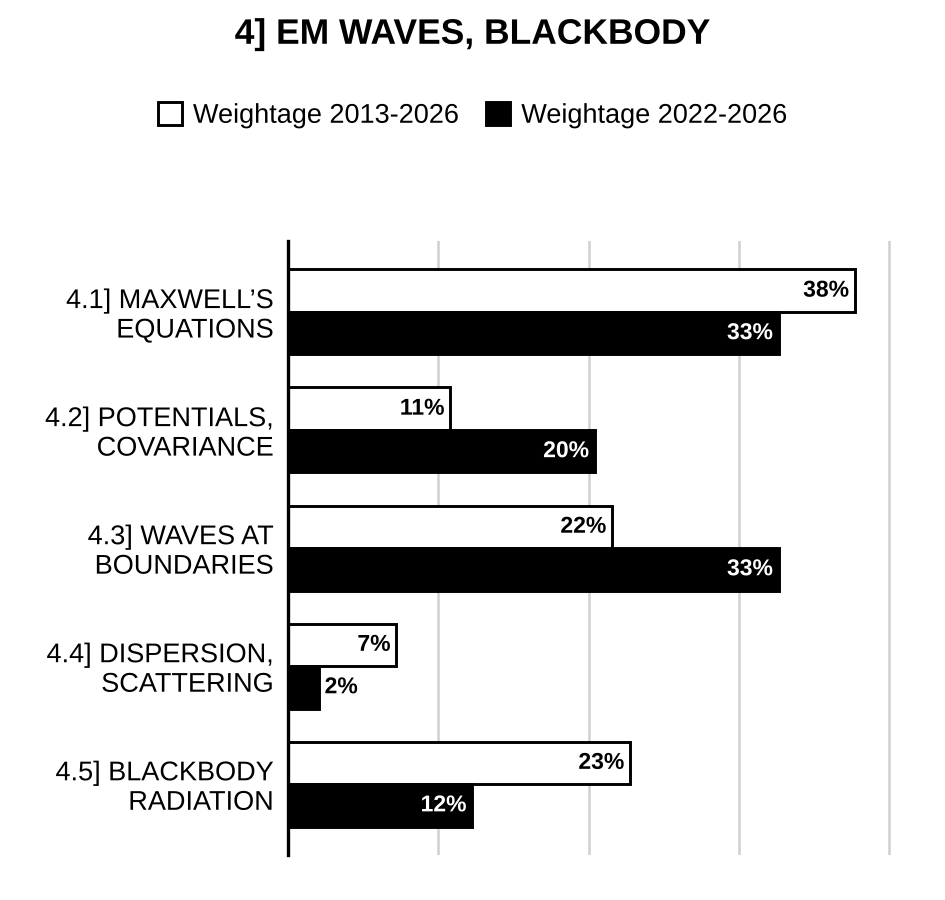
4.1] Maxwell’s equations and EM waves
52 questions
The magnetic field of an electromagnetic wave travels in the direction in free space with a phase shift constant of 30 rad/m and an amplitude of A/m. If the field has the direction when and , write the suitable expressions for and . Determine the frequency and wavelength of the wave. [2026/15m/8b]
A light beam of wavelength 600 nm produced by a 20 mW laser source is incident on a plane mirror. Determine: (i) number of photons per second striking the surface of the mirror. (ii) force exerted by the light beam on the mirror. [2025/10m/1e]
A parallel plate capacitor having circular plates of radius 10 cm is being charged. If the electric field at any instant within the capacitor changes at the rate , calculate the magnetic intensity inside the capacitor. [2025/10m/5d]
In free space, an electric field () is given by the following expression: Find the angular frequency and the displacement current. [2025/10m/8a(i)]
An electromagnetic wave has its magnetic field T. Determine the magnitude of the Poynting vector. [2025/5m/8a(ii)]
Show that Continuity equation is embedded in Maxwell’s equations. [2023/10m/5c]
In a partially conducting medium, , and . Find , , and the velocity , for a frequency of Hz. Determine . Given, . [2022/20m/8a]
Calculate the skin depth of electromagnetic waves of 1 MHz incident on a good conductor having . Assume that inside the conductor . [2021/10m/7b]
For the electric field given by , show that the conduction current is in phase with the electric field, while the displacement current leads the electric field by radians. Also, show that the displacement current in a good conductor is negligible compared to the conduction current at any frequency lower than the optical frequencies (). [2020/10m/5b]
For free space show that electromagnetic (EM) wave is transverse in nature. Show that for free space, the total outward flux of EM energy through surface S bounding volume V is equal to the rate of loss of EM energy from the volume V. A laser beam of 2 mm diameter has average power of 20 GW. Calculate the peak values of electric and magnetic fields in the laser beam. [2020/20m/6c]
Write Maxwell’s equations in free space in both differential and integral forms. Obtain wave equations and show that electromagnetic waves can travel in free space with a speed of light. Can one get the wave equations from the integral form of the Maxwell’s equations? [2020/15m/8b]
Find the values of E and H on the surface of a wire carrying a current. By computing the Poynting vector, show that it represents a flow of energy into the wire. [2019/20m/6c]
Write down Maxwell’s equations in integral form. Explain the significance of each of these equations. [2018/5m/6c(i)]
A parallel plate capacitor has plate area = 4.0 cm² and plate separation = 2.0 mm. An a.c. voltage volts is applied across the plates. If the dielectric constant of the medium between the plates is , calculate the displacement current. [2018/5m/6c(ii)]
Write down the physical significance of Maxwell’s equations and explain the concept of displacement current by using a proper example. [2017/10m/7c]
In free space, the electric field of electromagnetic wave is given as . Find the average power crossing a circular area of radius one metre in the -plane. [2016/10m/5b]
Write down Maxwell’s equations for linear dielectrics and deduce the equation of continuity. [2016/10m/6c]
State and prove Poynting’s theorem. [2016/20m/6d]
Show that the displacement current between the plates of a parallel-plate capacitor is equal to the conduction current across the conductor. [2016/10m/7b]
A parallel-plate capacitor is connected to a 240 V AC supply having angular frequency of 300 rad/s. Find the r.m.s. value of the conduction current in the circuit. What is the displacement current between the plates of the capacitor? Given, pF. [2016/10m/7c]
Derive the equation that represents Poynting’s theorem. What is its physical significance? [2015/20m/6a]
A radio station transmits electromagnetic waves isotropically with an average power of 200 kW. Determine the average magnitude of the maximum electric field at a distance of 5 km from it. [2015/15m/6b]
Starting from Maxwell’s equation, obtain the wave equation for the electric field in free space and appropriate wave equation for the electric field . [2014/10m/5e]
Using Ampere’s Law and continuity equation, show that the divergence of the total current density is zero. [2014/15m/6c]
The electric field of a plane e.m. wave travelling along the z-axis is Determine the magnetic field. [2013/10m/5e]
For a uniform wire of length L and radius a having a potential difference V between the ends and a current I along it, calculate the energy per unit time delivered to the wire by Poynting vector. [2013/10m/7b]
What is a displacement current? Prove that lines of conduction current plus displacement current are continuous. [2012/15m/4a]
Consider Maxwell’s equation in differential form in media. For , assume and and show that the relevant wave equation for a plane wave propagating along x-direction is where and . [2011/10m/5f]
Justify which of the four Maxwell’s equations imply that there are no magnetic monopoles. How these equations would have been written if they were? [2011/15m/7b]
Explain the term ‘Poynting vector’ and state the significance of Poynting theorem. [2010/20m/7b]
Calculate the skin depth for radio waves in free space of wavelength 3 m in copper, given that electrical conductivity for copper is . [2010/20m/7c]
In a non-charged current-free dielectric, and . Show that in this medium, electric and magnetic fields satisfy three-dimensional wave equations Using Poynting theorem of electromagnetic theory, describe the significance of the vector and the scalar [2009/20m/7b]
Write Ampere’s circuital law, and obtain a generalised form of this law, for non-stationary case. [2006/20m/6c]
Starting from Maxwell’s equations of electromagnetic field in vacuum obtain the classical wave equations for the four field vectors , , and . Show that the field vectors can be propagated as waves in free space with the velocity of propagation equal to m/s, where for free space we have the vacuum permittivity farad/m & vaccum permeability henry/m. [2006/20m/7a]
Show that the electric and magnetic field vectors, and , in plane electromagnetic waves are mutually perpendicular in a plane normal to the direction of propagation. How are phases of and related to each other? [2005/20m/5b]
Write down the macroscopic form of the Maxwell’s equations in any isotropic (but inhomogeneous) medium and define the symbols appearing therein. Convert these equations in the integral forms to highlight the laws represented by these equations. [2005/25m/7a]
Describe physical significance of the displacement current considering the example of current flow through a capacitor. [2005/15m/7b]
Show that the Poynting vector represents the energy flow per unit area per unit time both in magnitude and direction in case of a plane electromagnetic wave. [2004/20m/7c]
Define Poynting vector and explain its significance. The electric field vector for an electromagnetic field travelling in vacuum is given by Calculate the Poynting vector for the wave and show that its magnitude is equal to the energy density of the wave time the velocity of light. [2003/20m/6b]
Why did Maxwell have to introduce the idea of displacement current? Derive the wave equation from Maxwell’s laws. Obtain Fresnel’s formula for reflection and transmission coefficients of the electric vector when it is perpendicular to the plane of incidence. [2002/30m/7a]
Derive the energy continuity equation for electromagnetic waves using the poynting vector. [2001/20m/7b]
The introduction of the displacement current is one of the major contributions of Maxwell. Discuss. [2000/10m/3a]
Using Maxwell’s equations, derive the electromagnetic wave equations for a conducting medium and solve it. [2000/40m/3b]
What is the limiting case of a metallic conductor in the above case? Explain. [2000/10m/3c]
The electric field vector of a plane electromagnetic wave is given by: Write the magnetic field vector. Calculate the average energy per unit volume stored in electromagnetic field and the average energy flux density. [1999/40m/3a]
Calculate the peak values of and for a laser beam of power W and radius 0.1 mm. [1999/20m/3b]
What was the basis for light to be accepted as an electromagnetic wave? The vector in a light wave polarised in the (x, y) plane is expressed as Determine the propagation and the polarisation vectors. [1998/20m/7b]
A travelling electromagnetic wave is described by the equation. Determine: (i) Speed of the wave, v (ii) Wavelength, (iii) Time period, T (iv) Direction of propagation. [1998/30m/2b]
Write down maxwell’s equations in free space and hence show that the phase velocity of the electromagnetic wave is equal to the velocity of light in free space. [1997/30m/3a]
Obtain the characteristic impedance of the vacuum. Derive the expression used. [1997/30m/3b]
Show that attenuation constant and phase factor for an electromagnetic wave, propagating in a perfectly conducting medium, are equal. At what frequency the skin depth in silver is 1 µm. when the conductivity of silver is . Siemens/meter and relative permeability is 1.0? [1996/30m/3b]
Show that the Amperes circuital law fails for time varying currents. How has this difficulty been overcome by Maxwell by introducing the concept of displacement current density? How is the expression for modified for magnetized material for magnetisation vector ? [1995/20m/1b]
4.2] Potentials and covariance
14 questions
Show that the electromagnetic wave equation is invariant under Lorentz transformations. [2025/15m/2c]
Consider a long straight wire of length L carrying a current I. Determine the magnetic vector potential at a point P located at distance x from the wire. [2025/20m/6a]
A spherical shell of radius R, carrying a uniform surface charge , is set spinning at angular velocity about its axis. Find the vector potential it produces at point . [2023/15m/7c]
In an inertial reference frame there is only a uniform electric field . Find the magnitude of and in the inertial reference frame moving with a constant velocity relative to the frame at an angle to the vector . The velocity of the frame is 0.6 times the velocity of light . [2021/20m/6a]
Show that the operator is invariant under Lorentz transformations. [2013/20m/4c]
A cylindrical conductor is carrying a current along its axis which is assumed to be in z-direction. The current is uniformly distributed throughout its cross-section. Show that the vector potential associated with the magnetic induction due to the current-carrying cylindrical conductor is independent of z. [2009/10m/5a]
What do you mean by a gauge transformation? What is its importance? Show that the Lorentz gauge condition is Lorentz invariant. Here and ϕ are the vector and scalar potentials. [2006/20m/5c]
Write down the different components of the electromagnetic field tensors and further prove that Maxwell’s equations of electrodynamics are invariant to Lorentz transformations. [2006/20m/7b]
What are the vector and scalar potentials? Derive Maxwell’s wave equations in terms of these potentials. [2004/20m/7a]
What are vector and scalar potentials for the electromagnetic field? Are they unique? Explain what are Coulomb’s and Lorentz gauges. Derive the electromagnetic wave equation in Lorentz gauge and show that it is equivalent to Maxwell’s equation. [2002/30m/7b]
What is gauge transformation? Define coulomb gauge. Derive the equation for vector potential under coulomb gauge. [2001/20m/5b]
Define scalar and vector potentials. Recast Maxwell’s equations in terms of these potentials. [2001/20m/7a]
Starting from Biot Savart’s law, find the vector potential at a distance r, from a current carrying wire. [1996/20m/1b]
Starting from maxwell equations obtain differential equations for scalar and vector potentials. Choosing the required gauge obtain identical differential equations for scalar and vector potentials. Solve the equation for scalar potential in a dielectric medium having a source of charge density . [1995/60m/3]

Preparing for Prelims too?
Our UPSC Prelims Topic-wise PYQ eBook covers every Prelims question with detailed explanations, so you can see exactly where UPSC asks from.
View the BookDownload Free Sample4.3] EM waves at dielectric boundaries
22 questions
In a homogeneous non-conducting region where , find and , if [2026/10m/5c]
Obtain the general boundary conditions for fields , , and at a boundary between two different media carrying charge density or a current density . [2024/15m/8b]
A uniform plane wave with propagates in a lossless medium (, , ) in the -direction. Assume that is sinusoidal with a frequency 100 MHz and has a maximum value of at and . (i) Write the expression for instantaneous for any and . (ii) Write the expression for instantaneous . (iii) Determine the locations where is a positive maximum, when . [2024/20m/8c]
Consider the interaction of an electromagnetic wave at the interface of two dielectric media. If electric field is parallel to the plane of incidence, obtain Fresnel’s equations and Brewster’s law of polarization. [2023/20m/6c]
Write down Maxwell’s equations in a non-conducting medium with constant permeability and susceptibility (). Show that and each satisfies the wave equation, and find an expression for the wave velocity. Write down the plane wave solutions for and , and show how and are related. [2022/15m/6a]
Define a plane electromagnetic wave. A plane polarized wave is incident on the interface between two dielectric media. Obtain expressions for the amplitudes of the reflected and transmitted waves when the incident wave is polarized with its electric field E vector perpendicular to the plane of incidence. Discuss the phase relationships of the reflected and transmitted waves with respect to the incident wave. [2018/20m/6a]
Write down the electromagnetic wave equations in non-conducting dielectric medium. Hence show that the velocity of wave propagation is given by , where the symbols have their usual meanings. [2017/10m/6c]
A plane electromagnetic wave propagating along direction is incident normally on the boundary at between medium A () and medium B (). Determine the reflection coefficient and transmission coefficient for the wave. [2015/20m/7a]
Show that the energy flow due to a plane electromagnetic wave propagating along z-direction in a dielectric medium is given by where k and are the propagation vector and angular frequency, is electric field amplitude, is the relative permeability of the medium. [2014/10m/7d]
Considering an isotropic, linear, non-conducting, non-magnetic and inhomogeneous dielectric medium with show that the electromagnetic wave equation for the field is given by [2013/15m/7a(i)]
Write down the scalar equation for from the above equation. [2013/5m/7a(ii)]
Interpret physically the situation if we move from homogeneous to an inhomogeneous medium. [2013/5m/7a(iii)]
Obtain the similar vector equation for the magnetic field in inhomogeneous medium. [2013/15m/7a(iv)]
Consider a plane wave travelling along the positive y-direction incident upon a glass of refractive index . Find the transmission coefficient. [2011/25m/7a]
Using Maxwell’s field equations for a homogeneous non-conducting medium, derive the wave equation for the electric field. Calculate the velocity of EM wave in free space. [2010/20m/7a]
Consider the incidence of a plane-polarised electromagnetic wave at the interface of two media having dielectric permittivity and magnetic permeability and respectively. The interface is chosen to be plane. , and represent the propagator vectors associated with the incident, refracted and reflected waves respectively. Using the boundary conditions on them, establish the Snell’s laws of refraction. [2009/15m/7a]
In a non-charged current-free dielectric, and . Show that in this medium, electric and magnetic fields satisfy three-dimensional wave equations Using Poynting theorem of electromagnetic theory, describe the significance of the vector and the scalar [2009/20m/7b]
A plane-polarised electromagnetic wave is incident on the interface of two dielectrics having dielectric permittivity and . Assume that the electric vector lies in the plane of incidence. Using the boundary conditions at the interface, obtain the expressions for the amplitude reflection coefficient and the amplitude transmission constant . Using the components of the Poynting vector associated with the reflected and transmitted waves, obtain the expressions for reflection and transmission coefficients and respectively. Under what condition, and ? [2009/25m/7c]
A plane wave of frequency ω, which into two linear dielectric media. It has a normal incidence at the interface of the media. Giving appropriate for the intensities of reflected and transmitted rays. [2003/30m/7b]
Why did Maxwell have to introduce the idea of displacement current? Derive the wave equation from Maxwell’s laws. Obtain Fresnel’s formula for reflection and transmission coefficients of the electric vector when it is perpendicular to the plane of incidence. [2002/30m/7a]
Derive the wave equations for and and solve one of these for plane wave propagation in an unbounded, homogenous dielectric medium. Further show that in a plane wave form a mutually orthogonal right-handed system. [1998/30m/2a]
Show that electromagnetic propagating in a homogeneous isotropic medium, are transverse in nature. [1996/30m/3a]
4.4] Dispersion and scattering
5 questions
What is anomalous dispersion? How does the phenomenon of dispersion lead to the separation of white light into its constituent colours? [2024/5m/6b(i)]
Briefly outline the theory of scattering of electromagnetic radiation by a bound electron and hence derive the conditions for Rayleigh scattering. How can you explain the blue of the sky? [2019/20m/8b]
Find out the phase and group velocities of a radio wave of frequency in the ionosphere (as a dielectric medium) of refractive index . Here, is the ionospheric plasma frequency. [2015/15m/3d]
What are the characteristic features of Rayleigh scattering? A very thin monochromatic beam of light is incident on a particle. Suggest a simple experimental method to ascertain whether the scattering by the particle is of Rayleigh type. [2015/20m/8b]
Explain the Rayleigh Scattering of light. Show that the energy density of light scattered from an isotropic homogenous medium of a gas is inversely proportional to the fourth power of the wavelength of the incident light. [2007/35m/7a]
4.5] Blackbody radiation
27 questions
Blackbody radiation in a cavity at 2000 K is subject to isothermal reversible expansion through . Calculate (i) the heat transferred and (ii) the work done. If the initial volume was and expansion had been adiabatic, calculate the change in temperature of the radiation. (Given, Stefan-Boltzmann constant, ) [2026/15m/6b]
How does Planck’s law resolve the ultraviolet catastrophe predicted by classical physics? Calculate the average energy of an oscillator of frequency at , treating it as (i) classical oscillator and (ii) Planck’s oscillator. [2024/15m/7a]
The spectral composition of solar radiation is similar to that of a black body radiator whose maximum emission corresponds to the wavelength 0.48 μm. Find the mass lost by the Sun every second due to radiation. Evaluate the time interval during which the mass of the Sun reduces by 1 per cent. Given: Stefan Boltzmann constant , radius of the Sun m, surface temperature of the Sun = 5772 K and mass of the Sun is kg. [2021/20m/7c]
A historic failure of Classical Physics is its inability to describe the electromagnetic radiation emitted from a black body. Consider a simple model for an ideal black body consisting of a cubic cavity of side L with a small hole on one side. (i) Assuming the classical equipartition of energy, derive an expression for the average energy per unit volume and unit frequency range. In what way does this result deviate from actual observation? What is this law called? (ii) Repeat the calculations now using quantum idea to obtain an expression that properly accounts for the observed spectral distribution. Find the temperature dependence of the total power emitted from the hole.
[Figure: (with part (i)) A cube of side L (marked by a double-headed arrow along a vertical edge) with a small circular hole drawn at the centre of its front face.] [2020/20m/8a]
Discuss in brief the ultraviolet catastrophe. How did Planck solve this problem? [2019/10m/150w/5c]
(i) What are the limitations of Rayleigh-Jeans law in explaining the spectrum of radiations from a blackbody? Explain how these limitations were overcome in Planck’s radiation law. (ii) Deduce Wien’s displacement law from Planck’s radiation law. [2018/20m/6b]
(i) Write down Stefan-Boltzmann law of radiation and derive it from Planck’s law of radiation. (ii) An aluminium foil of relative emittance 0.1 is placed between two concentric spheres (assumed perfectly black) at temperatures 300 K and 200 K respectively. Find the temperature of the foil once the steady state is reached. [2017/15m/6b]
The spectral energy curve of the moon shows maxima at 470 nm and 14 μm. What inference can you draw from this data? Also calculate the energy density and radiation pressure in both cases. Given, Wien’s constant , Stefan’s constant and speed of light . [2016/10m/5c]
Briefly explain Planck’s law of blackbody radiation. Show that Planck’s law reduces to Wien’s law and Rayleigh-Jeans law at lower and higher wavelength limits respectively. [2016/20m/7a]
Two spheres A and B having same temperature T are kept in the surroundings of temperature . Consider . The spheres are made of same material but have different radii and . Using Stefan – Boltzmann distribution, determine which of these will lose heat by radiation faster. [2015/10m/5d]
Using Planck’s radiation law, deduce Wien’s displacement law. How does this law enable one to estimate the surface temperature of the Sun or a star? [2015/15m/7c]
In deriving radiation laws, we consider a cubical container of volume V containing a photon gas in equilibrium. Calculate the differential number of allowed normal modes of frequency . [2014/10m/5d]
State and explain Stefan-Boltzmann Law. Show that , where P is the power emitted by black body and R is the resistance of the black body, K is a constant. [2014/10m/7a]
In deriving the Rayleigh-Jeans law, we count the number of modes dn corresponding to a wave number k for a photon gas in a cubical box. Consider a cubical container of volume V containing such gas in equilibrium. Calculate the differential number of allowable normal modes of frequency . [2011/20m/7c]
Using Planck’s radiation formula, deduce Wien’s displacement law. [2009/10m/5e]
State Rayleigh-Jeans law. Show that the intensity of emissions at a particular wave-length is proportional to the temperature T. Discuss the limitations of this law in describing the intensity distribution of emission spectrum of a blackbody. [2007/25m/7b]
Using Planck’s radiation formula [?] where the symbols have their usual meaning, find the wavelength of the region where energy density is the greatest. Also calculate the total energy density over all the frequencies. [2006/20m/7c]
Use the Planck formula for the blackbody radiation with to derive Wien’s law, Rayleigh-Jeans law and Stefan-Boltzmann law. [2005/20m/7c]
Given the temperature of the Sun’s surface T = 5755 K, radius of the Sun = [?] km, distance between the Earth and the Sun = km. Estimate the solar constant (i.e. the energy received per sec per unit area of the Eath’s surface). Assume . [2004/20m/5d]
What do you understand by a perfect black body? Can it be realised in practice? Show that the ratio of the emissive power to the absorptive power for all bodies at a given temperature is equal to the emissive power of a perfectly black body. [2004/20m/7b]
Earth receives of radiant energy from the Sun. Assuming Sun to be a spherical black body of radius m and Earth-sun distance to be m, Calculate the surface temperature of Sun. (Stefan-Boltzmann constant ). [2003/20m/5c]
A bulb filament is constructed from a tungsten wire of length 2 cm and diameter 50 μm. It is enclosed in a vacuum bulb. What temperature does it reach when it is operated at a power of 1 watt? Given: (i) Emissivity of tungsten (ii) Stefan’s constant . [2002/30m/8b]
From Planck’s radiation law, derive Wien’s displacement law and Rayleigh Jean’s law. [2001/20m/7c]
Write down the expression for the energy distribution for the black body radiations at temperature T. Show that this expression goes into the Rayleigh-Jeans distribution at one end of the frequency spectrum and the Wiens distribution at the other end. [1998/20m/3b]
Derive the distribution law which explains the black body spectrum over the entire wavelength region. Using this relation determine the value of Wiens constant b. [1997/20m/4b]
Solar constant. [1996/20m/8e]
The solar constant on the lighted surface of the earth is given as ‘J’ Assuming solar radiation as black body radiation find an expression for the temperature of the photosphere of the sun. [1995/20m/5d]

Strengthen your GS papers
Our UPSC Mains Topic-wise & Year-wise PYQ eBook (2013–2026) maps every GS question to the syllabus, so you know what UPSC asks and how often.
View the BookDownload Free Sample« Previous: Electricity and Magnetism | Next: Thermal and Statistical Physics »
Back to: Physics Optional PYQs – Topic-wise
Last updated: 30 October 2026