
Here are all 249 Waves and Optics questions asked in UPSC Physics Optional Paper I from 1995 to 2026, arranged under the 9 topics of the official syllabus. Within each topic the latest questions come first.
Each question ends with a code such as [2024/15m/3b] – the year, the marks, the word limit (where UPSC set one) and the question number in the paper.
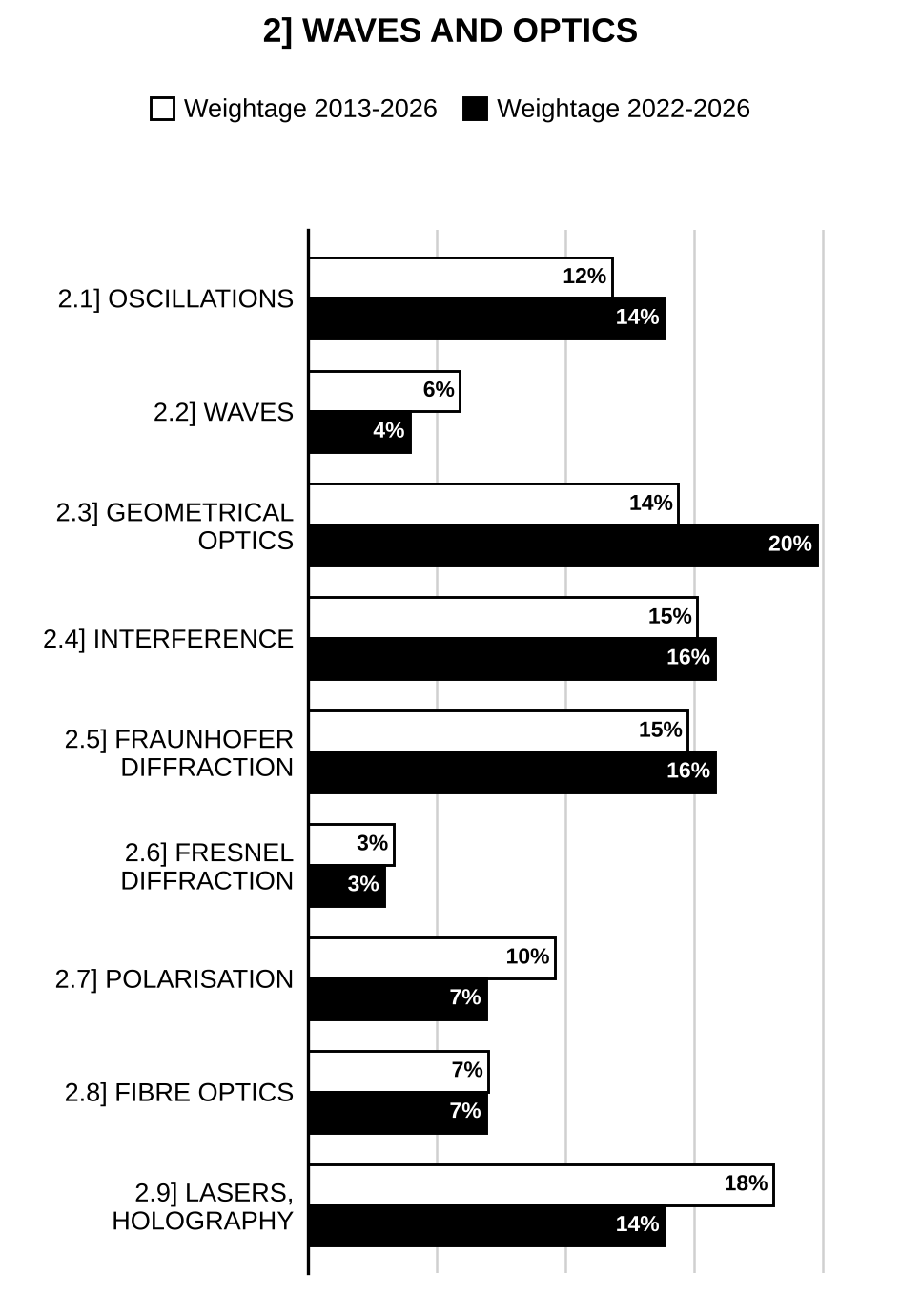
2.1] Oscillations
28 questions
A particle executes simple harmonic motion of amplitude and angular frequency . A damping force proportional to velocity acts on the particle. Derive the expression for the displacement of the particle as a function of time and discuss the effect of damping on amplitude and frequency. Also, calculate the time at which the amplitude reduces to half its initial value, if the damping coefficient is and mass is . [2026/10m/1e]
A harmonic oscillator is represented by the equation where kg, and . Determine (i) the period of oscillation, and (ii) the number of oscillations in which its amplitude will become half of its original value. [2025/15m/2b]
A weakly damped harmonic oscillator consisting of spring-mass system has the following parameters: Mass , Spring constant , Damping coefficient A periodic force (newton) is applied to the system. Determine (i) the amplitude of the oscillator at resonance and (ii) the -value of the oscillator. [2024/15m/2c]
Write equation for damped harmonic oscillations and obtain expression for logarithmic decrement. In a damped harmonic motion, the first amplitude is 10 cm, which reduces to 2 cm after 50 oscillations, each of period 4 seconds. Determine the logarithmic decrement. Also, calculate the number of oscillations in which the amplitude decreases to 25%. [2023/20m/3c]
Show that the mean kinetic and potential energies of non-dissipative simple harmonic vibrating systems are equal. [2022/10m/1b]
A mass is suspended by two springs having force constants and as shown in the figure. The mass is displaced vertically downward and then released. If at any instant , the displacement of the mass is , then show that the motion of the mass is simple harmonic motion having frequency
[Figure: Two springs in series hanging vertically from a fixed ceiling: the upper spring of force constant k1 is attached to the ceiling, the lower spring of force constant k2 hangs from the bottom of the first, and a block of mass m hangs from the lower end of the k2 spring.] [2021/10m/1e]
What is damped harmonic oscillation? Write the equation of motion and obtain the general solution for this oscillation. Discuss the cases of dead beat, critical damping and oscillatory motion based on the general solution. What would be the logarithmic decrement of the damped vibrating system, if it has an initial amplitude 30 cm, which reduces to 3 cm after 20 complete oscillations? [2021/20m/4c]
The equation for displacement (X) of a point on a damped oscillator is given by Find the velocity of oscillating point at and T, where T is the time period of the oscillator. What is the direction of velocity in each case? [2020/10m/1e]
When the two waves of nearly equal frequencies interfere, then show that the number of beats produced per second is equal to the difference of their frequencies. [2018/10m/1c]
Find the velocity of sound in a gas in which two waves of wavelengths 1.00 m and 1.01 m produce 10 beats in 3 seconds. [2017/10m/1e]
In a certain engine, a piston undergoes vertical SHM with an amplitude of 10 cm. A washer rests on the top of the piston. As the motor is slowly speeded up, at what frequency will the washer no longer stay in contact with the piston? [2014/10m/3c]
During an earthquake, a horizontal shelf moves vertically. If its motion can be regarded simple harmonic, calculate the maximum value of amplitude of oscillation so that the books resting on it stay in contact with it always. Take and T = 0.5 s. [2013/10m/1d]
Consider the following coupled inductor – capacitor circuit:
[Figure: Two-mesh ladder circuit. Top wire: inductor L in the left mesh and inductor L in the right mesh, in series along the top. Three vertical branches between the top and bottom wires: left branch capacitor C, middle (shared) branch capacitor , right branch capacitor C. Bottom wire plain. Thus each mesh contains L, C and the common coupling capacitor .]
Calculate the ratio of the frequencies of the anti-symmetric and symmetric modes . [2013/10m/6b]
The motion of a damped mechanical oscillator is represented by where m, and are constants. The oscillator is critically damped. The system is given an impulse at and , resulting in an initial velocity . After how much time the system experiences maximum displacement? [2012/12m/5a]
Write down the one-dimensional harmonic oscillator differential equation under damping and its solution for the lightly damped condition, with the meanings of symbols. Determine the dependent energy in the lightly damped condition. [2011/10m/1d]
In the steady-state forced vibration a point particle of mass ‘m’ moves under the influence of an external force in addition to the restoring force and damping force . Show that (i) the amplitude is maximum when , where and (ii) the value of the maximum amplitude is . What do you mean by the sharpness of resonance? [2006/15m/3b]
Write down the equation of motion for a damped harmonic oscillator assuming the damping force proportional to the velocity of the particle. Obtain the general solution for its displacement as a function of time. Discuss the cases of ‘overdamping’, ‘under-damping’ and ‘critical damping’. [2004/20m/3c]
An ideal massless spring of force constant k has a mass m attached to one of its ends, the other and being fixed to a rigid support. The spring is horizontal floor, A resistive force , proportional to the velocity v acts on the mass. Assuming the damping to be light, obtain the frequency of oscillation. When kg and N/m, it is found that the frequency of oscillation is times the frequency in the absence of damping. Calculate the value of the constant b. [2003/30m/2b]
Show that Simple Harmonic Motion can be described as the projection on its diameter of a uniform circular motion. [2000/20m/6b]
A book sits on a horizontal board that is undergoing simple harmonic motion with amplitude of 1 m. The coefficient of friction between the book and the board is . Find the frequency of the motion of the board at which the book is about to slip. [2000/20m/7c]
What are damped oscillations? Obtain the differential equation for damped oscillations and write its possible solution. Explain with corresponding sketches, when there can be very heavy damping, critical damping and weak damping. [1999/20m/5b]
Consider a spiral spring of length L and mass M suspended vertically from a rigid support. A mass m is attached to the lower end of the spring. The mass m is now pulled down through a small distance and is then released. If M and m are comparable describe the motion. What elastic constant of the material of the spiral spring provides the restoring force? [1998/20m/4a]
Coupled oscillations. [1998/20m/8f]
The amplitude of damped oscillator of frequency 300 Hz reduces one-tenth of its initial amplitude after 3000 oscillations. Calculate the damping constant and the time in which its energy will reduce to one-tenth of its initial energy. [1997/20m/5d]
The potential energy for the interaction between two gas molecules can be represented by the function. Where and are constant. Prove that for small oscillations the frequency is given by Where m is mass of each molecule. [1996/20m/3a]
Write the equation of motion for an oscillator driven by a simple harmonically varying force. Obtain the condition for maximum energy transfer to the oscillator. [1996/20m/3c]
Show that for forced oscillations amplitude resonance and energy resonance do not occur at the same frequency. [1995/20m/3a]
A body of mass m supported by a spiral spring causes an extension of d in the spring. The body is set in vertical oscillations of small amplitude. Find an expression for the periodic time of the oscillations. [1995/20m/3c]
2.2] Waves
27 questions
Using Huygens’ principle for a plane wave travelling from rarer medium 1 to a denser medium 2, show that where i and r are the angles of incidence and refraction, respectively. , and , are the velocities and refractive indices in media 1 and 2, respectively. [2023/10m/1d]
An observer on a railway platform observed that as a train passed through the station at 108 km/hr, the frequency of the whistle appeared to drop by 350 Hz. Find the frequency of the whistle. (Velocity of sound in air ) [2022/10m/1c]
The equation of a progressive wave moving on a string is . In this equation, and are in centimetres and is in seconds. Calculate amplitude, frequency and velocity of the wave. If two particles at any instant are situated 200 cm apart, what will be the phase difference between these particles? [2016/10m/3a]
A student is working in a physics laboratory, which is at temperature 27 °C, on a sonometer to study formation of stationary waves. The cross-sectional area of the sonometer wire is and a tension of 20 N is applied on it. If the rigid supports are 1.2 m apart and the temperature of the wire drops by 7 °C, calculate the (i) final tension and (ii) fundamental frequency of vibration of the wire. Take, coefficient of linear expansion and isothermal Young’s modulus as and respectively. [2016/10m/8a]
Show that the group velocity is equal to particle velocity. Also prove that the group velocity of the photons is equal to c, the velocity of light. [2014/15m/6a]
The dispersion relation for deep water waves is given by where g and a are constants. Obtain expressions for phase velocity and group velocity in terms of the wavelength . and k represent the angular frequency and wave number, respectively. [2013/15m/3a]
The displacement associated with a three-dimensional plane wave is given by Calculate the angles made by the propagating wave with the x, y and z-axes. [2013/10m/3c]
Show that a travelling wave on the string, clamped on both the ends, undergoes a phase change of . Hence obtain the time-independent form of the wave equation representing a standing wave on the string. [2012/12m/5b]
Explain the physical significance of group velocity from the concept of phase velocity with relevant expressions. [2011/15m/3a]
Prove that the group velocity of electromagnetic waves in a dispersive medium with refractive index at wavelength is given by where c is the free space velocity of light. Find the time taken for the electromagnetic pulse to travel a distance D. [2011/20m/3b]
In the propagation of longitudinal waves in a fluid contained in an infinitely long tube of cross-section A, show that where, = equilibrium density, = density of the fluid in the disturbed state, = volume strain [2010/15m/2c]
For stationary waves on a string whose ends are fixed, show that the energy density is maximum at antinodes and minimum at nodes. [2009/20m/3a]
Establish the relationship between the phase velocity and the group velocity of waves. Under what physical conditions , and can be possible? [2007/15m/3c]
For a transverse sinusoidal wave of wavelength λ propagating along negative x direction through a string fixed at a point, show that the nodes are located at while the kinetic energy/unit length at the antinodes is given by where, ρ, A and ω, are the mass density/unit length, amplitude of transverse displacement and angular frequency of the wave, respectively. [2005/20m/3b]
A siren of frequency 900 Hz is going towards a wall away from an observer at a speed 10 m/sec. Determine: (i) Frequency of sound directly heard from the siren. (ii) Frequency of sound reflected from the wall. (iii) Number of beats per second heard by the observer. (Velocity of sound = 330 m/sec) [2004/20m/1d]
Two transverse harmonic waves, each of amplitude 5mm, wavelength 1m and speed 3 m/s are travelling in opposite directions along a stretched string fixed at both ends. Obtain an expression for the standing wave Produced. Locate the position at the nodes and antinodes. [2003/20m/1c]
A wave is represented by . Find wavelength , velocity v, frequency f and the direction of propagation. If it interferes with another was given by , find the amplitude and the phase of the resultant wave. (All dimensions are in SI system). [2002/20m/1c]
The phase velocity of the surface wave in a liquid of surface tension T and density is given by Show that the group velocity of the surface wave is given by [2002/20m/3b]
Certain string has a linear mass density of and stretched with a tension of 25 N. One end is given a sinusoidal motion, its frequency 5 Hz and amplitude 0.01 metre. If at t = 0, the end has zero displacement and is moving along the positive Y direction, derive the wave speed, the wavelength and the wave equation of the wave in the string. [2001/20m/3b]
The phase velocity in a material is where k is the propagation constant. Prove that the group velocity will be half of the phase velocity. [2001/20m/3c]
When fixed at both ends, a wire under tension of 900 N and having a linear density kg/m is resonant at the frequency of 420 Hz. The next higher frequency at which it resonates is 490 Hz. What is the length of the wire. [2000/20m/3c]
The case of a Simple Harmonic Progressive Wave traversing through a medium is expressed as Determine (i) amplitude of vibration of the particles. (ii) wavelength of the sound wave and (iii) the phase difference between the particles situated at a distance of 22 cm. (The sound velocity in the medium is cm/s). [2000/20m/5a]
The maximum pressure variation P that the human ear can tolerate in loud sounds is about . Normal atmospheric pressure is about . Find the corresponding maximum displacement for a soundwave in air having a frequency of 100 cycles/second. (Take velocity of sound in air as 331 m/sec. and density of air = ) [2000/20m/6c]
The equation of a one-dimensional propagating harmonic transverse wave is given by: Find the resultant wave formed by the superposition of the incident and the reflected waves from a rigid end. Also determine the amplitude of stationary waves formed at x = 2 meter. What will be the distance between consecutive nodes? [1999/20m/5a]
State Huygens principle and use it to establish Snell’s law of refraction of light. How does this treatment of refraction differ from that given on the basis of Newton’s corpuscular theory? [1998/20m/6c]
A uniform rope of mass M and length L is hanging from a rigid support. A transverse wave travels along the rope. Calculate the speed of the wave at a distance x from the free end the time taken by the wave to travel the whole length. [1997/20m/3c]
Phase and group velocities in dispersive media. [1997/20m/8f]
2.3] Geometrical optics
27 questions
What is meant by achromatic combination of lenses? Derive the condition for achromatization of a pair of lenses separated by a distance . The two lenses have different dispersive powers. [2026/20m/2a]
Consider a thick lens of thickness t made of a material of relative refractive index n. Let and be the radii of curvature of its two surfaces. Obtain the system matrix of the lens. [2025/15m/4a]
Write down the system matrix for a combination of two thin lenses in paraxial approximation. Hence obtain the focal length of the combination and the positions of unit planes. [2024/10m/4a(i)]
Consider a thin lens combination of two convex lenses of focal lengths and , respectively, separated by 25 cm. Determine the focal length of the combination and the positions of unit planes. [2024/10m/4a(ii)]
Obtain condition for achromatism of two thin lenses separated by a finite distance. If the dispersive powers of the materials of the two lenses are 0.020 and 0.028, their focal lengths are 10 cm and 5 cm, respectively. Calculate the separation between them in order to form achromatic combination. [2023/15m/2b]
What is resolving power of a telescope? Why is the resolving power of microscope more with UV light than with visible light? [2023/10m/4c(ii)]
Obtain the system matrix for a thick lens and derive the thin lens formula. [2022/20m/2c]
What is chromatic aberration? Obtain the condition for achromatism using combination of two thin lenses placed in contact to each other. Can this system work as achromatic doublet if both are of same material? Justify your answer. [2021/15m/3b]
State and explain Fermat’s principle of extremum path. Discuss the cases of rectilinear propagation of light and reversibility of light rays in context of Fermat’s principle. Using Fermat’s principle, deduce the thin lens formula. [2020/15m/4b]
What is axial chromatic aberration? A convex lens has a focal length of m for red colour and m for violet colour. If an object is kept at a distance of 40 cm from the lens, calculate the longitudinal chromatic aberration of the lens. [2019/10m/150w/1d]
Prove that when light goes from one point to another via a plane mirror, the path followed by light is the one for which the time of flight is the least. [2019/20m/3a]
What do you mean by spherical aberration of a lens? Show that if two plano-convex lenses are kept at a distance equal to the difference of their focal lengths, the spherical aberration would be minimum. [2018/15m/4c]
Obtain the system matrix for a thin lens placed in air and made of material of refractive index 1.5 having radius of curvature 50 cm each. Also find its focal length. [2017/10m/3d]
Using matrix method, find out the equivalent focal length for a combination of two thin lenses of focal lengths and separated by a distance a. [2015/10m/4c]
Use matrix method to obtain an expression for the focal length of a coaxial combination of two thin lenses having focal lengths and separated by distance d. [2012/20m/8a]
Two thin symmetrical lenses of two different natures (convex and concave) and of different materials have equal radii of curvature cm. The lenses are put close together and immersed in water . The focal length of the system in water is 30 cm. Show that the difference between the refractive indices of two lenses is 1/3. [2010/10m/1b]
Show that two convex lenses of the same material kept separated by a distance a, which is equal to the average of two focal lengths, may be used as an achromat, that is, . [2010/10m/3b]
Derive the condition for achromatism of two thin lenses separated by a finite distance and made up of same material. [2009/10m/1e]
What are chromatic and spherical aberrations Explain. Calculate the longitudinal aberration for rays at a height of 0.01 m from the principal axis and incident on the curved surface (radius of curvature = 0.1 m) of a thin plano-convex lens made of glass (refractive index = 1.5). [2007/20m/1b]
Derive Snell’s law of refraction from fermat’s principle. How is the refractive index related to the velocity of light? Light of wavelength 600 nanometre (in vacuum) enters a glass slab of refractive index 1.5. What are the values of wavelength, frequency and velocity of light in glass? [Velocity of light in vacuum = ]. [2006/20m/3c]
What do you understand by paraxial rays? Show that the effect of translation of a paraxial ray while travelling along a homogeneous medium is represented by a 2 × 2 matrix if the ray is initially defined by a 2 × 1 matrix. [2005/20m/3c]
Show that the ratio of the focal lengths of the two lenses in an achromatic doublet is given by where and are the dispersive powers of the lenses of focal lengths and respectively. [2004/20m/1c]
A thin converging lens and a thin diverging lens are placed coaxially at a distance of 5 cm. If the focal length of each lens is 10 cm, find for the combination (i) the focal length, (ii) the power, (iii) the positions of the principal points. [2004/20m/3b]
Two thin convex lenses of focal length 0.2 m and 0.1 m are located 0.1m apart on the axis of symmetry. An object of height 0.1m is placed at a distance of 0.2 m from the first lens. Find by the matrix method, the position and the height of the image. [2003/20m/1d]
State Fermat’s principle. Apply it to get the laws of reflection from a plane surface. [2002/20m/3a]
How does the resolving power of a microscope differ from that of a telescope? Find the resolving power of an electron microscope that uses 15 keV electrons, assuming that this is equal to the electron wavelength. [2000/20m/1c]
Explain the terms resolving power and magnifying power of an optical instrument. On what parameter do these physical quantities depend in case of a telescope? For a given re-solving power what is the optimum magnifying power in this case? [1998/20m/5b]
2.4] Interference
35 questions
In Newton’s ring experiment, the space between planoconvex lens and glass plate is filled with a liquid of refractive index . Explain how interference pattern changes as compared to air. Starting from the condition for interference, derive an expression for the radius of the th dark ring. Discuss how the ring system changes if the refractive index increases. [2026/10m/4a(i)]
A Fabry-Pérot interferometer is illuminated by monochromatic light of wavelength nm. The mirror separation is mm. It is observed that two successive transmitted maxima correspond to wavelengths and , both satisfying the condition for normal incidence. Determine the smallest wavelength difference that can be resolved by the interferometer. Explain physically why this quantity depends on mirror separation. [2026/10m/4a(ii)]
Consider multiple reflections from a plane parallel film of thickness h and refractive index and derive an expression for the total reflectivity from the surface of the film. [2025/20m/4b]
The intensity at the central maximum observed on a screen in a double-slit experiment is . If the path difference between interfering waves reaching a point on the screen is , where is the wavelength of the light used in the experiment, determine the intensity at that point. [2024/10m/1d]
What are the requisite conditions for observation of interference pattern on a screen? [2023/5m/3a(i)]
Derive the expression for fringe width and intensity at a point on the screen in a double slit experiment. [2023/10m/3a(ii)]
Newton’s rings are observed between a spherical surface of radius of curvature 100 cm and a plane glass plate. The diameters of 4th and 15th bright rings are 0.314 cm and 0.574 cm, respectively. Calculate the diameters of 24th and 36th bright rings and also the wavelength of light used. [2022/15m/3b]
A thin film of petrol of thickness cm is viewed at an angle 30° to the normal. Find the wavelength(s) of light in visible spectrum which can be viewed in the reflected light. The refractive index of the film . [2021/10m/1d]
What are Newton’s rings? How are they formed by two curved surfaces? [2020/10m/1d]
Discuss the conditions for interference. Describe Young’s double-slit experiment and derive an expression for the estimation of fringe width. Discuss its dependency on various parameters. Green light of wavelength 5100 Å from a narrow slit is incident on a double-slit. If the overall separation of 10 fringes on a screen 200 cm away is 2 cm, find the slit separation. [2020/20m/3a]
(i) What are the fringes of equal thickness and fringes of equal inclination? (ii) In a Newton’s ring arrangement with a source emitting two wavelengths m and m, it is found that the dark ring due to one wavelength coincides with the dark ring due to the other. Find the diameter of the dark ring, if the radius of curvature of the lens is 90 cm. [2019/10m/150w/1e]
Describe how Michelson Interferometer can be used to determine refractive index of a gas. In a Michelson Interference experiment, a tube of length 25 cm containing a gas of refractive index is introduced between the upper mirror and the beam splitter. 150 fringes cross the centre of the field of view when the wavelength of light used is 5890 Å. Find the value of . [2018/20m/3c]
Explain with proper example the interferences due to ‘division of wavefront’ and ‘division of amplitude’. [2017/10m/1d]
What is multiple-beam interference? Discuss the advantages of multiple-beam interferometry over two-beam interferometry. Explain the fringes formed by Fabry-Perot interferometer. [2017/15m/3a]
In Michelson interferometer, 100 fringes cross the field of view when the movable mirror is displaced through 0.029 mm. Calculate the wavelength of the light source used. [2016/5m/3c]
Obtain the conditions for constructive interference and destructive interference in a thin film due to reflected light. [2016/15m/4d]
In a Young double slit experiment, the first bright maximum is displaced by y = 2 cm from the central maximum. If the spacing between slits and distance from the screen are 0.1 mm and 1 m respectively, find the wavelength of light. [2014/10m/5a]
The separation between the slits is 0.5 mm in Young’s double-slit experiment. The interference pattern observed on a screen placed 5 m away reveals the location of the first maximum which is 6 mm from the centre of the pattern. Calculate the wavelength of light and separation between second and third bright fringes. [2012/12m/5c]
When a thin film of a transparent material is put behind one of the slits in Young’s double-slit interference experiment, the zero-order fringe moves to the position previously occupied by the fourth-order bright fringe. The index of refraction of the film is and the wavelength of light, . Determine the thickness of the film. [2011/10m/3c]
An optical beam of spectral width 7.5 GHz at wavelength nm is incident normally on Fabry-Perot etalon of thickness 100 mm. Taking refractive index unity, find the number of axial modes which can be supported by the etalon. [2010/10m/1d]
Let By using analytical method, obtain an expression to explain interference. Also show that intensity varies along the screen in accordance with the law of cosine square in interference pattern. [2009/10m/1b]
Explain the phenomenon of interference in thin films. Why is the contrast better in brightness of fringes obtained from the interference of reflected light rays compared to the transmitted light rays? [2009/20m/3b]
Describe the working of a Fabry-Perot interferometer. Determine the intensity of the fringes of the transmitted light. Why the fringes obtained in the Fabry-Perot interferometer are comparatively sharper than those obtained from the Michelson interferometer? [2007/35m/4a]
Explain the working of Michelson interferometer using appropriate optical diagram. also draw paths of the rays. [2006/20m/4a]
Obtain the relation to find radii of the rings and the wavelength of light in Newton’s circular ring. Calculate the radius of curvature of the convex glass surface where diameter of and bright rings formed by sodium yellow light are measured to be 2.303 mm and 4.134 mm. Given and Å. [2006/20m/4b]
Two microscope slides of length 10 cm each form a wedge. At one end they are in contact and at the other end they are separated by a thin wire of diameter d (see the diagram below). Interference fringes are obtained when illuminated vertically by a monochromatic light of λ = 500 nanometers. The fringe spacing is found to be 1.25 cm. Estimate the diameter of the wire.
[Figure: Air wedge: two glass slides touching at the left end and separated at the right end by a thin wire (circle) of diameter d, marked by a vertical double arrow d; the length of the slides marked by a horizontal double arrow 10 cm.] [2004/20m/4b]
In an experiment using a Michelson interferometer, explain with the help of suitable ray diagrams (i) Why do we need extended source of light, (ii) Why do we get circular fringes, and (iii) Shifting of fringes inwards or outwards as we shift the movable mirror. [2002/20m/4c]
Monochromatic light from a distance source of wavelength falls on a double slit. A glass plate of thickness t is inserted between one slit and the screen. Calculate the intensity at the central point as the function of thickness t. [2001/20m/4b]
Explain in detail how one can obtain fringes with the Michelson Interferometer using incandescent lamps. [2000/20m/7a]
Why an extended source is necessary to see colours in a soap-film? Non-reflecting surfaces are made by coating very thin films of a transparent material. Find the maximum thickness of such thin coatings given that cm and . [1999/20m/5d]
What are the essential conditions for observing the interference of light? Two coherent sources with intensity ratio 4:1 interfere. Find . [1999/20m/6a]
Calculate the minimum plate separation in a Fabry-Perot interferometer to obtain free spectral range of 0.05 Å in the wavelength region 5000 Å. Calculate also the smallest resolvable wavelength difference for reflectivity of 0.95. [1998/20m/4c]
Why does a soap film appear coloured when is viewed by reflected white light? A thin film is illuminated by sodium light of wavelength 5900 Å. Its refractive index is 1.42. Calculate its minimum thickness so that it appears dark in reflected light. [1997/20m/6c]
Show that the interference fringes obtained in Young’s two slit experiment are hyperbolic in shape. Under what conditions these are expected to appear straight? [1996/20m/6a]
In a biprism experiment the fringe-width with light of wavelength Å is 0.43 mm. On introducing a mica sheet in the path of one of the interfering rays the central fringe shifts by 1.89 mm. If refractive index of mica is 1.59, calculate the thickness of the sheet. [1995/20m/7c]

Preparing for Prelims too?
Our UPSC Prelims Topic-wise PYQ eBook covers every Prelims question with detailed explanations, so you can see exactly where UPSC asks from.
View the BookDownload Free Sample2.5] Fraunhofer diffraction
31 questions
Light of wavelength 6000 Å is incident on a slit of width 0.40 mm. The screen is placed 2 m away from the slit. Find (i) the position of the first dark fringe and (ii) the width of the central bright fringe. [2026/10m/1c]
Using Fraunhofer diffraction theory, derive the expression for the intensity distribution due to a circular aperture and obtain the condition for the first minimum. Using this result, derive the expression for the resolving power of an optical instrument. Finally, calculate the minimum angular separation that can be resolved by a telescope of aperture diameter cm for light of wavelength 500 nm. [2026/15m/2b]
A monochromatic parallel beam of wavelength nm is incident on a single slit of width mm. A convex lens of focal length m forms the Fraunhofer diffraction pattern on a screen. (i) Determine the angular width and linear width of the central maximum on the screen. (ii) If the slit width is halved, explain quantitatively how diffraction pattern changes. (iii) A second wavelength 450 nm is added. Will the minima of the two wavelengths coincide? Justify mathematically. [2026/15m/4b]
In a double slit Fraunhofer diffraction experiment, the slit width is 0.12 mm and the spacing between the two slits is 0.48 mm. The distance of the screen from the slits is 1.5 m. If the wavelength of the light used is 600 nm, determine (i) the missing orders of the interference maxima, and (ii) the distance between the central maxima and the first minima. [2025/10m/1d]
A telescope has an objective lens of diameter 10 cm. Determine whether this telescope can resolve two stars having an angular separation of 2.4 seconds of arc. (Assume the wavelength of starlight as 550 nm) [2024/10m/1e]
Discuss the phenomenon of Fraunhofer diffraction at a single slit and show that the intensities of successive maxima are nearly in the ratio [2022/20m/4b]
Show that the phenomenon of Fraunhofer diffraction at two vertical slits is modulation of two terms viz. double slit interference and single slit diffraction. Obtain the condition for positions of maxima and minima. [2021/20m/2c]
A plane transmission grating has 3000 lines in all, having width of 3 mm. What would be the angular separation in the first order spectrum of the two sodium lines of wavelengths 5890 Å and 5896 Å? Can they be seen distinctly? [2018/10m/1e]
Discuss the intensity distribution in Fraunhofer diffraction pattern due to a single slit. Obtain conditions for maxima and minima of the intensity distribution. Show that the intensity of the first maxima is about 4.95% of that of the principal maxima. [2018/20m/4b]
Can and lines of sodium light ( Å and Å) be resolved in second-order spectrum if the number of lines in the given grating is 450? Explain. [2016/10m/1e]
Obtain an expression for the resolving power of a grating explaining the Rayleigh’s criterion of resolution. [2016/15m/3d]
A convex lens of focal length 20 cm is placed after a slit of width 0.5 mm. If a plane wave of wavelength 5000 Å falls normally on the slit, calculate the separation between the second minima on either side of the central maximum. [2015/10m/1d]
Considering a plane transmission diffraction grating, where d is the distance between two consecutive ruled lines, m as the order number and as the angle of diffraction for normal incidence, calculate the angular dispersion for an incident light of wavelength . [2014/10m/4c]
A parallel beam of light from a He – Ne laser ( = 630 nm) is made to fall on a narrow slit of width m. The Fraunhofer diffraction pattern is observed on a screen placed in the focal plane of a convex lens of focal length 0.3 m. Calculate the distance between the (i) first two minima and (ii) first two maxima on the screen. [2013/15m/3b]
Explain the physical significance of resolving power of a grating with relevant mathematical expression. [2013/10m/3d]
A diffraction grating of width 5 cm with slits of width cm separated by a distance of cm is illuminated by light of wavelength 550 nm. What will be the width of the principal maximum in the diffraction pattern? Would there be any missing orders? [2012/20m/6b]
The Fraunhofer single-slit diffraction intensity is given by where with l as the distance from slit to source, d the slit width, y the detector distance and the wavelength. What is the value of cumulative intensity ? [2011/10m/1e]
In relation to a plane diffraction grating having 5000 lines per cm and irradiated by light of wavelength 6000 Å, answer the following: (i) What is the highest order spectrum which may be observed? (ii) If the width of opaque space is exactly twice that of the transparent space, which order of spectra will be absent? [2011/15m/3d]
Distinguish between high dispersive power and high resolving power. [2009/5m/4a(i)]
Obtain an expression for the resolving power of a plane transmission grating. [2009/10m/4a(ii)]
Deduce the missing orders for a double-slit Fraunhofer pattern, if the slit widths are 0.16 mm and 0.8 mm apart. [2009/5m/4a(iii)]
Define resolving power and dispersive power of a grating. Two spectral lines of wavelengths 500 nm and 500.5 nm are seen clearly resolved in second order spectrum of a grating. If the grating has 250 lines per cm, what should be the minimum width of the grating? [2007/15m/4c]
What is the essential difference between interference and diffraction of light? How can you achieve Fraunhofer difraction in the laboratory? Using the concept of Fraunhofer diffraction at a single slit, find out the intensity distribution produced by two slits of equal width. [2005/20m/4b]
Obtain an expression for the intensity of light in the Fraunhofer diffraction pattern due to a circular aperture. What is Airy pattern? Explain with a neat diagram. [2003/20m/4b]
Derive the expression for resolving power of a diffraction grating with N lines. Calculate the minimum number of lines in the diffraction grating if it has to resolve the yellow lines of sodium (589.0 nm and 589.6 nm) in the first order. [2002/20m/1d]
Give Rayleigh’s criterion for resolution. Why telescopes with larger objectives are better? The objective of the telescope at St. Palomer has a diameter of 5.08 m. What is the least distance on Moon which could be resolved by it? (Given distance of moon from the Earth = 3,84,000 km and = 5890 Å). [1999/20m/6b]
Sodium light is incident normally upon a plane transmission grating having 5000 lines/cm. Calculate the angular separation of the and lines in the first order spectrum. As this angular separation is very small [?], how can one magnify it 10 times? (Given: = 5690 Å [?] and = 5896 Å) [1999/20m/7c]
Define dispersive and resolving powers of a plane transmission grating and obtain expressions for the two. Show that the first and second order spectra produced by such a grating will never overlap when the incident light contains wave-lengths in the range 4000 Å to 7000 Å. [1998/20m/3a]
A plane transmission grating has 6000 lines per cm. Determine the angular separation between the two lines of sodium of wavelengths 5896 Å and 5890 Å in the second order spectrum. If the width of the grating is 2.5 cm, will these lines be resolved? [1997/20m/6b]
The angular separation between two distant stars is 1 arc-second. If the effective wavelength of light is 5500 Å; what should be the diameter of the objective of a telescope so that the stars are just resolved? [1996/20m/1c]
Obtain the intensity pattern due to Fraunhofer diffraction at two parallel slits. Each slit has a width ‘a’ and the separation between the slits is ‘d’. How many interference fringes will appear in the central diffraction maximum, if ? [1995/20m/6a]
2.6] Fresnel diffraction
14 questions
The diameter of central zone of a zone plate is 2.4 mm. If a point source of light of wavelength 600 nm is placed at a distance of 5.0 m from the zone plate, calculate the position of the first image. [2024/10m/4b]
What is the difference between Fresnel diffraction and Fraunhofer diffraction? [2023/5m/4c(i)]
What is a zone plate? Give its theoretical description. Show that a zone plate has multiple foci. Differentiate a zone plate from a convex lens. Calculate the radius of the first half period zone in a zone plate behaving like a convex lens of focal length 60 cm for light of wavelength 6000 Å. [2020/15m/3b]
Show that the areas of all the half-period zones are nearly the same. Find the radius of 1st half-period zone in a zone plate whose focal length is 50 cm and the wavelength of the incident light is 500 nm. [2017/15m/3b]
Distinguish between Fresnel and Fraunhofer classes of diffraction. Show that the area of each Fresnel half-period zone is same. [2012/20m/6a]
Obtain the expression for the primary focal length of Fresnel zone plate. [2010/20m/4a]
The radius of the first zone in a zone plate is 2 mm. What will be the position of the first image of a point source of light of wavelength placed at a distance of 5 m from the zone plate? [2007/10m/4b]
The X and Y co-ordinates of Cornu’s spiral can be expressed quantitatively by two integrals. Derive the expressions of these integrals. [2006/20m/1c]
A narrow slit illuminated by monochromatic light of λ = 6400 Å is placed at a distance of 3 metres from a straight edge. If the distance between the straight edge and the screen is 6 metres, calculate the distance between the first and the fourth dark bands. [2004/20m/4c]
Discuss the Fresnel diffraction pattern formed by a straight edge using the Cornu’s spiral. [2002/20m/4b]
Parallel rays fall on circular aperture of diameter 1 mm. At a certain position of the screen one gets a dark spot on an axial point. When the screen is moved by 12.5 cm, one again gets a dark spot. Determine (wavelength). [2001/20m/4a]
Differentiate between Fresnel and Fraunhoffer diffractions. How can one explain the Fresnel diffraction pattern due to a straight edge? [1999/20m/7b]
Give the concept of Fresnel’s half period zones. Describe the salient features of Fresnel’s diffraction pattern due to a straight edge, showing the intensity distribution. How are these features explained? [1997/20m/7c]
A fine slit is illuminated by monochromatic light of wave-length 6000 Å. A thin wire is placed parallel to the slit and the diffraction pattern is observed on a screen at a distance of 1 m from the wire. In the shadow of the wire equidistant fringes of thickness 1.5 mm are observed. How do you explain this observation? Calculate the diameter of the wire also. [1996/20m/6c]
2.7] Polarisation
30 questions
Find the required thickness of the calcite plate to convert plane polarized light ( Å) into circularly polarized light. (For calcite, and ) [2026/10m/1d]
Explain the phenomenon of double refraction. What are positive and negative crystals? Give their examples. [2024/5m/3a(i)]
What do you understand by optical activity? A linearly polarized light is propagating along the optic axis of a quartz crystal of thickness 0.2 cm. If the difference in the refractive indices corresponding to right circularly polarized and left circularly polarized beams is and the wavelength of the light is 0.5 μm, calculate the angle of polarization. [2024/10m/3a(ii)]
A phase retardation plate of quartz has thickness 0.1436 mm. For what wavelength in the visible region will it act as quarter-wave plate? Given that and . [2022/10m/1e]
Explain the phenomenon of double refraction in calcite crystal. Considering birefringent crystal as non-conducting material, explain double refraction using electromagnetic theory. Calculate the thickness of a double refracting plate which produces a path difference of between extraordinary and ordinary waves. Given: [2020/15m/4c]
(i) How can one convert a left-handed circularly polarised light into a right-handed one (and vice versa)? (ii) Calculate the thickness of a quarter-wave plate when the wavelength of light is 589 nm. Given: and . [2019/10m/3b]
Distinguish between positive and negative crystals in terms of double refraction. How are these crystals used to make quarter wave plates? Explain how the quarter wave plate is used in producing elliptically and circularly polarized light. [2018/15m/3b]
Sunlight is reflected from a calm lake. The reflected light is 100% polarized at a certain instant. What is the angle between the sun and horizon? [2017/10m/1c]
A plane-polarized light passes through a double-refracting crystal of thickness 40 m and emerges out as circularly polarized. If the birefringence of the crystal is 0.00004, then find the wavelength of the incident light. [2017/10m/3c]
Explain the principle of producing polarized light by the method of reflection, refraction and double refraction with the help of neat diagrams. [2016/15m/4c]
Find out the angle between the reflected and refracted rays when a parallel beam of light is incident on a dielectric surface at an angle equal to the Brewster’s angle. Explain how do you use this concept to produce linearly polarized light. [2015/20m/2a]
Calculate the minimum thickness of a quartz plate which would behave as a quarter-wave plate for wavelength of light, . The refractive indices for ordinary and extraordinary rays are and . [2012/15m/8b]
A plane wave has the following expression for its electric field: If the phase difference is defined as , under what conditions do we achieve elliptic polarization? What are the conditions for circular polarization? [2011/10m/1f]
For calcite, the refractive indices of ordinary and extraordinary rays are 1.65836 and 1.48641 at respectively. A left circularly polarized beam of this wavelength is incident normally on such crystal of thickness 0.005141 mm having its optic axis cut parallel to the surface. What will be the state of polarization of the emergent beam? [2011/15m/4a]
An unpolarized light beam of intensity is incident on an ideal linear polarizer with its transmission axis parallel to vertical direction. Describe an experiment to reduce the intensity of light beam to . [2010/10m/1e]
Show that two light beams polarized in perpendicular directions will not interfere. [2010/15m/4b]
Show that the plane of polarisation is rotated through in optical rotation where symbols have their usual meanings. [2009/15m/4b(i)]
A plane-polarised light is incident perpendicularly on a quartz plate cut with faces parallel to optic axis. Find the thickness of the quartz plate which introduces phase difference of 60° between e- and o-rays. [2009/5m/4b(ii)]
Consider superposition of two plane polarized electromagnetic waves: and Discuss the conditions for the resultant wave to be left circularly and right circularly polarized adopting the convention as seen by an observer travelling with the wave. [2007/20m/1d]
What is optical activity? Give reasons for the conclusion that optical rotation in liquids has a molecular origin. What do you mean by ordinary and extraordinary rays? What are positive and negative crystals? Give an example of each. Compute the minimum thickness of a quarter-wave plate made from quartz for incident wavelength of 589.3 nanometer. Given and . [2006/20m/1d]
How would you produce plane polarized light by reflection? What is Brewster’s law? Calculate the angular position of the sun above the horizon so that light reflected from a calm lake is completely polarized. The refractive index of water is 1.33. Circularly polarized and unpolarized light are passed in turn through a Nicol prism. The Nicol is rotated about the direction of light as axis. What would you observe in each case? How would you distinguish between them? [2006/20m/4c]
Why does one see two image points for a single object point while viewed through a calcite crystal? What is this property of the crystal known as? What is an optic axis of a crystal? Explain the meanings of positive and negative crystals with one example for each kind. [2005/20m/4c]
A quartz quarter wave plate is to be used with the sodium light (λ = 5896 Å). What should be its thickness? [2004/20m/4a]
How do you know that the light is a transverse wave? What is a quarter wave plate? How is it constructed? [2002/20m/4a]
Why does one get polarised light from a Nicol’s prism? How should one adjust the polariser and analyser, so that an intensity of the incident light is reduced by a factor of 0.25? [2001/20m/4c]
Four perfect polarizing plates are stacked so that the axis of each is turned 30° clockwise with respect to the preceding plate: the last plate is crossed with the first. How much of the intensity of an incident unpolarized light is transmitted by the stack? [2000/20m/4c]
A thin quartz plate for incident light of = 6100 Å produces, a phase difference (45/4) between the ordinary and extraordinary rays. What will be the nature of polarisation of the emergent light when plane polarized light of wavelength 4500 Å is incident on it. [1998/20m/1d]
What is a quarter plate? A phase retardation plate of quartz has a thickness 0.1436 mm. Calculate the wavelength in the visible region for which this plate will act as a quarter for plate [?]. The refraction indices of quartz for ordinary and extraordinary rays are 1.5443 and 1.5533 respectively. [1997/20m/6a]
What is a quarter wave plate? Explain its use in the production and detection of circularly polarized light. For calcite for Å, and . If the minimum thickness of a plate that can be cut from calcite is 30 µm, what should be the minimum thickness for preparing a quarter wave plate? [1996/20m/5b]
A left circularly polarized beam of light ( Å) is incident on a quartz crystal (Optic axis parallel to the surface). Find the state of polarisation of the emergent beam. (Thickness of quartz crystal , , ) [1995/20m/6c]
2.8] Fibre optics
14 questions
What do you understand by attenuation in optical fibers? What are the factors responsible for the attenuation? [2024/5m/3b(i)]
Consider a 10 mW laser beam passing through a 50 km fiber link of attenuation 0.5 dB/km. Calculate the power of the laser at the end of the link. [2024/10m/3b(ii)]
Write conditions for working of a step-index optical fiber. In a step-index fiber, the core and cladding materials have refractive indices 1.50 and 1.43, respectively. Find the following: (i) Critical propagation angle (ii) Acceptance angle (iii) Total time delay in 1 km length of the fiber (iv) Total dispersion in 50 km length of the fiber. [2023/20m/4a]
In a step-index optical fiber system, explain the terms pulse dispersion and material dispersion. An optical fiber having refractive indices of core and cladding and respectively, uses a Laser diode with with a spectral width of 2 nm. At this wavelength if the material dispersion coefficient, is 18.23 ps/km.nm, then calculate the pulse dispersion and material dispersion for 1 km length of the fiber. [2021/20m/3a]
Explain the principle of operation of optical fibre. What are the different losses that take place in optical fibre? [2017/10m/4d]
The refractive indices of core and cladding in a step index optical fiber are 1.52 and 1.48 respectively. The diameter of the core is 30 μm. If the operating wavelength is 1.3 μm, calculate the parameter and the maximum number of modes supported by the fiber. [2016/10m/1d]
For a multimode step index optical fibre, the core refractive index is 1.5 and fractional index difference is 0.001. Calculate the pulse broadening for 1 km length of the fibre. Over a length of 2 km of the fibre, calculate the minimum pulse separation that can be transmitted without overlap. [2014/10m/1e]
Explain why information carrying capacity of an optical fibre can be enhanced by reducing the pulse dispersion. How does one minimize pulse dispersion using a graded index optical fibre? [2013/10m/1e]
Derive an expression for intermodal dispersion for a multimodal step-index fibre. [2012/20m/7a]
A pulse of nm and nm propagates through a fibre which has a material dispersion coefficient of 50 ps per km per nm at 600 nm. Calculate the pulse broadening in traversing a 10 km length of the fibre. If the pulse width at the input of the fibre is 12 ns, what will be the pulse width at the output of the fibre? [2012/10m/7b]
What should be the refractive index of cladding of an optical fibre with numerical aperture 0.5 with refractive index of core as 1.5? [2010/10m/1f]
Optical power of 1 mW is launched into an optical fiber of length 100 m. If the power emerging from the other end is 0.3 mW, calculate the fiber attenuation. [2009/7m/4c(iii)]
Drawing a neat diagram, discuss how light travels through an optical fibre. Show that the numerical aperture of a commercially available optical fibre is around 0.25. Explain its physical significance. [2005/20m/1d]
Explain the phenomenon of pulse dispersion in a step index optical fibre. [2003/20m/3c]
2.9] Lasers and holography
43 questions
The aperture width of a laser light source of wavelength 6000 Å is 3 mm and its power is 20 mW. Calculate the light intensity at a distance of 200 m from the light source. [2026/15m/3c]
Consider a laser system consisting of an active medium placed between a pair of mirrors forming a resonator. Obtain an expression for the threshold population inversion required for the oscillations of laser. [2025/20m/3a]
For a He – Ne laser system, what will be the magnitude of which represents FWHM of the line shape function , if resonant frequency and temperature K? [2025/10m/3b]
What are three and four level pumping schemes? Explain the lasing action in these with schematic diagrams. [2023/10m/1e]
In He-Ne laser, what is the function of He gas? Explain the answer with the help of energy level diagram for He-Ne laser. [2022/15m/3c]
Briefly discuss the postulates of Einstein to explain stimulated emission. Derive an expression for Einstein’s A and B coefficients and show that the ratio of coefficients of spontaneous versus stimulated emission is proportional to the third power of frequency of radiation. Why is it difficult to achieve laser action in higher frequency ranges such as X-rays? Can there be a temperature at which the rates of spontaneous and stimulated emission are equal? Illustrate with wavelength Å. [2020/15m/3c]
Discuss how population inversion is achieved in Ruby laser. What is ‘laser spiking’? Why does it occur? [2019/20m/3c]
In what way is holography different from conventional photography? Discuss the salient features of a hologram. What are the requirements for the formation and reading of a hologram? [2019/20m/4b]
Explain the principle and working of He-Ne laser. What is the role of He gas? Why is it necessary to use narrow tube? How many longitudinal modes can be excited for an He-Ne laser in a cavity of length 30 cm and having half width of gain profile of laser material nm? The emission wavelength is 6328 Å. [2018/15m/3a]
How is laser light different from ordinary light? Discuss the working principle of ruby laser. What role do chromium ions play in this process? [2017/15m/4c]
Explain the principle of (i) induced absorption, (ii) spontaneous emission and (iii) stimulated emission. Show that the ratio of Einstein’s coefficients is given by [2016/20m/3b]
What is the role of an optical resonator in a laser? Why does one prefer curved mirrors instead of plane mirrors in designing an optical resonator? [2015/10m/1e]
Using the concept of Einstein’s A and B coefficients for a two-level atomic system under thermal equilibrium, determine the ratio of the number of atoms per unit volume in the two levels experiencing spontaneous and stimulated emission. How does the principle of population inversion lead to the gain mechanism in the active medium of the laser? [2015/20m/4d]
What is the physical significance of Einstein’s A-coefficient? Explain why it is more difficult to achieve Lasing action at X-ray wavelength than at infra-red wavelength. [2014/10m/1d]
Explain the working principle of a 3-level laser with a specific example. Comment on why the third level is needed. [2014/10m/2c]
How does holography differ from conventional photography? What are the requirements for the formation and reading of a hologram? [2014/10m/5c]
In a tungsten filament lamp, thermionic emission takes place at K. Calculate the ratio of spontaneous emission to stimulated emission for non-degenerate energy levels. Interpret your result physically. Take = 550 nm, , Js and . [2013/10m/5d]
Bring out the essential differences between the physical principles of spontaneous and stimulated emission of radiation. Why is it difficult to get efficient lasing action in case of an ideal two-level material system? Can you propose a scheme to enhance efficiency? Discuss. [2011/15m/4b]
Show with proper mathematical analysis that the ratio of Einstein’s A and B coefficients depends upon the energy separation between the two energy levels participating in the optical transitions. What is the physical significance of A coefficient? Justify the statement, “It is very difficult to develop an X-ray laser”. [2011/30m/4c]
Describe Michelson interferometer for evaluation of coherence length of an optical beam. Calculate coherence length of a light beam of wavelength 600 nm with spectral width of 0.01 nm. [2010/30m/3c]
A laser beam of 1 micrometer wavelength with 3 megawatts power of beam diameter 10 mm is focussed by a lens of focal length 50 mm. Evaluate the electric field associated with the light beam at the focal point. (Dielectric permittivity of free space, ) [2010/25m/4c]
What are the characteristics of stimulated emission? Show that in the optical region, stimulated emission is negligible compared to spontaneous emission. [2009/10m/1f]
At what temperature are the rates of spontaneous and stimulated emission equal? (Assume nm) [2009/7m/4c(i)]
What are the important properties of a hologram? [2009/6m/4c(ii)]
Explain how Einstein’s A and B coefficients are related to the phenomena of spontaneous and stimulated emission of radiation, respectively. Derive the relation between A and B. Establish that at very high frequency around X-ray wavelength regime, lasers cannot be made as easily as at low frequencies, e.g. far infra-red regime. [2005/20m/1c]
Why does one get three-dimensional image in holography? Explain with appropriate figures hos can one construct and read a hologram. [2005/20m/4a]
What is holography? Describe the experimental set up for Gabor’s on-line holographic recording. What are the limitations of Gabors experiments? How these were over come by Leith and Upatneiks? [2003/20m/4a]
Explain the phenomenon of self focusing of laser beams. [2003/20m/4c]
A parallel laser beam is incident perpendicularly on a photographic plate. An object is placed at a distance a in front of the photographic plate. Discuss the recording from the plate. If the plate is illuminated by the same light, what is expected and why? [2001/20m/1a]
A short-focus lens is used to focus a laser beam of wavelength 6328 Å. If the beam width is comparable to the focal length of the lens, calculate the area of cross-section of the region of focus. [1999/20m/1b]
Explain why a two-level system is not adequate for laser operation. Draw the essential parts of a ruby laser and explain the working principle with the help of an energy level diagram. [1999/20m/3c]
Distinguish between spatial and temporal coherence of light. What kind of coherence is required for interference and diffraction? Explain why it is possible to produce interference effects using two tuning forks of the same frequency but not by two independent sources of light of the same wavelength. [1998/20m/2c]
Ruby laser. [1998/20m/8c]
What is spatial coherence? Considering Young’s two slit experiment, prove that the distance between the slits must be sufficiently less than for obtaining fringes of good contrast. is the wavelength of light used and is the angle subtended by the source at the slits. [1997/20m/1b]
In a hydrogen atom for the 2p → 1s transition the probability per unit time is . Calculate the angular frequency of the emitted photons and the order of Einstein’s coefficient . [1997/20m/1c]
A 3 MW laser beam which has a diameter of 1 cm is focussed by a lens of focal length 5 cm. The wavelength of laser is 10,000 Å. Calculate the intensity of the focal plane of the lens. [1997/20m/5c]
What is population inversion? Mention the methods of achieving population inversion. Explain the concept of negative temperature. [1997/20m/7b]
He-Ne laser. [1997/20m/8e]
What is meant by temporal and spatial coherence? Show that the coherence length , where is the mean wavelength and Q represents the purity of a spectral line. [1996/20m/1a]
Obtain an expression for the ratio of the probabilities of stimulated and spontaneous emissions. What do you infer from this relation? How is population inversion interpreted thermodynamically? [1996/20m/6b]
Describe the working principle of a three level solid state laser giving the transitions involved in the laser action. [1996/20m/7c]
Holography. [1996/20m/8c]
Discuss the working principle of He-Ne laser indicating the transitions involved in the process. Determine the power output of a laser in which a 3.0 J pulse is delivered in 1.0 ns. [1995/20m/6b]

Strengthen your GS papers
Our UPSC Mains Topic-wise & Year-wise PYQ eBook (2013–2026) maps every GS question to the syllabus, so you know what UPSC asks and how often.
View the BookDownload Free Sample« Previous: Mechanics | Next: Electricity and Magnetism »
Back to: Physics Optional PYQs – Topic-wise
Last updated: 30 October 2026