
Here are all 195 Nuclear and Particle Physics questions asked in UPSC Physics Optional Paper II from 1995 to 2026, arranged under the 8 topics of the official syllabus. Within each topic the latest questions come first.
Each question ends with a code such as [2024/15m/3b] – the year, the marks, the word limit (where UPSC set one) and the question number in the paper.
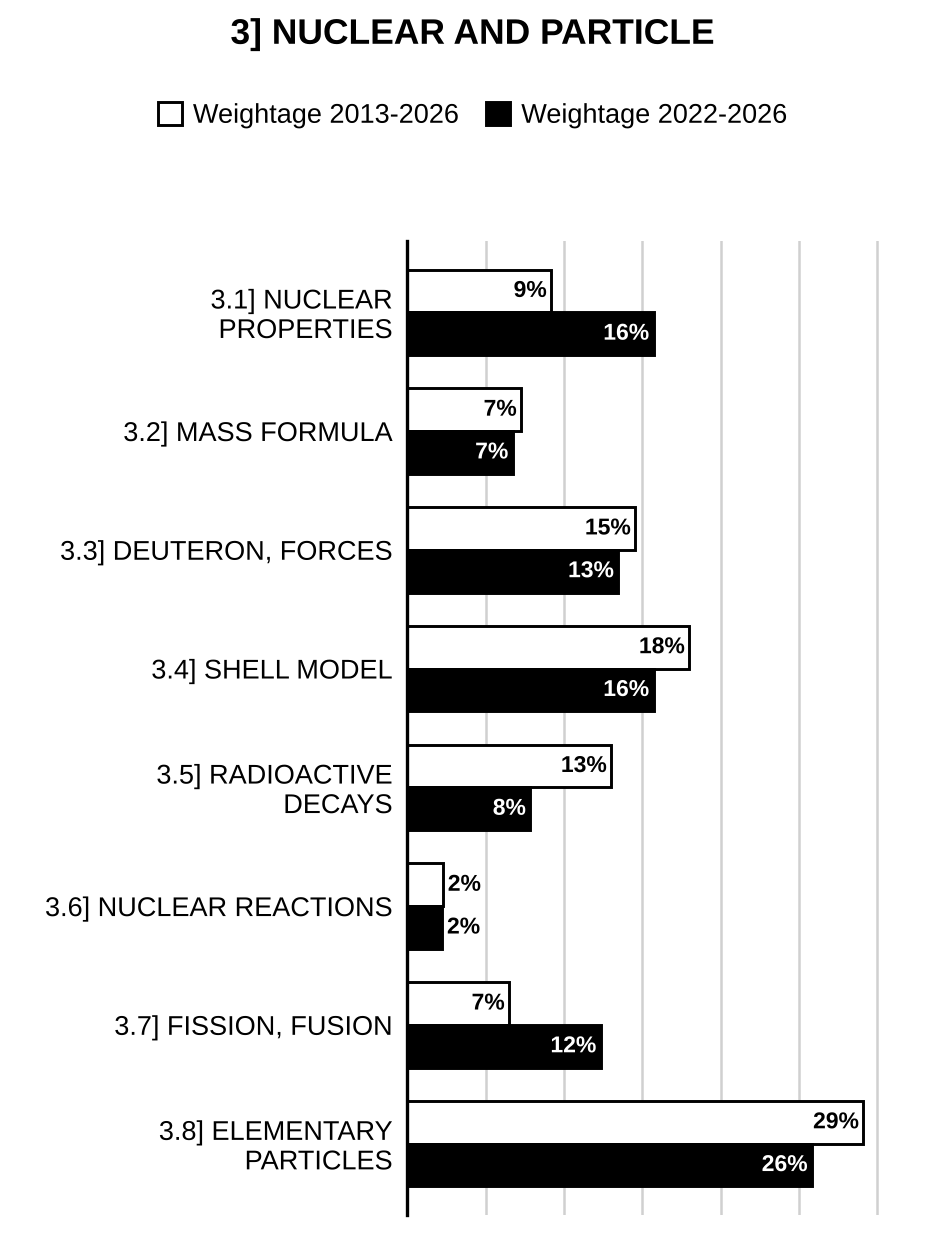
3.1] Basic nuclear properties
16 questions
What do you understand by the packing fraction ‘f’ and the binding energy ‘’ of a nucleus? Draw the graphs for packing fraction f versus mass number (A) and binding energy fraction versus mass number (A). Further, explain how the graphs of the variation of f and with A have complementary approaches. [2026/10m/6b]
What is the minimum energy required to break a nucleus into free protons and neutrons? [Given, amu, amu, amu and amu]. [2025/15m/7a]
Compare nuclear density of hydrogen () with its atomic density. (Assume the atom to have the radius of its first Bohr orbit). What inference can one get from the above comparison? [2024/10m/5a]
Does the nucleus possess magnetic moment? Justify your answer. Define nuclear magneton () and Bohr magneton (). Calculate their values. [2024/15m/6a]
Establish the Rutherford’s scattering cross section formula for -particle by considering the standard assumptions and symbols. [2023/20m/6a]
Explain the various methods of finding the size of the nucleus. How will you determine the nuclear radius from the observation of beta rays resulting from nuclear transition when the initial and final nuclei are mirror nuclei? [2019/20m/6a]
Explain the origin of the nuclear magnetic moment. Deduce expression for the magnetic dipole moment with the help of the Schmidt single particle model. [2019/10m/8c(i)]
Estimate the order of nuclear radius of lead (Z = 82) using the large angle (back) scattering of alpha particles of energy 10 MeV incident on a target (lead). [Given: ]. [2017/10m/5a]
How does one explain the approximate constancy of average binding energy per nucleon (BE/A) of nuclei in the region in the plot of BE/A versus mass number A? [2017/5m/6b(i)]
Explain how the nuclear spin I depends on the mass number A and atomic number Z of atoms. [2014/10m/4b]
Calculate the packing fraction and the binding energy per nucleon for and nuclei. [2010/10m/5a]
Compare the methods of electron scattering and neutron scattering experiments to obtain information about nuclear size. [2009/20m/6c]
Calculate the binding energy per nucleon for and . [2004/10m/5d(ii)]
Sketch carefully the binding energy per nucleon curve for stable nuclei. Explain its salient features. On the basis of this curve explain why fusion is possible only for low mass nuclei, whereas fission takes place in heavy nuclei. [2003/20m/5a]
Explain why a neutral particle such as neutron possesses a finite value of magnetic moment, and how it is determined. [2002/10m/5a(i)]
Taking only the spin motion of electron, proton and neutron and assuming them as point particles, obtain their magnetic moments. How far the values thus obtained agree with experimental values? If not, why? Explain. [1996/20m/5b]
3.2] Semi-empirical mass formula
14 questions
(i) Write semi-empirical mass formula. Calculate the atomic number (Z) of most stable nucleus for given mass number (A) using the above formula. (Use the value of fitted coefficients for Coulomb energy MeV and that for asymmetry energy MeV). (ii) Calculate the Q-value of the following nuclear reaction: Given: the mass of neutral atoms of Be, He and C are 9.015060, 4.003874 and 12.003815 amu, respectively. The mass of neutron is 1.008986 amu. [2024/20m/6b]
Write down the Weizsäcker semi-emperical mass formula and explain each term. Explain why nuclide is an -emitter and not a -emitter? [2022/20m/6c]
Write down the Weizsäcker mass formula for the nuclear binding energy. Give short justification for each term of the formula. [2020/20m/6a]
Stable light nuclei have equal number of protons and neutrons, whereas heavy nuclei have excess of neutrons. Explain why. [2019/10m/5a]
Write the semi-empirical mass formula for nuclei and on its basis draw mass parabolas for odd and even isobars. What would be the most stable isobar in each case? [2018/15m/6c]
Write the semi-empirical mass formula pointing out the role of volume term, surface energy term, coulomb and symmetry energy correction terms. [2017/10m/6b(ii)]
Explain why stable light nuclei have equal number of protons and neutrons whereas heavy nuclei have excess of neutron. [2014/10m/5a]
Write down the Bethe-Weizsäcker semiempirical mass formula for a nucleus. Explain the significance of each term occurring in it. Discuss the stability of a nucleus against -decay. What is the effect of pairing term on stability? [2012/45m/6a]
Write down the Bethe-Weizsacker semi-empirical mass formula for a nucleus. Explain the significance of each term occurring in it. Discuss the stability of a nucleus against β-decay. What is the effect of pairing term on stability? [2007/40m/6a]
Write the Weizacker mass formula and explain the significance of various terms. [2005/15m/5a(i)]
Write down the Bethe-Weizsäcker mass formula. Explain various terms of the formula. [2004/40m/6a]
Give Weiszacker formula for the binding energy of a nucleus. Explain the significance of each term. Derive an expression for the atomic number Z of the most stable nucleus for a given mass number A. Determine the atomic number Z of the stable nucleus having A = 64. [1999/60m/8]
Explain the physical meaning of each term, write semiempirical mass formula for a nucleus. Find the value of atomic number of most stable nucleus for a given mass number A. [1997/30m/8a]
Explain why even-even nuclei are more stable than odd-odd nuclei. [1995/20m/5c]
3.3] Deuteron and nuclear forces
25 questions
Binding energy and rest mass energy of a two-nucleon bound state are denoted by B and , respectively, where c is the speed of light. Calculate the minimum energy of a photon required to dissociate this bound state in terms of B and . [2026/10m/5b]
For the ground state of deuteron, prove that the radius of nucleon is of the order of cm. [2024/10m/5c]
What do you understand by nuclear forces? Explain meson theory of exchange forces. [2023/15m/6c]
If the nuclear force is charge independent and a neutron and proton form a bound state then why is there no bound state for two neutrons? What information does this provide on the nucleon-nucleon force? [2022/10m/5a]
A neutron and a proton can undergo radiative capture at rest: Find the energy of the photon emitted in this capture. Is the recoil of the deuteron important? [2022/15m/7b]
What is the importance of study of deuteron? Obtain the solution of Schrödinger equation for ground state of deuteron and show that deuteron is a loosely bound system. [2021/20m/6a]
Calculate in terms of the nuclear magneton, , the magnetic dipole moment of state of deuteron. Given, and . [2020/15m/4a]
For a system consisting of one proton and one neutron (not necessarily a deuteron), write down the various possible states specifying clearly its isospin, spin and orbital quantum numbers. [2019/10m/8c(ii)]
Nuclear forces are mediated by exchange of -mesons of rest mass 140 MeV. Estimate the range of nuclear forces. [2018/10m/5a]
Assuming that the neutron-proton interaction has a square well form the ground state wave function of deuteron nucleus is given as where and . Here M is the nucleon mass, W is the binding energy of deuteron and A and C are constants.
(i) Show that for a just bound state of deuteron [2018/10m/6a(i)]
(ii) Explain why deuteron is a loosely bound extended structure. [2018/10m/6a(ii)]
Distinguish between charge independence and charge symmetry of nuclear force. Give one example for each of these. [2017/10m/5b]
Write two properties of deutron which support the existence of non-central tensor force. [2017/5m/6a(i)]
Given that the deutron magnetic moment operator (in units of nuclear magneton) can be expressed as where is the relative angular momentum between neutron and proton, and are the Pauli spin operators and and are the respective magnetic moments. Find out the D-state probability of deutron wave function. [Given: , and ; (nuclear magneton)]. [2017/10m/6a(ii)]
Explain why the deuteron has no excited state. [2016/10m/5a]
What are salient features of nuclear forces? [2014/10m/7a(i)]
Discuss Yukawa’s theory of nuclear forces. [2014/10m/7a(ii)]
What are mirror nuclei? How does the charge independence of nuclear force emerge from this concept? [2012/15m/6b]
What is the importance of study of deuteron? Obtain the solution of Schrödinger equation for ground state of deuteron and show that deuteron is a loosely bound system. [2011/25m/6a(i)]
What do you mean by ‘non-central forces’? [2011/5m/6a(ii)]
Write down the Yukawa potential and derive an expression for the mass of -meson in terms of range of nuclear force. What part of the Nucleon – Nucleon interaction is explained by this potential? [2009/10m/5b]
What is the simplest two-nucleon bound system? How does its study help in obtaining information about nuclear forces? Indicate clearly how the non-central forces can be explained by the observed magnetic moment of this system. [2009/20m/6a]
What are mirror nuclei? How does the charge independence of nuclear force emerge from this concept? [2007/20m/6b]
Based on physical calculations, explain why deuteron is stable. [2006/20m/5a]
List some of the important properties of deuteron and show that it is a loosely bound system and has only one bounded state. [2003/30m/6a]
Using Heisenberg Uncertainty principle, calculate the mass of meson being exchanged between nucleons inside the nucleus, taking the range of nuclear force as 1.7 F. Distinguish between pion and muon. [1995/20m/5b]
3.4] Shell model
21 questions
By considering the three-dimensional harmonic oscillator potential, explain the energy levels of nucleons inside the nucleus. Also, derive the zero-point energy of nucleons. Why did this assumption fail to explain the existence of nuclei with higher magic number? [2026/20m/6a]
The total binding energies of , and are 111.96 MeV, 127.62 MeV and 131.76 MeV respectively. Determine the energy gap between and neutron shells for the nuclide whose mass number is close to 16. [2025/15m/6a]
State the basic assumption of single-particle shell model. How do the centrifugal and spin-orbit terms remove the degeneracy of three-dimensional spherical harmonic oscillator? [2025/20m/6b]
Show that for a specific value , there exists a large degeneracy relative to the energy characterized by the quantum number (N). Find the shell closures and the magic numbers predicted by harmonic oscillator potential. [2022/15m/6a]
Show that in the nuclear shell model, the level spacing between major oscillator shells is approximately MeV. [2021/15m/6b]
Given that the single particle energy separation between and in is 5 MeV. Calculate the strength of spin-orbit interaction. It is observed that level is lower than level. [2019/15m/6b]
Explain the origin of the nuclear magnetic moment. Deduce expression for the magnetic dipole moment with the help of the Schmidt single particle model. [2019/10m/8c(i)]
Obtain an expression for the magnetic moment of a nucleus having one nucleon outside the closed core. Use this to calculate the magnetic moment of nucleus. [2018/20m/7a]
Draw a schematic diagram of the single particle energy levels in a shell model including the effect of spin-orbit coupling. Show how it explains magic numbers in nuclei. Give two examples to show how this scheme predicts the spins and particles of odd A nuclei. [2017/20m/8c]
State the basic assumption of single particle shell model. How do the centrifugal and spin-orbit terms remove the degeneracy of a three-dimensional spherical harmonic oscillator? [2016/25m/6a]
Show that in the nuclear shell model, the level spacing between major oscillator shells is approximately MeV. [2016/15m/6b]
Predict the spin and parity of ground states of the following nuclei on the basis of shell model: (i) (ii) (iii) [2016/10m/6c]
What are the limitations of shell model? [2014/10m/7b(ii)]
What are the magic numbers in nuclei? List the experimental evidences indicating their existence. [2014/20m/8b]
Write down the nucleonic configuration of, , , and in the ground state of the nuclear shell model and hence calculate the corresponding ground state angular momenta and parities. How do the observed ground state angular momenta and parities agree with those predicted on the basis of shell model? [2013/10m/5b]
What are magic numbers? Discuss shell structure of a nucleus. How is this model able to explain various properties of nuclei? Discuss the limitations of this model. [2010/25m/6a]
Predict from the single particle shell model the shell configuration, ground state spin and parity for the following nuclei: ; [2010/10m/6b]
Write down the nucleonic configuration of , , and in the ground state of the nuclear shell model and hence calculate the corresponding ground state angular momenta and parities. How do the observed ground state angular momenta and parities agree with those predicted on the basis of the shell model? [2007/10m/5a(ii)]
Calculate the spin and parities of the ground states of and nuclei. [2005/10m/6c]
Write down the electronic configuration of , and in the ground state of the nuclear shell model. [2002/10m/5a(ii)]
Explain shell model of the nucleus. Give evidence for nuclear shell structure. What are the limitations of the shell model? [2002/30m/6b]

Preparing for Prelims too?
Our UPSC Prelims Topic-wise PYQ eBook covers every Prelims question with detailed explanations, so you can see exactly where UPSC asks from.
View the BookDownload Free Sample3.5] Radioactive decays
31 questions
A nucleus of rest mass M is initially in an excited state whose energy is above its ground state. The nucleus emits a -ray of energy and makes a transition to its ground state. Calculate the fractional change in energy for the nucleus. [2026/10m/5c]
What is nuclear resonance absorption of gamma rays? Describe the working and applications of Mossbauer spectrometer. [2024/15m/8a]
What is the age of a fossil that contains 6 g of carbon and has a decay rate of 27 decays per minute? Given: Ratio , Half life of yrs. [2023/10m/5b]
Explain the phenomenon of internal conversion and define the internal conversion coefficient. Discuss under what conditions the internal conversion process becomes important. [2021/20m/8c]
Write down the basic weak interaction processes in the nuclei. Also illustrate the beta decays of (i) neutron and (ii) proton. [2020/15m/4b]
Explain the Mössbauer effect. [2020/10m/5b]
Natural uranium found in the earth’s crust contains the isotopes and in the atomic ratio to 1. Assuming that at the time of formation these two isotopes were produced equally, estimate the time since formation. Given that the mean lives of both the isotopes are years and years, respectively. [2020/10m/5c]
Why is it not possible to detect the parity violation in weak interaction by observing only the beta decay rate? Justify your answer. [2019/15m/6c]
The maximum energy of a positron released in the decay of atom into a atom is 1.202 MeV. If the mass of the atom is 13.003354 u, calculate the mass of the atom. [2018/10m/5b]
Describe briefly how parity violation in -decay was experimentally observed? What do you understand by the statement, ‘neutrinos are left-handed’? [2017/10m/5c]
It is possible to estimate the nuclear radius from the study of alpha decay? Explain how. [2014/10m/5b]
Explain parity violation in -decay. Describe how parity violation was experimentally detected in the decay of . Mention any other decay process in which the parity violation has been demonstrated. [2013/20m/6a]
What is the role of neutrino in the weak interaction of radioactive nuclides? Explain the experimental detection of neutrino. [2013/15m/6b]
Calculate the recoil energy of nucleus when it emits a gamma photon of energy 14 keV. [2012/12m/5b]
Find the total kinetic energy of electron and antielectron neutrino emitted in beta decay of free neutron. (The neutron-proton mass difference is 1.30 MeV and mass of electron is 0.51 MeV) [2011/10m/5c]
Explain parity violation in -decay. Describe how parity violation was experimentally detected in the decay of Co. [2010/25m/6c]
Describe briefly the different types of physical processes with which gamma rays are absorbed by matter as they are emitted. [2006/20m/6a]
Illustrate the Geiger-Nuttall law in a plot between the decay constant and energy of various nuclides for any radioactive series. [2006/20m/6b]
Name the various classifications of the gamma rays based on electric, magnetic and order. How does parity affect these radiations? [2006/20m/6c]
What is the role of neutrino in the weak interaction of radioactive nuclides? Explain the experimental detection of neutrino. [2006/15m/7a]
Determine the amount of necessary to provide a source of α-particles of strength . The half-life of is 138 d. [2005/5m/5a(ii)]
Describe how parity violation was experimentally detected in β-decay. How was the observed asymmetry in the distribution of emitted electrons explained? [2005/30m/6a]
(i) Differentiate between K-capture and inverse β-decay. (ii) Explain what is internal conversion and how it differs from β-decay. [2005/20m/6b]
Describe in detail one experiment for the detection of neutrino. [2004/20m/7a]
Explain how neutrino was discovered from the β-decay of radioactive nuclei. [2002/10m/5b(i)]
Describe important experimental facts that led Pauli to postulate the existence of neutrino particle. [2001/15m/7b]
Using the uncertainty principle, show that the electrons cannot exist inside the nucleus. How does then one account for the beta decay of a nucleus? [2000/10m/7a]
How do you explain the continuous spectrum in beta decay of radioactive nuclei? [2000/25m/7b]
The specific activity of a sample containing radioactive and non-radioactive was observed to be disintegrations per second per gm. Half-life of is 71.3 days. Find the percentage of mass of radioactive element in the sample. [1999/20m/6b]
Write a comparative account of the following four processes: (i) β-decay (ii) positron emission (iii) electron capture (iv) inverse β-decay. [1996/20m/5d]
Define parity for a quantum mechanical system. Describe an appropriate experiment proving the parity violation in weak interaction. How can the parity violation in weak interaction be understood? Explain. [1996/60m/8]
3.6] Nuclear reactions and Q-value
8 questions
(i) Write semi-empirical mass formula. Calculate the atomic number (Z) of most stable nucleus for given mass number (A) using the above formula. (Use the value of fitted coefficients for Coulomb energy MeV and that for asymmetry energy MeV). (ii) Calculate the Q-value of the following nuclear reaction: Given: the mass of neutral atoms of Be, He and C are 9.015060, 4.003874 and 12.003815 amu, respectively. The mass of neutron is 1.008986 amu. [2024/20m/6b]
Define Q of a reaction. Calculate the Q-value of the reaction: Given: Mass (Be) = 9.012183 u Mass (He) = 4.002603 u Mass (C) = 12.000 u. [2015/10m/5a]
Calculate the Q-value of the reaction: Given: Mass , Mass , Mass , Mass [2013/10m/5a]
Determine from the given data whether the following reactions are exothermic or endothermic: (i) (ii) [2012/12m/5a]
Calculate the Q-value of the reaction Given Mass u Mass u Mass u. [2007/10m/5a(i)]
Distinguish between a nuclear reaction and decay. Which conservation laws are obeyed in nuclear reactions? Explain the significance of Q value. Calculate the Q value for the following nuclear reaction: [2003/30m/6b]
Which conservation laws are obeyed in nuclear reactions? Explain the significance of Q value of a nuclear reaction. [2002/30m/6a]
Use conservation laws to find the nature of residual nucleus when 50.0 MeV proton beam strikes the beryllium () target nucleus producing a beam of neutrons. [2001/20m/5a]
3.7] Fission, fusion and reactors
19 questions
What is the criticality of a self-sustained nuclear reactor? Write the basic processes affecting the nuclear chain reactions of a finite-size nuclear reactor. Also, write the critical size of reactors of different shapes in terms of geometrical buckling constant. [2026/20m/7c]
Consider a uranium nucleus () breaking up spontaneously into two equal parts. Estimate the reduction of electrostatic energy of the nucleus considering uniform charge distribution. [Assume that nuclear radius is cm]. [2025/15m/7b(i)]
What do you understand by the critical size of a reactor? Explain the main features of nuclear reactors. [2023/20m/8a]
What are chain reactions? What do you mean by critical size of the core in which chain reaction takes place? [2021/10m/5e]
List the main reactions in the pp chain leading from hydrogen to helium during stellar nucleosynthesis. Also mention the net effect of the reactions. [2020/10m/8c(i)]
How does liquid drop model explain fission? [2014/10m/7b(i)]
What are chain reactions? What do you mean by critical size of the core in which chain reaction takes place? What is critical mass? [2011/20m/6b(i)]
yields two fragments of and . Obtain the energy distribution of the fission products. Assume that the two fragments are ejected with equal and opposite momentum. [2011/10m/6b(ii)]
A star converts all its hydrogen to helium, achieving 100% helium. It then converts the helium to carbon via the reaction The mass of the star is kg and it generates energy at the rate of W. How long will it take to convert all Helium to carbon at this rate? [2010/10m/5e]
A star converts all its hydrogen to helium, achieving 100% helium composition. It then converts the helium to carbon via the reaction The mass of the star is kg and it generates energy at the rate of W. How long will it take to convert all helium to carbon at this rate? [2007/10m/5d(ii)]
[The stem of Question 5 and the beginning of this part are missing from the only available source] …duce 4 watts and the amount of energy that is released in the complete fissioning of 1 kg of U. (Assume energy released per fission of U is 200 MeV.) [2004/20m/5a]
Explain how energy is released in stars. [2004/20m/6b]
Discuss briefly the concepts of fission barrier, excitation energy and activation energy on the basis of liquid drop model. Why is fissionable by thermal neutrons while is not? [2001/15m/6a]
Classify the Indian power reactors into BWR, PHWR and FBR varieties, explaining the acronyms, type of fuel used and location for each variety. [2001/10m/6b]
A nuclear reactor operates at a power level of W. What will be the flux of neutrons required to maintain this power level? Given that a free neutron has an average lifetime of second before its capture in a uranium nucleus and energy released per fission is 200 MeV. [2001/15m/6c]
Describe briefly the various cycles for energy production in stars, relating them to the life history of a star. “Fusion reactors operate in the core of stars but have not become a reality on earth as yet.” Comment on the statement. [2001/20m/6d]
A nuclear reactor has an output power of 1 MW with a thermal efficiency of 30%. How much uranium per day is consumed to run this reactor, if the average energy released per fission of is 200 MeV, and the uranium is enriched to 2% ? [2000/25m/7c]
What is the basis of thermonuclear fusion? Estimate the order of temperatures required for promoting the fusion reaction of lighter nuclei. Calculate the Q-value of the proton-proton cycle. [1998/20m/5c]
Explain the phenomenon of nuclear fission and obtain the expression for fissionability parameter. Show that the critical value of the fissionability parameter is 50. [1997/30m/8b]
3.8] Elementary particles
61 questions
What do you understand by the SU(3) symmetry for the classification of baryons and mesons? Draw the octets for baryons and mesons along with their quarks and antiquarks. [2026/20m/8c]
and mesons both decay mostly to and . Why the mean lifetime of is s, whereas that of is s? [2025/10m/5b]
Explain the various leptonic family members. What is leptonic number conservation? Based on this conservation law, tell whether the following reactions are possible or not: (i) (ii) [2025/15m/6c]
What is meant by strength of the interactions of elementary particles? Classify the different forces on the basis of this strength of interaction. [2024/10m/5d]
What are the various conservation laws for elementary particles? Apply these conservation laws to confirm whether the following reactions are possible or not: (i) (ii) [2024/15m/6c]
How could you establish that and are two different particles? [2023/10m/5a]
(i) (ii) (iii) (iv) (v) (vi) (vii) (viii) (ix) (x) Name the interactions via which the above nuclear decays occur: [2023/10m/5c]
Explain why each of the following particles cannot exist according to the quark model. (i) A Baryon of spin 1 and (ii) An anti-Baryon of electric charge +2. [2022/10m/5b]
Which of the following decays are allowed and which are forbidden? If the decay is allowed, state which interaction is responsible. If it is forbidden, state which conservation law its occurrence would violate. (a) (b) (c) (d) (e) [2022/15m/8c]
and mesons both decay mostly to and . Explain why the mean lifetime of is shorter (s) compared to the mean lifetime of . [2021/10m/5c]
What are the properties of the particles made up of the following quarks? (a) (b) (c) (d) [2021/10m/5d]
How many types of neutrinos exist? How do they differ in their masses? [2021/15m/6c]
In a certain cyclotron, the maximum radius that the path of a deuteron may have before it is deflected out of the magnetic field is 20 cm. (i) Calculate the velocity of the deuteron at this radius. (ii) What is the energy of deuteron in MeV? Given, magnetic field = 1500 gauss and mass of deuteron kg. [2020/10m/1d]
List in two separate columns, the quantities that are conserved and not conserved in the weak interaction of particles. [2020/10m/8c(ii)]
Assuming equal masses for up (u) and down (d) quarks, find the ratio of the magnetic moments of neutron and proton. [2019/10m/5b]
Which of the following elementary particle reactions/decays are allowed under various conservation laws? If allowed, write down the type of interaction and the characteristic time by which it would proceed: (i) (ii) (iii) (iv) (v) [2018/10m/5c]
A -meson at rest decays into a -meson: Calculate the kinetic energy of the -meson emitted in the reaction. [2018/15m/6b]
State the three characteristic properties of strong, weak and electromagnetic forces distinguishing one from the other. [2017/5m/6c(i)]
Point out the interactions in which the following conservation laws are obeyed or violated (a) Isotopic spin (b) Hyper charge (c) Lepton number (d) Charge conjugation. [2017/10m/6c(ii)]
Write down the quark constituents of each of the following: (a) , (b) , (c) , (d) , (e) [2017/5m/6c(iii)]
What are elementary particles and how are they classified? Describe in brief the different types of interactions that can occur between the elementary particles. [2016/10m/5c]
Explain the various leptonic family members. What is leptonic number conservation? Based on this conservation law, state whether the following reactions are possible or not: (i) (ii) [2016/25m/7a]
Write down the quark structure of the following hadrons: Write down the following decays in terms of quarks: (i) (ii) (iii) [2016/15m/7b]
Explain unification of electromagnetic and weak interactions. What is -boson? What is its relevance in electroweak unification? [2016/10m/7c]
State the quantum numbers , Y and S for uds quarks and antiquarks. Which combination of these leads to the formation of a (i) proton and (ii) neutron? [2015/10m/5c]
Describe grand unification theories (GUT). [2015/20m/6a]
How many types of neutrinos exist? How do they differ in their masses? [2015/15m/6b]
Write down the following decays in terms of quarks: (i) (ii) (iii) . [2015/15m/6c]
How are elementary particles classified on the basis of their participation in fundamental interaction? [2014/10m/6c]
State the quantum numbers , Y and S for the u d s quarks and antiquarks. Which combination of these leads to the formation of (i) proton and (ii) neutron? [2013/10m/5c]
In the following reactions indicate with an explanation, whether they proceed by strong, electromagnetic or weak interaction or they are forbidden: (i) (ii) (iii) [2013/15m/6c]
Which of the following reactions are permitted or forbidden by various conservation laws? (i) (ii) (iii) (iv) (v) (vi) [2012/12m/5c]
Explain conservation of baryon number. Comment on stability of proton. [2011/10m/5e]
State the quantum numbers , Y and S for the uds quarks and antiquarks. Which combination of these leads to the formation of (i) proton and (ii) neutron? [2010/10m/5c]
Identify all the spin-half particles in the following list: Antineutron, Antiproton, Muon, Muon Neutrino, Neutral Kaon, Neutral Sigma, Neutral Xi, Neutron, Photon, Positive Pion, Positron, Proton, u-quark. [2009/10m/1c]
What are the field quanta of weak and electromagnetic interactions? Show that weak interaction is a short range force while electromagnetic interaction is a long range one. [2009/10m/5a]
At what energies, do we anticipate the unification of strong and electroweak interactions? What will happen to coupling constants of these interactions in this situation? How does unification indicate the decay of proton and existence of leptoquark? [2009/20m/6b]
State the quantum numbers , Y and S for the uds quarks and antiquarks. Which combination of these leads to the formation of (1) proton and (2) neutron? [2007/10m/5b(ii)]
Give some characteristic properties of strange particles which distinguish them from non-strange ones. Write the Gell-Mann-Nishijima relation. How is it used for the classification of elementary particles? [2007/30m/7a]
Discuss in detail the classification of elementary particles. [2006/10m/5b(i)]
Explain the quark structure of hadrons. Identify the field of quark of electro-weak and electro-strong interactions. Also verify the conservation of strangeness in the following reactions: [2006/10m/5d(i)]
In the following reactions indicate with an explanation, whether they proceed by strong, electromagnetic or weak interaction or they are forbidden: [2006/15m/7b]
State the quantum numbers , Y and S for the uds quarks and antiquarks. What combination of these leads to the formation of (a) proton and (b) neutron? [2005/6m/5b(i)]
(i) What are the basic interactions in nature? Give one example for each. Compare their relative strengths and ranges. (ii) What are the conservation laws for strong, electromagnetic and weak interactions? (iii) Distinguish between particle and anti-particle. How was positron discovered? [2005/30m/7a]
Which of the following reactions are allowed and forbidden under the conservation of strangeness, conservation of baryon number and conservation of charge? [2004/10m/5b(i)]
What is the difference between neutrino and anti-neutrino? How is helicity of neutrino determined? [2004/20m/7b]
State the conservation law which is violated in each of the following processes: (1) (2) (3) (4) [2003/8m/5b(i)]
Give two characteristics properties of strange particles which distinguish them from non-strange ones. Write the Gellmann-Nishijima relation and show how it is used for the classification of elementary particles. [2003/30m/7a]
What is the lowest non zero angular momentum for an elementary particle? Name at least three elementary particles having such an angular momentum. [2002/10m/1b(i)]
Distinguish between Hadrons and Leptons. [2002/10m/5d(ii)]
Distinguish between particle and antiparticle. How antiparticles were discovered? [2002/20m/7b]
Mention the conservation laws for strong, electromagnetic, and weak interactions. [2002/20m/7c]
Illustrate with any five examples that production of strange particles conserves strangeness, parity and isotopic spin while their decay violates all these quantities. [2001/20m/5b]
Discuss the significance of Gellmann-Nishijima relation in strange particle production and decay. Give examples in support of your answer. Obtain quark quantum numbers using the modified relation for quarks. [2001/15m/7a]
Which of the following reactions are allowed? What are the conservation laws violated by the rest? Classify the particles (fermions / bosons. mesons / baryons, leptons/ hadrons) involved and the type of interactions in the case of the allowed ones. (i) (ii) (iii) (iv) [2000/20m/5d]
The following reaction do not take place: (i) [?] (ii) [?] Explain the reasons in terms of conservation laws. [1999/20m/7a]
The frequency of applied voltage in a cyclotron is Hz. Find the magnetic field strength when protons are to be accelerated. If the radius of dees is 0.5 m, what is the energy of the accelerated protons? [1999/20m/7c]
In nature, we have basically four kinds of forces in the following order of increasing interaction strength: (i) Gravitational (ii) Weak (iii) electromagnetic (iv) Nuclear or strong. Comment on their spatial dependence and give their strength in terms of dimensionless coupling constants. [1998/20m/5d]
Mention the conservation laws violated in the following elementary particle reactions: (i) (ii) (iii) (iv) [1997/20m/5c]
What is the synchronization condition in a cyclotron? Under identical magnetic flux density, show that the kinetic energy of an accelerated α-particle is equal to that of proton. What should be the frequencies of r.f. electric fields for α-particles and proton, respectively placed under the same magnetic flux density? [1995/30m/8a]
State conservation laws obeyed by strong and weak interactions. [1995/30m/8b]

Strengthen your GS papers
Our UPSC Mains Topic-wise & Year-wise PYQ eBook (2013–2026) maps every GS question to the syllabus, so you know what UPSC asks and how often.
View the BookDownload Free Sample« Previous: Atomic and Molecular Physics | Next: Solid State Physics, Devices and Electronics »
Back to: Physics Optional PYQs – Topic-wise
Last updated: 30 October 2026