
Here are all 179 Thermal and Statistical Physics questions asked in UPSC Physics Optional Paper I from 1995 to 2026, arranged under the 9 topics of the official syllabus. Within each topic the latest questions come first.
Each question ends with a code such as [2024/15m/3b] – the year, the marks, the word limit (where UPSC set one) and the question number in the paper.
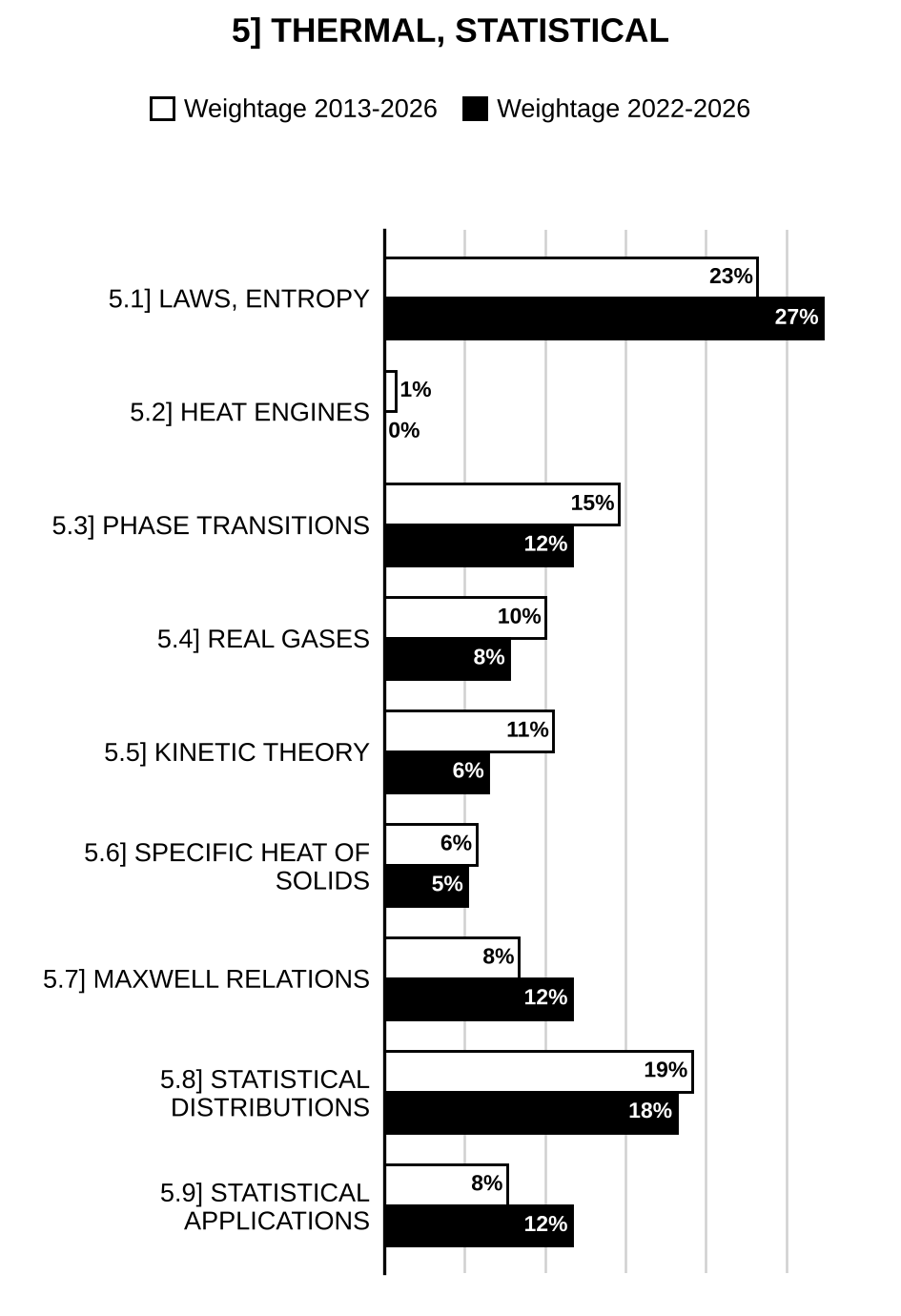
5.1] Laws of thermodynamics and entropy
40 questions
What are the limitations of the first law of thermodynamics? One mole of a gas, assumed to be perfect, at 0 °C is heated at constant pressure till its volume is twice its initial value. Calculate the amount of heat absorbed. Given, and . [2026/10m/5d]
A reversible heat engine operates with three reservoirs at 300 K, 400 K and 1200 K. It absorbs 1200 kJ energy as heat from the reservoir at 1200 K and delivers 400 kJ work. Determine the heat interactions with the other two reservoirs. [2025/10m/5e]
Prove that the work done by a perfect gas during a quasi-static adiabatic expansion is given by where is the ratio of specific heats. [2024/10m/5d]
Explain the – diagram for the reversible Carnot cycle and hence obtain the expression for the efficiency of the Carnot engine. [2024/10m/8a(i)]
Using Zeroth law of thermodynamics, introduce the concept of temperature. Explain how the isotherms of two different systems can be drawn. [2023/10m/5d]
A piston-cylinder device initially contains air at 150 kPa and 27°C. At this state, the piston is resting on a pair of stops, as shown in the figure, and the enclosed volume is 400 L. The mass of the piston is such that a 350 kPa pressure is required to move it. The air is now heated until the volume is doubled. Determine: (i) the final temperature, (ii) the work done by the air, and (iii) the total heat transferred to air. Given: and Gas constant of air,
[Figure: A vertical piston-cylinder device in cross-section: a U-shaped cylinder with hatched (solid) walls and base, open at the top (an upward arrow above the top of each side wall). Inside, a horizontal piston (labelled “Piston”) rests on a pair of stops (hatched blocks, labelled “Stop”) attached to the inner faces of the two side walls. The space below the piston contains air, labelled “Air, L, kPa, °C”. An arrow labelled Q points into the right-hand wall near the bottom, showing heat supplied to the air.] [2023/20m/7b]
A body of constant heat capacity and a temperature is put into contact with a reservoir at temperature . Equilibrium between the body and the reservoir is established at constant pressure. Determine the total entropy change and prove that it is positive for either sign of . Consider . [2022/10m/5b]
A compressor designed to compress air is used instead to compress helium. It is found that the compressor overheats. Explain this effect, assuming that the compression is approximately adiabatic and the starting pressure is same for both the gases. [2022/10m/6b(ii)]
A thermally insulated cylinder, closed at both ends, is fitted with a frictionless heat-conducting piston which divides the cylinder in two parts. Initially, the piston is clamped in the centre, with one litre of air at 200 K and 2 atm pressure on one side and one litre of air at 300 K and 1 atm pressure on the other side. The piston is released and the system reaches equilibrium in pressure and temperature, with the piston at a new position. Compute the final pressure and temperature. [2022/15m/7b]
Explain the characteristics of the following thermodynamic processes for a perfect gas: (i) Isothermal process (ii) Adiabatic process (iii) Isobaric process (iv) Isochoric process Obtain the expression for the work done by the gas during the above processes. [2021/20m/6c]
(i) The melting point of tin is 232°C, its latent heat of fusion is 14 cal/g and the specific heat of solid and molten tin are 0.055 and 0.064 cal/g °C respectively. Calculate the change in entropy when 1.0 gm of tin is heated from 100°C to 300°C. (ii) Calculate the efficiency of an engine having compression ratio 13.8 and expansion ratio 6 and working on diesel cycle. Given . [2021/15m/8a]
State the first law of thermodynamics for a diffusively interacting system. The temperature of 10 g of air is raised by 2°C at constant volume. Calculate the increase in its internal energy. Given: [2020/10m/5d]
What is Carnot’s theorem? Prove that Carnot’s reversible engine is the most efficient one and no other engine can be more efficient than Carnot’s engine. [2019/15m/7c]
The pressure on 100 g of solid copper is increased quasi-statically and isothermally at 0°C from 0 to Pa. Assuming the density and isothermal compressibility to remain at constant values of 8.96 g/cm³ and , respectively, calculate the work done. Comment on the sign and magnitude of work. [2018/15m/7b]
1 litre of hydrogen at 127 °C and pressure expands isothermally until its volume is doubled and then expands adiabatically until its volume is redoubled. Calculate the resulting pressure. [2017/10m/5d]
A reversible engine converts 1/6 of the heat input into work. When the temperature of the sink is reduced by 62 °C, its efficiency is doubled. Find the temperatures of source and sink. [2017/10m/8c]
gram of water at temperature is isobarically and adiabatically mixed with an equal mass of water at temperature . Show that the change in entropy is given by , where and . [2016/10m/5d]
One kg of water at 20°C is converted into ice at –10°C at constant pressure. Heat capacity of water is 4,200 J/kg.K and that of ice is 2,100 J/kg.K. Heat of fusion of ice at 0°C is J/kg. Calculate the total change in entropy of the system. [2014/15m/7b]
A thermally insulated ideal gas is compressed quasi-statically from an initial state with volume and pressure to a final state of volume and pressure . Show that the work done on the gas in the process is given by where and R having standard meanings. [2013/10m/5c]
In Leh, temperature of ice on a cold winter night is measured as – 20°C. Calculate the change in entropy when 1 kg of ice is converted into steam at 100°C. Given specific heat capacity of ice is , latent heat of ice is , latent heat of steam is and . [2013/15m/8b]
1 kmol of an ideal gas is compressed isothermally at 400 K from 100 kPa to 1000 kPa in a piston and cylinder arrangement. Calculate the entropy change of the gas, the entropy change of the surroundings and the total entropy change resulting from the process if the process is mechanically reversible and the surroundings consist of a heat reservoir at 400 K. [2010/10m/5d]
Consider one mole of an ideal gas whose pressure changes with volume as , where is a constant. If it is expanded such that its volume increases m times, find the change in internal energy, work done by the gas and heat capacity of the gas. [2010/25m/8a]
Define entropy. How is it related to disorder? Hence, derive the Boltzmann relation , where is the probability and k is the Boltzmann constant. Show that for any type of process, involving a closed system where the equality sign applies for internally reversible processes and the inequality for internally irreversible processes. [2009/20m/8a]
Prove the law of increase of entropy. Show that for a system at fixed temperature and pressure to be in equilibrium, its Gibbs free energy should be minimum. [2007/20m/5a]
A system at temperature is brought in contact with a reservoir at temperature . When the system and the reservoir reach thermal equilibrium, calculate the change in entropy of the universe assuming the heat capacity of of the system to be constant. Discuss whether the considered change is positive or not. [2007/20m/5b]
1 kg of ice at 0° C floats on 10 kg of water at 30° C, the whole system being thermally isolated. What will be the change in entropy of the sytem when thermal equilibrium is reached? [Specific heat of water = and latent heat of fusion of ice = ]. [2006/20m/5d]
Show that the entropy of one gram molecule of an ideal gas is given by [2004/20m/5c]
A gas expands isothermally from the pressure and volume to the pressure and the volume . Calculate (i) the change in internal energy. (ii) the change in entropy. (iii) the change in enthalpy. What will be the corresponding quantities when the gas expands adiabatically? [2004/30m/8a]
Two bodies A and B have the same mass m each and are made of the same material with specific heat C per unit mass. A is at a temperature T and B is at a temperature 4T. What will be the entropy change of the universe when the bodies are brought into diathermic contact with each other? [2003/20m/8a]
Solve any three of the following: Describe Carnot cycle and show that efficiency is given by where the symbols have their usual meaning. [2002/20m/5c]
Calculate the increase in entropy when 1 kg ice melts at zero degree centigrade. The Latent heat of fusion of ice is joules/kg. (Assume that the melting is an isothermal reversible process) [2001/20m/5c]
Define the efficiency of a Carnot Engine. An engine is designed to have an efficiency of 25% and to absorb heat at a temperature of 267° C. Find the maximum temperature at which it can exhaust heat. [2000/20m/1d]
What is an adiabatic process? Give three engineering examples of adiabatic processes which are in common use. [2000/20m/6a]
The specific heat of a substance is found to vary with temperature in the following way where c(T) is the specific heat at the temperature T and ‘a’ and ‘b’ are constants. Compare the average specific heat of the substance in the temperature range 0–T to the specific heat at the mid-temperature T/2. [1999/20m/1c]
Explain the concept of internal energy of a system. Formulate mathematically the first law of thermodynamics. Calculate the work done in an isothermal compression of a gas. [1999/20m/2c]
Prove that evaluated along a reversible path joining the states A and B does not depend on the path chosen. Hence define the entropy function S. Calculate the entropy change in an ideal gas undergoing a state change from (V, P) to (2V, P/2) for three suitably chosen different paths and show that the result turns out to be the same all the cases. [1998/20m/6a]
Explain the concept of entropy The specific heat of a material depends on temperature T according to the relation: where a, b and c are constants, Derive an expression for the change in its entropy when the temperature changes from to . [1996/20m/5c]
How is absolute scale of temperature obtained with the help of Carnot cycle? Hence define absolute zero. [1996/20m/7a]
State Nernst’s heat theorem. Taking the example of adiabatic demagnetisation show that no adiabatic process initiated at non-zero-temperature can lead to zero temperature. [1995/20m/4c]
Define entropy, Derive expressions for the entropy of a perfect gas in terms of (i) T and v (ii) T and p The symbols have their usual meanings. [1995/20m/5c]
5.2] Heat engines
3 questions
(i) The melting point of tin is 232°C, its latent heat of fusion is 14 cal/g and the specific heat of solid and molten tin are 0.055 and 0.064 cal/g °C respectively. Calculate the change in entropy when 1.0 gm of tin is heated from 100°C to 300°C. (ii) Calculate the efficiency of an engine having compression ratio 13.8 and expansion ratio 6 and working on diesel cycle. Given . [2021/15m/8a]
Derive an expression for the thermal efficiency of a reversible heat engine operating on the Diesel cycle with an ideal gas of constant heat capacity as the working medium. [2010/25m/8b]
Describe the Otto cycle and obtain an expression for the efficiency of the cycle, Show that the efficiency is lower than that of a Carnot cycle operating between the highest and the lowest temperature of Otto cycle. [2003/20m/8b]
5.3] Phase rule and phase transitions
18 questions
Calculate the pressure at which water will boil at 150 °C, given that the change in specific volume when 1 gram of water is converted into steam is . Given, latent heat of vaporization for steam = 540 cal per gram, ergs/cal and one atmospheric pressure = . [2026/15m/7b]
A ternary system consists of three components (A, B and C) in equilibrium with two phases. Determine the number of degrees of freedom using the Gibb’s phase rule and discuss the effect of pressure and temperature variations on the phase equilibrium. [2025/15m/7a]
Explain why, at equilibrium, the chemical potential of a component must be the same in all coexisting phases. Derive the equilibrium condition for a binary liquid-vapour system in terms of chemical potential. [2025/15m/8b]
Obtain the Clausius-Clapeyron equation. Using this equation, show that for the phase boundary of the liquid and vapour phases, p–T relation can be written as . Here it has been assumed that the latent heat L is independent of temperature, that vapour is treated as an ideal gas and that and that as . [2020/15m/7c]
What is Gibbs’ phase rule? Find the values of degrees of freedom when (i) only the liquid is in equilibrium with the gaseous . (ii) water is in the vapour-liquid saturation region. (iii) water is in a single-phase region. (iv) water is at the triple point. [2019/15m/7a]
Explain the effect of pressure on the melting and boiling points of a substance using Clapeyron’s latent heat equation. Calculate under what pressure, water will boil at 120°C, if the change in specific volume when 1 gram of water is converted into steam is . Latent heat of steam = 540 cal/g, 1 atmospheric pressure . [2019/15m/8c]
Derive Clausius-Clapeyron equation. How does it explain the effect of pressure on melting point of solids and boiling point of liquids? [2017/10m/7d]
What do you understand by the term ‘phase transition’? Using Clausius-Clapeyron equation, show that for first-order phase transitions, vapour pressure decreases exponentially with temperature. You can assume that the vapour behaves like an ideal gas and latent heat remains constant with temperature. [2016/15m/8b]
The vapour pressure of an organic substance is Pa at 40°C. Its normal boiling point is 80°C. If the substance in vapour phase can be treated like an ideal gas, find the latent heat of vaporization of the substance. [2015/15m/6c]
Explain the four thermodynamic relations of Maxwell. Using the same, obtain the Clausius-Clapeyron equation [2014/15m/8c]
The vapour pressure, in mm of Hg, of a substance in solid state is given by the relation , where T is in Kelvin. The vapour pressure, in mm of Hg, of the substance in liquid state is given by the relation . Calculate (i) the coordinates of the triple point, and (ii) the latent heat of vaporisation at the triple point. Take Gas constant . [2013/15m/8a]
Calculate the change in pressure for a change in freezing point of water equal to . Given, the increase of specific volume when 1 gm of water freezes into ice is 0.091 cc/gm and latent heat of fusion of ice is 80 cal/gm. [2010/10m/5e]
State Gibbs phase rule. Show that for a 1-component closed thermodynamic system having two phases, the condition for equilibrium between the phases is that their specific Gibbs functions are equal. [2009/10m/5b]
Show that the chemical potential of a system is an intensive quantity and is a function of temperature and pressure only. [2005/20m/8c]
Write short notes on the following: (i) Coriolis force (ii) Clausius – Clapeyron Equation (iii) Debyes’s theory of specific heat (iv) Adiabatic demagnetisation (v) Holography. [2000/60m/8]
Prove the latent heat equation where and are specific heats of saturated vapour and the liquid in contact with it respectively. Given the following values referring to 1 gm of water at 100 °C: L = 539 Cal/gm, , . Calculate . Explain why the specific heat takes a negative value. [1998/20m/2b]
Clausius Clapeyron equation. [1998/20m/8d]
Using a Carnot cycle obtain the Clausius Clayperon equation. At normal pressure the ratio of densities of ice and water is 9:10. When 1 kilo-mole of ice is melted, the change in entropy is . If the external pressure is increased by , what will be the change in the melting point of ice? [1997/20m/4a]
5.4] Real gases
16 questions
Discuss briefly the considerations which led Van der Waals to modify the gas equation. What are the critical constants of a gas? Calculate the values of these constants in terms of the constants of the Van der Waals equation. [2025/15m/7b]
Define Joule-Kelvin coefficient. Write it in its mathematical form. [2023/5m/6b(i)]
Determine the Joule-Kelvin coefficient for a van der Waals gas. Hence, obtain an expression for temperature of inversion. Discuss the conditions under which heating or cooling is produced. [2023/10m/6b(ii)]
Calculate the critical constants for for which the Van der Waals constants are given by and . Also calculate the Boyle’s temperature of . The unit of pressure is atmosphere and the unit of volume is that of a gm-mole of the gas at NTP. [2021/10m/5d]
What are the conditions for the change in temperature of a van der Waals gas passing through a porous plug? Prove that the ideal gas passing through the porous plug does not show any change in temperature. [2019/10m/150w/5d]
Calculate the critical temperature for helium, given the values for critical constants, , , where the unit of pressure is atm and the sample is kept at NTP. [2017/10m/8b]
Write down van der Waals’ equation of state for moles of a gas and calculate the temperature at which 5 moles of the gas at 5 atm pressure will occupy a volume of 20 litres. Given, , , and . [2016/10m/7d]
A Van der Waals gas undergoes Joule-Kelvin expansion with a pressure drop of 50 atm. If its initial temperature is 300°K, determine its final temperature. (Given Van der Waals constant , , , ) [2015/10m/5e]
For a Van der Waals gas, write down the equation of state. Determine the coefficient of critical expansion . [2015/15m/8c]
Define Enthalpy and show that it remains constant in a throttling process. [2014/10m/5b]
What led van der Waals to modify the ideal gas equation? Using the concepts of critical temperature , pressure and volume , show that the critical constant for a real gas is 8/3. [2011/20m/8a]
Find out the expressions for van der Waals constants a and b. [2011/20m/8b]
Calculate the values of van der Waals constants a and b for oxygen with , atmosphere and atmosphere/K. [2011/20m/8c]
Using thermodynamic principles show that the Joule-Thomson coefficient μ can be expressed as Calculate the value of μ for an ideal gas and interpret your result physically. [2006/20m/8a]
Obtain van der waals’ equation of state for real gases. What is the value of critical coefficient for an ideal gas? Show that the value of the critical coefficient for van der Waals’ gas is independent of the type of gas. [2001/20m/8b]
Hydrogen and oxygen suffer Joule-Thomson expansion at room temperature. Discuss the results with reasons. [1995/20m/1c]

Preparing for Prelims too?
Our UPSC Prelims Topic-wise PYQ eBook covers every Prelims question with detailed explanations, so you can see exactly where UPSC asks from.
View the BookDownload Free Sample5.5] Kinetic theory
27 questions
Use the Maxwell-Boltzmann distribution to find the number of oxygen molecules whose velocities lie between 195 m/s and 205 m/s at 0°C. The given mass of oxygen gas is 0.1 kg. (Assume mass of proton to be kg) [2023/15m/8c]
Assume that the Earth’s atmosphere is pure nitrogen in thermodynamic equilibrium at a temperature of 300 K. Calculate the height above sea level at which the density of the atmosphere is one-half its sea level value. (Molecular weight of is 28 gm/mole) [2022/10m/5a]
Starting from Maxwell-Boltzmann distribution for a free particle in 3-dimension, obtain the expression for root mean square (rms) speed of a particle. Calculate the rms speed of nitrogen () molecule at room temperature (27°C). [2020/20m/7b]
Write and explain the Maxwell-Boltzmann distribution. Using this distribution, find the expressions for the most probable speed, mean speed and root-mean-square speed. [2017/15m/8a]
The molecules of a gas obey Maxwell-Boltzmann distribution. Calculate the fraction of molecules of the gas within 1% of the most probable speed at STP. Interpret your result. [2016/10m/5e]
The viscosity in a liquid arises due to friction between adjacent layers. What causes viscosity in a gas? Explain. [2016/5m/8d(i)]
The molecules of a gas obeying Maxwell-Boltzmann distribution move with an average speed of . If the coefficient of viscosity of the gas is , density of the gas is and number density is , calculate the mean free path and diameter of the gas molecules. [2016/10m/8d(ii)]
Consider a system of free gas particles having f degrees of freedom. Use equipartition theorem to establish the relation where and are molar specific heats at constant pressure and constant volume respectively. Obtain the values of for diatomic and triatomic gases. [2014/15m/8a]
The coefficient of viscosity of helium at 27°C is . Calculate (i) the average speed and (ii) the diameter of a helium molecule, if it is assumed that the gas obeys Maxwell – Boltzmann distribution. Given Boltzmann constant and mass of helium atom kg. [2013/10m/8c]
Derive an expression for the Maxwellian distribution of velocities for the molecules of an ideal gas. [2001/20m/8a]
Explain the evaporation of a liquid at a temperature below its boiling point on the basis of kinetic theory of matter. [2000/20m/2c]
What is the most probable distribution of speeds in a large number of molecules of a gas and indicate the steps for its derivation. [2000/20m/3a]
A tank whose capacity is contains helium at a pressure of 10 atmospheres and a temperature of 20°C. A rubber weather balloon is inflated with this helium. (i) When the pressure of helium in the balloon is 1 atmosphere, its temperature is –40° C. Find the volume of the balloon. (ii) Eventually the helium in the balloon absorbs heat from the air around it and returns to 20° C. Find the volume of the balloon at this time. [2000/20m/5c]
At the N.T.P., the mass of one litre of Hydrogen is 0.09 gm. Calculate the (i) RMS (ii) Mean and (iii) Most Probable Speed at 27° C. [1999/20m/4a]
The RMS speed of oxygen molecules at 0° C is . What would be the RMS speed of Argon molecules (Mol. wt. = 40 gm/mole) at 40° C and at what temperature this speed would be double than at N.T.P.? [1999/20m/7a]
The molecules of a gas are made up of four non coplanar atoms. Enumerate the translational, vibrational and rotational degrees of freedom of each molecule. Hence obtain the specific heat at constant volume of the gas. Does the value so obtained agree with the observed value in general? If not why? [1998/20m/2a]
Brownian motion. [1998/20m/8b]
A gas at a pressure P and temperature T has a density . The velocity of sound in this gas is v. Obtain an expression for the degrees of freedom of the gas molecules. At STP, and . Calculate the degrees of freedom. [1997/20m/1d]
Show the distribution of velocities for temperatures , and () of gas molecules according to the Maxwell-Boltzmann law. Using this law prove that the most probable velocity is times the root-mean-square velocity. [1997/20m/4c]
Obtain an expression for the mean free path. Mention the correction introduced by Maxwell. Calculate the value of Avogadro’s number if the mean free path of nitrogen molecules at STP is m. The molecular diameter is 3.5 Å. [1997/20m/5b]
Law of equipartition of energy. [1997/20m/8c]
A vacuum of the order of cm of Hg is obtained in the laboratory. Estimate the number of molecules of gas per cubic centimeter at 27°C in that vacuum. [1996/20m/1d]
What is Brownian motion? Deduce Einstein’s formula for translatory Brownian motion of particles suspended in a liquid and hence determine the Avogadro’s number. [1996/20m/2c]
State the principle of equipartition of energy. What are its limitations? Show that it is applicable only when the energy is a quadratic function of the associated variable. [1996/20m/4a]
To what extent the pressure in a cathode ray tube must be reduced so that 90% of the electrons emitted by the cathode reach the anode which is at a distance of 20 cm from the cathode? The mean molecular radius of main constituent gases of atmosphere is 2Å and the number of molecules at standard pressure (760 mm of Hg) is per . [1996/20m/4c]
Calculate the most probable speed , the average speed and the root-mean-square speed for hydrogen molecules at 273 K. [1995/20m/4b]
Brownian motion. [1995/20m/8c]
5.6] Specific heat of solids
14 questions
Two solids and have Debye temperatures 200 K and 300 K respectively. At K, compare their specific heats. [2026/10m/5e]
Why does the specific heat of solids depend on material at low temperatures but become independent of material at high temperatures? [2026/5m/8c(ii)]
The specific heat of a solid at low temperatures is given by the relation , where is a constant and is the absolute temperature. How much heat will be required to raise the temperature of gm of the solid from 300 K to 500 K? [2024/5m/8a(ii)]
Einstein’s molar specific heat capacity of a solid is given by where Obtain the expressions for the cases: (i) when (ii) when What is the discrepancy of Einstein model to explain the variation of specific heat capacities of solids with the temperature? The molar specific heat capacity of a solid at constant volume is at 36.8 K. Determine the Debye temperature of the solid. [2019/20m/7b]
If the temperature variation of heat capacity is known, how do you calculate the change of entropy during an isochoric process? According to Debye’s theory of specific heat of a solid, the molar heat capacity of diamond crystal at constant volume varies with temperature (T) as follows: where R is the molar gas constant = 8.315 J/mol-K and = 2230 K for diamond. Calculate the change in entropy of diamond of 0.36 g mass when it is heated at constant volume from 0 K to 300 K. [2018/20m/7a]
The Einstein theory of specific heat of solids gives the expression where with as the Einstein temperature. (i) Mention Einstein’s assumptions in deriving it. Also obtain low- and high-temperature limiting expressions for it. (ii) Give schematic plot of versus and comment on the validity of expressions in (i) in comparison with experiments. [2012/25m/8c]
What are the limitations of Einstein’s theory of specific heat of solids when compared with experiments at low temperature? Outline the assumptions made in Debye’s theory and show that the specific heat at low temperature follows law. What is the significance of Debye’s temperature, ? [2009/20m/8b]
State Dulong and Petit’s law. How does it agree with experiment? Discuss the limitations of the classical theory and success of the quantum theory in explaining the specific heat of solids. [2006/20m/8b]
Discuss the differences in the assumptions underlying Einstein and Debye theories of specific heat . Give schematic plots of versus reduced temperature for these therories and elucidate the differences therein. Elaborate the meaning of the “law of corresponding states” for these plots. [2005/20m/5c]
Mention the assumptions made by Einstein in explaining the variation of specific heat of solids with temperature. Show how these assumptions were used to derive the formula for the specific heat of solids. How and why Einstein’s theory fails at very low temperatures. [1999/20m/4b]
State the basic assumptions of Debye theory of specific heat of solids and write the expression for derived from this theory. Show that this expression yields the famous law of specific heat at low temperature. Discuss the extent to which the theory agrees (or disagrees) with observation on specific heat through the variation of the Debye characteristic temperature with temperature, in general. [1998/20m/7a]
Debye theory of specific heat of solids. [1997/20m/8d]
Specific heat of solids. [1996/20m/8b]
Write the expressions obtained from Einstein’s and Debye’s theories for the specific heat of solids. What is the basic difference between the two theories? Calculate the heat required to raise the temperature of a solid of mass m from to in the low temperature region. [1995/20m/4a]
5.7] Maxwell relations and adiabatic demagnetisation
19 questions
Define internal energy , Helmholtz’s function , enthalpy , Gibbs’ potential and hence obtain the four Maxwell’s thermodynamic relations. [2024/20m/6c]
One mole of gas obeys van der Waals equation of state. If its molar internal energy is given by (in which is the molar volume, is one of the constants in the equation of state and is a constant), calculate the molar heat capacities and . [2022/10m/6b(i)]
A gas of interacting atoms has an equation of state and heat capacity at constant volume given by the expressions where through are constants which are independent of and . Find the differential of the internal energy in terms of and . [2022/15m/6c]
Discuss the principle of adiabatic demagnetization process to achieve low temperatures. Determine the fall in temperature produced by adiabatic demagnetization of a paramagnetic material at initial temperature of 3 K when the magnetic field is switched off from 10,000 oersted to zero. Given: heat capacity at constant magnetic field and Curie constant per gram mole per . [2020/15m/7a]
One mole of a gas obeys the following equation of state: where v is the molar volume and, a and b are constants. Show that internal energy of the gas increases as the volume increases, with the temperature remaining constant. [2018/10m/5d]
At 4°C temperature, the density of water is found to be maximum. Prove that heat capacity at the constant pressure is equal to the heat capacity at constant volume for water at 4°C. [2018/10m/5e]
Explain the four thermodynamic relations of Maxwell. Using the same, obtain the Clausius-Clapeyron equation [2014/15m/8c]
Show that the Helmholtz free energy of a system never increases in any isothermal-isochoric transformation. [2012/12m/5d]
Establish the relation and then derive . Hence show that the heat capacity of an ideal gas is independent of pressure P. [2012/20m/6c]
Prove the law of increase of entropy. Show that for a system at fixed temperature and pressure to be in equilibrium, its Gibbs free energy should be minimum. [2007/20m/5a]
Establish the relation Use it to find out an expression for of one mode of a gas whose internal energy is given by and which satisfies the equation of state . Here a, b and c are constants. [2007/25m/8a]
Consider the expression and give reasoning regarding the values of T when for water. Also, evaluate for a vander Waals gas to elaborate that its value is larger for any real gas as compared to an ideal gas. [2005/20m/5d]
Write short notes on the following: (i) Coriolis force (ii) Clausius – Clapeyron Equation (iii) Debyes’s theory of specific heat (iv) Adiabatic demagnetisation (v) Holography. [2000/60m/8]
Explain how very low temperatures can be produced by adiabatic demagnetisation. [1999/20m/5c]
Write short notes on any three of the following: (i) Geostationary satellites (ii) Applications of Bernoulli’s equation (iii) Thermodynamic potentials (iv) Forced oscillations (v) Carnot cycle (vi) Holography. [1999/60m/8]
Define Helmholtz free energy F and Gibbs free energy G. What does decrease in F and G signify? Show that the internal energy U at temperature T is given by [1997/20m/3b]
Using Maxwell’s thermodynamic relations show that the internal energy of an ideal gas at a constant temperature is independent of its volume while for a real gas it is a function of Volume also. [1996/20m/4b]
State Nernst’s heat theorem. Taking the example of adiabatic demagnetisation show that no adiabatic process initiated at non-zero-temperature can lead to zero temperature. [1995/20m/4c]
Define thermodynamic temperature of a magnetic system. Discuss how cooling takes place due to adiabatic demagnetisation. Explain, why cooling due to adiabatic demagnetisation is important at low temperatures. [1995/20m/7a]
5.8] Statistical distributions
30 questions
A gas has only two particles and . Show with the help of diagrams how these two particles can be arranged in three energy states 1, 2, 3 using (i) Maxwell-Boltzmann, (ii) Fermi-Dirac and (iii) Bose-Einstein statistics. [2026/20m/7a]
The average kinetic energy of hydrogen atoms in a certain stellar atmosphere, assumed to be in thermal equilibrium, is 1.2 eV. Calculate the ratio of the number of atoms in the second excited state () to the number in the ground state. [2026/10m/8c(i)]
Consider a mixture of molecules of a monatomic gas A and molecules of a monatomic gas B. For this mixture, obtain the Helmholtz free energy and pressure. (The particle partition function for a monatomic gas is ). [2025/15m/6c]
Calculate the Fermi energy in electron-volt for sodium assuming that it has one free electron per atom. The density of sodium = 0.97 gm/cc and the atomic weight of sodium is 23. [2024/10m/5e]
What do you understand by macrostates and microstates? Briefly explain. [2024/5m/7b(i)]
Write down the expressions for the Fermi-Dirac distribution and the Bose-Einstein distribution. Plot the distributions as a function of the energy. [2023/10m/5e]
Eight indistinguishable balls are to be arranged in six distinguishable boxes. Calculate the total number of ways in which the above can be done. [2021/10m/5b]
(i) Write the expression for the Fermi-Dirac distribution. Plot the Fermi-Dirac distribution at and for . Now from the plot propose two alternative definitions of the Fermi level. (ii) Calculate the probability of an electron occupying an energy level 0.02 eV above the Fermi level at K. [2021/20m/8b]
(i) The energy level of a quantum harmonic oscillator with frequency is given by Calculate its partition function. (ii) Calculate the partition function of a two level system. [2020/10m/5e]
A gas has only two particles, a and b. With the help of a diagram, show that how these two particles can be arranged in the three quantum series 1, 2, 3 using (i) Maxwell-Boltzmann, (ii) Fermi-Dirac, and (iii) Bose-Einstein statistics. [2019/10m/150w/5e]
A system having two energy levels, and with = 10 meV is populated by 1000 particles at a low temperature close to 100 K. Obtain the average energy per particle using classical distribution law. [2018/15m/7c]
Schematically, show the variation of density of states, and distribution function, , of particles in a non-relativistic Fermi gas at high temperatures. At a temperature T, an electron occupies a state with energy 100 meV above the Fermi energy with the probability of 1%. Find the temperature T. [2018/20m/8c]
Explain Bose-Einstein distribution and obtain the same from the grand canonical ensemble. [2017/15m/8d]
Consider a system of particles and a phase space consisting of only two states with energies 0 and . Obtain the expressions for the partition function and the internal energy of the system, if it obeys M-B statistics. [2016/10m/8c]
Show that both Fermi-Dirac and Bose-Einstein distribution functions at an energy E are given by: where f(E) is much smaller than unity, and are the chemical potential and thermal energy of the atom. [2014/10m/8b]
N particles obeying Classical Statistics are distributed among three states having energies , and , where is Boltzmann constant. If the total equilibrium energy of the system is , calculate the value of N. [2013/10m/8d]
Show that both Fermi-Dirac and Bose-Einstein distributions reduce under certain condition in a form which gives the total number of particles as where A is a constant and . Further show that this expression is just the same as that obtained from the Maxwellian speed distribution. [2012/30m/7c]
Write down the expressions for Bose-Einstein and Fermi-Dirac distribution functions, and show how Fermi-Dirac distribution leads to the explanation of Pauli’s exclusion principle. [2011/10m/5c]
Calculate the number of different arrangements of 10 indistinguishable particles in 15 cells of equal a priori probability, considering that one cell contains only one particle. [2010/10m/5f]
Consider the following statement: “The Fermi energy of a given material is the energy of that quantum state which has the probability equal to of being occupied by the conduction electrons.” Is the above statement correct? Give reasons for your answer. [2010/10m/8c]
Energy distribution for particles in classical statistical mechanics is given by where and are constants. is the single particle states in the i th level. Using equipartition theorem, show that correct thermodynamic interpretation is (Use and ) [2009/20m/8c]
Derive a relation between the total number of Fermions in terms of Fermi momentum and hence obtain the expression for the total energy E of the system at absolute zero. Combine this expression with the equation of state to show that the pressure of an ideal Fermi gas at T = 0 is proportional to 5/3 power of its number density. [2007/35m/8b]
Derive the expression for the Fermi-Dirac distribution function. Represent it graphically for T = 0 and T ≠ 0. [2006/20m/8c]
Starting from the expression , where is the average number of particles in the quantum state, derive an expression for the average number of particles in the ground state of an ideal Bose gas. [2005/15m/8a]
Utilize the above expression to elaborate the concept of the Bose–Einstein condensation and discuss that the phenomenon explains qualitatively the properties in the low-temperature phase of liquid He. [2005/25m/8b]
Show that for a distribution of electrons, the number of electrons in the energy state are given by where represents the number of quantum states in the energy level . Further state under what conditions this distribution law goes over to Maxwell-Boltzmann statistics. Show by drawing curves how the Fermi-Dirac distribution function varies with the energy at T = 0 and also at the other finite temperatures. [2004/30m/8b]
100 particles at a temperature T and distributed among three energy levels , and . What is the total energy of the system? [2003/20m/5d]
Define Fermi energy. For an ideal Fermi gas of N particles at absolute zero temperature, show that the total energy of is , where is the Fermi energy. [2003/20m/8c]
Solve any three of the following: Derive the Bose-Einstein distribution for an ideal gas. [2002/20m/5d]
Discuss the phenomenon of Bose-Einstein condensation. Obtain the expression for the condensation temperature. Briefly comment on observation of Bose-Einstein condensate. [2002/30m/8a]
5.9] Applications of statistical physics
12 questions
Derive the Planck’s radiation law for blackbody radiation using the Bose-Einstein distribution function. Explain how results from quantum statistics differ from classical results derived from the Rayleigh-Jeans law. [2025/20m/8c]
A three-level laser system emits laser light at a wavelength of 550 nm. If the population of the upper level exceeds that of the lower level by 25%, determine the negative temperature characterizing the system. [2024/10m/7b(ii)]
What do you understand by negative temperature? Write and explain various restrictions on a system for the concept of negative temperature to be meaningful. [2022/15m/8b]
If the partition function for a perfect gas is given by calculate (i) average kinetic energy per molecule and (ii) specific heat of the gas. [2019/15m/8a]
Using the Maxwell-Boltzmann distribution law, show that there cannot be any negative absolute temperature. [2017/10m/5e]
Using Maxwell-Boltzmann distribution law prove that there cannot be any negative absolute temperature. [2014/10m/8d]
Consider non-equilibrium situation for a system in which the population inversion has been achieved. Explain that such a system can be treated as if it has negative absolute temperature. [2012/12m/5e]
How can one obtain a temperature and identify the elements in stellar bodies using Saha’s thermal ionisation equation? [2001/20m/8c]
How one can obtain the various types of information about the physical conditions on the stellar surface using thermal ionization equation to interpret the stellar spectra. [2000/20m/7b]
What is population inversion? Mention the methods of achieving population inversion. Explain the concept of negative temperature. [1997/20m/7b]
Stellar spectra. [1996/20m/8a]
Concept of negative temperature. [1995/20m/8a]

Strengthen your GS papers
Our UPSC Mains Topic-wise & Year-wise PYQ eBook (2013–2026) maps every GS question to the syllabus, so you know what UPSC asks and how often.
View the BookDownload Free Sample« Previous: Electromagnetic Waves and Blackbody Radiation | Next: Quantum Mechanics »
Back to: Physics Optional PYQs – Topic-wise
Last updated: 30 October 2026