
Medical Science Optional PYQs Topic-wise for UPSC Mains (1995–2026) are listed below unit by unit, in the order of the official syllabus – 1806 questions in all. Click any unit to open all its previous year questions, arranged topic-wise with the latest first.
Want full papers instead? Open the Medical Science Optional year-wise question papers for Paper I and Paper II.
Paper I
| Unit | Topic (click to open PYQs) | Sub-topics | Questions | Link |
|---|---|---|---|---|
| 1 | Human Anatomy | 6 | 183 | Click here → |
| 2 | Human Physiology | 6 | 174 | Click here → |
| 3 | Biochemistry | 4 | 124 | Click here → |
| 4 | Pathology | 5 | 130 | Click here → |
| 5 | Microbiology | 5 | 125 | Click here → |
| 6 | Pharmacology | 5 | 159 | Click here → |
| 7 | Forensic Medicine and Toxicology | 4 | 124 | Click here → |
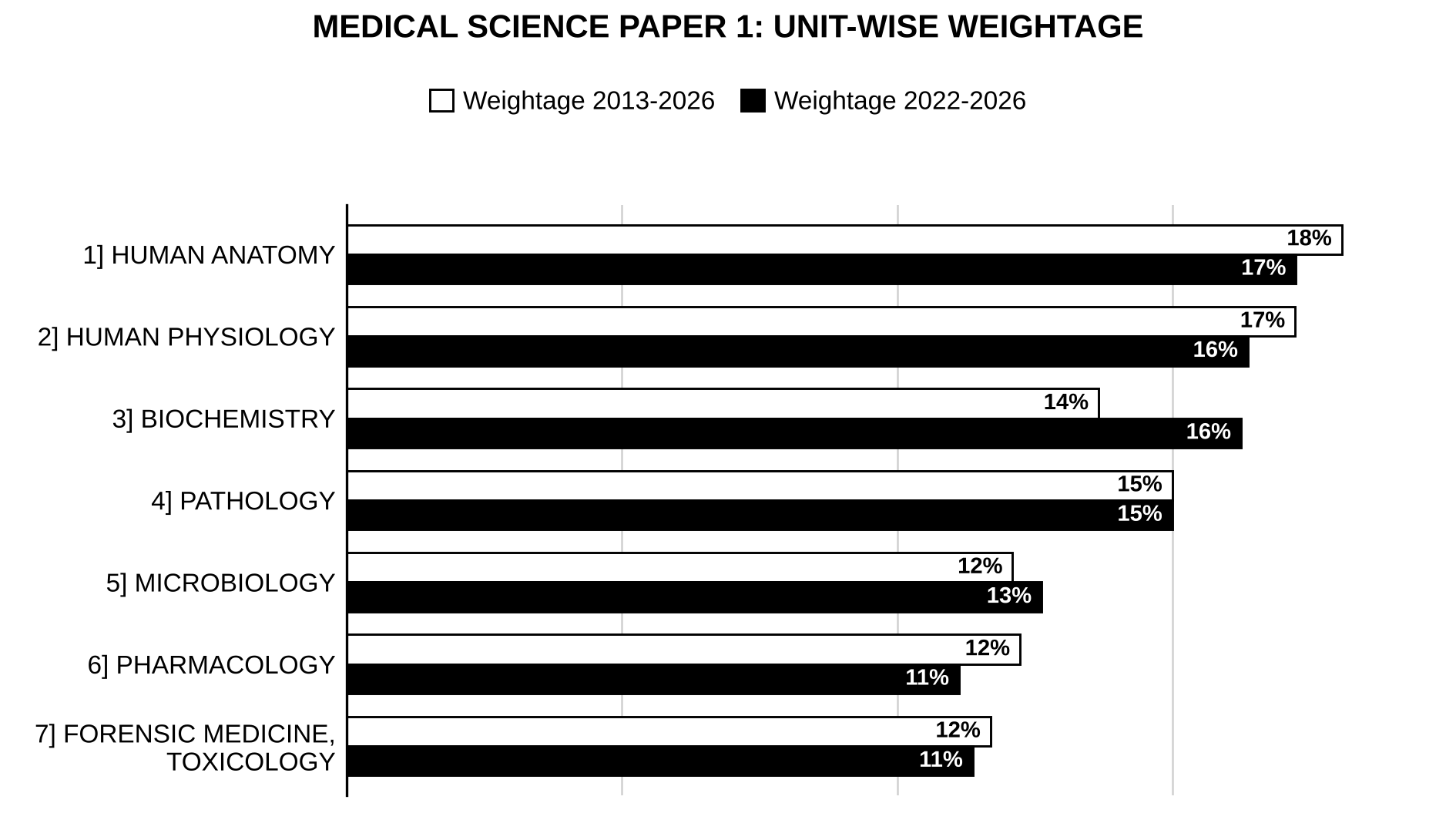
Trend: Paper I spreads its marks over seven units: Human Anatomy (about 17–18%) and Human Physiology (16–17%) carry the most, followed by Pathology (about 15%), Biochemistry (14–16%), Microbiology (about 12%), Pharmacology (11–12%) and Forensic Medicine and Toxicology (about 11–12%). The most-asked topics since 2013 are vitamins and minerals (3.3), limbs and joints (1.1) and the gross anatomy of organs (1.2), specific cancers (4.4), neurophysiology (2.2), analgesics and antimicrobials (6.1) and endocrine physiology (2.3). In 2022–2026 Biochemistry has gained, especially protein synthesis (3.2), and asphyxial deaths and burns (7.4) and fungal infections (5.5) have come up more often, while analgesics and antimicrobials (6.1) and the blood and seminal stain / DNA questions (7.2) have been asked less.

Preparing for Prelims too?
Our UPSC Prelims Topic-wise PYQ eBook covers every Prelims question with detailed explanations, so you can see exactly where UPSC asks from.
View the BookDownload Free SamplePaper II
| Unit | Topic (click to open PYQs) | Sub-topics | Questions | Link |
|---|---|---|---|---|
| 1 | General Medicine | 8 | 197 | Click here → |
| 2 | Paediatrics | 4 | 105 | Click here → |
| 3 | Dermatology | 2 | 77 | Click here → |
| 4 | General Surgery | 9 | 150 | Click here → |
| 5 | Obstetrics and Gynaecology Including Family Planning | 5 | 145 | Click here → |
| 6 | Community Medicine (Preventive and Social Medicine) | 7 | 113 | Click here → |
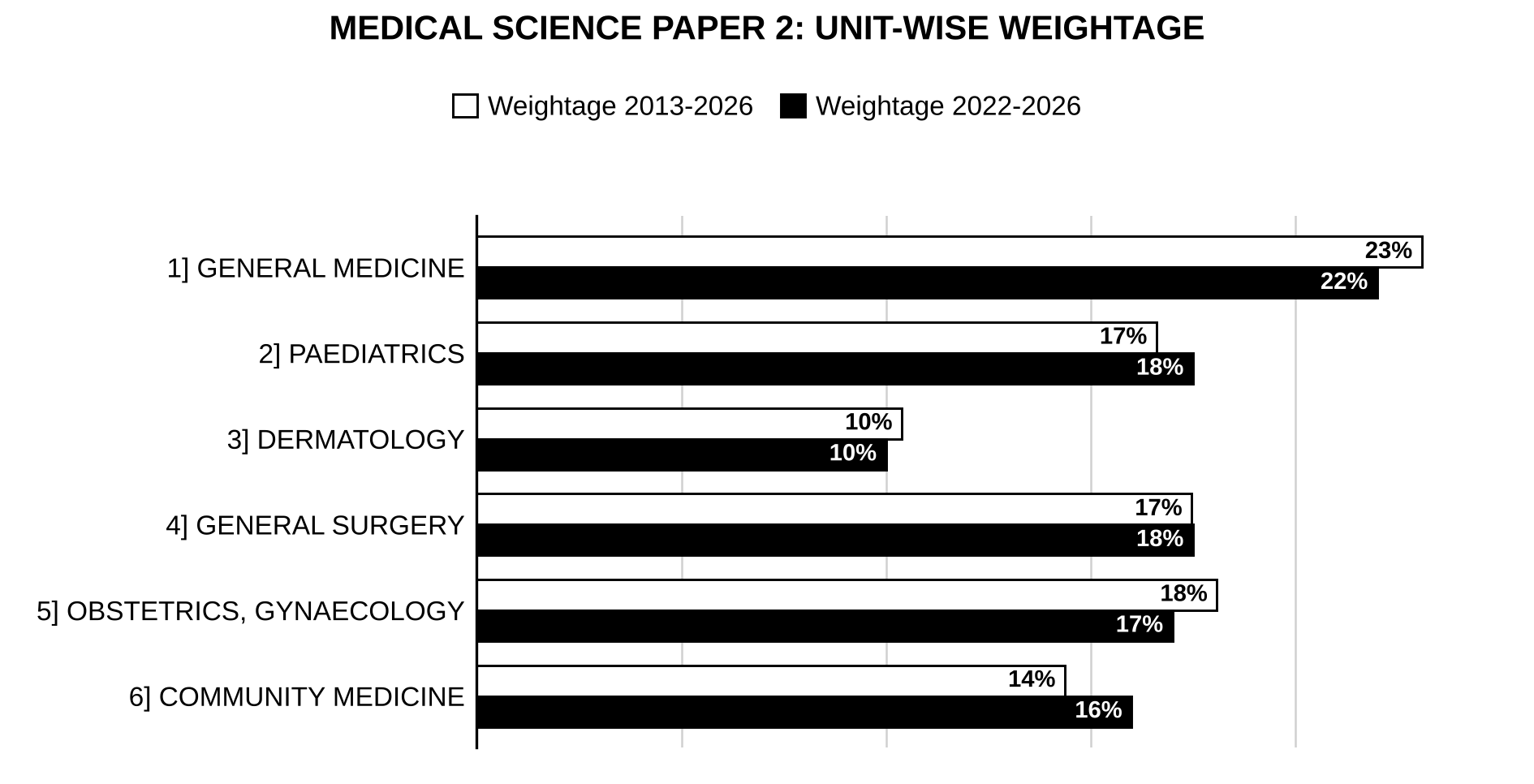
Trend: In Paper II General Medicine is the largest unit (about 22–23%), followed by Obstetrics and Gynaecology (17–18%), General Surgery (about 17–18%), Paediatrics (17–18%), Community Medicine (14–16%) and Dermatology (about 10%). The most-asked topics since 2013 are psoriasis, eczema and dermatitis (3.1), gynaecology (5.5), neonatal and cardiac conditions in children (2.2), cardiovascular and respiratory diseases (1.2), IMNCI, ARI and diarrhoea (2.3), labour and its complications (5.2) and national disease control programmes (6.4). In 2022–2026 immunization (2.1), national programmes (6.4), endocrine and haematological diseases (1.5) and surgery of the oesophagus, stomach and bowel (4.4) have come up more often, while neonatal and cardiac conditions (2.2), infectious diseases (1.1) and newborn care (5.3) have been asked less.
More questions
Other questions (outside the present syllabus) – 28 questions
How this collection is organised
Considering the changing exam pattern over the years, we felt it necessary to declare some practices we’ve adopted in this collection.
Units follow the official syllabus – Paper 1: 1 Human Anatomy, 2 Human Physiology, 3 Biochemistry, 4 Pathology, 5 Microbiology, 6 Pharmacology, 7 Forensic Medicine and Toxicology; Paper 2: 1 General Medicine, 2 Paediatrics, 3 Dermatology, 4 General Surgery, 5 Obstetrics and Gynaecology including Family Planning, 6 Community Medicine. The official syllabus has been divided into numbered topics (e.g. Paper 1 – 3.3 Vitamins and minerals) to arrange the questions.
The syllabus names particular diseases, drugs and organisms; questions on others of the same kind are placed under the nearest topic: for example, other bacteria under bacterial infections (Paper 1 – 5.2), other cancers under specific cancers (4.4), respiratory physiology under cardiovascular physiology (2.6); in Paper 2, other medical diseases under the nearest system topic of General Medicine, and programmes not named in the syllabus (leprosy, blindness) under national disease control programmes (6.4). Questions that fit no topic of their subject (e.g. general pharmacology, intermediary metabolism) are kept under “Other Questions (Outside the Present Syllabus)” at the end of each paper.
Until 2008 the two papers followed an older syllabus, and some subjects appeared in the other paper. The 1995–2000 papers also had a different layout: a compulsory Question 1 followed by three or four sections. Such questions of 1995–2007 are placed under the topic of the present syllabus, even when that topic is now in the other paper; Part III shows each paper as set. From 2009 every question is kept in its own paper.
Some questions cover more than one topic. We’ve kept such questions in each topic of relevance.
Every diagram printed with a question is given as a complete description in square brackets – [Figure: …] – with every numbered pointer and label shown, so that the question can be solved from the description. Standard tables attached to a paper are not reproduced.
Graphs at the start of each paper show the weightage of every unit in that paper, and graphs for each unit show the weightage of its topics. Weightage is the share of marks asked from a unit or topic, compared for 2013–2026 (white bars) and the last five years, 2022–2026 (black bars). A question placed under two topics has its marks split equally between them.
Each of the topicwise question is suffixed by a question code like this [2024/20m/2a]. This code indicates a) year in which the question was asked, b) maximum marks the question carried, c) prescribed word limit (where UPSC set one, e.g. 200w) and, d) the question number in actual paper, in given order.
Until 2012, each paper carried 300 marks (60 per question); since 2013 each paper carries 250 marks (50 per question). Where a compulsory question offered more parts than were to be answered (“any three” of four), every part is included with its own marks. Where a retyped copy of an older paper prints no marks for a part, the code carries the marks implied by the question. Split marks such as 15+5=20 are kept as printed.
The 2026 papers are transcribed from the official UPSC question papers, 2009–2025 from scans of the printed papers, and 1995–2007 from typed copies (for every year two copies were found, but they go back to one typing). Where a copy prints no marks for a question, the code carries the marks implied by the question pattern. No copy of the 2008 papers could be found.
The wording, figures and data of the questions are as printed, including the papers’ own grammar and apparent misprints such as misspelt drug or disease names; these are listed with the likely intended reading in the year-wise notes.
Spotted an error? Use the “Report an Error” box at the end of any page – we review every report and update the page.

Strengthen your GS papers
Our UPSC Mains Topic-wise & Year-wise PYQ eBook (2013–2026) maps every GS question to the syllabus, so you know what UPSC asks and how often.
View the BookDownload Free SampleLast updated: 31 October 2026