
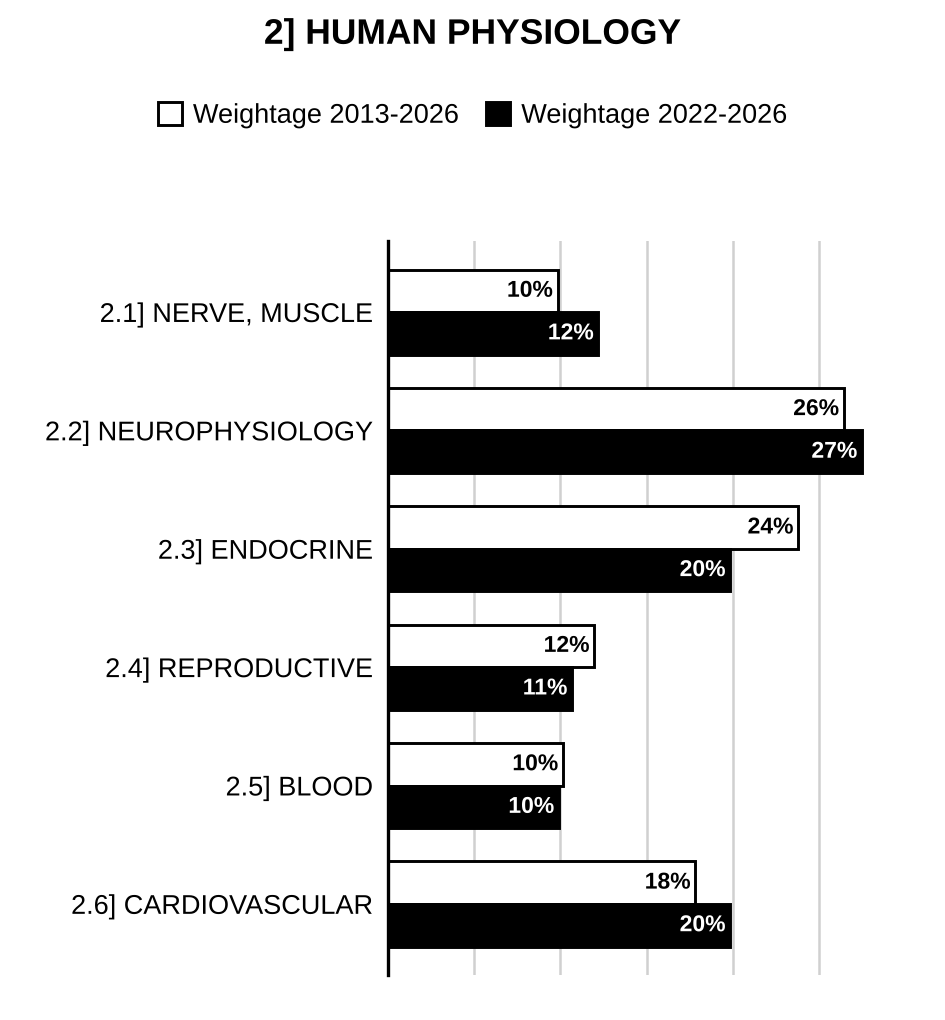
Here are all 174 Human Physiology questions asked in UPSC Medical Science Optional Paper I from 1995 to 2026, arranged under the 6 topics of the official syllabus. Within each topic the latest questions come first.
Each question ends with a code such as [2024/15m/3b] – the year, the marks, the word limit (where UPSC set one) and the question number in the paper.
2.1] Nerve and muscle physiology
16 questions
Describe the phases of action potential in a neuron. State the difference in ‘conduction’ between myelinated and unmyelinated neuron. [2026/10m/1d]
Describe the process of generation and conduction of nerve impulses in humans. Add a note on saltatory conduction. [2025/10m/1d]
Give the sequence of events at the neuromuscular junction during the transmission of a nerve impulse. Name the muscles most commonly affected by myasthenia gravis. [2024/10m/1d]
Discuss the mechanism of excitation-contraction coupling in the skeletal muscle. [2022/10m/3a(ii)]
With the help of a schematic diagram describe the process of excitation-contraction coupling in skeletal muscles. Add a note on Rigor mortis. [2020/10m/1b]
Illustrate a diagram of Neuromuscular function elaborating neuromuscular transmission and muscular contraction. [2019/5m/4b(i)]
What are modes of contraction in a skeletal muscle? Give suitable examples. Explain length-tension relationship in skeletal muscle. [2018/10m/3a(ii)]
Give the sequence of events that occurs during transmission of nerve impulse through neuromuscular junction. [2015/10m/150w/1b]
Differentiate between isometric and isotonic contraction in skeletal muscle. Give one example of each type. [2015/10m/150w/1c]
Define synapse, enumerate the steps of synaptic transmission. What is the significance of synaptic delay? [2013/10m/1c]
Name the contractile proteins in skeletal muscle. What is the electron microscopic appearance of muscle? Write sequence of events in muscular contraction. [2011/15m/2d]
Discuss in short the structure and sequence of events at neuromuscular junction during nerve impulse transmission. Add a note on myasthenia gravis. [2011/20m/3a]
Describe the sequence of events in neuromuscular transmission. What happens in myasthenia gravis? [2005/20m/1c]
Compare with the help of a diagram the length-tension relationship for skeletal, cardiac and smooth muscles. What is the latch phenomenon in smooth muscle? [2001/20m/3a]
Answer any three of the following (each in about 200 words): (i) Explain why cyanosis does not occur in histotoxic hypoxia. (ii) Explain briefly how drinking large amounts of plain water leads to an increase in urinary output. (iii) Explain why cardiac muscle cannot be tetanized. (iv) Enumerate the advantages of saltatory conduction. [1998/20m/200w/1a]
Describe the sequence of events during impulse transmission of neuromuscular junction. How can neuromuscular junction be blocked? [1996/20m/2a]
2.2] Neurophysiology
43 questions
With the help of a suitable well-labelled diagram, explain the principal connections of basal ganglia. [2026/10m/1e]
Discuss the structure and function of Golgi tendon organ. [2026/5m/3c(ii)]
Discuss in brief the functional divisions of cerebellum and state the role of each division. [2026/5m/4c(i)]
Discuss in brief the medial and lateral descending pathways and their functions. [2026/5m/4c(ii)]
With the help of a suitable diagram, explain the innervation and functions of muscle spindle. [2025/10m/1e]
Describe the components of the nervous system which are concerned with ‘conscious alert state’ that makes perception possible. [2024/10m/1e]
Describe the role of cerebellum in control of voluntary movement. Add a note on cerebellar dysfunction. [2023/10m/1d]
Describe the genesis of Rapid Eye Movement (REM) sleep. Why is REM sleep called paradoxical sleep? [2023/10m/1e]
Discuss the functions of basal ganglia. Add a note on Parkinson’s disease. [2022/10m/3a(i)]
Draw a well-labelled diagram of stretch reflex. [2022/5m/4b(i)]
What are the functions and clinical applications of stretch reflex? [2022/10m/4b(ii)]
Describe the role of cerebellum in maintenance of posture and equilibrium. [2021/10m/1b]
Compare and contrast the features of Rapid Eye Movement (REM) and non-REM sleep. [2021/10m/1e]
With the help of a neatly-labelled diagram describe the cortico-spinal tract from its origin to termination. Add a note on Upper Motor Neuron paralysis. [2020/10m/3a(i)]
Describe the pathophysiology and clinical features of Parkinson’s disease. Give a brief account of the physiological basis of its treatment. [2020/10m/3a(ii)]
A 52 year old chronic alcoholic man has difficulty in his gait with imbalance and tendency to fall. Elaborate the underlying physiology of motor coordination and features of cerebellar dysfunction. [2019/10m/1b]
Describe the physiological mechanism involved in control and maintenance of tone, posture and equilibrium and its various anatomical structures and pathways. [2019/10m/3a(i)]
Elaborate types and stages of sleep along with EEG findings. Describe neuronal and neurohumoral mechanism causing sleep with possible role of serotonin in it. [2019/10m/3a(ii)]
What are extra pyramidal tracts? Describe their functions. How do they differ from pyramidal tracts? [2018/10m/1b]
Describe the functions of spinocerebellum. [2017/10m/1d]
Describe the functions of basal ganglia in voluntary actions. [2017/10m/3a(i)]
Compare the functions of basal ganglia with primary cortex. [2017/10m/3a(ii)]
Discuss the neurophysiological basis of sleep. [2016/10m/1d]
Describe the role of cerebellum in regulation of posture and movement. What is cerebellar ataxia? [2016/20m/3a]
Name the lateral descending tracts. List the effects of their lesion. What will happen to sensory loss in the lesion around central canal of spinal cord? [2014/10m/1b]
Define sleep. What are the different types of sleep? What are the differences in sleep of a newborn compared to that of an adult? What type of waves will be seen in electroencephalographic record in deep sleep? [2014/20m/3a]
Define reflex. Classify them with examples and their significance in daily life. [2012/12m/1c]
Describe the origin, course and function(s) of corticospinal tracts. Add a note on effect(s) of damage to these tracts and the resulting paralysis. [2012/30m/2b]
Define sleep. Write briefly on architecture of a sleep cycle. What are the variations in it with age? [2010/12m/1c]
Define consciousness. Which areas of the brain are mainly responsible for it? What are the disturbances of consciousness? [2009/15m/1c]
What are the functional divisions of cerebellum? What will happen in lesion of each? [2009/20m/3a]
Describe neuronal pathways and reflexes which maintain balance and posture of human body. [2007/20m/2c]
Discuss the physiology of normal sleep. [2007/20m/4a]
List the features of cerebellar lesions and their physiological basis. [2006/20m/1c]
What are the different mechanisms for regulation of body temperature? Why in summer, when humidity of air increases the person feels more uncomfortable? [2003/20m/200w/1c]
Which are the main circadian rhythms in the body? Discuss any one of them. [2002/20m/3b]
Describe the role of hypothalamus in the control of secretion of pituitary hormones. How is body temperature regulated by the hypothalamus? [2001/20m/200w/1c]
Describe the reflex arcs of stretch and inverse stretch reflexes. What are the differences in the properties of monosynaptic and polysynaptic reflexes? [2001/20m/3b]
What is plantar reflex? How it is elicited? Describe its nerve supply and importance. [2000/12m/200w/1c]
(i) Describe the structure and functions of muscle spindle. (ii) Compare the properties of monosynaptic and polysynaptic reflexes. [1999/20m/3b]
Define muscle tone, flaccid and spastic muscle. Describe the higher centres controlling muscle tone. Compare classical and ischaemic decerebration. [1997/20m/2b]
Classify the nuclei of hypothalamus. Describe its relationship to food and water intake. [1995/20m/2a]
What are normal EEG waves? How are they generated? Compare EEG between REM and NREM sleep. Add a note on clinical significance of EEG. [1995/20m/3a]
2.3] Endocrine physiology
37 questions
Describe the functions of growth hormone. Write a note on the regulation of secretion of growth hormone. [2026/10m/2c(i)]
Discuss the mechanism of action of insulin at receptor level. [2026/5m/2c(ii)]
With the help of suitable examples explain the second messenger mechanisms that mediate the downstream actions of hormones inside the cell. [2025/10m/3c(i)]
Give a brief account of synthesis, storage, secretion and functions of the posterior pituitary hormones. [2025/5m/3c(ii)]
Enumerate the major hormonal causes of dwarfism. Give their characteristic features. [2024/10m/3c(i)]
Describe the functions of vasopressin and the regulation of vasopressin secretion. [2023/10m/4c(i)]
Describe the physiological effects of glucagon. [2023/5m/4c(ii)]
Discuss the regulation of secretion and physiological functions of growth hormone. [2022/10m/1b]
Elaborate on the hormonal regulation of blood glucose level. Explain in brief the signs and symptoms of hypoglycemia. [2021/20m/3a]
Explain in detail the absorption and hormonal regulation of blood calcium in body. Discuss in brief the clinical manifestations of hypocalcemia. [2021/20m/4a]
Give an account of the synthesis, release, regulation and functions of the hormones of the posterior pituitary. [2020/10m/4b(ii)]
Enumerate various hormones secreted by pituitary gland with their cell types. [2019/5m/2b(i)]
A 28 year old man noticed marked enlargement of bones of his hands and feet along with coarsening of facial features and prognathism. He was diagnosed as a case of pituitary adenoma. What ailment he is suffering from and its features? Describe physiological status of anterior pituitary hormones of this patient and its control mechanism. [2019/10m/2b(ii)]
Discuss in detail the hormonal regulation of calcium and phosphate homeostasis. Add a note on the causes and clinical manifestations of hypocalcemia. [2019/15m/3b]
Give an account of characteristics of a hormone. Describe the hormonal regulation of calcium level in the blood. [2018/10m/1e]
List growth promoting hormones. Explain their contribution to growth after birth. [2018/7m/4b(ii)]
Name the hormones secreted by pituitary gland. Describe the role of growth hormone in the body. [2016/15m/4b]
Name the hormones involved in the regulation of blood glucose level. Discuss the pathophysiology of diabetes mellitus. [2015/15m/4b]
Enumerate the hormones of posterior pituitary gland and describe their actions in the body. [2015/15m/4c]
Write the various roles of calcium in the body. How is blood calcium level regulated? [2014/20m/2a]
Discuss the physiological basis of signs and symptoms seen in insulin deficiency, explain the saying starvation in the midst of plenty. [2013/20m/3c]
Why pancreas is called a dual gland? What is the mechanism of hyperphagia in insulin deficiency? How will you differentiate between hypoglycemic coma and hyperglycemic coma? [2012/12m/1d]
What are the growth curves of various body organs after birth? Enumerate the various factors affecting growth. Discuss briefly clinical abnormalities related to growth. [2011/20m/3b]
What is the role of ADH in maintaining the plasma osmolarity and volume? What will happen in its deficiency? [2010/20m/3a]
What are the hormones which regulate growth and development of human body during adolescence? How development is regulated by them? [2007/20m/1c]
Describe the endocrine functions of hypothalamus. Enumerate the clinical features of Acromegaly. [2007/20m/3c]
Name the hormones of posterior pituitary and their function. What will happen in the deficiency of them? [2006/20m/3a]
Explain the physiological basis of various signs and symptoms of Diabetes mellitus. [2005/20m/3b]
List anterior pituitary hormones and their main actions in brief. What will happen in the deficiency of growth hormone? [2004/20m/3a]
Enumerate the hormones secreted by thyroid gland. What is the mechanism of thyroid enlargement in iodine deficiency in diet? [2003/20m/3b]
What are the different hormones and other factors affecting growth? [2002/20m/200w/1c]
Describe the role of hypothalamus in the control of secretion of pituitary hormones. How is body temperature regulated by the hypothalamus? [2001/20m/200w/1c]
What is the mechanism, sites of actions and of origin of insulin? What other hormones balance it in human body and how? [2000/20m/3a]
Discuss the mechanism of action of Hormones. [1999/20m/2b]
Give an account of the structure, secretion and functions of insulin. [1997/20m/200w/1b]
Discuss the regulation of gastric secretion and motility. [1997/20m/3b]
Discuss the calcium-phosphorus homeostasis in human body and disorders associated with it. [1996/20m/200w/1c]

Preparing for Prelims too?
Our UPSC Prelims Topic-wise PYQ eBook covers every Prelims question with detailed explanations, so you can see exactly where UPSC asks from.
View the BookDownload Free Sample2.4] Reproductive physiology
22 questions
Discuss in brief the role of oxytocin in parturition and lactation. [2026/5m/4c(iii)]
Describe the principal events during oogenesis in brief. [2024/5m/3c(ii)]
Explain the physiological changes that occur in a mother during pregnancy, under the following headings: (i) Genital organs (ii) Blood and its constituents (iii) Cardiovascular system. [2023/15m/2c]
Discuss the physiological functions of placental hormones in pregnancy. [2022/10m/1e]
Describe the key events occurring in the ovarian cycle with reference to their hormonal basis. Enumerate the diagnostic tests for ovulation. [2021/15m/2b]
Describe the hormonal regulation of the development of breast and lactation. Draw a schematic labelled diagram of the milk ejection reflex. [2020/10m/2b(ii)]
Explain the changes which takes place during luteal phase of menstrual cycle. [2018/10m/3a(i)]
Show the sucking reflex through a diagram. Describe positive and negative feedback actions of estrogen. [2017/8m/4b(i)]
Explain the term Ovulation. Name the hormones necessary for ovulation. How is the knowledge of ovulation time helpful? [2014/15m/2b]
What are the functions of placenta? What do you mean by feto-placental unit? [2014/15m/4b]
What are the advantages of breast-feeding? Why is there amenorrhoea during lactation? [2014/15m/4c]
Discuss briefly the role of different hormones in lactation. Why there is amenorrhoea during lactation and what is its importance? [2012/20m/3a]
Write about the tests which indicate that the female is ovulating. [2011/20m/3c]
Write the steps in lactation. What are the advantages of breast feeding? [2010/12m/1d]
Define menstrual cycle. What changes occur in the uterus during the cycle? Name the common disorders of the menstrual cycle. [2009/20m/3c]
Describe normal menstruation. Why is it absent during the first few months of lactation? [2006/20m/3b]
List the hormones secreted by placenta and their functions. What is the physiological basis of early immunological test for pregnancy. [2005/20m/3a]
What is Puberty? Summarise the changes that occur at Puberty in females. [2004/20m/3c]
What changes take place in the ovary, uterus, vagina and breast during a menstrual cycle? [2003/20m/3c]
What changes are produced in the uterus by female sex hormones during the menstrual cycle? How can the cycle be delayed? [2002/20m/3c]
Describe the structure and functions of ovary. [2001/20m/200w/1b]
Describe the microscopic anatomy of testis. Add a note on spermatogenesis. [2000/12m/200w/1a]
2.5] Blood
26 questions
Briefly describe the development of Cell-Mediated Immunity. List the cell types involved, along with their actions. [2025/5m/4c(i)]
Briefly describe the process of Phagocytosis. [2025/5m/4c(ii)]
Give an account of the formation and function of thrombocytes. [2025/5m/4c(iii)]
Give the physiological basis of anaemia in kidney and liver disease. [2024/5m/4c(i)]
Describe the role of eosinophils in control of allergy reactions. [2024/5m/4c(ii)]
Describe the role of platelets in haemostasis. [2024/5m/4c(iii)]
Discuss the factors regulating erythropoiesis. [2023/5m/3c(ii)]
Give an account of the factors that affect the formation and maturation of erythrocytes. [2020/5m/2b(i)]
Explain regulation of megakaryocytopoiesis. [2018/5m/2b(i)]
Give an account of monophylactic theory of haemopoiesis. [2018/8m/4b(i)]
Enumerate the sites for formation of erythrocytes in the embryo, foetus and adults. [2017/5m/2b(i)]
Describe the characteristic changes in the cytoplasm and nucleus during erythropoiesis. [2017/10m/2b(ii)]
Describe the process of thrombolysis. Write briefly about anti-coagulants. [2016/15m/2b]
Describe the morphological characteristics of platelets and their functions. What will happen in their deficiency? [2014/10m/1c]
Enumerate the factors required for normal erythropoiesis. Why polycythaemia occurs at high altitude? [2013/15m/3a]
List the various types of cells found in the blood and their functions. What will happen due to deficiency of each type? [2012/20m/3b]
Write the morphology of red blood corpuscles. List the factors required for their formation and mention how the shape is advantageous. [2010/20m/3b]
Discuss in short the morphology, functions and disorders of platelets. [2009/20m/3b]
Describe the normal development and differentiation of haematopoietic cells. [2007/20m/3a]
Describe the control and regulation of normal homeostasis. [2007/20m/4b]
What will be the consequences if a Rh -ve mother carries a Rh +ve fetus and how can they be prevented? [2006/20m/3c]
List the various types of cells found in blood and the precursor cell, function and normal values of each. [2005/20m/3c]
What are the steps of homeostasis? Why blood clotting is abnormal in patients with Vitamin K deficiency? [2004/20m/3b]
What is the normal percentage of reticulocytes in blood? Mention the conditions in which reticulocyte count increases, giving reasons. [2003/20m/3a]
What do you mean by haemorrhagic disorders? Name the two common disorders. What are the steps of haemostasis? [2002/20m/3a]
How are platelets formed? Describe the properties and functions of platelets. [2001/20m/3c]
2.6] Cardiovascular physiology
30 questions
Describe any two methods to measure cardiac output. Explain the role of ‘Frank-Starling law’ in cardiac contraction. [2026/10m/3c(i)]
Define cardiac output and describe the regulation of cardiac output in normal adults. Add a note on Cardiac Index and Cardiac Reserve. [2025/10m/2c(i)]
Define Systemic Vascular Resistance and list its determinants. Briefly explain the role of its determinants. [2025/5m/2c(ii)]
Define the Frank-Starling law. State the significance and causes of shift of Frank-Starling curve to right and left. [2024/10m/2c(i)]
What is the role of baroreceptors and chemoreceptors in the regulation of blood pressure? [2024/5m/2c(ii)]
Describe the intrinsic regulation of cardiac output. [2023/10m/3c(i)]
Discuss the physiological mechanism of short-term and long-term regulation of arterial blood pressure. [2022/15m/2b]
Describe the key mechanisms for regulation of cardiac output. Comment on the changes observed in moderate isotonic exercise. [2021/15m/4b]
Define blood pressure and describe the Neuro-endocrine regulation of blood pressure with the help of flow charts. [2020/15m/3b]
Describe the functional significance of atrio-ventricular nodal delay and add a note on Wolff-Parkinson-White syndrome. [2020/5m/4b(i)]
Describe various Cardiovascular changes during physical exercises. [2019/10m/4b(ii)]
Define the term “cardiac reserve”. Explain how is its control governed? [2018/10m/2b(ii)]
Describe baroreceptor reflex mechanism in the regulation of blood pressure. [2017/7m/4b(ii)]
Draw a diagram to depict blood flow in left versus right coronary artery. [2016/10m/1c]
Define ‘cardiac output’ and ‘cardiac index’. Describe the regulation of cardiac output in the body. [2015/20m/3a]
Describe the role of baroreceptors in regulation of B.P. Why this is effective only in short term regulation of blood pressure (B.P.)? [2013/15m/3b]
What are the effects of exercise on cardiovascular system? What is the importance of exercise in maintaining the health of CVS? [2012/20m/3c]
Define Blood Pressure. Enumerate the various factors affecting the blood pressure. How is the blood pressure regulated in the long term? [2011/10m/1d]
Enumerate the functions of cardiovascular system. What will happen if valves would not have been there? [2010/20m/3c]
Define cardiac output. What factors maintain it? What happens to it during exercise and how? [2009/20m/4a]
What are the properties and functions of pulmonary surfactants. Discuss the pulmonary function tests. [2007/20m/3b]
Define sinus arrythmia. How is it produced and what is its clinical significance? [2006/20m/4b]
What is cardiac output? What are the factors affecting it? [2003/20m/4b]
Name the different chemoreceptors present in the body. Write the mechanism of action of any one of them. [2002/20m/2b]
What are the normal values of diffusion capacities of oxygen and carbon dioxide? Which factors affect the diffusion of oxygen in lungs? [2002/20m/4b]
What is nerve-supply of carotid sinus? What are the functions of carotid sinus? [2000/12m/200w/1d]
What are the main factors which maintain and regulate venous return? [2000/20m/3b]
What are the factors which increase oxygen supply to more active tissues? [2000/20m/3c]
Define ECG. Describe the common leads used to record ECG. Describe a normal ECG with the help of a labelled diagram. [1998/20m/3b]
Define hypoxia and classify its types. What are the physiological factors causing hypoxia? Discuss the role of oxygen in each type. [1996/20m/3a]

Strengthen your GS papers
Our UPSC Mains Topic-wise & Year-wise PYQ eBook (2013–2026) maps every GS question to the syllabus, so you know what UPSC asks and how often.
View the BookDownload Free Sample« Previous: Human Anatomy | Next: Biochemistry »
Back to: Medical Science Optional PYQs – Topic-wise | Also see: Medical Science Optional year-wise question papers
Last updated: 31 October 2026