
Here are all 125 Microbiology questions asked in UPSC Medical Science Optional Paper I from 1995 to 2026, arranged under the 5 topics of the official syllabus. Within each topic the latest questions come first.
Each question ends with a code such as [2024/15m/3b] – the year, the marks, the word limit (where UPSC set one) and the question number in the paper.
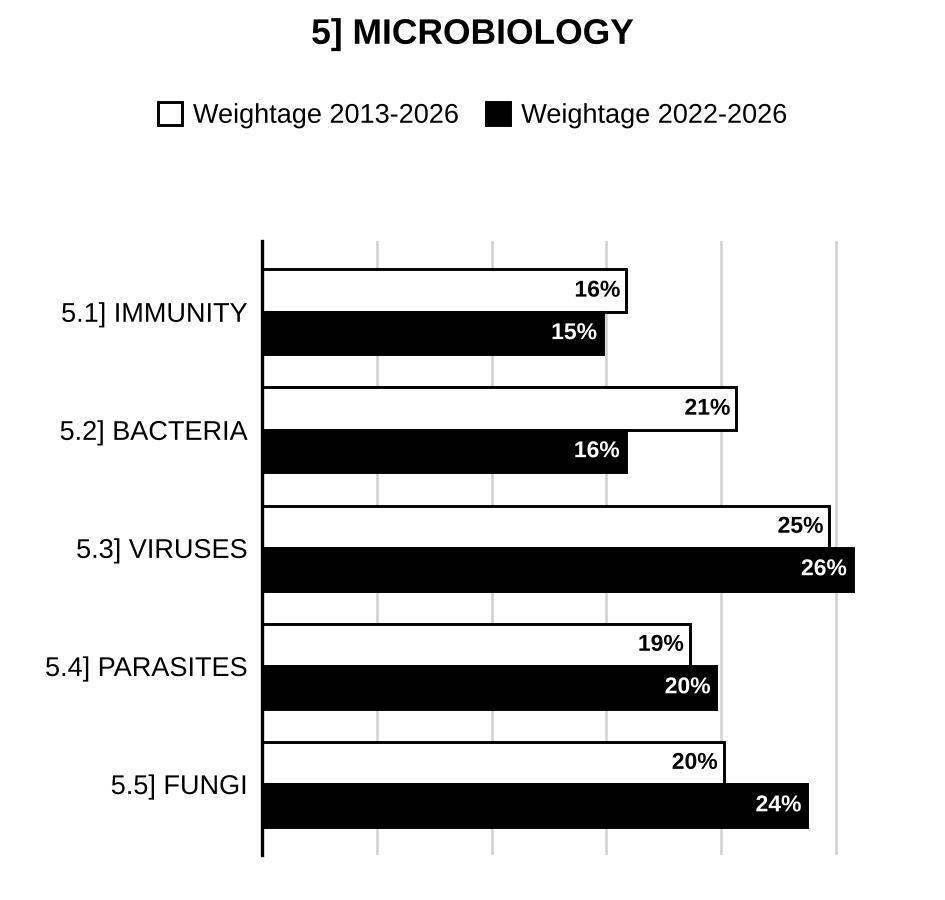
5.1] Immunity
22 questions
Enumerate any four ‘antigen-presenting cells (APCs)’. Describe in brief two major antigen processing pathways. [2026/5m/5b(i)]
Enumerate any two types of effector T cells. What are Treg cells? [2026/5m/5b(ii)]
Briefly describe the development of Cell-Mediated Immunity. List the cell types involved, along with their actions. [2025/5m/4c(i)]
Enumerate the cells of lymphoreticular system. Schematically represent the process of B-cell maturation. [2025/5m/5b(i)]
What is hypersensitivity? Enumerate different hypersensitivity reactions along with examples. Define type I hypersensitivity reaction and write its role in health and disease. [2024/10m/5b]
Describe mechanism of T-cell mediated immune response in Type IV hypersensitivity reaction. Explain it by giving example of tuberculin testing. [2023/5m/5b(i)]
Draw a diagram of IgA. What is its role in a disease? [2022/5m/5b(i)]
Explain the functions of each class of immunoglobulins. Describe the subsets of T-lymphocytes. [2021/5m/5b(i)]
Write short note on: Monoclonal antibody and its application. [2018/5m/8a(ii)]
Write short notes on Interferons and their uses. [2018/5m/8a(iii)]
Define immunological tolerance and discuss its role in autoimmunity, with one example. [2017/10m/8a(ii)]
What are the features of innate and acquired immunity? What is the mechanism of action of immunoglobulins? [2015/15m/2b]
Define and classify hypersensitivity. Describe type I hypersensitivity. [2015/10m/150w/5b]
Discuss the role of Natural Killer (NK) cells and Antibody Dependent Cytotoxic Cells (ADCC). [2014/10m/5b]
Briefly describe various cells of immune system. Discuss classification systems to differentiate lymphocytes. [2013/10m/5b]
Discuss cell-mediated immunity. [2012/12m/5b]
What is the mechanism involved in Type I hypersensitivity reaction? What types of agents can induce it? Describe the laboratory evaluation and management of allergic reactions. [2011/12m/5b]
What are Immunoglobulins? Classify Immunoglobulins. Describe their role in host defence against communicable diseases. What are the modes by which immunoglobulins act on antigens? [2010/15m/6c]
Discuss virus-host cell interactions and immunity in infection caused by viruses. [2006/20m/6b]
Discuss the genesis of two important immune-complex diseases. What serological tests will help to determine the prognosis of the illness? [2003/20m/6c]
Discuss briefly immune response to Virus Infection. [1999/20m/200w/1c]
Describe briefly acquired immunity. [1995/30m/4b]
5.2] Bacterial infections
35 questions
Make a schematic flowchart of pathogenesis of Salmonella causing enteric fever. Mention two important categories of drug resistance in Salmonella typhi. [2025/5m/5b(ii)]
What is shigellosis? What are its causative organisms and their modes of pathogenicity? Give the laboratory diagnosis of a case. [2024/10m/6c(ii)]
What is enteric fever? What are its causative agents? Give a detailed presentation of a case according to the time of the disease and the respective tests used for diagnosis. [2024/10m/8a(i)]
List the clinical diseases caused by typhoidal and non-typhoidal Salmonellae. Discuss the Widal test and its interpretation. [2023/5m/5b(ii)]
Define meningococcaemia. Discuss laboratory diagnosis of acute meningococcal meningitis. Briefly write about the available meningococcal vaccines to prevent the disease. [2023/10m/8a(ii)]
Describe the antigenic structure of Salmonella typhi with its implication in diagnosis of enteric fever cases and carriers. [2021/10m/6c(ii)]
A 20 year old man was admitted with fever, nausea, vomiting, headache, neck stiffness and confusion. CSF showed intracellular Gram negative diplococci. Write the most probable diagnosis in this case. Describe the processing of CSF sample to identify the aetiological agent. [2020/10m/5b]
A 30 year old woman presented with step-ladder type fever for 7 days. On examination, there was relative bradycardia, rose-spot rashes and hepatosplenomegaly. She was managed with probable diagnosis of enteric fever. Give details of tests to confirm the diagnosis of enteric fever in this patient. [2020/15m/6c]
Discuss the laboratory diagnosis of acute meningococcal meningitis. [2019/5m/5b(i)]
Briefly describe the pathogenesis and laboratory diagnosis of enteric fever. [2019/10m/8a(i)]
Discuss the epidemiology, pathogenesis and laboratory diagnosis of a patient presenting with bacillary dysentery. [2018/10m/8a(i)]
Discuss the pathogenesis of enteric fever. What are the different mechanisms by which salmonella acquires antimicrobial resistance? [2017/10m/8a(i)]
Discuss the pathogenecity and laboratory diagnosis of meningococcal meningitis. [2016/15m/6c]
Discuss the etiology of bacillary dysentery and its laboratory diagnosis. [2014/15m/6c]
Write briefly on pathogenesis and laboratory diagnosis of meningococcal meningitis. [2011/20m/7a]
Name the SHIGELLA species causing diseases in man. Describe the pathogenesis of Bacillary dysentery. What are the laboratory procedures in the diagnosis of Bacillary dysentery? Mention how laboratory findings in Bacillary dysentery are different from those of Amoebic dysentery. [2010/12m/5c]
What is the etiology of Epidemic Meningitis? Describe the laboratory methods in the diagnosis of Epidemic meningitis. Compare the laboratory findings with those of Aseptic meningitis. [2010/15m/6d]
Discuss the pathophysiology and laboratory diagnosis of Cholera. How does classical vibrio cholerae differ from Eltor vibrio? [2007/20m/5b]
Name various methods of acquisition of new genes in bacteria. Discuss in detail mechanism of drug resistance in bacteria. [2006/20m/5b]
Define sterilization and disinfection. Classify sterilization methods. Describe the sterilization and disinfection methods to be adopted in a District General Hospital having all the major clinical departments including the critical care units. [2005/20m/5b]
What are Nosocomial infections? Classify staphylococcal infections with examples. Explain MRSA, VISA & VRE and the significance of these in hospitals. [2005/20m/6c]
Define and classify bacterial food poisoning; give examples. Describe in detail the method of investigating a suspected outbreak of food poisoning in a school having mid-day meal programme to find the cause and source. [2004/20m/200w/5b]
What are ‘OPPORTUNISTIC INFECTIONS’? Discuss the role of AIDS in the emergence of opportunistic infections. Briefly describe the genesis and spread of “Multi-Drug-Resistance” (MDR) tuberculosis in India. [2003/20m/200w/5b]
Discuss the aetiopathogenesis of infective diarrhoeas in children. What are bacterial Resistance transfer factors (RTFs) and their role in the prevalence of infective diarrhoeas. [2003/20m/6b]
What is biological warfare? Name the agents involved, in the genesis of biological warfare. Discuss the preventive measures you would like to undertake to contain biological warfare. [2002/20m/6b]
Write briefly about the following: (i) Tuberculous meningitis (ii) Candidiasis. [2001/20m/6c]
What are the complications and sequelae of streptococcal sore throat? Discuss its treatment. [2000/12m/200w/5b]
Discuss pathogenesis and laboratory diagnosis of Cholera. [1999/30m/4b]
Discuss etiology, epidemiology and pathogenesis of bacterial food poisoning. [1998/30m/4b]
Enumerate the causes of patches in throat. How will you proceed to establish the diagnosis? [1998/30m/5b]
Define the terms sterilisation and disinfection. Describe the principles and uses of sterilisation by irradiations and vapour phase disinfectants. [1997/30m/4b]
Describe the bacterial growth curve. [1997/30m/5b]
Describe briefly about the pathogenesis of staphylococcus aureus. [1996/30m/4b]
Define cholera. Describe briefly its epidemiology and laboratory diagnosis. [1996/30m/5b]
Define “Disinfection”, and mention various chemical agents used for disinfection and their applications. [1995/30m/5b]

Preparing for Prelims too?
Our UPSC Prelims Topic-wise PYQ eBook covers every Prelims question with detailed explanations, so you can see exactly where UPSC asks from.
View the BookDownload Free Sample5.3] Viral infections
28 questions
Discuss the role of ‘antibody-dependent enhancement’ in pathogenesis of severe dengue. Write in brief the laboratory diagnosis of dengue. [2026/10m/8a(ii)]
A 12-year-old child developed fever with multiple crops of vesicular rash starting from the face spreading towards the trunk. (I) Mention the mode of transmission and spread of the probable viral agent. Prepare a flowchart of the course of the infection in humans. Mention three tests for laboratory diagnosis of the agent. (II) Discuss the post-exposure preventive strategies. [2025/10m/6c(i)]
Describe the challenges of circulating Vaccine-Derived Poliovirus (VDPV). Add a note on the environmental surveillance and preventive strategies for effective maintenance of Polio elimination. [2025/10m/8a(i)]
Draw a diagram of HIV virion depicting the various antigens and proteins. Give the serological pattern in an HIV infection according to the time of presentation. List the various diseases associated with AIDS. [2024/10m/8a(ii)]
Enumerate Human Herpes Viruses (HHV) with their primary target cells. How will you approach to diagnose a case of HSV infection in the laboratory? [2023/10m/6c(ii)]
What are opportunistic infections? Enumerate the various bacterial, parasitic, viral and fungal opportunistic infections seen in a case of AIDS. [2022/5m/5b(ii)]
What are the different dengue viruses? Give the pathogenesis of the infections by them. How is the laboratory diagnosis done in a case of dengue haemorrhagic fever? [2022/10m/6c(ii)]
Discuss the importance of cell count and viral load in HIV infection. [2021/10m/6c(i)]
Describe the uniqueness of Pulse Polio Programme in India. [2021/10m/8a(i)]
Discuss the tests you would perform for the diagnosis of HIV in the window period. [2020/5m/8a(iii)]
Discuss the laboratory diagnosis of HIV in an asymptomatic individual. [2019/5m/5b(ii)]
Discuss epidemiology, pathogenesis and laboratory diagnosis of Polio virus infection. [2019/7.5m/6c(i)]
Discuss the strategic plans laid down by NACO for diagnosis of individuals with AIDS indicative disease symptoms. [2018/5m/5b(i)]
Discuss pathogenesis and laboratory diagnosis of Dengue haemorrhagic fever. [2018/5m/5b(ii)]
(i) Describe laboratory diagnosis of AIDS. (ii) Describe laboratory diagnosis of cryptococcosis. [2016/20m/8a]
Discuss morphology and antigenic types of dengue virus. Describe the clinical manifestations and laboratory diagnosis of dengue fever. [2015/15m/6c]
Discuss the pathogenicity of poliovirus infection. How is this virus isolated during surveillance programme? [2014/20m/8a]
Discuss pathogenicity and laboratory diagnosis of Herpes simplex virus. [2013/10m/6c(ii)]
Discuss laboratory diagnosis of AIDS. [2012/10m/6c(i)]
Enumerate the important parasitic and fungal opportunistic infections which can occur during the course of HIV infection. Discuss the current strategies of HIV testing and to monitor the progress of HIV infection. Write briefly the recommended treatment. [2011/20m/6a]
Discuss briefly the following:
(i) Pathogenesis, laboratory diagnosis and prophylaxis of Dengue [2009/8m/6c(i)]
(ii) Pathogenesis, laboratory diagnosis and prophylaxis of Candidiasis [2009/7m/6c(ii)]
Discuss virus-host cell interactions and immunity in infection caused by viruses. [2006/20m/6b]
Name the STD’s and their causative agents. Describe the various modes of spread of HIV. Describe the functions of VCTC and PPTCT programme. [2004/20m/6b]
What are ‘OPPORTUNISTIC INFECTIONS’? Discuss the role of AIDS in the emergence of opportunistic infections. Briefly describe the genesis and spread of “Multi-Drug-Resistance” (MDR) tuberculosis in India. [2003/20m/200w/5b]
Discuss the etiopathogenesis and pathology of aseptic meningitis. [2002/20m/6c]
Discuss pathogenicity and laboratory diagnosis of Herpes simplex virus infection. [2001/20m/6b]
Write briefly about the diseases caused by Epstein-Barr virus. [1996/20m/200w/1b]
Describe herpes viruses and lesions produced by them. [1995/20m/200w/1b]
5.4] Parasitic infections
21 questions
1. Enumerate five agents of malaria in humans. 2. Describe in brief rapid diagnostic test (RDT) used for malaria and its advantages. 3. Mention the vaccine available for malaria. [2026/10m/8a(i)]
Enumerate the malarial parasites prevalent in India. Of them, which species is notoriously associated with life-threatening complications? What are the different characteristic peripheral blood smear findings in different species of parasites that cause malaria? [2025/10m/6c(ii)]
Discuss various stages in the asexual life cycle of Plasmodium falciparum. Describe the principle, advantages and disadvantages of non-microscopic Rapid Diagnostic Test (RDT) for diagnosis of malaria. [2023/10m/6c(i)]
What is Giardia lamblia? Write the manifestations of the disease produced by infection with Giardia and give its laboratory diagnosis. [2022/10m/6c(i)]
What is dysentery? Give the differences between bacterial and amoebic dysentery. Describe the laboratory diagnosis of a case of amoebic dysentery. [2022/10m/8a(ii)]
List the intestinal and extraintestinal manifestations of amoebiasis. [2021/5m/5b(ii)]
Describe the laboratory diagnosis of intestinal amoebiasis. Enumerate the differences between amoebic and bacillary dysentery. [2020/10m/8a(i)]
Describe in brief the life-cycle of Plasmodium vivax. How will you make a laboratory diagnosis of malaria? [2019/10m/8a(ii)]
Write the laboratory diagnosis and complication of Plasmodium falciparum infection. [2018/7.5m/6c(i)]
Explain the challenges in epidemiology and control measures in malaria. Discuss its laboratory diagnosis. [2017/10m/5b]
Name opportunistic fungal (two) and parasitic (two) agents causing infections in an HIV patient. Describe the laboratory diagnosis of any one of them. [2017/7.5m/6c(ii)]
Describe pathogenesis and laboratory diagnosis of extra-intestinal amoebiasis. [2016/10m/5b]
Write short notes on the following: (i) Morphology, life cycle, pathogenicity and laboratory diagnosis of Giardia lamblia (ii) Pathogenesis and laboratory diagnosis of Candida albicans. [2015/20m/8a]
Discuss pathogenicity and laboratory diagnosis of amoebiasis. [2013/10m/6c(i)]
Discuss pathogenesis and laboratory diagnosis of extraintestinal amoebiasis. [2012/10m/6c(ii)]
Discuss laboratory diagnosis of malaria with special reference to new approaches to the diagnosis of malaria. [2009/15m/6d]
What is hydatid disease? Describe the etiopathogenesis, pathological lesions and laboratory diagnosis of echinococcus. [2007/20m/6c]
Name various parasites causing anaemia. Discuss morphology, life cycle, pathogenicity and laboratory diagnosis of Ancylostoma duodenale. [2006/20m/6c]
Name various parasites which may be found in the peripheral blood. Discuss briefly life cycle, pathogenicity and laboratory diagnosis of Plasmodium Falciparum. [1999/30m/5b]
Discuss pathogenesis and lab diagnosis of Amoebic liver abscess. [1998/20m/200w/1c]
Mention the diseases caused by helminth infestation and discuss their laboratory diagnosis. [1997/20m/200w/1f]
5.5] Fungal infections
19 questions
1. Name five clinically important species of Candida. 2. Write the laboratory diagnosis of Candida infection. 3. Mention a seromarker for invasive candidiasis. [2026/10m/6c(i)]
Describe in brief any five clinical manifestations of Aspergillus infection. Mention one specific antigen test used for its diagnosis. [2026/10m/6c(ii)]
Describe the mode of infection and clinical manifestation of cryptococcosis. Discuss the role of the rapid diagnostic test in comparison to conventional techniques for identifying the infection. [2025/10m/8a(ii)]
What is candidiasis? What are its different presentations and etiological causes? Give the laboratory diagnosis of a case of invasive candidiasis. [2024/10m/6c(i)]
Describe the morphological characteristics of Cryptococcus neoformans on microscopic examination. Discuss the pathogenesis of Cryptococcosis. [2023/10m/8a(i)]
Enumerate different species of Aspergillus and the infections caused by them. Give the laboratory diagnosis of a case of pulmonary aspergillosis. [2022/10m/8a(i)]
A 28-year-old man with history of HIV antibody positive brought to the emergency with headache and fever for three days. He also has a history of forgetfulness, irritability and confusion for the last two weeks. His cerebrospinal fluid examination shows numerous WBCs predominantly lymphocytes and budding yeasts with a wide capsule in Indian Ink preparation. (1) Write the most probable diagnosis in this case. (2) Describe the laboratory diagnosis of the condition. (3) Mention the predisposing conditions. (4) What is the treatment to be given to the patient? [2021/10m/8a(ii)]
Describe the laboratory diagnosis of cryptococcal meningitis. [2020/5m/8a(ii)]
Enumerate infections caused by candida species. Suggest a laboratory approach for the diagnosis of invasive candidial infections. [2019/7.5m/6c(ii)]
Enumerate species of Aspergillus, infections caused and laboratory diagnosis of aspergillosis. [2018/7.5m/6c(ii)]
What are the factors responsible for invasive candida infection. Briefly describe the laboratory diagnosis of bloodstream candida infection. [2017/7.5m/6c(i)]
Name opportunistic fungal (two) and parasitic (two) agents causing infections in an HIV patient. Describe the laboratory diagnosis of any one of them. [2017/7.5m/6c(ii)]
(i) Describe laboratory diagnosis of AIDS. (ii) Describe laboratory diagnosis of cryptococcosis. [2016/20m/8a]
Write short notes on the following: (i) Morphology, life cycle, pathogenicity and laboratory diagnosis of Giardia lamblia (ii) Pathogenesis and laboratory diagnosis of Candida albicans. [2015/20m/8a]
Discuss morphology, pathogenicity and laboratory diagnosis of Candidiasis. [2013/15m/7a]
Discuss pathogenesis and laboratory diagnosis of cryptococcosis. [2012/20m/7a]
Discuss briefly the following:
(i) Pathogenesis, laboratory diagnosis and prophylaxis of Dengue [2009/8m/6c(i)]
(ii) Pathogenesis, laboratory diagnosis and prophylaxis of Candidiasis [2009/7m/6c(ii)]
Classify fungi morphologically. Name the opportunistic fungi and the organ commonly affected by them. Write the general approach to the Lab diagnosis of fungal infections. [2004/20m/6c]
Write briefly about the following: (i) Tuberculous meningitis (ii) Candidiasis. [2001/20m/6c]

Strengthen your GS papers
Our UPSC Mains Topic-wise & Year-wise PYQ eBook (2013–2026) maps every GS question to the syllabus, so you know what UPSC asks and how often.
View the BookDownload Free Sample« Previous: Pathology | Next: Pharmacology »
Back to: Medical Science Optional PYQs – Topic-wise | Also see: Medical Science Optional year-wise question papers
Last updated: 31 October 2026