
Here are all 113 Community Medicine (Preventive and Social Medicine) questions asked in UPSC Medical Science Optional Paper II from 1995 to 2026, arranged under the 7 topics of the official syllabus. Within each topic the latest questions come first.
Each question ends with a code such as [2024/15m/3b] – the year, the marks, the word limit (where UPSC set one) and the question number in the paper.
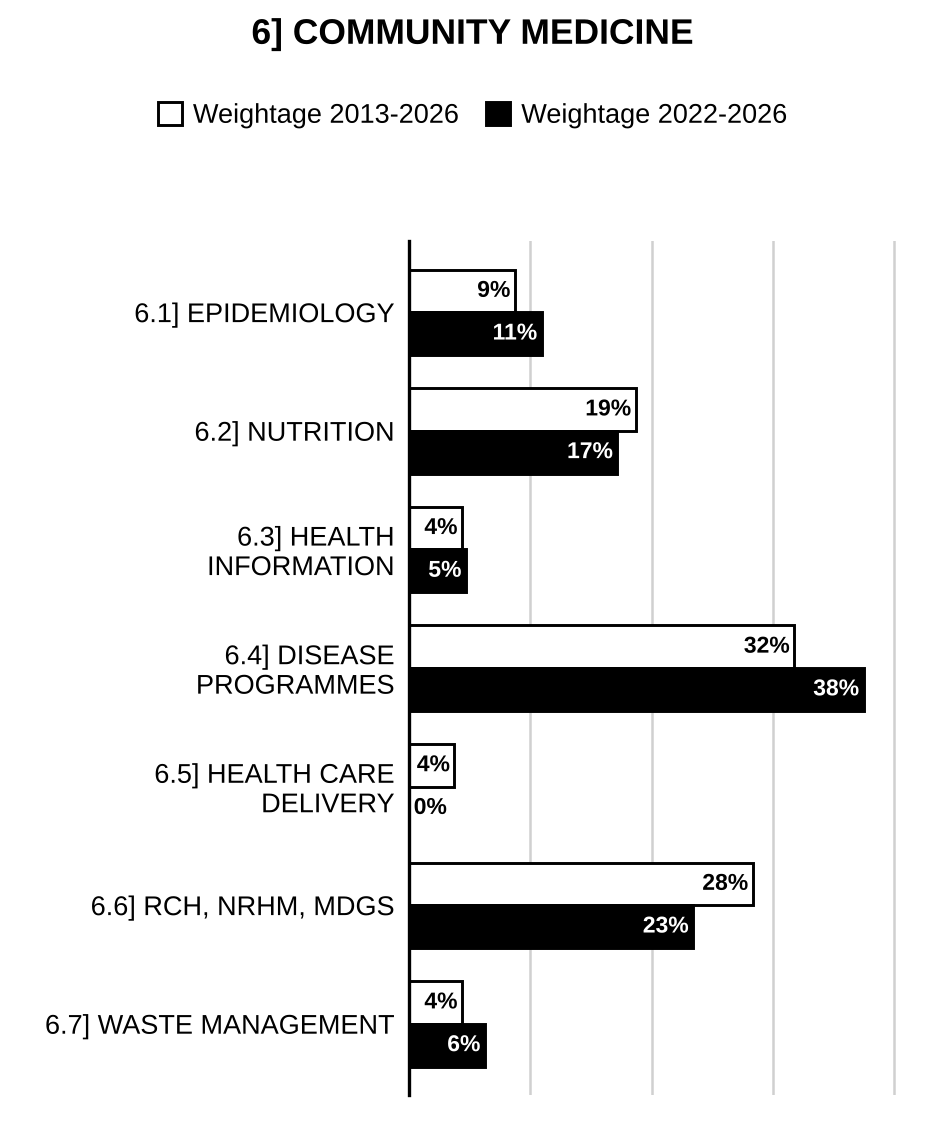
6.1] Epidemiology
17 questions
(i) What are the different types of epidemiological studies? (ii) What are the possible sources of control in case-control studies? (iii) List the advantages of case-control studies as compared to cohort studies. [2024/20m/8a]
(i) What are the objectives of investigating an epidemic? (ii) Briefly state the various steps you would undertake while investigating an epidemic. [2022/15m/6c]
(i) Define the sensitivity and specificity of a diagnostic test. (ii) Briefly discuss the role of Rapid Diagnostic Test (RDT) in malaria comparing it with the slide test. [2015/10m/5e]
Describe the steps in designing, conducting and analyzing a cohort study for diabetes mellitus. [2014/20m/8c]
Write a paragraph on relative and attributable risks related to a disease. How do they differ in the case of heart diseases? [2013/10m/5e]
Discuss measurements of Disease Frequency in Epidemiology, giving their advantages and limitations. [2010/20m/6c]
Enumerate common life style diseases in adults in India and the causes for their increasing incidence. [2009/20m/4a]
What is an epidemic? Describe the various steps in the investigation of an epidemic. [2007/30m/8b]
Outline the kind of epidemiological method that provides information on Relative Risk and Attributable Risk. Illustrate with suitable examples, what is meant by these two terms. [2005/30m/8b]
Define and classify bacterial food poisoning; give examples. Describe in detail the method of investigating a suspected outbreak of food poisoning in a school having mid-day meal programme to find the cause and source. [2004/20m/200w/5b]
Name diseases which have been eradicated in India after Independence. Discuss various epidemiological factors which help in eradication of a communicable disease. [2003/60m/8]
Epidemiological triad. [2000/12m/1e]
Uses of Cohort studies in Epidemiology. [1999/20m/200w/1d]
Define Epidemiology. Discuss the uses of Epidemiology in Community Medicine. [1997/20m/9a]
Describe the natural history of Poliomyelitis. How will you apply the knowledge of levels of prevention for the eradication of poliomyelitis? [1996/60m/8]
Enumerate the water borne viral infections. Outline the steps you would follow to investigate an epidemic of jaundice in an urban slum area. [1995/60m/8]
What are the measures used to evaluate a “screening test”? [1995/20m/9a]
6.2] Nutrition
17 questions
‘Anaemia Mukt Bharat Programme’ employs a multipronged approach. What are the interventions it focuses on to achieve its goals? What are the specific measures being undertaken under this programme? Which are the specific population groups that this programme targets? [2025/15m/7b]
(i) What are essential amino acids? List any six. (ii) When is a protein said to be ‘biologically complete’? What does the term ‘supplementary action of proteins’ mean? Explain this concept by citing an example from daily life. [2023/15m/7b]
State the National Guidelines on feeding of infant and young child. What are the goals which these guidelines strive to achieve? [2022/10m/5e]
(i) What is the total content of iron in the human body? (ii) What are its bodily functions? (iii) State the interventions being undertaken under the ‘Anaemia Mukt Bharat Strategy’. [2022/15m/7b]
(i) When is a protein said to be “biologically complete”? (ii) How do vegetable proteins compare and compete with animal proteins? (iii) What are proteins needed for in the body? [2021/15m/6c]
(i) Summarise the spectrum of Iodine Deficiency Disorders. (ii) State the goal, objectives and salient features of Iodine Deficiency Disorder Control Programme. [2021/20m/8a]
(i) State in brief how dietary factors may influence the cardio-vascular health in adults highlighting the specific cause-effect relationship. (ii) Explain why vegans are more at risk to develop Vitamin B₁₂ deficiency. State the ill-effects of Vitamin B₁₂ deficiency on human health. [2020/20m/8a]
(i) In reference to human nutrition, various Expert Committees of WHO have made recommendations regarding dietary goals. On the basis of these recommendations, what constitutes a ‘prudent’ or ideal’ diet in a normal person? (ii) In reference to pediatric nutrition, define the term “Stunting”. What is it indicative of? What are its causes? [2019/15m/7b]
(i) As per the National Family Health Survey-4, how grave is the situation in India with regard to Nutritional Anaemia. Give statistics substantiating your statement. (ii) Under the “National Iron+ Initiative”, which are the specific groups being specially targeted? (iii) What specific interventions are being employed for different target groups under the National Iron+ Initiative? (iv) What are the mechanisms of service delivery being employed to implement the National Iron+ Initiative? [2018/15m/6c]
(i) What are trans-fatty acids? (ii) Which foods are major source of trans-fatty acids? (iii) What is the significance of trans-fatty acids from public health viewpoint? [2017/10m/5e]
The increasing use of ‘junk food’ in the country has distinct negative connotations for the health of its citizens. What do you understand by the term ‘junk food’? Cite some common examples. State the ill effects of excessive consumption of junk food on health, outlining the scientific basis. [2012/20m/7b]
Describe the problem of nutritional anaemia in India. Describe the National Nutritional Anaemia Prophylaxis Programme. [2010/20m/6a]
Discuss briefly Iodine deficiency disorders. [2009/20m/5d]
Describe briefly the prevention of nutritional blindness in a community. [2007/20m/5d]
What are the signs and symptoms of Lathyrism? Discuss them very briefly. [2006/20m/5d]
Discuss major nutritional diseases prevalent in India. [2000/60m/3]
Plan a diet for 3-year old normal male child prescribing the amount of various food-stuffs including the quantity of proteins and calories available in them. [1997/20m/9c]
6.3] Health information
5 questions
(i) List the various sources of health information. (ii) Describe the limitations of hospital records as a source of health information. (iii) Write in brief the use of pictograms for presenting health information data. [2024/15m/7b]
What are the components and uses of Health Information System? Enumerate briefly the different sources of health information. [2016/20m/8a]
Computers in medicine. [2001/12m/1f]
Components and uses of Health Information System. [1998/20m/9c]
Describe briefly the ‘stages’ in the demographic cycle. What are the factors contributing to high fertility in India? [1995/20m/9b]

Preparing for Prelims too?
Our UPSC Prelims Topic-wise PYQ eBook covers every Prelims question with detailed explanations, so you can see exactly where UPSC asks from.
View the BookDownload Free Sample6.4] National disease control programmes
35 questions
Discuss the various sputum-based tests for the diagnosis of tuberculosis under the National Programme in India, along with their advantages and disadvantages. [2026/10m/1a]
In the context of HIV/AIDS Control and the National AIDS Control Programme in India, answer the following questions: (i) Define Post-Exposure Prophylaxis (PEP). (ii) How will you establish eligibility for Post-Exposure Prophylaxis (PEP) based on exposure and HIV source codes? (iii) What are the Post-Exposure Prophylaxis (PEP) drug regimens for healthcare personnel? [2026/15m/6c]
(i) What are the main objectives and key strategies of the National Strategic Plan (NSP) for Tuberculosis Elimination in India? (ii) Explain the significance of the “Pradhan Mantri TB Mukt Bharat Abhiyaan” (PMTBMBA) in eliminating tuberculosis. [2026/20m/8a]
Under the National Framework for Malaria Elimination in India, what are the targets set for the years 2027 and 2030 respectively? What are the key interventions recommended for States and UTs which require intensified control and fall under Category 3? Which are the parameters employed for maintaining epidemiological surveillance over malaria? [2025/20m/8a]
In the context of HIV/AIDS control and the National AIDS Control Programme in India, comment upon the following: (i) 95-95-95 targets (ii) Categorization of districts (iii) TB-HIV coordination to reduce mortality. [2024/15m/6c]
State the vision, goals and objectives of the National Framework for Malaria Elimination in India, 2016–2030. What are the milestones and targets to be met under this framework by the years 2024, 2027 and 2030? Outline the broad strategies of this national framework. [2023/20m/8a]
The ‘End TB Strategy’ is an evolution over the previous strategies to win over tuberculosis. (i) What are the key principles of the ‘End TB Strategy’? (ii) What are the ‘pillars and components’ of this strategy? (iii) What are the major barriers that have thwarted the progress in the battle against the disease? [2022/20m/8a]
Dengue has become a major health problem for the country. The number of cases and disease severity have worsened over the years. Keeping this in context, answer the following questions: (i) What are the reasons which have led to a major shift in the geographic extent of dengue in the country? (ii) How is climatic change impacting the disease? [2021/10m/5e]
(i) Name the States in India which continue to be heavily infected with lymphatic filariasis. (ii) Under the National Filaria Control Programme, what is the strategy being adopted to achieve the elimination of lymphatic filariasis? (iii) Define the criteria which must be met to state that elimination of lymphatic filariasis has been achieved. [2020/15m/6c]
Drug-resistant tuberculosis has emerged as a major public health challenge before the country. Keeping this in context, answer the following questions: (i) What are the major culpable factors which have led to this situation? (ii) To limit the burden of multi-drug-resistant tuberculosis (MDR-TB) and extensively drug-resistant tuberculosis (XDR-TB) in the community, public health experts have drawn a 7-point plan of action. State those 7 points in brief. (iii) List the subgroups of tuberculosis patients currently eligible for receiving treatment with a Bedaquiline containing regimen. [2019/20m/8a]
(i) Discuss in brief the epidemiological factors which have led to the spread of dengue in different parts of the country. (ii) Discuss in brief the guidelines laid down by the Directorate of National Vector Borne Diseases Control Programme for the prevention and control of dengue. [2018/10m/5e]
‘The End TB Strategy’ is a logical evolution and a paradigm shift from the past global TB strategies. (i) What are its vision, goal, milestones and target indicators that are set to be achieved in specific future years? (ii) What are the major hurdles which stand in its success? (iii) What steps are required to overcome these hurdles? [2017/20m/8a]
Write briefly on ‘Stop TB Strategy’. [2016/15m/6c]
(i) Define the sensitivity and specificity of a diagnostic test. (ii) Briefly discuss the role of Rapid Diagnostic Test (RDT) in malaria comparing it with the slide test. [2015/10m/5e]
(i) What are “vector-borne diseases”? (ii) List any five vector-borne diseases specifying the vector in each. (iii) Specify the “International Travel Health Regulations” that have been derived to check the spread of vector-borne diseases. [2015/15m/7b]
Write about the Revised National Drug Policy for treatment of malaria. [2014/10m/5e]
Discuss the role of Information, Education and Communication (IEC) systems in the management of Sexually Transmitted Diseases (STDs). [2013/15m/7c]
Write about Revised National Tuberculosis Control Programme. [2011/20m/6a]
List the causative organisms and vectors of lymphatic filariasis in India. What are its salient control measures? [2009/30m/8a]
How is the diagnosis of malaria confirmed? Describe the presumptive and radical treatment of malignant malaria. [2009/30m/8b]
List the salient reasons for resurgence of Malaria: [2006/30m/8a]
Name the STD’s and their causative agents. Describe the various modes of spread of HIV. Describe the functions of VCTC and PPTCT programme. [2004/20m/6b]
List the components of the revised national tuberculosis control programme. How is tuberculin test interpreted? Analyse the reasons for high defaulter rates in the treatment of pulmonary tuberculosis. [2004/60m/8]
Mention the changes in strategy of National Malaria Eradication Programme. [2002/60m/8]
Directly observed Treatment Short Course Chemotherapy (DOTS) in Pulmonary Tuberculosis Control Programme. [2001/12m/1e]
Describe National Programme for Control of Blindness. [2001/60m/3]
Discuss the various methods for control of rabies in India. [2000/20m/7c]
Describe the levels of prevention with reference to leprosy. [2000/20m/4c]
Discuss the multi-factorial etiology, resulting in malaria. List the steps in the control of malignant malaria. [1999/60m/8]
Discuss the prevention and treatment of Kala-azar. [1999/20m/9a]
Enumerate the various National Control Programmes against communicable diseases in India. Describe briefly the National Leprosy Control Programme. [1998/60m/8]
Discuss various modes of transmission of HIV/AIDS prevalent in India. [1997/20m/200w/1d]
Enumerate various causes of Blindness in India. Discuss briefly National Programme for Prevention of Blindness and Visual Impairment. [1997/60m/8]
Describe the Modified Plan of Operation to control Malaria in an area with API more than 2. [1996/20m/9a]
Discuss the nature and magnitude of the HIV/AIDS problem in India. [1995/20m/200w/1d]
6.5] Health care delivery and management
9 questions
What is meant by Network Analysis? Write in brief about Programme Evaluation and Review Technique (PERT). What are the uses of PERT? [2016/15m/7b]
What are the shortfalls in the health care delivery systems at the secondary and tertiary levels? [2013/15m/6b]
Describe public health sector and private sector health care delivery systems in rural area of India and comment on their functioning. [2011/20m/6b]
What do you understand by Evaluation of Health Services? Describe the elements of an Evaluation Study and discuss the general steps involved. [2010/20m/6b]
Describe measures to reduce the effects of Noise Pollution in urban areas of India. [2005/30m/8a]
Describe the health provisions under ESIS (Employees State Insurance Scheme). [2001/20m/4c]
What are the health hazards of coal miners in open cast and underground mines? [1999/20m/9b]
Discuss the concept of social security. [1998/20m/200w/1d]
Describe the steps of chlorination of a well. [1996/20m/9c]
6.6] RCH, NRHM and MDGs
26 questions
Under the National Rural Health Mission, explain the concept of Comprehensive Primary Health Care and outline the key strategic areas essential for its effective operationalization. [2026/15m/7b]
(i) Define maternal mortality rate (MMR) and enumerate the causes of maternal mortality in India. (ii) What are the steps to be taken to reduce maternal mortality in India? [2025/10m/5c]
Explain the significance of the ‘Kilkari’ initiative with reference to National Rural Health Mission. Who is it aimed at and how is it being implemented? [2025/10m/5e]
What are the major objectives of ‘Home-based Newborn Care’? State the responsibilities that ‘ASHA’ is entrusted with to make the programme a success. [2025/15m/6c]
The Janani-Shishu Suraksha Karyakram is a unique national initiative of the Government of India. State in brief the entitlements to pregnant women and neonates under this scheme. [2023/10m/5e]
The National Rural Health Mission is committed towards improving rural healthcare delivery system in the country. State the major initiatives that have been undertaken under this Mission to strengthen the healthcare infrastructure in rural areas. [2023/15m/6c]
The Mother and Child Tracking System (MCTS) is a significant initiative of the government. (i) Briefly explain what is MCTS. (ii) What are its objectives? (iii) How is it being put into operation? [2021/15m/7b]
(i) Enumerate the common causes of under-5 mortality. (ii) Enumerate the vaccines preventing CNS infections in children and their schedule. (iii) What are the adverse events and contraindications of DPT vaccine? [2020/15m/4c]
(i) State in brief how the National Rural Health Mission aims to fulfil the goals of Janani Suraksha Yojana at the community level. (ii) List the key areas of action proposed under the National Rural Health Mission which aim to make primary healthcare comprehensive and universal. [2020/15m/7b]
Home Based Newborn Care (HBNC) is a strategy which aims at improving newborn survival. In the context of this strategy, answer the following questions: (i) What are the major responsibilities of ASHA in delivery of HBNC? (ii) What is the specified schedule under which ASHA is expected to visit the newborn in a case of home delivery? [2019/10m/5e]
A high maternal mortality rate continues to be a major public health challenge before the country. Keeping that in context, answer the following questions: (i) How is “Maternal Mortality Rate” (MMR) defined? State the major causes of maternal mortality in the country. (ii) The recent data indicates a major decline in MMR in the country. Briefly state, with due reasons, the various governmental initiatives which have led to this favourable decline in maternal mortality rate in India. (iii) The government has grouped the different states in the country in a specific manner to obtain a greater understanding of the ground situation and to map the changes following its initiatives. Briefly outline this strategy, and its benefits. [2018/20m/8a]
(i) Mention the important causes of mortality in children under 5 years of age. (ii) Enlist the vaccines which can reduce the incidence of Acute Respiratory Infection in children. (iii) Mention the measures to reduce mother to child transmission of HIV (Human Immunodeficiency Virus) infection. [2017/10m/1e]
(i) What are the primary objectives of ‘Janani Suraksha Yojana’? (ii) What are the salient features of this scheme? (iii) What is the ‘Vande Mataram Scheme’? How is it related to the Janani Suraksha Yojana? [2017/15m/6c]
(i) Under the National Rural Health Mission (NRHM), what are the changes being carried out in the rural healthcare infrastructure in order to strengthen it? (ii) Which of the existing programmes of Health and Family Welfare have been integrated into the National Rural Health Mission? [2017/15m/7b]
Enumerate various goals and targets set for Child Health in India. [2016/10m/5e]
(i) Define “Infant Mortality Rate (IMR)”. (ii) List the major causes of IMR in India. (iii) What are the key steps that can bring down the IMR in India? [2015/10m/1d]
Briefly discuss the proposed goals and targets under the Integrated Reproductive, Maternal, Newborn, Child and Adolescent Health in India. [2015/15m/6c]
Enumerate the Millennium Development Goals related to health. Describe the challenges for MDG. [2014/15m/7c]
You have just been appointed to the post of District Magistrate. What measures would you take to ensure that the main aims of the ‘National Rural Health Mission’ are met with? State briefly, citing the thrust areas at each level of the district. [2012/20m/6b]
Write briefly about key strategies of National Rural Health Mission. Describe the roles and responsibilities of an Accredited Social Health Activist. [2011/20m/6c]
Exogenous factors in post-neonatal mortality. [2004/20m/5d]
Discuss the concept and components only of Reproductive and Child Health Programme (R.C.H.). [2002/20m/5d]
Components of reproductive and child health. [2000/12m/5d]
Describe in detail “Target Free Approach” in Indian Family Welfare Programme. [1997/20m/9b]
The indicators of maternal & child health services. [1996/20m/1d]
Briefly describe the steps to eliminate Neonatal Tetanus in India. [1995/20m/9c]
6.7] Hospital and industrial waste
4 questions
In the context of treatment and disposal technologies for healthcare waste, comment upon the following: (i) The ‘Process of Inertization’ with its advantages and disadvantages (ii) Wet and dry thermal treatment. [2026/10m/5e]
(i) Describe the ‘yellow’ category of biomedical waste in terms of – types of waste, types of bags or containers to be used, and treatment and disposal options. (ii) Comment upon ‘incineration’ as a method of biomedical waste management. [2024/10m/5e]
What are the principles of hospital waste management? Describe the various treatment and disposal technologies for biomedical waste. [2014/15m/6c]
Describe the management of Biomedical Waste. [2010/15m/5e]

Strengthen your GS papers
Our UPSC Mains Topic-wise & Year-wise PYQ eBook (2013–2026) maps every GS question to the syllabus, so you know what UPSC asks and how often.
View the BookDownload Free Sample« Previous: Obstetrics and Gynaecology Including Family Planning | Next: Other Questions »
Back to: Medical Science Optional PYQs – Topic-wise | Also see: Medical Science Optional year-wise question papers
Last updated: 31 October 2026