
Here are all 105 Paediatrics questions asked in UPSC Medical Science Optional Paper II from 1995 to 2026, arranged under the 4 topics of the official syllabus. Within each topic the latest questions come first.
Each question ends with a code such as [2024/15m/3b] – the year, the marks, the word limit (where UPSC set one) and the question number in the paper.
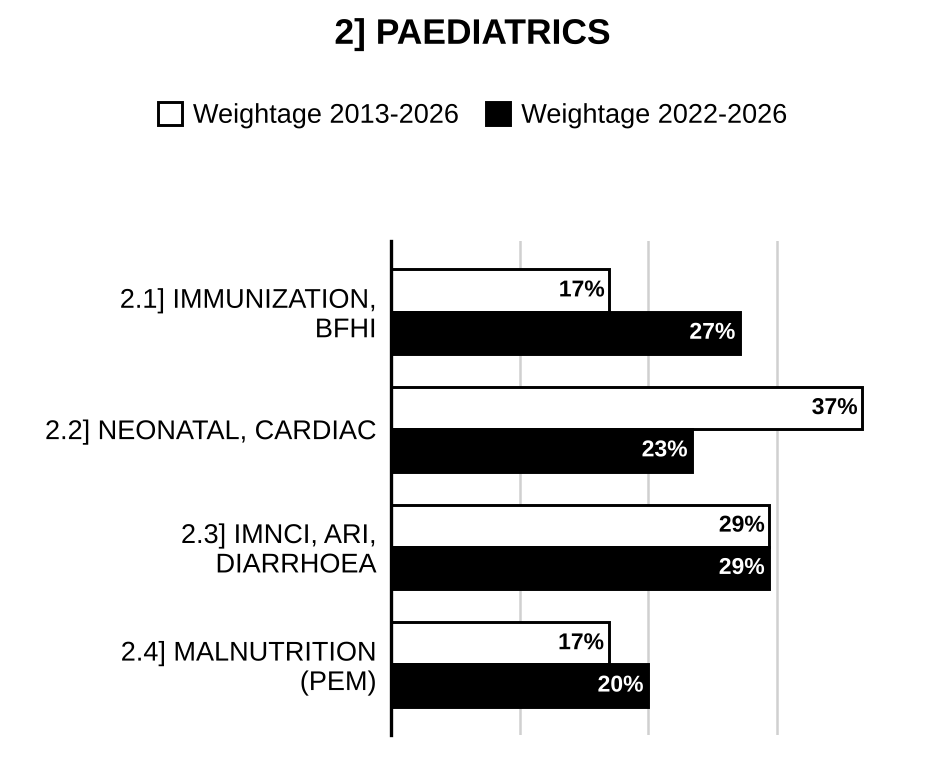
2.1] Immunization and Baby Friendly Hospital
20 questions
A 12-year-old girl, unvaccinated since the age of 1 year, reports to you for a ‘catch-up vaccination’. (i) How would you draw her vaccination plan? Which vaccines should be administered to the girl and what should be their schedule? (ii) Describe the possible adverse events that may occur following vaccination (immunization). (iii) Discuss the clinical manifestations of acute anaphylaxis following vaccination and its management. [2026/15m/4b]
Enumerate the various types of vaccines available in National Immunization Schedule (NIS) in children. Define adverse events following immunization. State the adverse events of any three vaccines. [2025/15m/4b]
Write in brief the ten steps of Baby-friendly Hospital Initiative (revised 2018). [2024/10m/2b(i)]
Write the advantages of breast-feeding. [2024/5m/2b(ii)]
What are the types of vaccines currently in use against Pneumococcus organisms? State the National Immunization Schedule for administering Pneumococcal Vaccine in infants. Enumerate the diseases that the Pneumococcal Vaccine can safeguard against. [2024/15m/3b]
State the immunization schedule under the National Immunization Programme for infants and children. [2023/10m/1d]
(i) Give two examples for each of the following types of vaccines used in under-5 children: 1. Capsular polysaccharide vaccines 2. Conjugate vaccines 3. Recombinant vaccines (ii) Define the following terms: 1. Herd effect 2. Vaccine efficacy. [2022/10m/1d]
A 22 year old primi mother comes to you with complaint of “NOT ENOUGH MILK”. Due to this, her baby remains hungry and is constantly biting at her nipples. She is feeling soreness in the nipples. (i) How will you assess the mother-child duo to identify the underlying etiology of “NOT ENOUGH MILK”? Discuss briefly. (ii) Outline the 4 criteria each for “correct positioning” and “correct attachment” of the baby for proper breastfeeding. (iii) Discuss in brief the management of sore nipples. [2022/15m/3b]
(i) Enumerate the common causes of under-5 mortality. (ii) Enumerate the vaccines preventing CNS infections in children and their schedule. (iii) What are the adverse events and contraindications of DPT vaccine? [2020/15m/4c]
(i) Briefly state the basis which led to setting up of the programme “Mission Indradhanush”. What are its targets and eventual goals? (ii) More recently, the government has launched “Intensified Mission Indradhanush”. Discuss the thoughtline, specific focus, and operative strategy which govern its implementation. [2018/15m/7b]
(i) Mention the important causes of mortality in children under 5 years of age. (ii) Enlist the vaccines which can reduce the incidence of Acute Respiratory Infection in children. (iii) Mention the measures to reduce mother to child transmission of HIV (Human Immunodeficiency Virus) infection. [2017/10m/1e]
(i) Describe the characteristics of Haemophilus influenzae b (Hib) vaccine. (ii) Enumerate the diseases which can be prevented by this vaccine. (iii) Describe the primary schedule of vaccination with Hib vaccine in an 8-month-old child. [2014/15m/4b]
What do you understand by Expanded Programme of Immunization (EPI)? Describe its components. [2013/20m/8a]
Tabulate the National Immunization Schedule. What are newer vaccines? Give their immunization schedule. [2012/12m/1d]
Write briefly about ‘Baby Friendly Hospital Initiative’. List all the ten steps of its policy. [2012/20m/2c]
How does human milk compare with animal milks? Enumerate three key differences between them. Which micronutrients is natural milk deficient in? [2012/15m/5a]
Write short notes on: (i) Cold chain (ii) Measles, Mumps, Rubella Vaccine. [2011/15m/1c]
Outline the National Immunization Schedule as practiced under the RCH programme. [2010/20m/2c]
Write a short note on Immunization against Hepatitis B. [2005/20m/5d]
Immunization schedule upto 18 months of a child as per Government of India guidelines. [2003/20m/5d]
2.2] Neonatal and cardiac conditions
40 questions
A 24-hour-old newborn has presented with jaundice extending to the palms and soles. (i) Classify and enumerate the possible causes of hyperbilirubinemia in this newborn. (ii) Outline the management for unconjugated hyperbilirubinemia at this age. [2026/10m/1d]
A 6-day-old newborn presents with cyanosis, respiratory distress, tachycardia and hepatomegaly. (i) Discuss the differential diagnosis of this newborn. (ii) Outline the diagnostic approach. (iii) Discuss the acute and long-term management of this newborn. [2026/15m/3b]
Write the risk factors for respiratory distress syndrome (RDS)s in newborn. What is the differential diagnosis of RDS? How will you manage respiratory distress syndrome in newborn? [2025/15m/3b]
Enumerate the causes of respiratory distress in a newborn. How would you differentiate between respiratory distress of respiratory origin and that of cardiac origin? [2024/8m/4b(i)]
Write the complications of cyanotic congenital heart diseases. [2024/4m/4b(ii)]
A 2-year-old boy was brought to the emergency with the complaints of sudden onset of respiratory distress with irritability. On examination, the child is disoriented and he has both peripheral and central cyanosis. He has deep sighing respiration with < 65% at room air. On oxygen therapy, his is increased to 80%. He has no organomegaly or neurological deficit. (i) Write the complete diagnosis of this boy. (ii) How will you manage this case in emergency? (iii) Classify the congenital cyanotic heart diseases. [2023/15m/2b]
(i) Write the causes of unconjugated hyperbilirubinemia in a newborn. (ii) What is the mechanism of action of phototherapy in the treatment of hyperbilirubinemia? (iii) What are the potential complications of the phototherapy? [2023/15m/3b]
A neonate born at 30 weeks of gestation is found to have tachypnea, chest retractions and grunt within 30 minutes of birth. (i) What is the most likely diagnosis? Mention the basis of your diagnosis and state briefly the pathophysiology of the condition. (ii) Describe the management of this condition. [2021/10m/1c]
A 6-month-old infant attending paediatrics OPD is found to have central cyanosis, clubbing and no hepatomegaly. (i) What is the most likely cardiovascular condition? State its cardiovascular examination findings and accompanying haemodynamic changes. (ii) Write about the clinical course and complications related to this condition. [2021/10m/1d]
A term neonate born to ‘O’ negative blood group mother was found to have deep jaundice involving palms and soles, excessive crying and convulsions at 20 hours of life. (i) How would you assess the clinical severity of jaundice in this neonate? (ii) List the key investigations to arrive at the diagnosis. (iii) Describe the management of this neonate. [2021/15m/3b]
(i) What are the causes of “neonatal jaundice”? (ii) Outline the algorithm for its work-up. (iii) How will you manage a 34 weeks newborn at 7 days of life weighing 1600 gm with hyperbilirubinemia? (iv) Enumerate the indications of exchange transfusion and outline the procedure. [2020/20m/2a]
(i) Enumerate the causes of cyanotic congenital heart disease and the ages of their presentation. (ii) How will you manage a 6 weeks infant presenting with cyanosis and congestive heart failure? (iii) How will you manage a 2-year-old child weighing 10 kg in a cyanotic spell? [2020/15m/3b]
A 2-year-old boy was hospitalized with episodes of excessive crying and extreme bluishness of the body during these episodes. There is a history of 4 such episodes in the last 6 months. Examination reveals cyanosis, clubbing and conjunctival suffusion. Oxygen saturation was 75% in all four limbs. After stabilization, examination revealed normal S₁ and single S₂. There was a grade 3 ejection systolic murmur at left upper parasternal border. (i) What is the likely diagnosis? Justify. (ii) Outline the principles of management of acute episode of extreme bluishness, precipitated by excessive crying, in this child. (iii) Describe the palliative surgical options available to treat this condition. [2019/20m/3b]
A 32-week-old boy (birth weight 1300 grams) was delivered by caesarean section. There was a history of premature rupture of membranes 18 hours before delivery. The newborn developed tachypnea, soon after birth with chest retraction and grunting. (i) What is the likely diagnosis in this newborn? Also give 2 differential diagnoses. (ii) Outline the steps of diagnostic work-up required to establish the diagnosis. (iii) Describe the principles of management of this child. [2019/15m/4b]
A 10-month-old infant with “Tetralogy of Fallot” is brought to the paediatric emergency ward with history of excessive crying and then becoming dyspneic, drowsy and bluish. (i) What is the likely diagnosis in this infant? Mention the basis for diagnosis. (ii) Describe the management of this condition. [2018/10m/1b]
A 32-week preterm neonate born by a Caesarian section is found to have a respiratory rate of 70/minute, grunting and cyanosis within half an hour of birth. (i) What is the most likely diagnosis in this neonate? (ii) Describe the management of this condition. (iii) Write about its important complications. [2018/20m/3b]
A baby is delivered at 34 weeks of gestation; develops respiratory distress soon after birth. (i) List the important causes of respiratory distress in this baby. (ii) Mention the pathogenesis of Respiratory Distress Syndrome. (iii) Outline the management of the baby. [2017/10m/1d]
A 2-month-old infant presents with Central Cyanosis. He had two episodes of cyanotic spells. (i) Enlist the differential diagnosis of Congenital Cyanotic Heart Diseases with reduced pulmonary blood flow. (ii) Mention the complications of Congenital Cyanotic Heart Diseases. (iii) Outline the management of a cyanotic spell. [2017/15m/2b]
(i) Describe the clinical features of bilirubin encephalopathy in early neonatal period. (ii) Enumerate the predisposing factors contributing to bilirubin encephalopathy in newborn infants. (iii) Name the long-term pathological and clinical sequelae of bilirubin encephalopathy. [2016/10m/1c]
A newborn baby weighing 1.5 kg develops respiratory distress on the first day of life. (i) List the differential diagnosis. (ii) How would you assess this baby? (iii) How would you manage the most common condition manifesting with respiratory distress in the newborn? [2015/10m/1b]
A term neonate born to Rh negative mother is brought at 22 hours of life with jaundice, fever and one episode of convulsion. (i) What is the most likely diagnosis and its basis? (ii) Enumerate the key investigations and principles of management. (iii) List four important long-term complications of this disease. (iv) Mention the preventive measures. [2015/18m/4c]
(i) How can you recognize heart failure in infants below 1 year of age? (ii) Enumerate the common causes of heart failure in infants. [2014/15m/2b]
(i) Discuss the etiology and pathophysiology of kernicterus in newborns. (ii) How can you prevent kernicterus? [2014/15m/3b]
A 3-year-old child was brought to you with history of cyanotic spells and exertional dyspnea. The symptoms were relieved on assuming a knee-chest position. The child had central cyanosis and clubbing. There were no features suggestive of congestive heart failure. Heart size was normal. (i) What is the most probable diagnosis? (ii) What is the major pathophysiological abnormality? (iii) Describe the pathophysiology and management of cyanotic spells in this condition. [2013/15m/3b]
(i) Draw a flow diagram showing the pathophysiology of Respiratory Distress Syndrome in a newborn. (ii) Outline the measures to prevent RDS in a pregnant woman at 30 weeks of gestation, with threatened preterm labour. (iii) Enumerate the clinical factors predisposing to bilirubin toxicity in newborn infants. [2013/15m/4b]
What is tetanus neonatorum? [2012/2m/3a(i)]
Describe its clinical features. [2012/5m/3a(ii)]
What is its treatment? [2012/5m/3a(iii)]
How can this condition be prevented? [2012/3m/3a(iv)]
A 25 day old baby presented with fever, loose stools, vomiting and refusal to accept feeds. C.R.P. was positive. Discuss the diagnosis and management of this baby. [2011/20m/3c]
(i) Enumerate common acyanotic heart diseases in pediatric practice. (ii) Describe the salient clinical features of ventricular septal defect. [2011/20m/4c]
Enumerate common congenital cyanotic heart diseases in paediatrics practice. Describe salient clinical features of tetralogy of Fallot. [2010/20m/3c]
A 4.2 kg, 38 weeks gestation, male baby is born to a 28-year-old primi-gravida who has an unsupervised pregnancy by an emergency caesarean section. The child at 1 hour of age was noticed to have respiratory distress and blood glucose of 12 mg/dl. Discuss, in brief, the differential diagnosis and outline the key points in management of this child. [2010/20m/4c]
A 20-year old primigravida delivered a preterm baby by normal vaginal delivery at 31 weeks of Gestation. The baby breathed and cried at birth. Weight was 1.1 kg. At 1 hour of age the baby was found to be in respiratory distress with Grunting. (i) What is the likely diagnosis? (ii) What are the complications of this condition? (iii) How will you manage this baby? [2009/15m/1d]
A 3-day old neonate was found to be cyanosed on routine pre-discharge check-up. The baby was otherwise well with no dyspnoea and only a mild tachycardia of 140/MT. On examination there are normal femoral pulses, no hepatomegaly, a loud second heart sound and no murmur. (i) What are the likely diagnoses? (ii) Chest X-ray demonstrated a typical appearance of a particular cyanotic heart disease. What complications are likely to arise in the neonatal period for this baby? (iii) How will you manage this baby? [2009/20m/2b]
A newborn comes with deep jaundice at the age of 48 hours. What history would you like to take? What all investigations will you advise? How will you treat the case if serum bilirubin (indirect) levels comes 18 mg/dl? [2007/20m/3b]
Name important causes of CHF in a child. How would you investigate a child with systolic murmur at apex. [2006/20m/1c]
An 8 year old child was brought with acute onset dyspnoea and found to have continuous murmur in left parasternal region. Discuss the differential diagnosis of this child. Name few important investigations. [2006/20m/3a]
Enumerate various causes of jaundice in a new born child. Write briefly the laboratory investigations and management of haemolytic jaundice in a new born. [2002/20m/1c]
Discuss the clinical features and management of a case of Fallot’s Tetralogy. [1996/20m/3a]

Preparing for Prelims too?
Our UPSC Prelims Topic-wise PYQ eBook covers every Prelims question with detailed explanations, so you can see exactly where UPSC asks from.
View the BookDownload Free Sample2.3] IMNCI, ARI and diarrhoea
29 questions
A 15-month-old child, weighing 8 kg, is brought to the District hospital with fever for 5 days, loose motions and vomiting for 2 days, and respiratory distress for 1 day and has not passed urine. (i) Assess and classify the child as per IMNCI guidelines and document the complete diagnosis. (ii) How will you manage this case as per the IMNCI guidelines? [2026/10m/1c]
Write the criteria for diagnosing pneumonia in children according to the ‘Acute Respiratory Infection (ARI) Control Programme’ (WHO). Write the treatment strategies of different types of pneumonia according to the ARI Control Programme. [2025/10m/1c]
Define acute diarrhoea in children. List its causes. How would you assess for dehydration in such a child? [2025/10m/2b(i)]
Write the nutritional management of acute diarrhoea and the steps to be taken for prevention of acute diarrhoea. [2025/10m/2b(ii)]
How will you manage a one-year five-month old child presenting with severe respiratory distress with a history of cough and fever for 5 days? [2024/8m/4b(iii)]
(i) What is the full form of IMNCI and what are its objectives? (ii) What are the components of integrated care provided under IMNCI? [2023/10m/1c]
A 3 year old girl, who weighs 12 kg, presents with a history of loose stools mixed with blood and mucus, and fever for 3 days. On examination, she is active and feeling excessively thirsty. There is some loss of skin turgor. (i) Write your complete diagnosis. (ii) Name the most common micro-organism responsible for this condition. (iii) Write two most important life-threatening complications of this condition. (iv) Outline the management of the condition in this girl. [2022/10m/1c]
A 2 year old unimmunized boy weighing 6 kg presented with fever, cough, and difficult breathing for 5 days. There was a history of fever with maculopapular rash lasting for 3 days around 7 days prior to this episode. The child is febrile, has a pulse rate 116/min, respiratory rate: 72/min, 88%. There is severe chest indrawing and nasal flaring. Auscultation revealed bronchial breath sounds on left side and bilateral crepitations. (i) State the complete diagnosis. (ii) Enumerate 3 most important complications associated with this condition. (iii) How would you assess the severity of illness in this child? (iv) Discuss in brief the management of this child. [2022/15m/2b]
A 6 week old sick looking young infant is brought to a primary health centre with suspicion of “Possible Bacterial Infection” as per Integrated Management of Neonatal and Childhood Illness (IMNCI) strategy. (i) How will you assess this child, and classify as having “Possible Serious Bacterial Infection” or “Local Bacterial Infection”? (ii) State the treatments for “Possible Serious Bacterial Infection” and “Local Bacterial Infection”, as per IMNCI strategy. [2022/20m/4b]
A 15-month-old child brought by the mother with history of 6 episodes of vomiting and 4 episodes of watery diarrhoea was found to have lethargy and is unable to drink. The child weighed 10 kg before this event of illness. (i) How would you assess the severity of the illness in this child? (ii) Write the fluid management in the first 3 hours. (iii) Write the treatment guidelines after 3 hours if the child still exhibits signs of dehydration. (iv) Write the composition and preparation of the WHO Oral Rehydration Salts (ORS). [2021/20m/4b]
An 18-month-old child weighing 7 kg has presented with history of diarrhoea, vomiting, rapid breathing and dehydration. How will you manage the child as per IMNCI protocol? [2020/10m/1c]
A 12-month-old child has presented with cough, respiratory distress and noisy respiration. Enumerate their causes and the management. [2020/10m/1d]
A 4-year-old girl is brought to you with fever and noisy respiration for last two days. Examination reveals a febrile, dyspnoeic child with a low-pitched sound heard during inspiration. Chest examination reveals conducted sounds. (i) What is the most likely diagnosis and differential diagnoses? (ii) Name the micro-organisms that can be considered in the etiology of this condition. (iii) Outline three major principles of management of this child, after hospitalization. [2019/10m/150w/1c]
A 3-year-old child presents with history of loose stools for last 20 days, that started as an acute infective diarrheal episode. On examination, the child appeared sick looking, irritable, undernourished, and having some dehydration. There was marked perianal excoriation. Systemic examination is essentially within normal limits. (i) What is your complete diagnosis? Justify the same. (ii) Discuss the probable etiopathogenesis leading to the present diagnosis. (iii) Outline the principles of stepwise management of this child, in brief. [2019/15m/2b]
A 10-month-old infant having watery nasal discharge for the last 2 days developed rapid breathing, chest retraction and decreased feeding over the last one day. (i) What is the likely diagnosis in this patient? (ii) Enumerate the microbiological agents for this condition. (iii) Discuss the investigations and management of this condition. [2018/15m/2b]
A 13-month-old boy was brought by his mother with six episodes of loose stools and persistent vomiting to the emergency ward. He was found to be lethargic and his pulse rate was 160 per minute. (i) What are the danger signs you would ask for and look for in this child to assess the severity of his illness? (ii) If you find severe dehydration, how will you treat the child? (iii) If the child is fit to be discharged, yet has 2 – 3 episodes of loose stools, what advice would you give to the mother? [2018/15m/4a]
(i) Define “persistent diarrhoea” in under-five children. How is it different from “chronic diarrhoea”? (ii) Discuss the dietary management of persistent diarrhoea. (iii) Enumerate a few common causes of chronic diarrhoea. [2016/15m/2b]
Discuss the classification and identification of treatment of a young infant (age 6 weeks) with feeding problem and malnutrition, according to IMNCI case-management guidelines. [2016/15m/3b]
A one-year-old, previously healthy child presents with fever, cold and cough for three days. Mother complains of whistling sound during breathing. There is no history of similar episodes in the past. Examination reveals tachypnea, audible wheeze and hyperinflated chest. His oxygen saturation is 94%. (i) What is the most likely diagnosis and what are the probable micro-organisms causing this condition? (ii) Classify the severity of disease in this patient. (iii) Outline the principles of management of this child. [2016/15m/4b]
(i) Enumerate the common causes of community-acquired pneumonia in under-five children. (ii) Discuss the criteria for diagnosis and classification of pneumonia in the community, without resorting to investigations. [2014/10m/1c]
A 2-year-old boy was brought to you with cough and fever for 3 days. On examination, the respiratory rate was 46 per minute along with lower chest indrawing. (i) Classify the illness of this child as per IMNCI guidelines. (ii) Outline the treatment for this child. (iii) Enumerate the general danger signs you will ask or look for in this child to assess the severity of illness. [2013/10m/1c]
An 8-month-old child, weighing 8 kg, is brought with loose motions 6 per day, mixed with blood, for last 2 days. There is no history of vomiting. (i) Enumerate the 4 most important signs you will look/feel for to assess the severity of dehydration. (ii) Assessment of dehydration reveals SOME dehydration. Write the initial prescription for appropriate management of this child. [2013/10m/1d]
What is IMNCI? Why is it necessary for our country? Write the principles of this approach. [2012/15m/4c]
Discuss the management of a 2-year-old child presenting with diarrhoea for 10 days. The child weighs 5 kg, looks moribund and has low volume peripheral pulses. [2010/15m/1d]
Describe the diagnostic categories for acute respiratory infections and pneumonia as per WHO classification. Outline the management of severe pneumonia. [2010/15m/1e]
A 9-month old baby is brought with complaints of 3 episodes of diarrhoea since his mother stopped breast-feeding at the age of 6 months and started cow’s milk along with other food. The current episode of diarrhoea began 18 days ago. The baby still takes cow’s milk but his mother has reduced his intake of solid food since the diarrhoea began. There is no blood in the stool. He weighs 6 kg. (i) How will you classify his illness? (ii) What will you look for during examination of this baby? (iii) How will you manage this baby? [2009/15m/1c]
(i) What is the definition, etiology and importance of Dysentery in young children? (ii) What are the clinical features and complications of Dysentery in children? (iii) How will you manage a child brought with Dysentery? [2009/20m/3b]
A 2-year old boy is brought with a history of recurrent episodes of fever, cough and breathlessness. He was well till 10 months of age. When suddenly for the first time he developed breathing difficulty when left in the care of his elder sibling. (i) What is the most likely diagnosis? (ii) How will you investigate this child? (iii) How will you manage this child? [2009/20m/4b]
Infantile diarrhoea. [2000/12m/1c]
2.4] Protein-energy malnutrition
16 questions
A 2-year-old boy, weighing 8 kg, with a length of 72 cm, has presented at the hospital. (i) How does one assess and classify malnutrition in this boy? (ii) What are the clinical features of malnutrition and what are its complications? (iii) Outline the stepwise management of ‘Severe Acute Malnutrition’. (iv) Explain the dietary management during the rehabilitation phase. [2026/20m/2b]
How will you treat hypothermia in a 3-year-old child with severe acute malnutrition (SAM)? How will you prevent hypothermia in an SAM child? [2025/10m/1d]
What are the key differences between Kwashiorkor and Marasmus? Which is the easiest method which can help in the early detection of Protein Energy Malnutrition (PEM) in children? [2024/10m/1c]
During the initial phase of stabilization in a severe acute malnourished child, map out the dietary plan. State the type, amount and frequency of feed that the child requires and for how long that would be necessary. In this phase, what is the vitamin and mineral supplementation given? [2024/10m/1d]
(i) What are the criteria for the identification of severe acute malnutrition (SAM) in children 6 months to 59 months of age? (ii) Enumerate the criteria for admission in the facility-based care for severe acute malnutrition. (iii) Write ten steps in the management of SAM. [2023/20m/4b]
A 12-month-old infant with history of delayed initiation of complementary feeding and few diarrhoeal episodes was found to have length of 72 cm, weight of 5 kg, mid arm circumference of 10 cm and loss of subcutaneous fat. (i) State the diagnosis. Under what severity of condition would you place this infant? (ii) Enumerate the complications associated with the condition. (iii) Describe the steps and phases of treatment. [2021/15m/2b]
A 2-year-old boy is brought with complaints of loose stools for 7 days, lethargy and inability to feed. Anthropometry of the child is as follows: [Weight 4.2 kg (expected 12.2 kg); Length 66 cm (expected weight for length 7.5 kg); Mid-upper arm circumference 10.0 cm.] On examination, the child is having severe pallor and peripheral pulses were poorly palpable. (i) Identify four major problems (diagnoses) in this child and provide points in favour for each diagnosis. (ii) Outline the management of this child in first two hours after immediate hospitalization. [2019/10m/150w/1d]
A 16-month-old child attending Paediatrics OPD with past history of diarrhoea and respiratory infections was found to have loss of subcutaneous fat and weight of 5.5 kilograms. (i) Which physical examination findings would help you to arrive at diagnosis in this child? (ii) Describe the two phases of treatment for this condition. [2018/10m/1d]
(i) Define “Severe stunting” and “Severe wasting” in under-five children. (ii) Outline the diagnostic criteria for “Severe Acute Malnutrition” (1) in children between 6 months – 5 years of age; and (2) in infants below 6 months of age. [2016/10m/1d]
An 11-month-old infant is brought to hospital with delayed weaning and history of recurrent diarrhoeal episodes. The child is apathic, weighs 5.5 kg, has depigmented hair and oedema over the limbs. (i) What is the most likely diagnosis? (ii) Enumerate the clinical assessment and investigations that would be helpful in this infant. (iii) Enumerate the ten essential steps and two phases of treatment for this child. [2015/17m/3b]
(i) Enlist the diagnostic criteria for severe malnutrition according to WHO classification in under-five children. (ii) Discuss the home/community-based management of children with moderate malnutrition. [2014/10m/1d]
An 18-month-old girl is diagnosed with Severe Acute Malnutrition (SAM). Outline the 4 diagnostic criteria for this condition. Write the 10 steps for appropriate management of severe malnutrition as per WHO guidelines. [2013/15m/2b]
Write the WHO classification of undernutrition, and also describe the complications and causes of death in kwashiorkor. [2012/10m/3b]
Discuss the management of a 2-year-old child presenting with diarrhoea for 10 days. The child weighs 5 kg, looks moribund and has low volume peripheral pulses. [2010/15m/1d]
Describe in brief all the different types of developmental milestones in the first year of life. [2007/20m/1b]
A 2 years old child is brought to you with history of still unable to walk. There is history of some delayed milestones. On examination anterior fontanelle was open and wrists were widened, (i) Write what all history you would like to know. (ii) What positive examination findings, will you try to find, to make a diagnosis? (iii) What is your differential diagnosis? (iv) What drugs are used in the treatment of rickets and hypothyroidism? Also mention their doses. [2007/20m/3a]

Strengthen your GS papers
Our UPSC Mains Topic-wise & Year-wise PYQ eBook (2013–2026) maps every GS question to the syllabus, so you know what UPSC asks and how often.
View the BookDownload Free Sample« Previous: General Medicine | Next: Dermatology »
Back to: Medical Science Optional PYQs – Topic-wise | Also see: Medical Science Optional year-wise question papers
Last updated: 31 October 2026