
Here are all 150 General Surgery questions asked in UPSC Medical Science Optional Paper II from 1995 to 2026, arranged under the 9 topics of the official syllabus. Within each topic the latest questions come first.
Each question ends with a code such as [2024/15m/3b] – the year, the marks, the word limit (where UPSC set one) and the question number in the paper.
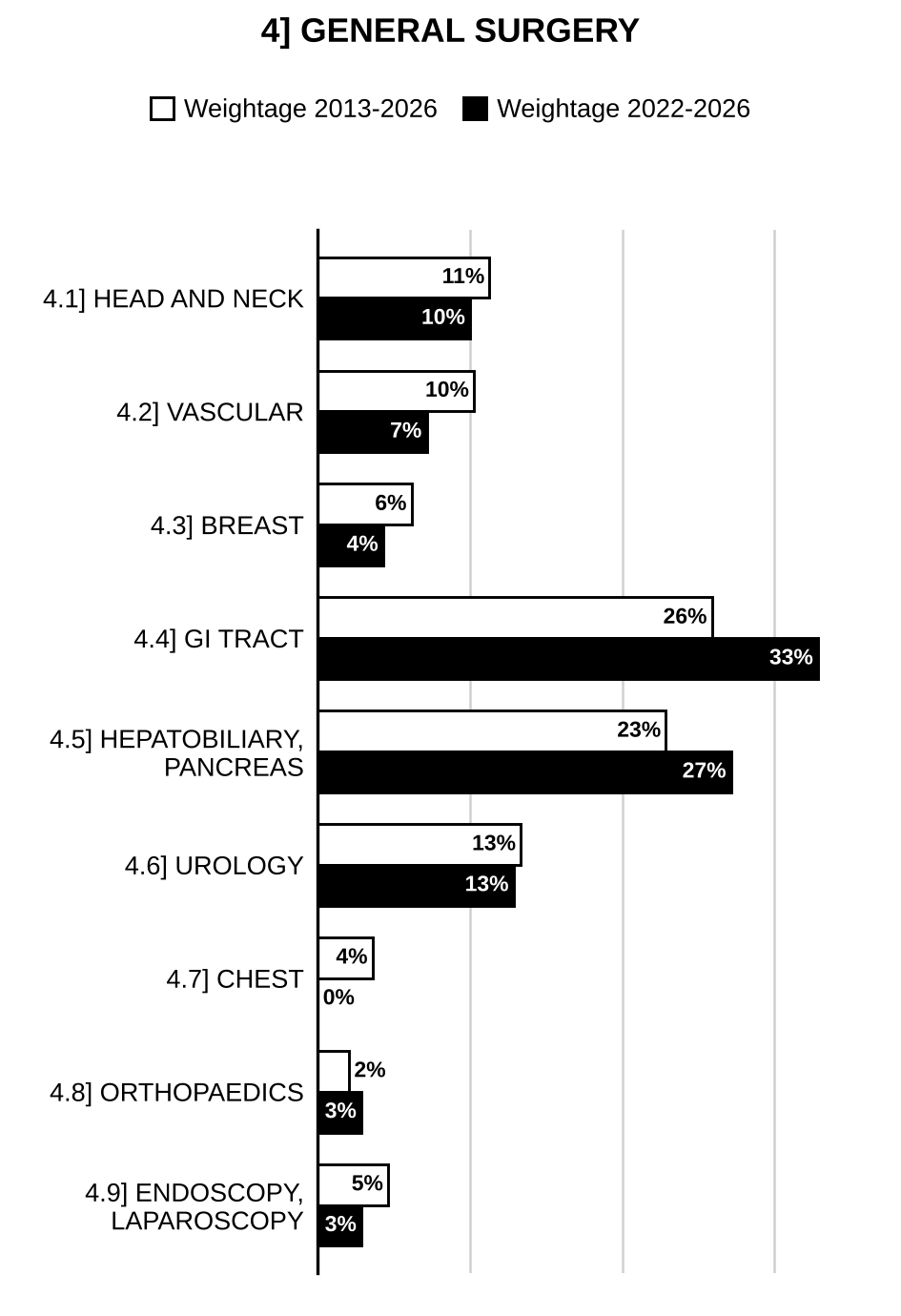
4.1] Head and neck
20 questions
Describe the embryogenesis, clinical features and principles of management of cleft palate. [2025/15m/8c]
A 50-year-old male presented with a 3 cm nodule in the left lobe of thyroid gland with a hard left cervical lymph node. Fine Needle Aspiration Cytology (FNAC) from the thyroid nodule revealed orphan Annie-eyed nuclei. (i) What is the diagnosis in this case? How can this condition be managed surgically? (ii) Enumerate different prognostic scoring systems for this condition. (iii) What are the post-operative complications of total thyroidectomy? [2024/20m/7a]
A 55-year-old male, tobacco chewer, presents to OPD with difficulty in opening mouth for one month. On examination, he is found to be having poor oral hygiene and a white patch on right buccal mucosa. (i) Briefly describe leukoplakia and its significance. (ii) What are the premalignant conditions for oral cavity cancer? (iii) What are the different cervical lymph nodes which can get involved in a patient with oral cavity cancer? [2021/15m/6b]
A 47-year-old female presents to the surgery OPD with a solitary nodule in the right lobe of thyroid gland. (i) How will you investigate this case? (ii) What is the ideal treatment if investigations are suggestive of follicular neoplasm? (iii) How will you follow-up a patient who has undergone total thyroidectomy for papillary carcinoma thyroid 5 days back? [2021/15m/8c]
Describe in brief the clinical features, diagnostic work-up and management of a case of pheochromocytoma. [2020/10m/5a]
A 30-year-old female presented with thyroid swelling. Her S. T3, T4 and TSH are within normal limits. (i) Discuss the differential diagnosis of the thyroid swelling. (ii) Throw light on the investigation of the above mentioned condition. (iii) Discuss the management of papillary carcinoma of thyroid. [2016/10m/5b]
(i) List the causes of tongue ulcer. (ii) State the predisposing factors which may lead to the development of tongue carcinoma. (iii) What is the preferred modality of treatment in carcinoma of the tongue? [2015/10m/5a]
What are the boundaries and parts of oral cavity? Enumerate various factors predisposing to oral cancers. Briefly enumerate the assessment and treatment of a patient with ulceroproliferative growth involving anterior rd of tongue. [2013/15m/6c]
How would you investigate a 40-year-old lady found to have 5 × 5 cm adrenal mass? [2010/15m/5b]
Enumerate the premalignant lesions of oral cavity. How would you manage a 40 yrs. old smoker with a 2 × 2 cm ulcer on the right lateral border of tongue. [2009/20m/5b]
Enumerate the surgical causes of hypertension. How would you manage a 25 yrs. young man with severe hypertension with right adrenal mass? [2009/20m/6c]
What are the indications of tracheostomy? Describe the steps of emergency tracheostomy and its post-operative management. [2007/20m/5b]
A 14 years old boy presents with a painful swelling on the left side of the neck with fever for 2 weeks. Discuss the differential diagnosis and investigative workup. Outline the management of tuberculous lymphadenitis. [2007/20m/6c]
How will you investigate a case of Solitary Thyroid Nodule? outline the differential diagnosis and the plan of management. [2006/20m/6a]
Write short notes on: (i) Cyst (ii) Rodent ulcer (iii) Scalene node. [2005/20m/5a]
Classify the tumours of salivary gland. Briefly describe the management of 3 × 3 cm parotid swelling in a 50 year old. [2000/60m/6]
Describe the pathology and outline of diagnostic modalities of solitary nodule of thyroid. [1999/20m/5b]
Discuss the pathogenesis and clinical manifestations of Tubercular cervical lymphadenitis. [1997/20m/5c]
Enumerate the various etiological factors of oral cancer. [1996/20m/5c]
What are the common causes of enlargement of cervical lymph nodes? How will you treat a case of tubercular cervical lymphadenitis? [1995/20m/200w/1b]
4.2] Vascular surgery
15 questions
(i) Enumerate the signs of lower limb arterial ischaemia. (ii) Briefly outline the diagnostic workup in a 62-year-old male with atherosclerotic lower limb peripheral arterial disease. (iii) State the management of this case. [2023/15m/6b]
(i) Name the clinical tests for checking sapheno-femoral junction competence and deep venous system patency. (ii) Enumerate the complications of varicose veins. (iii) Briefly discuss the management of venous ulcer. [2022/10m/5a]
A 60-year-old male presented to OPD with pus discharging ulcer over his right great toe for the last 1 month. He is suffering from uncontrolled diabetes for 10 years. (i) How will you investigate this patient? (ii) Briefly describe the management of this condition. (iii) How will you differentiate between arterial ulcer and venous ulcer? [2019/10m/5a]
Describe the aetio-pathogenesis, clinical features, investigations and management of varicose veins of lower limbs. [2018/20m/7a]
A 50-year-old male who is a chronic smoker presents with dry gangrene of Rt great toe and rest pain in Rt lower limb. On examination, it was found that his Rt dorsalis pedis artery pulse is absent. (i) Define chronic limb ischaemia and discuss the causes of lower limb gangrene. (ii) Discuss the management of the above mentioned condition. [2016/20m/7a]
Discuss the clinical features, investigation and management of varicose vein in Rt lower limb. [2016/15m/8c]
Describe briefly the clinical presentation, diagnosis and management of a patient with coarctation of aorta. [2014/10m/5a]
Enumerate the various causes of chronic ulcers in the leg. Briefly describe how you will assess and treat a patient with varicose veins including newer modalities. [2012/20m/6a]
How would you investigate a 30-year old lady admitted with dry gangrene of right index finger? [2011/20m/7b]
How would you manage a young man with recurrent ulceration just above the medial malleolus of right lower limb? [2010/15m/5a]
Discuss in brief, the clinical features and management of frost bite and chilblains. [2004/30m/4a]
Discuss the management of a 35 yr old man with dry gangrene of big toe. [2004/30m/6a]
Classify Lymphedema. What are the causes of Lymphedema? Give management of a case of Lymphedema due to Filariasis of leg. [1998/60m/4]
Describe the pathogenesis of varicose ulcer. [1997/20m/5a]
Buerger’s disease. [1996/20m/1b]
4.3] Breast
10 questions
A 60 year old lady comes to surgery OPD with 6×4 cm lump in her right breast with nipple discharge. (i) What will be the possible findings on clinical examination if this lump were to be malignant? (ii) How will you investigate this patient? (iii) What are the important structures which are to be preserved during modified radical mastectomy? [2022/15m/8c]
A 40-year-old lady presents in the OPD with complaint of right breast lump for the last one year which is progressively increasing in size. (i) How will you evaluate this patient? (ii) Briefly outline the treatment of “early breast cancer”. [2018/10m/5a]
Discuss the causes of Benign Breast Disease, its investigation and management of bilateral fibroadenosis with mastalgia. [2017/15m/6b]
What are various types and causes of nipple discharge in a female? How would you examine, investigate and treat a patient with large 6 cm breast tumor with mobile axillary lymph nodes in the axilla? [2013/20m/7a]
How would you manage a 35-year-old lady with 2 × 2 cm carcinoma breast? [2010/20m/7c]
Enumerate the cystic lesions of the breast. How would you manage a 18 yrs. old girl presenting with 8×8 cm, lobulated, soft to firm lump in right breast without any lymphadenopathy? [2009/20m/6b]
Write on the following: (i) Breast Conservation Therapy (ii) Subphrenic Abscess. [2007/20m/5a]
Discuss the management of a case of bleeding from nipple in a female of 40 years of age. [2002/60m/6]
Discuss the pathogenesis and treatment of Breast Abscess. [1999/20m/5a]
Describe the causes associated with cancer cervix and cancer breast, among women 40 years and above. [1999/20m/9c]
4.4] Oesophagus, stomach and bowel
38 questions
Enumerate the causes of lower gastrointestinal bleeding in an adult. Discuss the management of actively bleeding haemorrhoids. [2026/10m/5a]
Describe the clinical features, investigations and treatment of gastro-oesophageal reflux disease in a 40-year-old male. [2026/15m/6b]
(i) Describe the aetiopathogenesis of carcinoma colon. (ii) Briefly mention the management of carcinoma of descending colon in a 65-year-old male who has presented with intestinal obstruction. [2026/15m/8c]
Describe the aetiology, clinical features and management of anal fissure. [2025/10m/5b]
(i) Describe the clinical features and management of ulcerative colitis. (ii) Enlist the differences between ulcerative colitis and Crohn’s disease. [2025/15m/6b]
A 55-year-old male patient underwent subtotal gastrectomy for carcinoma stomach. Briefly describe early and late complications of this procedure. [2024/10m/5b]
(i) Write the clinical features and diagnostic work-up in a case of carcinoma rectum. (ii) Briefly mention Dukes’ staging for this condition. (iii) Enumerate surgical options for this disease. [2024/15m/6b]
A 65-year-old lady has progressively increasing dysphagia for last 6 months. She also has significant weight loss. How will you investigate her? [2023/10m/5a]
Describe clinical features, diagnosis and management of ileo-caecal tuberculosis. [2022/15m/6b]
(i) Write briefly about the medical management of peptic ulcer disease. (ii) Enumerate various surgeries for duodenal ulcer. (iii) Discuss in brief about the sequelae of peptic ulcer surgery. [2020/15m/6b]
A 45-year-old male is having pain and pus discharging wound near anus. On examination, he is found to be having fistula-in-ano. (i) What is ‘Goodsall rule’? (ii) Briefly describe Park’s classification system of fistula-in-ano. (iii) Outline the management of this condition. [2020/15m/8c]
A 25-year-old young patient is presented to the emergency department with severe pain in abdomen for the last 3 hours. On clinical examination, the patient is oriented, but is dehydrated, having tachycardia with a blood pressure of 90/60 mm Hg. (i) Discuss the differential diagnosis of this patient. (ii) How will you investigate the case? (iii) Briefly outline the management of peptic ulcer perforation peritonitis. [2018/10m/5b]
A 25-year-old male presented with history of off and on central abdominal distension with evening rising temperature and weight loss. On abdominal examination, firm, non-tender lump is present in right iliac fossa. (i) Discuss the differential diagnosis of the above-mentioned case. (ii) Mention the investigations and its findings. (iii) Outline the management of ileocaecal tuberculosis. [2017/20m/7a]
(i) What are the key clinical features of abdominal tuberculosis? (ii) How would you investigate a patient suspected to be a case of abdominal tuberculosis? (iii) Briefly discuss the role of surgery in the management of a patient with abdominal tuberculosis. [2015/20m/7a]
(i) List the five most commonly found cancers in India. (ii) Enumerate the clinical features of carcinoma of upper third of oesophagus. (iii) How would you manage a case of carcinoma of upper third of oesophagus? [2015/15m/8c]
What are the various causes of upper gastrointestinal (GI) bleed? Briefly discuss how you will assess and manage a patient with massive upper gastrointestinal bleed. [2014/15m/6a]
Describe the clinical features, investigations and management of patients with ulcerative colitis. [2014/20m/7a]
What is the difference in clinical presentation of right- and left-sided colonic cancers? Enumerate various factors predisposing to colonic cancers and briefly outline the management of a patient with caecal carcinoma. [2013/15m/8b]
Describe ‘polyp’ and enumerate the various types of polyps seen in the colorectum. Briefly enumerate how you will assess and manage a patient with familial adenomatous polyposis (FAP). [2012/15m/5b]
A 40-year-old male is diagnosed with rectal cancer located 7–8 cm from anal verge. Briefly enumerate how you will assess this patient. What are the treatment options available for this patient who is unwilling for permanent colostomy? [2012/20m/7c]
Briefly enumerate the various differential diagnoses in a patient presenting with gastric outlet obstruction. How will you assess and manage such a patient due to gastric carcinoma in pyloric area? [2012/20m/8b]
How would you manage a 21-year-old lady admitted with features suggestive of repeated episodes of sub acute intestinal obstruction? Her mother was treated for pulmonary tuberculosis. [2010/20m/7a]
Describe the management of a 30 yrs. old man presenting with painless bleeding per-rectum. [2009/20m/6a]
What are the causes and clinical features of acute intestinal obstruction? How will you assess and prepare such a patient for operative management? [2007/20m/6a]
A 14 year old girl presents with pain in the right iliac fossa with vomiting. What is the differential diagnosis? How will you reach the diagnosis and treat her? Describe the steps of appendicectomy. [2006/20m/5b]
Describe the clinical features of ulcerative colitis. Enumerate its complications and outline the plan of management. [2006/20m/6c]
A young male is having fever since one week with abdominal pain of 2 days duration with abdominal distension. Discuss its management. [2005/30m/6a]
Enumerate the causes of Dysphagia. How will you manage a case of Hiatus Hernia? [2005/30m/6b]
Management of a 65 yr old diabetic patient with recurrent inguinal hernia. [2004/20m/5a]
A 20 year old male presents with painful progressive swelling in the right groin. Enumerate the causes. Describe the management of strangulated indirect inguinal hernia. [2003/60m/6]
Classify the types of intestinal obstruction. How would you manage a 20-year old lady with tuberculous stricture with perforation in terminal ileum? [2001/60m/6]
Ischio-Rectal abscess. [2001/20m/8b]
Management of perforated duodenal ulcer in a 45 year old man. [2000/20m/8a]
Complications of Ulcerative Colitis. [1999/20m/200w/1b]
Describe the pathology and management of Ileocaecal Tuberculosis. [1999/60m/4]
Discuss complications of Inguinal Hernia. [1998/20m/5a]
Enumerate the various complications of peptic ulcer. [1996/20m/5b]
How will you treat a case of strangulated inguinal Hernia in a middle aged man? [1995/20m/5a]

Preparing for Prelims too?
Our UPSC Prelims Topic-wise PYQ eBook covers every Prelims question with detailed explanations, so you can see exactly where UPSC asks from.
View the BookDownload Free Sample4.5] Hepatobiliary, pancreas and spleen
30 questions
Briefly discuss the life cycle of the hydatid cyst. How will you manage a large hydatid cyst of the liver? [2026/10m/5b]
Describe the various complications of acute pancreatitis. Discuss the role of surgery in acute pancreatitis. [2026/20m/7a]
(i) Describe the clinical features and diagnostic workup of a suspected case of peritonitis. (ii) Enumerate the principles of management of peritonitis. (iii) Enlist the important complications of peritonitis. [2025/20m/7a]
A 42-year-old male, known case of alcoholic liver disease with portal hypertension, is brought to casualty with severe haematemesis. Describe the management of this case. [2023/10m/5b]
(i) Enumerate the therapeutic indications of splenectomy. (ii) Briefly mention the aetiopathogenesis and prophylaxis of ‘overwhelming postsplenectomy infection (OPSI)’ syndrome. [2023/15m/8c]
A 40 year old lady came to casualty with pain in the right upper abdomen associated with vomitings for 5 days. On examination, she was found to be having tenderness in right hypochondrium; the rest of the abdomen was normal. Ultrasound abdomen revealed a thick walled gallbladder with gall stones and pericholecystic fluid. (i) What is the clinical diagnosis and how will you manage this condition? (ii) Enumerate the complications of gall stones. (iii) What is Mirizzi Syndrome? How would you investigate and manage it? [2022/20m/7a]
Briefly describe the clinical features, diagnostic workup and management of a patient of choledochal cyst. [2021/10m/5a]
A 60-year-old male presents with progressively increasing jaundice for 2 months. He is having clay coloured stools and pruritus. On examination, he is having a palpable and distended gall bladder. (i) How will you investigate this patient? (ii) Briefly mention Courvoisier’s law and its exceptions. (iii) What are the treatment options for this patient? [2021/20m/7a]
Describe in brief the etiopathogenesis, clinical features and management of a case of amoebic liver abscess. [2020/10m/5b]
An 18-year-old male presented to casualty with massive upper GI bleed. On examination, he is found to be having ascites and enlarged spleen. (i) Briefly describe the management of this case. (ii) Enumerate the causes of portal hypertension. (iii) What is “OPSI” and how can it be prevented? [2019/20m/7a]
A 50-year-old male presented with fluctuating jaundice and melaena for last 3 months. He is also giving history of itching and clay coloured stools. (i) How will you investigate this patient? (ii) What is the differential diagnoses in this case? (iii) Write Courvoisier’s law. [2019/15m/8c]
A 40-year-old female fair in colour presented in casualty department with history of severe upper abdominal pain and vomiting after heavy fatty meal. On examination, tenderness is present in right hypochondrium. (i) What is the diagnosis of the above-mentioned clinical condition, its etiopathogenesis and differential diagnosis? (ii) Outline the management of chronic cholecystitis with cholelithiasis. [2017/10m/5a]
A 45-year-old gentleman presented in emergency with haematemesis. Examination revealed massive splenomegaly. (i) List five differential diagnosis of ‘massive splenomegaly’. (ii) What is the most likely diagnosis in this patient? (iii) Which investigations are warranted in the patient described above? (iv) Enumerate the steps in the initial management of this patient in emergency. [2015/18m/3a]
Describe the differential diagnosis in a 60-year-old male patient with painless, progressive jaundice of 2 months and palpable gallbladder. Briefly discuss how you will assess, investigate and manage a patient with a mass in pancreatic head. [2014/15m/8a]
What are the mode of infection, clinical presentation and complications of amoebic liver abscess? Briefly outline the management of patients with amoebic liver abscess including surgical intervention. [2013/10m/5b]
Enumerate the complications of liver abscess. How would you manage a 40-year old diabetic with suspected liver abscess in left lobe of liver? [2011/15m/5b]
How would you investigate a 16-year old patient admitted with repeated episodes of haematemesis? [2011/20m/7c]
A 40-year old person comes with acute abdominal pain of 4 hours duration. What is the differential diagnosis? How will you manage a case of acute pancreatitis? [2009/20m/2a]
Discuss the management of a 30 yrs. old lady presenting with complaints of repeated attacks of pain in upper abdomen, jaundice and fever. [2009/20m/5a]
Write on the following: (i) Breast Conservation Therapy (ii) Subphrenic Abscess. [2007/20m/5a]
What are the causes of liver abscess? Discuss their clinical presentation. How will you investigate and manage them? [2006/20m/6b]
Discuss the emergency management of bleeding esophageal varices in a 12 yr old child. [2004/30m/6b]
Choledochal cyst, types and management. [2003/20m/5a]
Complications of Gall-stones. [2002/20m/5a]
Complications of Whipple’s operation (Pancreatico-duodenectomy) [2000/12m/5a]
What is Pseudocyst of the Pancreas? Describe its management. [1998/20m/5b]
What are the causes of Portal Hypertension? Outline the current management of bleeding oesophageal varices. [1997/60m/4]
Discuss the causes of huge splenomegaly in our country. [1995/20m/3a]
Describe the clinical features of Amoebic abscess liver and its management. [1995/60m/4]
What is Courvoisier’s Law? What is its fallacy? How will you manage a case of obstructive jaundice due to CA Head pancreas? [1995/20m/5c]
4.6] Urology
21 questions
(i) Enumerate the causes of hematuria in a 60-year-old male. (ii) Briefly describe the management of carcinoma prostate in a 60-year-old male. [2024/15m/8c]
(i) Enumerate the causes of radio-opacities on a plain abdominal radiograph. (ii) Enlist the causes of hydronephrosis in adults. (iii) How would you investigate an adult patient with unilateral right-sided hydronephrosis? (iv) State in brief the management of PUJ obstruction. [2023/20m/7a]
A 65 year old male came to casualty with acute retention of urine. He also gave history of nocturia, urgency, dribbling and thin stream of urine for two years. (i) How will you manage acute retention of urine in this patient? (ii) Briefly outline the definitive management in this patient. [2022/10m/5b]
Describe causes, clinical features and management of pelvi-ureteric junction (PUJ) obstruction in a 12-year-old male child. [2019/10m/5b]
A 40-year-old male patient is presented with hematuria off and on for the last 4 months. (i) Enumerate the causes of hematuria. (ii) How will you investigate the patient to reach the diagnosis? (iii) Discuss the treatment of renal stones. [2018/15m/6b]
A 75-year-old male presented with acute retention of urine with haematuria. On per rectal examination, hard nodular prostatic enlargement is present. (i) Discuss the diagnosis and its investigation. (ii) Outline the management of the above-mentioned condition. [2017/10m/5b]
Discuss the etiology, types, clinical features, investigation and treatment modalities of renal stone. [2016/10m/5a]
A 50-year-old male presented with a history of haematuria and dragging discomfort in the left loin. On abdominal examination, it was found that he has Lt sided renal lump with Lt varicocele. (i) Discuss the differential diagnosis and investigation of the above mentioned condition. (ii) Mention the treatment of left-sided renal cell carcinoma. [2016/15m/6b]
A 55-year-old male presents with acute urinary retention. (i) List the differential diagnosis. (ii) What steps would you take to relieve him of his condition? (iii) How would you investigate this patient to reach at the diagnosis? [2015/10m/5b]
(i) List the causes of haematuria. (ii) Briefly discuss the management of carcinoma of the prostate. [2015/15m/6b]
How would you manage a 40-year old lady with stag-horn calculus in left kidney? [2011/20m/7a]
Discuss the hormonal management of a 70-year-old man with carcinoma prostate. [2010/20m/7b]
What are the clinical features and plan of assessment of a patient of benign prostatic hypertrophy? Discuss its medical management and indications for surgery. [2007/20m/6b]
Write short notes on:
(i) Perinephric Abscess [2006/10m/5a(i)]
(ii) Colles Fracture [2006/10m/5a(ii)]
A young female is having Multiple Bilateral Renal Stones with body aches and recurrent urinary infection. How will you manage it? Give outline only. [2005/20m/5b]
Management of Cancer of Prostate. [2002/20m/5b]
Non-surgical management of BPH (Benign Prostatic Hyperplasia) [2001/12m/5a]
Investigate work up in unilateral hydronephrosis in a 15 year old child. [2000/12m/5b]
Enumerate various methods of treatment of kidney stones. [1998/20m/5c]
Discuss treatment of a child with Wilm’s Tumour. [1997/20m/5b]
Enumerate the various methods for the treatment of Renal stones. [1996/20m/5a]
4.7] Chest
3 questions
A 35-year-old male is brought to casualty after suffering from blunt trauma chest. He is having significant hemothorax. (i) What will be the clinical picture of this patient? (ii) Write boundaries of triangle of safety. What is the rationale of underwater seal in intercostal drainage? (iii) What is ‘Flail chest’ and what is its significance? How will you manage it? [2020/20m/7a]
A 35-year-old male sustains road traffic accident. On general examination, he is oriented and pale, pulse rate 120/minute, BP 90/60 mm of Hg, respiratory rate 32/minute. Chest contusion is present and right chest wall with decreased movement. On auscultation decreased breathing sound (Rt) with stony dullness (Rt) on percussion. (i) Discuss the differential diagnosis. (ii) How would you investigate? (iii) Give the treatment of the above-mentioned clinical scenario. [2017/15m/8c]
How would you manage a 50-year old man admitted with dyspnoea following blunt trauma to the chest? [2011/15m/5a]
4.8] Orthopaedics
9 questions
(i) Enlist conditions having an increased risk of malignant disease in bone and cartilage. (ii) Briefly mention classification of bone tumours. [2024/10m/5a]
A 60-year-old lady presents to the casualty after a fall on her right outstretched hand. X-ray image is suggestive of Colles’ fracture. (i) Briefly write the clinical features of this condition. (ii) Enumerate five complications of this fracture. [2021/10m/5b]
Write short notes on:
(i) Perinephric Abscess [2006/10m/5a(i)]
(ii) Colles Fracture [2006/10m/5a(ii)]
Investigative work-up in a 50 yr old lady with pathological fracture of shaft of femur. [2004/20m/5b]
Complications of supracondylar fracture of humerus. [2003/20m/5b]
Volkman’s Ischaemia. [2001/12m/5c]
Management of supracondylar fracture of femur in a 30 year old. [2000/12m/5c]
Classify the types of extra-capsular fractures of Proximal Femur and describe the treatment of trochanteric fractures. [1999/20m/5c]
Discuss the clinical features, diagnosis and treatment of fracture of bones. [1996/60m/4]
4.9] Endoscopy and laparoscopic surgery
4 questions
(i) Enumerate the advantages as well as the limitations of laparoscopic surgery. (ii) Describe the different techniques of creating pneumoperitoneum during laparoscopic surgery. [2025/10m/5a]
(i) Enumerate the indications and complications of colonoscopy. (ii) Outline the principle of primary survey in trauma. (iii) Enumerate the advantages and disadvantages of “laparoscopic surgery”. [2018/15m/8c]
Briefly enumerate and discuss the various therapeutic esophagoduodenoscopic procedures. [2014/10m/5b]
What are the advantages and limitations of minimally invasive surgery? Briefly enumerate the principles of laparoscopic cholecystectomy and the complications which can occur during the procedure. [2013/10m/5a]

Strengthen your GS papers
Our UPSC Mains Topic-wise & Year-wise PYQ eBook (2013–2026) maps every GS question to the syllabus, so you know what UPSC asks and how often.
View the BookDownload Free Sample« Previous: Dermatology | Next: Obstetrics and Gynaecology Including Family Planning »
Back to: Medical Science Optional PYQs – Topic-wise | Also see: Medical Science Optional year-wise question papers
Last updated: 31 October 2026